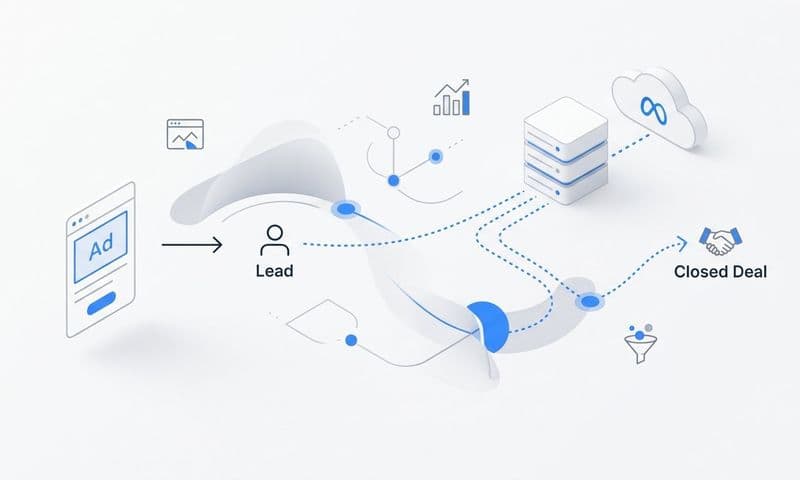
Your prospect downloaded a whitepaper in January. They attended your webinar in March. Someone from their company clicked three different LinkedIn ads in April. Another person from the same organization requested a demo in May. By June, they're a customer worth $50,000 annually. Which marketing campaign actually drove that revenue?
If you can't answer that question with confidence, you're not alone. Most B2B marketing teams are flying blind, unable to connect their campaigns to actual closed revenue.
The problem isn't your effort. It's that B2B buying journeys are fundamentally different from consumer purchases. A single decision involves multiple stakeholders, months of research, and touchpoints scattered across digital ads, content downloads, sales calls, and offline events. Traditional analytics tools track individual clicks and conversions, but they completely miss how marketing influences entire buying committees over extended sales cycles.
Marketing attribution for B2B solves this challenge by connecting every touchpoint in your customer journey—from that first anonymous website visit through to closed-won revenue. It reveals which campaigns are actually driving deals, not just generating clicks. And it gives you the visibility to make confident decisions about where to invest your budget.
This guide breaks down everything you need to know about B2B marketing attribution: why traditional tracking fails for complex sales cycles, which attribution models actually work for B2B, and how to build a system that connects your ad spend to real revenue outcomes.
Why B2B Buying Journeys Break Traditional Tracking
Think about how B2B purchases actually happen. A marketing director sees your LinkedIn ad and visits your website. Two weeks later, a sales operations manager from the same company downloads your case study. A month after that, their VP attends your webinar. Eventually, all three end up in a buying committee meeting where they decide to request a demo.
Traditional analytics sees these as three separate, unrelated visitors. It has no idea they work for the same company. It can't connect the dots between your LinkedIn campaign, that case study download, and the webinar registration because it's tracking individuals, not accounts.
This is where B2B attribution gets complicated. Consumer purchases involve one person making one decision. B2B purchases involve buying committees where 5-10 stakeholders each conduct independent research before anyone talks to sales. They're evaluating your solution across different channels, using different devices, often over a span of several months.
The sales cycle itself creates massive tracking gaps. When a prospect moves from marketing qualified lead to sales qualified lead to opportunity to closed-won customer, that journey typically spans 3-12 months or longer. During that time, they interact with your content, your ads, your sales team, and possibly your customer success team at events or demos.
Every one of those touchpoints matters. But most marketing analytics only sees the beginning—the initial website visit or form fill. Your CRM sees the end—the closed deal. Nothing connects the two.
Offline interactions make this even harder. Your prospect might attend your booth at a conference, have three sales calls, and receive a personalized direct mail piece before they convert. None of that shows up in Google Analytics. Your ad platforms have no idea those touchpoints happened. Yet they absolutely influenced the final decision.
Here's the real problem: without proper B2B attribution, you're making budget decisions based on incomplete data. You see that your content downloads are up, but you can't prove they're driving revenue. Your demand gen campaigns look expensive on a cost-per-lead basis, but you have no idea if those leads are turning into customers. Meanwhile, you might be starving the awareness campaigns that are actually filling your pipeline because they don't get last-touch credit.
B2B marketing attribution fixes this by tracking at the account level, connecting marketing touchpoints to CRM data, and following the entire journey from anonymous visitor through to closed revenue. It's the difference between knowing which campaigns generated activity versus knowing which campaigns generated actual business outcomes. For a deeper dive into the fundamentals, explore our B2B marketing attribution 101 complete guide.
Attribution Models That Actually Work for B2B
Attribution models determine how you assign credit for conversions across multiple touchpoints. Choose the wrong model, and you'll systematically undervalue the campaigns driving your best customers while overinvesting in channels that just happen to be last in line.
First-touch attribution gives 100% credit to the initial interaction. If someone clicks your Google ad, then interacts with five more campaigns over three months before becoming a customer, that Google ad gets all the credit. This model makes your top-of-funnel awareness campaigns look amazing and completely ignores everything that actually closed the deal.
Last-touch attribution does the opposite. It gives 100% credit to the final touchpoint before conversion. In B2B, this typically means your retargeting campaigns and direct traffic get all the glory while the webinars, case studies, and nurture emails that educated the prospect get nothing. Last-touch systematically undervalues the long nurture process that B2B sales require.
Both single-touch models fail B2B marketers for the same reason: they ignore the reality that complex sales involve many influences over time. Your prospect didn't convert because of one brilliant touchpoint. They converted because your marketing built awareness, demonstrated value, addressed objections, and stayed present throughout their entire buying journey.
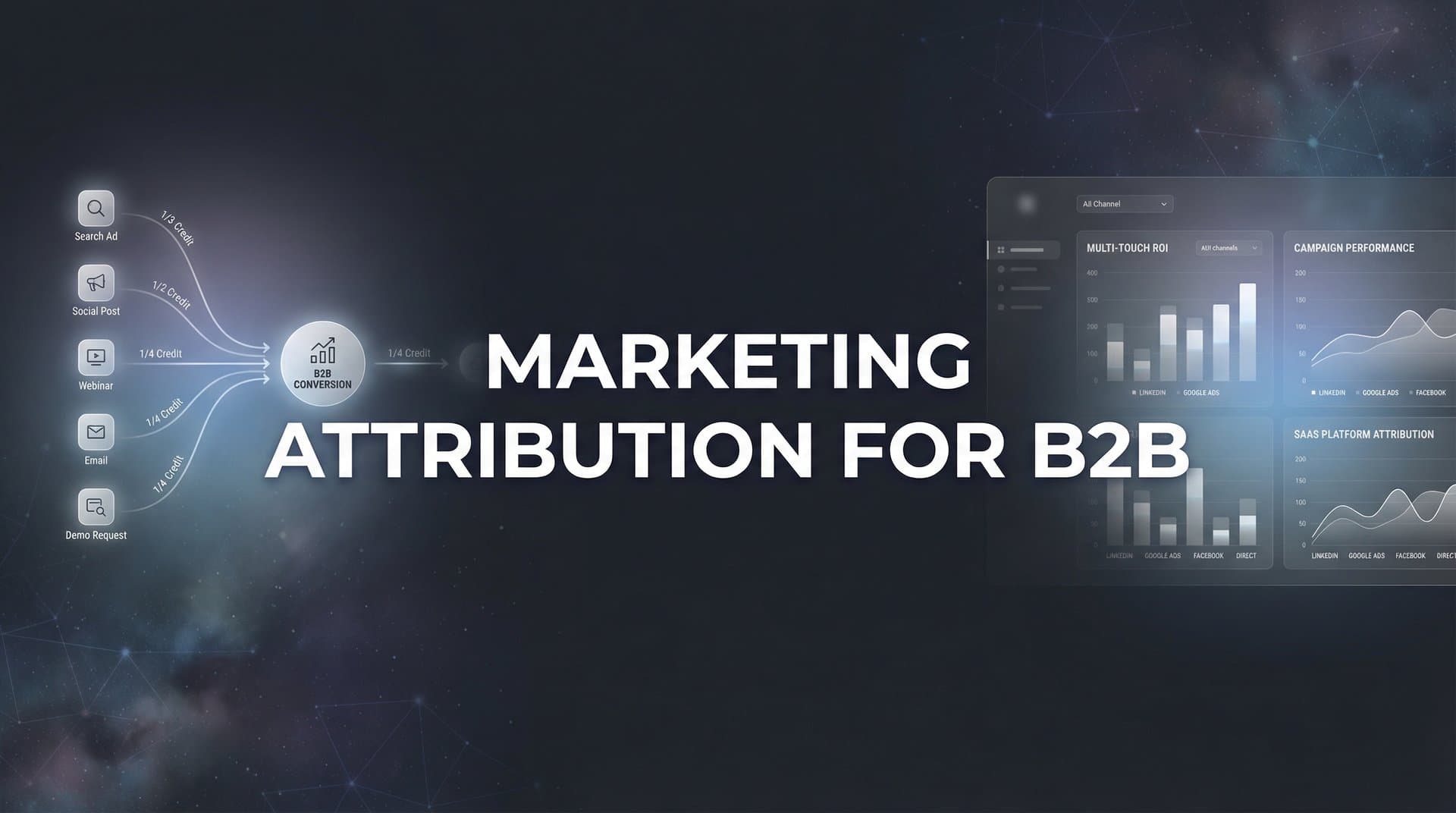
Multi-touch attribution models attempt to solve this by distributing credit across multiple interactions. Linear attribution splits credit equally among all touchpoints. If a customer interacted with six campaigns before converting, each campaign gets one-sixth of the credit. This is simple and fair, but it treats every touchpoint as equally important—which isn't how buying journeys actually work. Our multi-touch marketing attribution platform complete guide breaks down these nuances in detail.
Time-decay attribution gives more credit to touchpoints closer to conversion. The logic is that recent interactions matter more than early awareness touches. For B2B companies with long sales cycles, this often makes sense. A demo request two weeks before closing probably influenced the decision more than a blog post they read six months ago. But time-decay can still undervalue the awareness campaigns that brought the prospect into your ecosystem in the first place.
Position-based attribution, sometimes called U-shaped, tries to balance these priorities. It typically assigns 40% credit to the first touch, 40% to the last touch, and distributes the remaining 20% among middle interactions. This model recognizes that both initial awareness and final conversion moments are critical, while still acknowledging that middle touches played a role.
For many B2B marketers, position-based attribution provides a practical middle ground. It rewards the campaigns that generate awareness and fill your pipeline while also crediting the tactics that close deals. It's not perfect, but it's directionally accurate enough to make better budget decisions.
Data-driven attribution takes a different approach entirely. Instead of using a predetermined rule about how to split credit, it uses machine learning to analyze your actual conversion data and identify which touchpoints statistically correlate with closed deals. If prospects who attend your webinar convert at 3x the rate of those who don't, data-driven attribution gives that webinar more credit. If your retargeting campaigns show up in most journeys but don't actually improve conversion rates, they get less credit. Learn more about how data science for marketing attribution powers these insights.
The advantage of data-driven attribution is that it's based on your specific customer journey, not generic assumptions. The challenge is that it requires significant conversion volume to generate statistically meaningful insights. If you're only closing 20 deals per month, you probably don't have enough data for machine learning to identify reliable patterns.
The best approach? Start with a multi-touch model like position-based attribution to get beyond the limitations of first-touch and last-touch. As your data volume grows and you build more sophisticated tracking, consider moving toward data-driven attribution that reflects your actual conversion patterns. The key is choosing a model that acknowledges the multi-touch reality of B2B buying journeys rather than pretending one campaign deserves all the credit. Explore the best attribution modeling for marketing to find the right fit for your organization.
Connecting the Full Journey: Ads to CRM to Revenue
The biggest challenge in B2B attribution isn't choosing the right model. It's getting the data in the first place. Your ad platforms know about clicks and impressions. Your website analytics knows about sessions and page views. Your CRM knows about opportunities and closed deals. But these systems don't talk to each other, which means you can't actually track the full journey from ad click to revenue.
This data disconnect creates a massive blind spot. You can see that your Google Ads campaign generated 200 clicks and 15 form submissions. You can see in your CRM that you closed three deals this month worth $150,000. But you can't definitively say whether those deals came from your Google Ads campaign, your LinkedIn campaign, your content marketing, or some combination of all three.
Building proper B2B attribution requires creating a unified view that connects these siloed data sources. When someone clicks your ad, that interaction needs to be tracked and associated with their account. When they fill out a form, that conversion needs to be connected back to the original ad click. When they become an opportunity in your CRM, that needs to be linked to all their previous marketing touchpoints. And when they close as a customer, you need to see the complete journey that led to that revenue.
This is where server-side tracking becomes critical. Traditional browser-based tracking relies on cookies and pixels that fire when someone loads a page. But iOS privacy changes, ad blockers, and cross-device behavior have made browser tracking increasingly unreliable. Many of your visitors are invisible to your analytics because their browser blocks your tracking scripts.
Server-side tracking solves this by capturing data at the source—on your server—rather than relying on the visitor's browser. When someone submits a form or completes a conversion action, your server records that event and sends it to your analytics platform and ad networks. This approach bypasses browser limitations and gives you more accurate data about who's actually converting.
For B2B marketers, server-side tracking is especially valuable because it allows you to enrich conversion data with CRM information. When a lead becomes an opportunity, you can send that signal back to your ad platforms. When an opportunity closes as a customer, you can feed that revenue data into your attribution system. This creates a closed loop where marketing can see not just which campaigns generated leads, but which campaigns generated revenue. Platforms focused on marketing attribution platforms revenue tracking make this integration seamless.
The technical implementation typically involves connecting your website to your CRM through a marketing attribution platform. When someone visits your site, the platform tracks their journey across sessions and devices. When they fill out a form, it creates or updates their contact record in your CRM and associates all their previous touchpoints. As that contact moves through your sales pipeline, the attribution platform continues tracking which marketing interactions they have.
The result is a unified customer journey that spans from anonymous visitor through to closed-won customer. You can see that the deal that closed today started with a LinkedIn ad six months ago, included three content downloads, two webinar registrations, a demo request, and five sales calls. Every touchpoint is captured and connected, giving you the complete picture of what it took to win that customer.
This level of visibility transforms how you make marketing decisions. Instead of guessing which campaigns drive revenue, you know. Instead of arguing with sales about marketing's contribution, you have data showing exactly how marketing influenced each deal. And instead of optimizing for vanity metrics like impressions or clicks, you can optimize for the metrics that actually matter: pipeline influence and closed revenue.
Measuring What Matters: B2B Attribution Metrics
Once you've built proper attribution tracking, the next challenge is knowing which metrics to actually pay attention to. Many B2B marketers drown in data, tracking dozens of metrics that don't actually inform better decisions.
Start with pipeline influence. This metric shows how much of your sales pipeline was influenced by marketing touchpoints. If you have $2 million in open opportunities and marketing touched $1.5 million of those deals at some point in their journey, your pipeline influence is 75%. This is a much more meaningful measure of marketing's impact than lead volume or website traffic.
Revenue attribution takes this a step further by connecting marketing to actual closed-won revenue. Instead of just tracking which campaigns generated leads, you track which campaigns contributed to deals that actually closed. This lets you calculate true customer acquisition cost by channel, not just cost per lead. You might discover that your LinkedIn campaigns cost $500 per lead but generate customers worth $50,000, while your cheaper Google Ads leads rarely convert to revenue. Understanding revenue attribution for B2B SaaS companies is essential for making these calculations accurately.
Multi-touch revenue attribution becomes especially important when deals involve multiple campaigns over months of nurturing. A typical B2B customer might interact with ten different marketing touchpoints before closing. Your attribution model determines how to split credit for that revenue across those ten interactions, but the key metric is understanding which combination of touchpoints drives the highest-value customers.
Velocity metrics reveal how marketing accelerates deals through your pipeline. Track how long it takes for marketing-influenced opportunities to move from stage to stage compared to opportunities without marketing touches. If prospects who attend your webinar close 30% faster than those who don't, that's valuable insight about which programs to scale.
Channel-level return on ad spend becomes meaningful when you can connect ad spend to actual revenue. If you spent $10,000 on LinkedIn ads last month and those ads influenced $200,000 in closed revenue, your ROAS is 20:1. This is far more actionable than knowing you got 500 clicks or 50 leads from that spend. Learn how channel attribution in digital marketing revenue tracking enables these insights.
The key is moving beyond activity metrics to outcome metrics. Impressions, clicks, and even leads are just activities. They don't tell you whether marketing is actually driving business results. Pipeline influence, revenue attribution, and channel-level ROAS connect your marketing investments to actual business outcomes.
Set up reporting that shows both leading and lagging indicators. Leading indicators like pipeline influenced and opportunity velocity help you predict future results. Lagging indicators like closed revenue and customer acquisition cost show you what actually happened. Together, they give you the visibility to make confident decisions about where to invest. Effective attribution reporting for marketing teams combines both types of metrics into actionable dashboards.
Common B2B Attribution Mistakes and How to Avoid Them
The most expensive attribution mistake is over-crediting last-touch channels. When you give all the credit to the final interaction before conversion, you systematically undervalue the awareness and nurture campaigns that filled your pipeline in the first place. Your retargeting campaigns look amazing because they always get the last touch, while your content marketing and top-of-funnel programs appear ineffective because they rarely close deals directly.
This leads to terrible budget allocation. You pour more money into bottom-funnel tactics that capture existing demand while starving the programs that generate new demand. Your pipeline shrinks over time because you're not feeding it with new prospects, even though your last-touch metrics look great.
The fix is adopting a multi-touch attribution model that acknowledges the reality of B2B buying journeys. Give credit to the campaigns that create awareness, the content that educates prospects, and the nurture programs that keep you top of mind throughout the sales cycle. Don't just reward the channel that happened to be last in line.
Another common mistake is ignoring offline touchpoints entirely. Your prospect attends your conference booth, has three sales calls, receives a personalized mailer, and then converts. If your attribution system only tracks digital interactions, you're missing critical influences on the buying decision. Events, sales touches, and direct outreach absolutely matter in B2B, but they often don't show up in your analytics.
Solve this by manually tracking offline interactions in your CRM and including them in your attribution model. When someone attends an event, log it as a touchpoint. When sales has a meaningful conversation, record it. These offline moments often carry more weight than digital touchpoints, and excluding them gives you a distorted view of what's actually driving conversions. Our guide on common attribution challenges in B2B marketing covers these blind spots in depth.
Analysis paralysis is another trap. Some marketers become so obsessed with achieving perfect attribution that they never actually use the data to make decisions. They spend months debating whether to use linear versus time-decay attribution, or they wait to implement tracking until they can capture every possible touchpoint.
The reality is that directionally accurate attribution is far more valuable than perfect attribution you never act on. If your data shows that webinar attendees convert at 3x the rate of non-attendees, that insight is actionable even if your attribution model isn't perfectly calibrated. Start with a reasonable multi-touch approach, use the insights to make better budget decisions, and refine your model over time as you learn what works.
Many B2B teams also make the mistake of treating attribution as a one-time setup rather than an ongoing process. Customer journeys evolve. New channels emerge. Buying behavior changes. Your attribution model and tracking need to evolve with them. Review your attribution data quarterly, test different models to see which provides the most actionable insights, and continuously refine your approach based on what you learn.
The goal isn't perfection. It's having enough visibility into your customer journey to make confident decisions about where to invest your marketing budget. Directionally accurate insights that inform better decisions beat perfectly accurate data that sits unused.
Putting Your Attribution Data to Work
Attribution data is only valuable if you actually use it to make better marketing decisions. The most immediate application is budget reallocation. When you can see which channels drive actual revenue versus just activity, you can confidently shift spend away from vanity metrics and toward business outcomes.
Start by identifying your highest-ROAS channels. If your data shows that LinkedIn campaigns consistently drive customers worth 15x what you spend, while display ads generate clicks but rarely convert to revenue, the decision becomes obvious. Reallocate budget from display to LinkedIn. This seems simple, but most B2B marketers can't make this decision confidently because they don't have revenue-level attribution data.
Look for campaigns that punch above their weight in pipeline influence. You might discover that a relatively small investment in a specific content asset or webinar topic drives disproportionate pipeline. Double down on what's working. Create more content on that topic. Run more webinars with similar positioning. Let your attribution data reveal which messages and formats resonate with your best customers.
Use attribution insights to optimize your conversion data feeds back to ad platforms. Modern ad algorithms from Meta, Google, and LinkedIn work better when you feed them high-quality conversion data. Instead of just sending lead conversions, send opportunity conversions and closed-won conversions. This teaches the algorithm which leads actually turn into revenue, allowing it to optimize for quality over quantity.
Server-side conversion tracking makes this especially powerful. When you can send enriched conversion events that include deal value, customer lifetime value, and other CRM data back to your ad platforms, their algorithms can optimize toward your highest-value customers. This creates a feedback loop where your ads get smarter over time, targeting prospects who look like your best customers rather than just anyone who might click.
Build a regular reporting cadence that connects marketing activity to revenue outcomes. Monthly or quarterly attribution reviews should show which campaigns influenced pipeline, which drove closed revenue, and how marketing investment correlates with business results. Share this data with sales and leadership to demonstrate marketing's contribution and make the case for continued investment in high-performing programs.
Create a feedback loop between marketing and sales that keeps attribution data accurate. When sales closes a deal, they often have context about what really influenced the decision that doesn't show up in your tracking. Maybe the prospect mentioned a specific piece of content that resonated, or they attended an event that wasn't properly logged. Capture this qualitative feedback and use it to refine your attribution model and improve your tracking. Unified dashboards for marketing and sales attribution help bridge this gap between teams.
The marketers who win with attribution aren't those with the most sophisticated models or perfect data. They're the ones who use directionally accurate insights to make better decisions faster than their competitors. They shift budget toward what's working. They optimize their conversion feeds to improve ad targeting. And they continuously refine their approach based on what the data reveals about their actual customer journey.
Making Attribution Work for Your Business
B2B marketing attribution isn't about achieving perfect measurement of every touchpoint in your customer journey. It's about gaining enough visibility to make confident decisions about where to invest your marketing budget and which campaigns actually drive revenue.
The marketers winning today are those who can connect their ad spend to actual business outcomes, not just leads or clicks. They understand that B2B buying journeys involve multiple stakeholders, months of nurturing, and touchpoints across digital and offline channels. And they've built attribution systems that track the full journey from anonymous visitor through to closed-won customer.
Start with the fundamentals: implement server-side tracking to capture accurate data despite browser limitations, connect your ad platforms to your CRM to track revenue outcomes, and adopt a multi-touch attribution model that reflects the reality of complex B2B sales cycles. Use your attribution insights to reallocate budget toward channels that drive revenue, feed better conversion data back to ad platforms to improve targeting, and build a feedback loop between marketing and sales that keeps your data accurate.
The goal isn't perfection. It's having the visibility to make better decisions than you could make yesterday. Even directionally accurate attribution that shows which campaigns influence pipeline and drive revenue is infinitely more valuable than flying blind with vanity metrics that don't connect to business outcomes.
Ready to elevate your marketing game with precision and confidence? Discover how Cometly's AI-driven recommendations can transform your ad strategy. Track every touchpoint from first click to closed deal, with server-side accuracy and multi-touch attribution that reveals what's actually driving your revenue. Get your free demo today and start capturing every touchpoint to maximize your conversions.