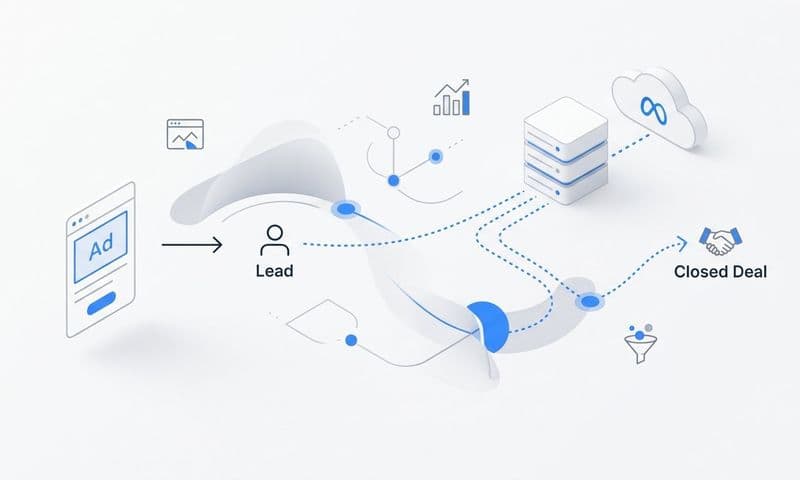
Your prospect clicked a LinkedIn ad in January. They downloaded a whitepaper in March. Attended your webinar in May. Then went silent for two months before finally booking a demo in July. Three more stakeholders joined the evaluation. By October, they closed as a $50K customer.
Which marketing touchpoint actually drove that revenue?
This is the daily reality for B2B marketers: long, winding sales cycles where the path from awareness to closed-won spans months and involves multiple decision-makers. Traditional attribution models built for quick e-commerce conversions fall apart when your average deal takes 180 days to close and requires buy-in from five different people.
Marketing attribution for B2B companies isn't just about tracking clicks—it's about connecting every interaction across your entire funnel to actual revenue outcomes. It's the difference between guessing which campaigns work and knowing exactly where to invest your next dollar. This guide breaks down how to build an attribution system that actually works for complex B2B sales cycles, from choosing the right models to integrating your tech stack to making confident budget decisions based on real data.
Why B2B Attribution Demands a Different Approach Than B2C
The attribution playbook that works for e-commerce companies will fail you in B2B. The fundamental difference? Time and complexity.
In B2C, someone sees an ad, clicks through, and buys—often within the same session. Single-touch attribution works fine when the entire customer journey happens in thirty minutes. But B2B sales cycles stretch across months, sometimes years for enterprise deals. That initial touchpoint from six months ago matters just as much as the demo request that happened last week.
The buying committee problem: B2B purchases rarely involve just one person. You're not tracking a single lead's journey—you're tracking an entire account with multiple stakeholders. The marketing director who clicked your Facebook ad, the VP who attended your conference, the CFO who downloaded your ROI calculator, and the CEO who finally signed off on the purchase. They're all part of the same deal, but traditional lead-based attribution treats them as separate individuals.
This is where account-based attribution becomes essential. Instead of giving credit to individual lead sources, you need to track all interactions across everyone involved in the buying decision. When you close that enterprise account, your attribution system should show you every touchpoint across every decision-maker—not just credit the last person who filled out a form.
The CRM integration imperative: Website analytics alone won't cut it for B2B attribution. You need to track beyond form submissions and demo requests all the way to closed-won revenue. That means connecting your marketing data directly to your CRM where deals actually close.
Without this connection, you're flying blind. You might see that LinkedIn ads generate lots of leads, but are those leads converting to customers? Are they high-value customers or small deals that churn quickly? You can't answer these questions by looking at website conversions alone.
Many B2B companies discover that their "best performing" channels based on lead volume are actually their worst performers when measured by closed revenue. The channel driving the most form fills might be attracting tire-kickers while a lower-volume channel brings in serious buyers. You only see this when your attribution extends through the entire sales cycle to actual revenue outcomes. Understanding revenue attribution for B2B SaaS companies is critical for making this connection.
Attribution Models That Actually Work for Long Sales Cycles
Single-touch attribution—giving all credit to either the first or last touchpoint—makes no sense for B2B. When someone interacts with your brand fifteen times before buying, why would you credit only one of those touches?
Multi-touch attribution distributes credit across the entire customer journey. But not all multi-touch models work the same way, and choosing the right one depends on your specific sales cycle and marketing strategy. A comprehensive multi-touch marketing attribution platform guide can help you understand the nuances of each approach.
Linear attribution: This model gives equal credit to every touchpoint. If someone had ten interactions before converting, each one gets 10% of the credit. The advantage? It's simple and acknowledges that every touchpoint contributed. The downside? It treats all interactions as equally important, which probably isn't true. Your brand awareness ad and your bottom-funnel demo request likely had different impacts on the final decision.
Linear attribution works well when you're just starting with multi-touch models and want a straightforward view of how all your channels contribute. It's also useful for companies with relatively short sales cycles where every touchpoint genuinely matters about equally.
Time-decay attribution: This model gives more credit to recent interactions. A touchpoint from last week gets more weight than one from three months ago. The logic? Recent interactions are fresher in the buyer's mind and likely had more influence on the final decision.
Time-decay makes sense for B2B companies where the decision accelerates toward the end. Think about enterprise sales where prospects research casually for months, then suddenly go into active evaluation mode. Those late-stage touchpoints—product demos, case study downloads, pricing conversations—probably deserve more credit than the initial awareness ad from six months earlier.
Position-based attribution: Also called U-shaped attribution, this model gives heavy credit to the first and last touchpoints (typically 40% each) and distributes the remaining 20% across everything in between. The reasoning? The first touch created awareness and got them into your funnel. The last touch pushed them over the finish line. Everything else played a supporting role.
This model works well when you want to emphasize both top-of-funnel acquisition and bottom-funnel conversion efforts. It's particularly useful if you're running distinct campaigns for awareness versus conversion and want to see how both contribute to revenue.
Data-driven attribution: Instead of using predetermined rules, data-driven models use algorithms to analyze your actual conversion data and assign credit based on which touchpoints statistically correlate with conversions. This approach learns from your specific customer journeys rather than assuming all customers follow the same pattern. Exploring data science for marketing attribution can help you understand how these algorithms work.
The advantage is accuracy—the model adapts to your unique sales cycle and marketing mix. The challenge is that you need significant conversion data for the algorithm to work reliably. If you're only closing a handful of deals per month, you don't have enough data for meaningful statistical analysis.
The multi-model approach: Here's the truth most attribution platforms won't tell you: no single model gives you the complete picture. The smartest B2B marketers compare multiple attribution models side by side.
Look at your channel performance through different lenses. If a channel performs well in first-touch attribution but poorly in last-touch, it's an awareness driver that gets people into your funnel but doesn't close deals. That's not bad—it's just a different role. Conversely, channels that excel in last-touch but barely show up in first-touch are conversion accelerators. You need both types of channels working together.
Comparing models helps you understand the full story of how your marketing works rather than getting locked into one perspective. You make better decisions when you see how channels contribute across the entire funnel, not just at one point.
Building Your B2B Attribution Tech Stack
Attribution isn't just about choosing a model—it's about connecting all your marketing data sources into a unified system that tracks the complete customer journey. This requires the right integrations and tracking infrastructure.
Essential integrations: Your attribution platform needs to pull data from everywhere your prospects interact with your brand. That means connecting your ad platforms (LinkedIn, Google Ads, Facebook), your website analytics, your marketing automation platform, and most critically, your CRM.
The ad platform connections let you see which specific campaigns, ad sets, and even individual ads contributed to conversions. Website tracking captures organic visits, content engagement, and form submissions. Marketing automation shows email interactions and nurture campaign engagement. The CRM integration brings it all together by showing which marketing touchpoints ultimately led to closed-won deals and how much revenue they generated. Reviewing the best marketing attribution tools for B2B SaaS companies can help you find solutions with robust integration capabilities.
Without these integrations, you're stuck with data silos. You might know that someone clicked a LinkedIn ad, but you can't connect that click to the deal that closed four months later. Or you can see that a lead came from organic search, but you don't know if they ever became a customer. Attribution only works when you can follow the thread from first touch to closed revenue.
Server-side tracking for accuracy: Browser-based tracking faces increasing limitations. Privacy regulations restrict cookies. Ad blockers prevent tracking scripts from firing. iOS updates limit cross-site tracking. The result? Your website analytics are missing a significant percentage of actual user activity.
Server-side tracking solves this by capturing data on your server rather than relying on browser-based scripts. When someone fills out a form or takes an action on your site, the data goes directly to your server where it can be processed and sent to your attribution platform—no browser restrictions involved.
This approach dramatically improves data accuracy. You're not losing 20-30% of your conversions to ad blockers and privacy tools. You get a complete view of your marketing performance, which means your attribution insights are based on real data, not a partial sample.
For B2B companies where every conversion matters (you're not dealing with thousands of daily transactions), losing even a handful of conversions to tracking gaps significantly skews your attribution data. Server-side tracking ensures you capture everything.
Conversion sync for better optimization: Here's where attribution becomes proactive rather than just analytical. Conversion sync technology sends enriched conversion data back to your ad platforms like Meta and Google Ads.
Why does this matter? Ad platform algorithms optimize based on the conversion data you feed them. If you're only sending basic conversion events like "form submitted," the algorithm doesn't know which form submissions actually turned into customers. It optimizes for more form fills, not more revenue.
When you sync enriched conversion data—showing which leads became customers, their deal size, their lifetime value—the ad platforms can optimize for actual business outcomes. The algorithm learns to find more prospects who look like your best customers, not just people who fill out forms. Understanding marketing attribution platforms with revenue tracking capabilities is essential for implementing this effectively.
This creates a feedback loop where your attribution insights directly improve your campaign performance. You're not just measuring what happened—you're using that measurement to get better results going forward.
From Data to Decisions: Acting on Attribution Insights
Attribution data only matters if it changes what you do. The goal isn't perfect measurement—it's making better marketing decisions faster.
Pipeline generation versus deal closing: One of the most valuable insights attribution reveals is the difference between channels that generate pipeline and channels that close deals. These aren't always the same.
You might discover that LinkedIn ads create tons of opportunities but have a low close rate, while organic search generates fewer leads but they convert at twice the rate. Neither channel is "better"—they serve different purposes. LinkedIn fills your pipeline with new potential customers. Organic search captures high-intent prospects who are already looking for solutions like yours.
This distinction changes how you allocate budget. You need pipeline generation channels to keep your funnel full. You need high-conversion channels to maximize ROI. The right mix depends on your current business stage. If your pipeline is thin, invest more in awareness and lead generation. If you have plenty of opportunities but they're not closing, focus on bottom-funnel conversion channels.
Budget reallocation based on revenue contribution: Most B2B companies allocate marketing budget based on lead volume or cost per lead. Attribution shifts this to revenue contribution. Which channels actually drive closed-won deals and how much revenue do they generate?
When you measure by revenue instead of leads, the picture often changes dramatically. That expensive conference that generated only twenty leads might have produced three enterprise deals worth $200K each. Meanwhile, that "efficient" paid search campaign generating hundreds of cheap leads might not have closed a single customer.
Use your attribution data to calculate revenue per dollar spent for each channel. This shows your true marketing ROI. Then shift budget toward the channels with the highest revenue contribution. You're not chasing vanity metrics like impression volume or click-through rates—you're investing in what actually grows the business. Implementing channel attribution with revenue tracking makes this analysis possible.
Start with small shifts. Move 10-15% of budget from lower-performing channels to higher-performing ones. Monitor the results. Make another adjustment. Attribution isn't about one dramatic reallocation—it's about continuous optimization based on real performance data.
AI-powered recommendations for scaling: Modern attribution platforms use AI to analyze your campaign data and surface optimization opportunities you might miss manually. The AI identifies patterns across thousands of touchpoints to recommend which campaigns to scale, which audiences to expand, and which creative approaches drive the best results.
This matters because human analysis has limits. You can't manually compare every possible combination of channel, campaign, audience, and creative to find the optimal mix. AI can process all that data simultaneously and highlight the specific opportunities with the highest potential impact.
When the AI recommends scaling a particular campaign, you can act with confidence knowing the recommendation is based on comprehensive data analysis, not gut feeling. This removes the guesswork from scaling decisions. You're not hoping a campaign will perform well at higher spend—you're scaling based on proven performance patterns.
Common B2B Attribution Pitfalls and How to Avoid Them
Even with the right tools and models, B2B marketers often fall into predictable traps that undermine their attribution efforts. Understanding the common attribution challenges in B2B marketing helps you avoid these mistakes.
Over-crediting last-touch channels: The easiest mistake is giving too much credit to bottom-funnel touchpoints while ignoring the awareness and consideration activities that got prospects into your funnel in the first place.
Someone might click a retargeting ad right before converting, but they wouldn't have been in your retargeting audience without that initial brand awareness campaign three months earlier. Or they might request a demo after reading a case study, but they only found that case study because they were already familiar with your brand from previous touchpoints.
Last-touch channels look efficient because they're right before conversion. But if you cut all your awareness and mid-funnel activities to focus only on last-touch optimization, your pipeline dries up. You need top-funnel activities to create the audience that bottom-funnel tactics convert.
This is why comparing multiple attribution models matters. When you see that a channel performs well in first-touch but not last-touch, don't dismiss it—recognize its role in starting customer journeys even if it doesn't finish them.
Ignoring offline touchpoints: B2B buying journeys include plenty of interactions that don't happen on your website. Sales calls. Conference booth conversations. Direct mail pieces. Lunch meetings. Referrals from existing customers.
If your attribution system only tracks digital touchpoints, you're missing huge parts of the story. That enterprise deal might show up in your data as coming from "direct traffic" when it actually resulted from a conference conversation followed by several sales calls. You can even implement marketing attribution for phone calls to capture these critical touchpoints.
The solution is manual attribution for offline touchpoints. When someone books a meeting after a conference, add that conference as a touchpoint in your CRM. When a referral comes in, log it. When sales makes an outbound call that leads to interest, track it.
Yes, this requires more work than automated digital tracking. But for B2B companies, offline touchpoints often drive the most valuable deals. Excluding them from attribution gives you an incomplete and misleading picture of what's actually working.
Analysis paralysis: Perfect attribution is impossible. There will always be gaps in your data. You'll never capture every single touchpoint. Attribution models will always involve some level of assumption and approximation.
Don't let the pursuit of perfect measurement prevent you from taking action. The goal is to be more informed than you were before, not to achieve 100% accuracy.
Start with the data you can reliably track. Build your attribution system incrementally. Make decisions based on the best information available, knowing you'll refine your approach over time. A good attribution system that drives action beats a perfect attribution system that never gets implemented. Reviewing B2B marketing attribution software options can help you find a solution that balances comprehensiveness with usability.
The companies that succeed with attribution are the ones who use it as a decision-making tool, not a measurement exercise. They accept that their data will have limitations and focus on extracting actionable insights rather than achieving theoretical perfection.
Putting It All Together
B2B marketing attribution isn't about tracking every click with perfect precision—it's about understanding your customer journey well enough to make confident decisions about where to invest your marketing budget.
The shift from single-touch to multi-touch attribution acknowledges the reality of complex B2B sales cycles where multiple touchpoints across months contribute to a single conversion. The move from website-only tracking to full-funnel CRM integration ensures you're measuring actual revenue outcomes, not just lead volume. The transition from guesswork to data-driven confidence comes from connecting all your marketing data into a unified attribution system.
Start with the fundamentals: integrate your ad platforms, website, and CRM into an attribution platform that tracks the complete customer journey. Choose attribution models that match your sales cycle—likely multi-touch approaches that distribute credit across the entire buying process. Use server-side tracking to ensure data accuracy despite privacy restrictions. Send enriched conversion data back to ad platforms so their algorithms optimize for revenue, not just form fills.
Then focus on action over analysis. Use your attribution insights to identify which channels drive pipeline versus close deals. Reallocate budget based on revenue contribution, not lead volume. Scale winning campaigns with confidence knowing your decisions are grounded in real performance data.
The B2B companies winning with attribution are the ones who recognize it as an ongoing practice, not a one-time project. They continuously refine their tracking, compare multiple models, and let data guide their marketing strategy. They accept imperfection while still extracting meaningful insights that drive better results.
Ready to elevate your marketing game with precision and confidence? Discover how Cometly's AI-driven recommendations can transform your ad strategy—Get your free demo today and start capturing every touchpoint to maximize your conversions.