You've just reviewed your monthly marketing report, and something doesn't add up. Your Google Ads dashboard shows strong conversion numbers. Facebook claims credit for the same sales. Your email platform is celebrating record engagement. Meanwhile, your CFO is asking a simple question you can't confidently answer: "Which of these channels is actually driving revenue?"
This isn't just a reporting problem—it's a strategic blindspot that costs businesses millions in misallocated budget every year. Without a clear view of how your marketing touchpoints connect to actual revenue, you're essentially flying blind, making decisions based on incomplete stories told by platforms that are incentivized to overstate their own impact.
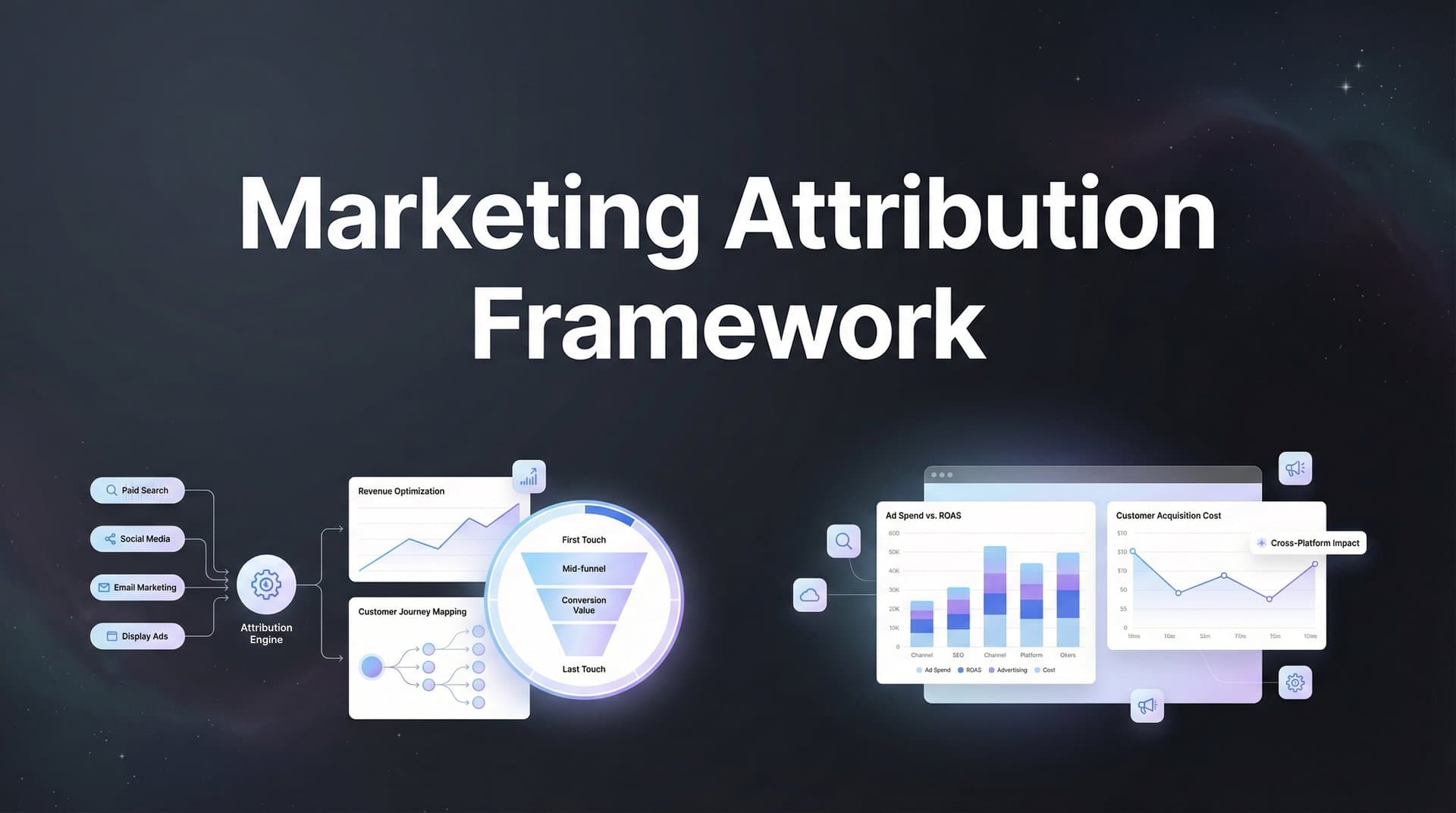
A marketing attribution framework solves this. It's your structured approach to connecting every customer interaction—from that first awareness-stage ad click to the final purchase—into a complete, accurate picture of what's really working. Instead of guessing which channels deserve more budget or trusting platform-reported conversions that overlap and contradict each other, you'll have a unified system that shows you the truth about your marketing performance.
In this guide, we'll walk through everything you need to build, implement, and optimize an attribution framework that gives you clarity and confidence. You'll learn which components are essential, how to choose the right attribution model for your business, and how to navigate modern tracking challenges like iOS limitations and cross-device journeys. Most importantly, you'll discover how to turn attribution insights into actions that actually improve your ROI.
The Building Blocks of Attribution: Core Components Every Framework Needs
Think of your attribution framework as a house. Before you worry about paint colors or furniture placement, you need a solid foundation. In attribution terms, that foundation is your data collection infrastructure—the technical setup that captures every meaningful interaction a prospect has with your brand.
At the core, you need tracking mechanisms that follow users across their entire journey. This starts with tracking pixels on your website and landing pages that fire when someone takes an action. But here's where many marketers stop short: relying solely on browser-based pixels creates massive blind spots, especially in today's privacy-focused environment.
Server-side tracking has become essential for accurate attribution. Unlike pixels that depend on browser cookies (which get blocked, deleted, or restricted), server-side tracking captures conversion data directly from your servers and sends it to ad platforms and analytics tools. This means you're collecting first-party data that you control, making your attribution more reliable and privacy-compliant. Understanding attribution marketing tracking fundamentals is crucial for building this foundation correctly.
Your CRM integration is equally critical. Marketing doesn't end when someone fills out a form—that's often just the beginning of a complex sales process. Connecting your CRM events (demos scheduled, proposals sent, deals closed) back to the original marketing touchpoints shows you which campaigns drive not just leads, but revenue. This connection between marketing activity and actual sales outcomes is what separates strategic attribution from vanity metrics.
UTM parameters are your attribution framework's common language. These tags appended to your campaign URLs (utm_source, utm_medium, utm_campaign) tell you exactly where traffic originated. But consistency matters enormously here. If one team member tags Facebook ads as "facebook" while another uses "fb" or "Facebook," your data becomes fragmented and unreliable. Establish clear UTM conventions and enforce them across every campaign and every team member.
Now let's talk about touchpoint identification—deciding what actually counts as a meaningful interaction. Not every website visit or social media impression deserves credit in your attribution model. You need to define which actions represent genuine engagement: ad clicks, email opens, content downloads, webinar attendance, demo requests, and so on.
The key is creating a hierarchy that reflects your actual customer journey. Someone who clicked your ad, downloaded a guide, attended a webinar, and then requested a demo has shown progressively stronger buying intent at each stage. Your framework should capture all these touchpoints and understand their relative importance.
This brings us to conversion events hierarchy. You need to map out both micro-conversions and macro-conversions. Micro-conversions are the smaller actions that indicate interest: newsletter signups, blog post reads, calculator tool usage. Macro-conversions are the money moments: demo bookings, trial starts, purchases, contract renewals.
Understanding this hierarchy helps you see the full picture. A channel might not directly drive many sales (macro-conversions) but could be excellent at generating awareness and initial engagement (micro-conversions) that other channels later convert. Without tracking both levels, you might cut a channel that's actually playing a crucial role early in your funnel. The right marketing attribution platforms for revenue tracking can help you visualize these relationships clearly.
Choosing Your Attribution Model: Single-Touch vs. Multi-Touch Approaches
Once your data infrastructure is collecting touchpoints, you face a fundamental question: how do you distribute credit for a conversion when multiple channels were involved? This is where attribution models come in, and choosing the wrong one can lead you to dramatically misunderstand your marketing performance.
Single-touch attribution models are the simplest approach—they give 100% credit to one touchpoint. First-click attribution credits whatever brought someone to you initially, making it useful if your primary goal is understanding awareness channels. If you're focused on top-of-funnel performance and want to know which channels are best at introducing new prospects to your brand, first-click tells that story.
Last-click attribution does the opposite, giving all credit to the final touchpoint before conversion. Ad platforms love this model because they often appear at the end of the journey when someone is ready to buy. Last-click is valuable if you're optimizing for immediate conversions and want to identify your strongest closing channels.
Here's the problem with both: they ignore reality. Customer journeys aren't single moments—they're sequences of interactions. Someone might discover you through a podcast ad, research you via organic search, engage with your LinkedIn content, click a retargeting ad, and then finally convert through a direct visit. Single-touch models would credit either the podcast (first-click) or the direct visit (last-click), completely missing the role that search, LinkedIn, and retargeting played.
This is why multi-touch attribution in marketing has become essential for most businesses. These models distribute credit across multiple touchpoints, acknowledging that conversions result from cumulative marketing efforts, not single magic moments.
Linear attribution is the most straightforward multi-touch approach—it splits credit equally among all touchpoints. If someone interacted with five different channels before converting, each gets 20% credit. This works well when you genuinely believe all touchpoints contribute equally, though in practice, some interactions are usually more influential than others. You can explore linear model marketing attribution software options to implement this approach effectively.
Time-decay attribution gives more credit to touchpoints closer to the conversion, based on the logic that recent interactions had more influence on the final decision. If someone's journey spans three months, the ad they clicked yesterday gets more credit than the blog post they read two months ago. This model makes sense for businesses with longer consideration periods where recent engagement strongly predicts conversion.
Position-based attribution (also called U-shaped) assigns 40% credit to the first touchpoint, 40% to the last touchpoint, and distributes the remaining 20% among everything in between. This acknowledges that both introduction and closing moments matter most, while still recognizing the nurturing that happened in the middle. Many B2B companies find this model reflects their reality well.
Data-driven attribution is the most sophisticated approach. Instead of applying predetermined rules, it uses machine learning to analyze your actual conversion patterns and assign credit based on which touchpoints statistically increase conversion likelihood. If your data shows that prospects who engage with webinars are significantly more likely to convert, webinars receive more credit in the model. Learn more about how machine learning can be used in marketing attribution to leverage this advanced methodology.
So which model should you choose? The honest answer: it depends on your business model and sales cycle. E-commerce businesses with short consideration periods might find last-click or time-decay sufficient. B2B SaaS companies with 60-day sales cycles and multiple stakeholders almost certainly need multi-touch attribution to understand their complex journeys.
Here's the reality check: if your average customer interacts with your brand 5-10 times across different channels before converting, single-touch attribution is lying to you. You're either over-crediting awareness channels (first-click) or over-crediting closing channels (last-click), which leads to budget misallocation and missed opportunities. Understanding the types of marketing attribution models available helps you make an informed decision.
The best approach? Start with a multi-touch model that matches your sales cycle length, then compare different models side-by-side. Look at how each model credits your channels and ask yourself which story aligns with what you know about your customer behavior. Your attribution model should illuminate truth, not obscure it.
From Data Chaos to Clarity: Implementing Your Framework Step-by-Step
Understanding attribution concepts is one thing. Actually implementing a framework that delivers reliable insights is another. Let's break down the practical steps that take you from scattered data to strategic clarity.
Step 1: Audit your current tracking setup. Before building anything new, you need to understand what you already have. Log into your ad platforms, analytics tools, and CRM, then trace a typical customer journey. Can you see the complete path from first touch to conversion? Where do the connections break?
Common gaps include: landing pages without proper tracking pixels, campaigns missing UTM parameters, form submissions that don't pass source data to your CRM, and offline conversions (phone calls, in-person demos) that never get connected back to marketing touchpoints. Document every gap you find—these are the leaks in your attribution framework that need fixing. Our guide on fixing common marketing attribution challenges addresses these issues in detail.
Review your UTM parameter usage across teams. Pull a list of all the different utm_source and utm_medium values currently in your data. You'll likely find inconsistencies: "google" vs "Google" vs "google-ads," or "social" vs "social-media" vs "socialmedia." Create a standardized naming convention document and commit to using it religiously going forward. Consistency in tagging is non-negotiable for accurate attribution.
Step 2: Connect your data sources into a unified view. This is where the magic happens—bringing together data from ad platforms, website analytics, email marketing, and your CRM into one system that can see the complete customer journey.
Start by integrating your major ad platforms. Connect Google Ads, Facebook Ads, LinkedIn Ads, and any other paid channels to your attribution system. This allows you to see not just what these platforms report internally, but how their traffic actually behaves on your site and whether it converts.
Next, ensure your website analytics (Google Analytics or similar) is properly connected. This captures organic search, direct traffic, referral sources, and on-site behavior that fills in the gaps between paid touchpoints. If you're using GA4, check out our guide on how to use GA4 for marketing attribution to maximize its capabilities.
Your CRM integration is crucial for closing the loop. When a lead converts to an opportunity and eventually to a customer, that revenue data needs to flow back to your attribution system. This connection shows you not just which channels drive leads, but which channels drive revenue—a critical distinction that changes everything about budget allocation.
For businesses with phone call conversions, implement call tracking that dynamically assigns phone numbers to different marketing sources. This captures offline conversions that would otherwise be invisible in your attribution data. Our resource on marketing attribution for phone calls provides a comprehensive tracking guide.
Step 3: Define attribution windows and credit distribution rules. An attribution window is the lookback period during which touchpoints receive credit for a conversion. If someone clicked your ad 90 days ago and converts today, does that ad get credit? Your attribution window determines this.
Your attribution window should match your actual sales cycle. If most prospects convert within 30 days of first contact, a 30-day window makes sense. If you're selling enterprise software with 90-180 day sales cycles, you need a longer window to capture the full journey. Look at your historical data: what's the average time from first touch to conversion for your closed deals?
Set different windows for different conversion types if needed. A content download might have a 7-day attribution window (someone who engaged with your content recently), while a demo request might have a 60-day window (capturing the longer consideration period before someone's ready to talk to sales).
Finally, choose your attribution model (as discussed in the previous section) and configure how credit gets distributed. Most attribution platforms let you compare multiple models side-by-side, which is valuable for understanding how different perspectives change your channel performance story.
Navigating Modern Attribution Challenges: Privacy, Cross-Device, and iOS Limitations
Building a perfect attribution framework was already complex. Then the privacy landscape shifted dramatically, making traditional tracking methods less reliable and forcing marketers to adapt their entire approach.
The iOS 14.5 update fundamentally changed mobile attribution. Apple's App Tracking Transparency framework requires apps to ask users for permission to track their activity across other apps and websites. Unsurprisingly, most users opt out. This means the tracking pixels that Facebook, Google, and other platforms relied on to measure conversions often can't fire anymore on iOS devices.
The impact is significant: your ad platforms are now working with incomplete data, seeing only a fraction of actual conversions. Facebook might report 50 conversions from a campaign that actually drove 100, because half happened on iOS devices where tracking was blocked. This isn't just a reporting problem—it affects campaign optimization too, since algorithms are making decisions based on partial information. These are among the key attribution challenges in marketing analytics that modern marketers must overcome.
Server-side tracking has emerged as the solution. Instead of relying on browser-based pixels that can be blocked, you collect conversion data on your own servers and send it directly to ad platforms via their Conversion APIs. This first-party data collection method is more privacy-compliant and dramatically more accurate.
Here's how it works: when someone converts on your website, your server captures that event along with the user's click ID (a parameter passed in the ad URL). Your server then sends this conversion data directly to Facebook's Conversion API or Google's Enhanced Conversions, bypassing browser restrictions entirely. The ad platforms receive accurate conversion signals they can use for optimization, and you get reliable attribution data.
Implementing server-side tracking requires more technical setup than dropping a pixel on your site, but the accuracy gains are worth it. You're no longer losing 30-50% of your conversion data to iOS limitations—you're capturing everything that happens on your website regardless of device or browser settings.
Cross-device tracking presents another challenge. Your prospect might discover you on their phone during a commute, research you on their work laptop, and finally convert on their home tablet. Traditional cookie-based tracking sees these as three different users, fragmenting the journey and making attribution impossible.
The solution requires identity resolution—connecting these disparate interactions to the same person. This happens through authenticated events: when someone logs into your site, fills out a form with their email, or clicks an email link, you can tie that identifier across devices. The more touchpoints where you can capture email addresses or other identifiers, the better your cross-device attribution becomes.
Cross-platform gaps are equally tricky. Someone might click your Facebook ad on mobile, search your brand name on Google desktop, and convert through a direct visit on their tablet. Each platform wants to claim credit, but without a unified view, you're seeing overlapping conversions that add up to more than your actual total. Implementing cross-channel marketing attribution software helps resolve these discrepancies.
This is why platform-reported conversions should never be your source of truth. Facebook's dashboard and Google Ads' dashboard will both claim credit for the same conversion, making it look like you drove twice as many results as you actually did. Your attribution framework needs to deduplicate these conversions and assign credit according to your chosen model, giving you one accurate number you can trust.
Turning Attribution Insights Into Action: Optimizing Campaigns With Confidence
Data without action is just expensive entertainment. The real value of your attribution framework comes when you use its insights to make smarter marketing decisions that improve ROI.
Start by identifying which channels drive awareness versus which close deals. Your attribution data might reveal that LinkedIn drives expensive clicks but those prospects convert at high rates, while display ads generate cheap traffic that rarely converts. This insight changes everything about how you allocate budget—you might increase LinkedIn spend despite higher CPCs because the ultimate cost-per-customer is actually lower.
Look for channel combinations that work together. Multi-touch attribution often reveals that certain sequences perform exceptionally well. Maybe prospects who engage with your content marketing and then see a retargeting ad convert at 3x the rate of those who only see one or the other. This insight tells you to increase retargeting budgets specifically for content engagers, creating a more sophisticated strategy than simply spending more on whichever channel has the lowest cost-per-click.
Pay attention to assist conversions—touchpoints that don't get last-click credit but play crucial roles in the journey. A channel might look weak in last-click attribution while actually being essential for moving prospects through your funnel. Your attribution framework shows you these hidden performers that deserve protection (or even increased investment) despite not being obvious winners in simpler models. Leveraging a marketing attribution report helps surface these insights for enhanced decision-making.
Use your attribution insights to feed better data back to ad platforms. When you send accurate conversion signals through Conversion APIs, you're helping Facebook, Google, and other platforms optimize their algorithms more effectively. Their systems learn which audiences and creative approaches actually drive results for your business, improving targeting and delivery over time.
This creates a virtuous cycle: better attribution data leads to better optimization signals, which leads to better campaign performance, which generates more conversion data to refine your attribution further. Platforms that receive rich, accurate conversion data can identify patterns and opportunities that remain invisible when working with incomplete pixel-based tracking.
Review your attribution model assumptions regularly. As your marketing mix evolves—adding new channels, changing your sales process, adjusting campaign strategies—your attribution framework should evolve too. What made sense six months ago might not reflect your current reality.
Compare your attribution model's predictions against actual outcomes. If your model suggests that certain touchpoints are highly valuable, track whether increasing investment in those areas actually improves results. This validation loop ensures your framework is genuinely predictive, not just descriptive.
Test changes systematically. When you shift budget based on attribution insights, document the change and measure the impact. Did moving budget from last-click winners to high-assist channels improve overall efficiency? Did increasing spend on awareness channels that your multi-touch model valued lead to more downstream conversions? This experimentation, guided by attribution data, is how you continuously refine your marketing strategy.
Don't forget to communicate your attribution insights to stakeholders. When leadership questions marketing ROI, you can show them exactly which channels and campaigns drive revenue, backed by data that connects ad spend to actual sales. This transparency builds trust and makes it easier to secure budget for high-performing initiatives.
Building Your Competitive Advantage Through Better Attribution
A marketing attribution framework isn't a set-it-and-forget-it project—it's a living system that evolves with your business, your marketing sophistication, and the changing privacy landscape. The framework you build today will need refinement next quarter as you add new channels, adjust your sales process, or discover new insights about your customer journey.
But here's what doesn't change: the competitive advantage of knowing exactly which touchpoints drive revenue versus operating on guesswork and platform-reported metrics that tell conflicting stories. While your competitors are still debating whether their Facebook ads or Google Ads "work better" based on incomplete data, you'll have a complete view of how these channels work together to drive results.
The businesses that win in today's complex marketing environment aren't necessarily the ones with the biggest budgets—they're the ones with the clearest visibility into what's working. They can confidently scale winning campaigns, cut underperforming spend, and optimize the sequences and combinations that drive their best customers.
Your attribution framework gives you this clarity. It transforms marketing from a cost center that leadership questions into a revenue driver that you can prove and optimize. It changes budget conversations from "Can we afford this?" to "Should we invest more in this channel that's driving X% of our revenue?"
Start by assessing your current attribution gaps. Where are you losing visibility into the customer journey? Which conversions are you not tracking? What data sources aren't connected? These gaps represent opportunities—fixing them will immediately improve your marketing intelligence and decision-making.
Ready to elevate your marketing game with precision and confidence? Discover how Cometly's AI-driven recommendations can transform your ad strategy—Get your free demo today and start capturing every touchpoint to maximize your conversions.