When it comes to marketing attribution software, integrations are not a nice-to-have. They are the entire foundation. An attribution platform that cannot connect deeply to your ad platforms, CRM, payment processor, and email tools will give you incomplete data, and incomplete data leads to exactly the wrong decisions: cutting channels that are actually working, scaling campaigns that look good on the surface but are not driving revenue, and reporting numbers to stakeholders that do not reflect reality.
Fragmented data creates blind spots throughout the customer journey. A prospect might click a Facebook ad, open three emails, visit your pricing page twice, and then convert through a Google search. If your attribution tool cannot stitch those touchpoints together by pulling data from each platform, you will never see the full picture.
The tools on this list were selected based on breadth of native integrations, depth of data passed between systems, real-time syncing capabilities, ease of setup, and whether the platform can push enriched conversion data back to ad platforms to improve their algorithms. That last criterion matters more than ever in 2026, as server-side tracking and bidirectional data syncing have become essential for accurate attribution in a privacy-first world.
Here are the top marketing attribution software integrations worth considering this year.
1. Cometly
Best for: Multi-channel paid advertisers and agencies needing bidirectional ad platform syncing and AI-powered attribution
Cometly is an AI-powered marketing attribution platform that connects your ad platforms, CRM, payment tools, email software, and website to track the complete customer journey in real time.
 9 Best Marketing Attribution Software Integrations to Unify Your Data in 2026
Where This Tool Shines
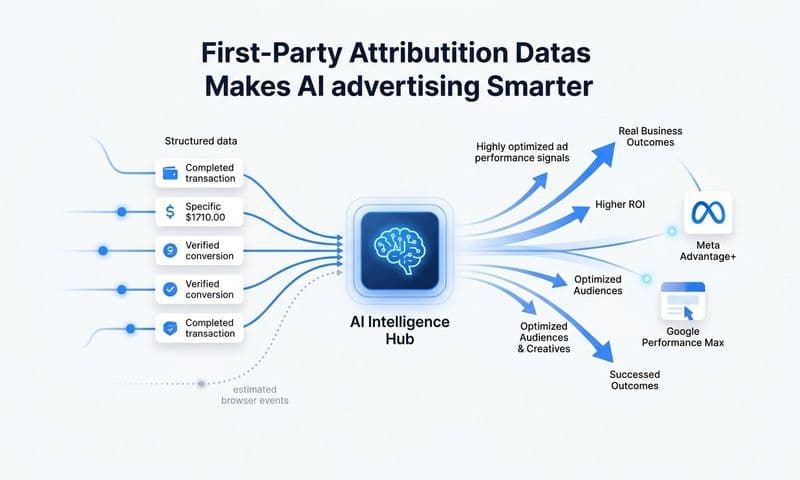
What separates Cometly from many attribution platforms is the direction of data flow. Most tools pull data in from your connected platforms. Cometly does that, and then it pushes enriched conversion events back to Meta, Google, TikTok, and other ad networks through its Conversion Sync feature. This means the ad platform algorithms receive better data, which improves targeting, reduces wasted spend, and compounds your results over time.
The server-side tracking implementation is particularly valuable for teams dealing with iOS privacy changes and browser-based tracking limitations. Instead of relying on a browser pixel that can be blocked or degraded, Cometly captures conversion data server-side, giving you a more complete and accurate picture of what is actually driving results. Layered on top of this is an AI engine that identifies top-performing ads and campaigns and surfaces actionable recommendations.
Key Features
Server-Side Tracking: Captures conversion data beyond browser limitations, improving accuracy for iOS and cookie-restricted environments.
Conversion Sync: Pushes enriched conversion events back to Meta, Google, TikTok, and other ad platforms to fuel their optimization algorithms with better data.
Native CRM Integrations: Connects directly with HubSpot, Salesforce, and GoHighLevel to tie ad clicks to CRM pipeline and closed revenue.
Payment and Email Integrations: Native connections to Stripe, Klaviyo, and Kit, along with support for popular web builders, ensure full-funnel visibility.
AI-Powered Recommendations: Identifies high-performing ads and campaigns across every connected channel and surfaces scaling opportunities.
Webhooks and API: Flexible custom integration options for teams with unique data sources or non-standard tech stacks.
Best For
Cometly is built for digital marketers, agencies, and growth teams running paid campaigns across multiple platforms who need accurate attribution and want to actively feed better data back to ad platform algorithms. It is particularly strong for teams that have been burned by tracking gaps caused by iOS changes or cookie deprecation.
Pricing
Custom pricing based on ad spend volume. A free demo is available to see the platform in action before committing.
2. Triple Whale
Best for: Shopify-based ecommerce and DTC brands focused on ad attribution and creative analytics
Triple Whale is an ecommerce attribution platform built tightly around Shopify with integrations to major ad platforms and DTC-specific tools like Klaviyo and Recharge.
 7 Best Funnel.io Alternatives for Marketing Data Analytics in 2026
Where This Tool Shines
Triple Whale's core strength is its deep Shopify integration. Order data flows in real time, which means attribution is tied directly to actual revenue rather than proxy conversion events. For DTC brands running heavy ad spend across Meta and TikTok, this level of accuracy makes a meaningful difference in how you allocate budget.
The creative analytics layer is another standout feature. Rather than just knowing which campaigns performed, you can see which specific ad creatives are driving conversions, which helps creative teams make better decisions about what to produce next.
Key Features
Shopify Integration: Real-time order data synced directly from Shopify for revenue-based attribution.
First-Party Pixel: Proprietary tracking pixel that captures customer journeys across ad platforms with first-party data.
Creative Analytics: Attribution data broken down to the creative level so you know which ads are actually converting.
DTC Tool Integrations: Native connections to Klaviyo, Recharge, and major ad networks including Meta, Google, and TikTok.
Best For
Triple Whale is purpose-built for Shopify-based ecommerce and DTC brands. If your store runs on Shopify and you want attribution tied directly to order revenue with creative-level visibility, this platform is a natural fit.
Pricing
Plans start around $100 per month and scale based on store revenue. Higher tiers unlock more advanced analytics and attribution features.
3. Northbeam
Best for: Mid-market ecommerce and DTC brands needing machine-learning-driven multi-touch attribution
Northbeam is a machine-learning-based attribution platform designed for ecommerce and DTC brands that want sophisticated multi-touch modeling across their paid media mix.
 9 Best Conversion Tracking Software Options: Pricing Comparison for 2026
Where This Tool Shines
Northbeam applies machine learning to attribution modeling rather than relying on static rule-based models like last-click or linear. This means the platform continuously learns from your conversion data and adjusts how credit is distributed across touchpoints based on actual patterns in your customer journeys.
Creative-level attribution is a particular strength. Northbeam connects ad creative performance to actual conversion outcomes, which gives creative and media teams a shared language for evaluating what is working and what is not.
Key Features
ML-Driven Attribution: Machine learning models that adapt to your specific conversion patterns rather than applying fixed attribution rules.
Creative Attribution: Performance data broken down to the individual creative level across ad platforms.
Ad Platform Integrations: Native connections to Meta, Google, TikTok, and Snapchat.
Shopify Integration: Direct connection to Shopify for revenue-based attribution.
Custom Data Sources: API access for connecting non-standard data sources into the attribution model.
Best For
Northbeam is positioned for mid-market and enterprise ecommerce brands that have outgrown simpler attribution tools and want ML-driven modeling with creative-level visibility. It is generally not the right fit for early-stage brands with limited data volume.
Pricing
Custom pricing based on company size and data volume. Northbeam is generally positioned for mid-market brands and above.
4. HubSpot Marketing Hub
Best for: Teams already using HubSpot CRM who want attribution built directly into their existing ecosystem
HubSpot Marketing Hub is an all-in-one marketing platform with built-in multi-touch attribution reporting tied directly to CRM deal and revenue data.
 9 Best Attribution Software for B2B SaaS in 2026
Where This Tool Shines
The biggest advantage HubSpot offers for attribution is that it lives inside the same system as your CRM. There is no need to sync data between a standalone attribution tool and your CRM because the attribution data and the deal data are already in the same place. This makes revenue attribution reporting straightforward and removes a common source of data discrepancy.
The HubSpot Marketplace offers over 1,700 native integrations, which means the platform connects to a wide range of ad platforms, analytics tools, and sales systems without requiring custom development. For teams already running their marketing and sales operations in HubSpot, the attribution features are a natural extension of existing workflows.
Key Features
Built-In Attribution Models: Multiple multi-touch attribution models available directly within the HubSpot CRM interface.
1,700+ Integrations: Extensive marketplace of native integrations covering ad platforms, analytics tools, and sales software.
Revenue Attribution: Attribution tied directly to CRM deal data for closed-loop reporting from first touch to closed revenue.
Custom Report Builder: Flexible reporting tools for building tailored attribution analyses without needing a data analyst.
Best For
HubSpot Marketing Hub is ideal for B2B and B2C teams already using HubSpot as their CRM who want attribution without adding another standalone tool to their stack. Teams not using HubSpot as their CRM will find less value here.
Pricing
Marketing Hub Professional starts at $800 per month. Attribution reporting features are available at the Professional tier and above.
5. Ruler Analytics
Best for: Lead generation businesses that need to connect offline conversions like calls and form submissions back to specific marketing touchpoints
Ruler Analytics is a closed-loop attribution platform specializing in bridging the gap between online marketing activity and offline conversion events.
 8 Best Attribution Tools with Onboarding Support in 2026
Where This Tool Shines
Most attribution tools are built around digital conversion events like purchases and form fills that happen entirely online. Ruler Analytics is designed for businesses where the actual conversion happens offline: a phone call, a sales meeting, or a deal closed in a CRM weeks after the first click. The platform tracks individual visitor journeys and then matches those journeys to offline conversions when they occur.
The ability to push offline conversion data back to Google Ads and Meta is a particularly strong feature. Rather than optimizing ad campaigns toward top-of-funnel form submissions, you can feed actual revenue data back to the ad platforms so their algorithms optimize toward customers who actually convert.
Key Features
Call Tracking: Tracks phone call conversions and attributes them back to the specific marketing source that drove the call.
Form Tracking: Ties individual form submissions to complete visitor journey data for full-funnel visibility.
CRM Integrations: Native connections to Salesforce and HubSpot for closed-loop revenue attribution.
Ad Platform Integrations: Connects to Google Ads, Meta, and Google Analytics with offline conversion data syncing.
Best For
Ruler Analytics is best suited for lead generation businesses, professional services firms, and any company where conversions happen offline or through phone calls rather than purely through digital transactions.
Pricing
Plans start around $200 per month, with pricing scaling based on the number of tracked sessions and features required.
6. Segment (by Twilio)
Best for: Engineering and data teams that need a flexible data infrastructure layer to unify customer data across their entire tool stack
Segment is a customer data platform with over 400 pre-built integrations that routes clean, unified customer data to attribution tools, analytics platforms, and marketing systems.
 8 Best Attribution-Focused Platforms vs Segment: Which Approach Fits Your Marketing Stack in 2026
Where This Tool Shines
Segment operates differently from the other tools on this list. Rather than being an attribution platform itself, it is the data infrastructure that feeds attribution platforms with clean, consistent data. Think of it as the plumbing that connects your entire tech stack. Data collected from your website, app, or backend flows into Segment and is then routed to any connected destination in real time.
The Protocols feature enforces data quality standards across your integrations, which solves one of the most common attribution problems: inconsistent event naming and data formatting that makes cross-platform analysis unreliable. For teams with complex tech stacks, Segment can dramatically improve the quality of data flowing into their attribution tools.
Key Features
400+ Integrations: Pre-built connections to sources and destinations across analytics, attribution, CRM, and marketing categories.
Real-Time Data Routing: Customer events are routed to connected destinations in real time without custom development.
Protocols: Data quality enforcement that ensures consistent event naming and formatting across all integrations.
Identity Resolution: Stitches together user identities across devices and channels for a unified customer profile.
Best For
Segment is best for mid-market and enterprise teams with technical resources who need a centralized data layer to power multiple downstream tools. It is not a standalone attribution solution and works best as part of a broader analytics stack.
Pricing
A free tier is available for lower data volumes. The Team plan starts at $120 per month, and the Business plan is custom-priced based on data volume and feature requirements.
7. Rockerbox
Best for: Brands running both digital and offline media who need unified attribution across channels like TV, radio, and direct mail
Rockerbox is a multi-channel attribution platform that unifies performance data across digital channels and offline media including television, radio, direct mail, and podcast advertising.
Where This Tool Shines
Most attribution tools are built for digital-only media mixes. Rockerbox is designed for brands that invest in offline channels alongside digital and need a way to understand how those channels interact and contribute to conversions. This is a relatively rare capability in the attribution market.
The combination of multi-touch attribution with marketing mix modeling gives brands two complementary views of performance: the granular touchpoint-level view from MTA and the broader channel-level view from MMM. Incrementality testing adds a third layer for validating whether specific channels are actually driving incremental lift.
Key Features
Offline Channel Attribution: Tracks and attributes conversions from TV, radio, direct mail, and podcast advertising alongside digital channels.
Digital Integrations: Native connections to Meta, Google, TikTok, Shopify, and Klaviyo.
Marketing Mix Modeling: Channel-level modeling that complements multi-touch attribution for strategic budget planning.
Incrementality Testing: Built-in tools for measuring whether specific channels are driving incremental conversions beyond what would have happened anyway.
Best For
Rockerbox is built for growth-stage and enterprise brands that spend across both digital and offline media and need a unified view of performance. Brands running purely digital campaigns will find more purpose-built options on this list.
Pricing
Custom pricing based on channel volume and company size. Rockerbox is generally positioned for brands with meaningful offline media investment.
8. Dreamdata
Best for: B2B companies with long sales cycles that need account-level attribution across multi-stakeholder journeys
Dreamdata is a B2B-focused revenue attribution platform with account-based journey mapping and native integrations to B2B sales and marketing tools.
Where This Tool Shines
B2B attribution is fundamentally different from B2C attribution. Sales cycles are longer, multiple stakeholders from the same company interact with your marketing before a deal closes, and the conversion event is not a purchase but a signed contract that might happen months after the first touchpoint. Dreamdata is built specifically for this reality.
The account-level attribution model groups all individual touchpoints from everyone at a target company into a single account journey, which gives revenue and marketing teams a much more accurate picture of what influenced a deal than contact-level attribution alone. The content attribution feature is particularly useful for B2B teams that invest heavily in thought leadership and want to know which assets are actually influencing pipeline.
Key Features
Account-Level Attribution: Groups touchpoints from all contacts at an account into a unified journey for B2B deal attribution.
B2B Integrations: Native connections to Salesforce, HubSpot, LinkedIn Ads, and Google Ads.
Revenue Attribution: Ties marketing touchpoints to closed revenue across long, complex sales cycles.
Content Attribution: Tracks which content assets and pages influence pipeline and deal progression.
Best For
Dreamdata is designed for B2B SaaS and services companies with sales cycles longer than a few weeks and multiple stakeholders involved in the buying process. It is not the right fit for B2C or ecommerce attribution use cases.
Pricing
A free tier is available with limited features. Paid plans start around $999 per month, with pricing scaling based on data volume and feature requirements.
9. AppsFlyer
Best for: Mobile-first businesses and app developers that need attribution across thousands of ad networks and media sources
AppsFlyer is a mobile attribution platform with SDK integrations across thousands of ad networks, DSPs, and analytics tools built specifically for app-first businesses.
Where This Tool Shines
Mobile attribution has its own set of challenges that desktop-focused tools are not equipped to handle: SKAdNetwork limitations, privacy sandbox requirements, deep linking complexity, and the sheer volume of ad networks operating in the mobile ecosystem. AppsFlyer was built from the ground up to navigate these challenges.
The fraud protection layer is a meaningful differentiator. Mobile ad fraud is a significant problem, and having fraud detection built directly into the attribution layer means you are not paying for conversions that were never real. The breadth of ad network integrations is also unmatched in the mobile attribution space.
Key Features
Ad Network Integrations: Connections to thousands of ad networks and media sources across the global mobile advertising ecosystem.
SKAdNetwork and Privacy Sandbox Support: Built-in support for Apple and Google's privacy frameworks for accurate iOS and Android attribution.
Deep Linking: Standard and deferred deep linking to route users to the right in-app destination after clicking an ad.
Fraud Protection: Built-in mobile ad fraud detection integrated directly into the attribution reporting layer.
Best For
AppsFlyer is purpose-built for mobile app businesses: gaming companies, consumer apps, fintech apps, and any brand where the primary conversion experience happens inside a mobile application rather than on a website.
Pricing
A free tier is available for up to 12,000 conversions per month. Paid plans are usage-based and scale with conversion volume and feature requirements.
Which Attribution Platform Is Right for You
The right attribution tool depends almost entirely on your business model, your tech stack, and the specific integration gaps you are trying to close. Here is a quick guide to matching each platform to the right use case.
Cometly is the strongest choice for multi-channel paid advertisers and agencies who need accurate attribution across ad platforms, CRMs, and payment tools, and who want to actively push enriched conversion data back to ad platform algorithms. The server-side tracking and Conversion Sync features make it particularly valuable for teams navigating iOS and cookie-related tracking challenges.
Triple Whale and Northbeam are both built for Shopify-based ecommerce and DTC brands. Triple Whale is a strong fit for brands that want creative analytics alongside attribution. Northbeam is the better choice when ML-driven modeling and a larger data volume are in play.
HubSpot Marketing Hub makes the most sense for teams already running their CRM in HubSpot who want attribution without adding another tool to manage.
Ruler Analytics is purpose-built for lead generation businesses where conversions happen offline through phone calls or in-person meetings.
Segment is not an attribution tool on its own but an excellent data infrastructure layer for teams that want to clean and unify customer data before routing it to attribution and analytics platforms.
Rockerbox is the right call for brands with meaningful offline media investment who need TV, radio, and direct mail attribution alongside digital channels.
Dreamdata is built specifically for B2B companies with long, multi-stakeholder sales cycles that need account-level attribution tied to closed revenue.
AppsFlyer is the clear choice for mobile-first businesses that need attribution across thousands of ad networks with built-in fraud protection.
Across all of these platforms, the core principle holds: attribution software is only as good as the integrations that feed it data. If you are running paid campaigns across multiple platforms and want to see exactly which ads and channels are driving revenue while feeding better data back to ad algorithms, get your free demo of Cometly and see how bidirectional integration and AI-powered attribution can change how you make decisions.