You're spending $50,000 a month across Google Ads, Meta, LinkedIn, and TikTok. Your dashboard shows thousands of conversions. Your sales team closes 47 deals. But when you dig deeper, the numbers don't add up. Google claims credit for 38 conversions. Meta says it drove 52. LinkedIn insists it influenced 29. Somehow, your ad platforms are collectively taking credit for 119 conversions when you only closed 47 deals.
Sound familiar?
This is the reality for most marketers today. You're making budget decisions based on incomplete, conflicting data from platforms that are incentivized to overstate their own impact. Meanwhile, your actual revenue-driving campaigns might be getting starved of budget while you pour money into channels that look good on paper but don't actually convert.
A marketing attribution solution solves this visibility gap by tracking the entire customer journey—from first ad click through every touchpoint to final conversion and beyond. Instead of trusting what each ad platform tells you, you get an independent, unified view of what's actually driving revenue. This guide breaks down how attribution solutions work, what makes them effective, and how to choose the right one for your business.
Why Most Marketers Are Flying Blind With Their Ad Spend
The core problem isn't that marketers lack data. It's that they're drowning in conflicting data from sources that don't talk to each other.
Every ad platform operates in its own ecosystem with its own attribution windows and rules. Meta might claim credit for a conversion if someone clicked your ad within 7 days or viewed it within 1 day. Google Ads uses different windows. LinkedIn has its own methodology. Each platform independently takes credit for the same conversion, creating a mathematical impossibility where your total reported conversions exceed your actual sales by 2x or 3x.
This wasn't always such a critical issue. Before iOS 14.5 introduced App Tracking Transparency in 2021, marketers could rely on third-party cookies and device-level tracking to piece together customer journeys. But today, the majority of iOS users opt out of tracking. Browser privacy features block third-party cookies. The tracking infrastructure that powered digital marketing for the past decade is fundamentally broken.
The result? Your pixel-based tracking misses conversions. Your ad platforms use modeled data and statistical estimates to fill the gaps. Your reporting becomes increasingly divorced from reality. Understanding these common attribution challenges in marketing analytics is the first step toward solving them.
Here's what this actually costs you. Let's say your Meta campaigns are generating clicks and engagement, but most of those users convert after seeing a Google search ad later. If you're only looking at last-click attribution from Google, Meta looks like it's wasting money. If you're trusting Meta's self-reported numbers, Google looks redundant. In reality, both channels work together—but without proper attribution, you can't see it.
You end up making budget decisions based on guesswork. You scale campaigns that look good in isolation but don't actually drive revenue. You cut spending on channels that appear inefficient but are actually critical touchpoints in your customer journey. The misallocation compounds over time, and your competitors who've solved attribution are outmaneuvering you with better data.
How Attribution Solutions Connect the Dots Across Your Customer Journey
A marketing attribution solution acts as an independent referee that sits above your ad platforms, website, and CRM. Instead of trusting what each platform reports, it tracks every touchpoint directly and connects them to actual revenue outcomes.
Think of it like this: when someone clicks your Meta ad, the attribution platform logs that interaction with a unique identifier. When that same person later visits your website from a Google search ad, it recognizes them and adds that touchpoint to their journey. When they fill out a lead form, that's logged. When your sales team marks them as a qualified lead in your CRM, that's tracked. When they finally become a customer three weeks later, the attribution platform has the complete story—every ad click, every website visit, every email open, every sales touchpoint.
This is where server-side tracking becomes critical. Traditional pixel-based tracking relies on browser cookies and JavaScript that runs in the user's browser. This approach breaks when users block cookies, use privacy-focused browsers, or opt out of tracking. Server-side tracking takes a different approach: conversion data is sent directly from your server to the attribution platform, bypassing browser limitations entirely. Implementing proper attribution marketing tracking ensures you capture every conversion regardless of browser restrictions.
When someone converts on your website, your server sends that conversion event along with the user's identifier to your attribution platform. Because this happens server-to-server, it's not affected by ad blockers, cookie restrictions, or iOS privacy settings. You capture conversions that pixel-based tracking would miss entirely.
The real power comes from unification. Your attribution solution connects data from every source into one coherent view. It sees the Meta ad click from two weeks ago, the Google search visit from yesterday, the email click from this morning, and the CRM conversion from this afternoon—all as part of the same customer journey. This unified view reveals patterns that are impossible to see when each platform reports in isolation.
For businesses with longer sales cycles, this becomes even more valuable. A B2B software company might have a 60-day sales cycle with a dozen touchpoints before close. Without proper attribution, you're essentially guessing which marketing activities contributed to that $50,000 annual contract. With attribution tracking, you know exactly which ads, content pieces, and campaigns influenced that decision at each stage. Companies selling to other businesses should explore B2B marketing attribution strategies designed for complex buying cycles.
Attribution Models Explained: Choosing the Right Lens for Your Business
Here's where attribution gets interesting. Once you're tracking the complete customer journey, you need to decide how to distribute credit across all those touchpoints. This is where attribution models come in—and choosing the wrong one can be just as misleading as having no attribution at all.
First-touch attribution gives 100% of the credit to the first interaction. If someone clicked your Facebook ad three weeks ago and eventually converted after seeing five other ads, that first Facebook ad gets all the credit. This model is useful for understanding what's driving awareness and bringing new prospects into your funnel. It answers the question: "What's getting people's attention initially?"
Last-touch attribution does the opposite—it gives all credit to the final touchpoint before conversion. If that same customer clicked a Google search ad right before purchasing, Google gets 100% of the credit. This model shows you what's closing deals, but it completely ignores everything that happened earlier in the journey.
Both single-touch models tell you something valuable, but they're incomplete. Real customer journeys don't work in straight lines. For a deeper dive into how these models work, review our guide on what is a marketing attribution model.
Multi-touch attribution distributes credit across all touchpoints based on various rules. Linear attribution splits credit evenly—if there were five touchpoints, each gets 20%. Time-decay attribution gives more credit to touchpoints closer to conversion. Position-based attribution (also called U-shaped) gives extra weight to the first and last touchpoints while distributing the remainder across middle interactions.
The mistake most marketers make is choosing one model and treating it as gospel. The better approach? Compare multiple models side-by-side. When you look at first-touch, last-touch, and multi-touch attribution simultaneously, you get the complete picture. A robust multi-touch marketing attribution platform makes this comparison seamless.
Let's say your first-touch data shows that Facebook is your top awareness channel, bringing in 60% of new prospects. Your last-touch data shows that Google search closes 70% of deals. Your multi-touch model reveals that LinkedIn plays a crucial role in the middle of the journey, even though it rarely gets credit in single-touch models. Now you understand the full story: Facebook drives awareness, LinkedIn builds credibility during consideration, and Google captures intent at the bottom of the funnel.
Your sales cycle length should influence which models you prioritize. If you're selling a $20 impulse purchase with a one-day sales cycle, last-touch attribution probably tells you most of what you need to know. If you're selling enterprise software with a 90-day sales cycle and multiple decision-makers, multi-touch attribution becomes essential because there are simply too many influential touchpoints to ignore.
Key Features That Separate Effective Solutions From Basic Tracking
Not all attribution platforms are created equal. The difference between a basic tracking tool and an effective marketing attribution solution comes down to a few critical capabilities. Understanding the top features of effective marketing attribution software helps you evaluate options objectively.
Real-time data syncing is non-negotiable. If your attribution data is delayed by 24 or 48 hours, you're making budget decisions based on yesterday's reality. Markets move fast. Ad performance changes throughout the day. By the time you see that a campaign is underperforming, you've already wasted another day of budget. The best attribution solutions sync data continuously, giving you an up-to-the-minute view of what's working.
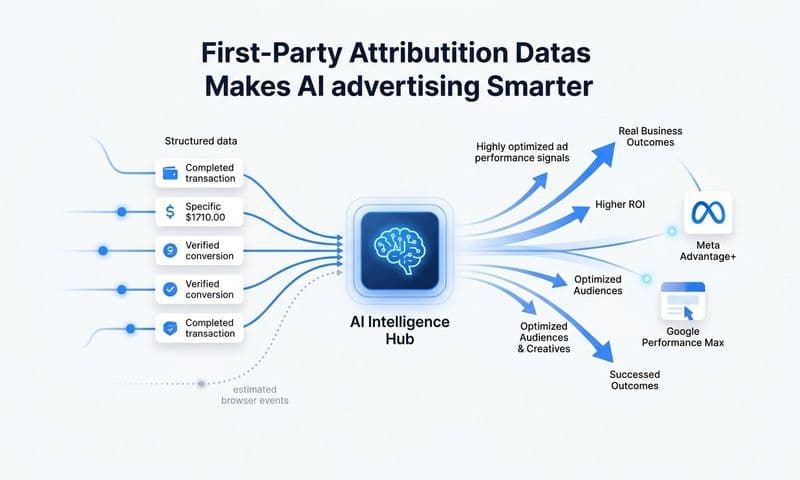
Conversion sync capabilities—also called offline conversion tracking or Conversions API—fundamentally change how your ad platforms optimize. Here's how it works: your attribution platform captures conversions that happen on your website, in your CRM, or even offline. It then feeds that verified conversion data back to your ad platforms like Meta and Google.
Why does this matter? Ad platform algorithms optimize based on the conversion data they receive. If they're only seeing partial data because of iOS tracking limitations, they're optimizing based on an incomplete picture. When you sync accurate, server-side conversion data back to the platforms, their algorithms can optimize more effectively. Meta's algorithm learns which types of users actually convert, not just which ones click. Google's smart bidding gets better data to work with. Your campaigns improve because the platforms are optimizing toward real outcomes instead of modeled estimates.
AI-powered analysis is where attribution solutions move from reporting tools to strategic assets. Raw data doesn't tell you what to do—you still need to interpret it and identify patterns. Advanced attribution platforms use AI to surface insights automatically. They flag campaigns that are underperforming relative to historical benchmarks. They identify audience segments that convert at higher rates. They recommend budget reallocation based on actual performance across all channels. Explore how data science for marketing attribution powers these intelligent recommendations.
The difference is speed and scale. A human analyst might spot that Campaign A outperforms Campaign B by looking at the data. AI can analyze thousands of campaigns simultaneously, identify subtle patterns across audience segments, compare performance across different attribution models, and generate specific recommendations—all in real time. This is particularly valuable for agencies and teams managing multiple clients or large advertising budgets across dozens of campaigns.
Putting Attribution Data to Work: From Insights to Action
Having attribution data is pointless if you don't act on it. The real value comes from using these insights to make smarter decisions about where you invest your marketing budget.
Start by identifying which campaigns and creatives actually drive revenue, not just engagement metrics. Your Meta campaign might have a lower cost-per-click than your Google campaign, but if Google converts at 3x the rate, it's the better investment. Your TikTok ads might generate impressive view counts, but if they rarely lead to actual sales, that awareness isn't translating to business outcomes.
Attribution data lets you separate vanity metrics from revenue metrics. You can see which campaigns drive customers who actually buy, which channels bring in high-value customers versus bargain hunters, and which creative approaches resonate with your target audience at different stages of the journey. Proper marketing revenue attribution connects every dollar spent to actual business outcomes.
Budget reallocation becomes strategic rather than reactive. Instead of making gut-feel decisions about where to shift spending, you're working from data that shows actual ROI across all channels. Maybe you discover that LinkedIn drives fewer conversions than Meta, but those LinkedIn conversions are enterprise customers worth 10x more. That changes how you allocate budget between the two platforms.
The key is looking at the complete picture. A channel that appears inefficient in isolation might be playing a critical supporting role in your overall strategy. Your display ads might not drive direct conversions, but attribution data might reveal that prospects who see your display ads convert at higher rates when they later click search ads. That's not wasted spend—it's strategic brand building that supports your bottom-of-funnel campaigns. Mastering cross-channel attribution reveals these hidden relationships between your marketing efforts.
Use attribution insights to improve ad platform optimization and targeting. When you identify that certain audience segments convert at higher rates, you can create lookalike audiences based on actual customers rather than proxy metrics. When you see which creative approaches drive revenue versus just clicks, you can produce more of what works and cut what doesn't.
The most sophisticated approach involves feeding attribution insights back into your creative strategy. If you notice that video ads drive awareness but carousel ads close deals, you can structure your campaigns accordingly—using video for cold audiences and carousels for retargeting. If certain messaging angles resonate with high-value customers, you can emphasize those themes across all channels.
Selecting the Right Marketing Attribution Solution for Your Team
Choosing an attribution platform isn't just a technical decision—it's a strategic one that affects how your entire marketing team operates.
Start with integrations. Your attribution solution needs to connect seamlessly with every tool in your marketing stack. At minimum, that means your major ad platforms (Meta, Google Ads, LinkedIn, TikTok), your website analytics, and your CRM. If you're running a complex operation, you might also need integrations with email marketing platforms, marketing automation tools, and e-commerce systems.
The quality of these integrations matters as much as their existence. Some platforms offer surface-level integrations that only capture basic data. Look for solutions that support server-side tracking, sync conversion data bidirectionally, and capture granular details like campaign IDs, ad creative variations, and audience segments. When comparing marketing attribution software features, integration depth should be a primary evaluation criterion.
Ask specific questions about data accuracy. How does the platform handle iOS tracking limitations? Does it use server-side tracking or rely on pixels? How does it deduplicate conversions across platforms? What's the data refresh rate? Can it track post-view conversions or only post-click? These technical details determine whether you're getting accurate data or just slightly better guesses than what ad platforms provide natively.
Implementation complexity is another critical factor. Some attribution platforms require extensive technical setup, custom coding, and ongoing maintenance. Others offer plug-and-play integrations that your marketing team can configure without developer support. Consider your team's technical capabilities and whether you have engineering resources available for implementation and troubleshooting.
Look for signs you've outgrown basic tools. If you're managing your attribution in spreadsheets, manually pulling data from multiple platforms, and spending hours each week just compiling reports, you need a real solution. If your team is making budget decisions based on conflicting data from different platforms, you need unified attribution. If you're scaling ad spend but can't confidently identify which campaigns drive the best ROI, you need better measurement. Our roundup of the best marketing attribution solutions in 2026 can help you evaluate your options.
Ongoing support and training matter more than most marketers realize. The best attribution platform is useless if your team doesn't know how to use it effectively. Look for solutions that offer comprehensive onboarding, ongoing training resources, and responsive support when issues arise.
Making Measurement Your Competitive Advantage
Modern marketing requires modern measurement. The era of trusting ad platform reporting and making budget decisions based on incomplete data is over. Your competitors who've implemented proper attribution are already making smarter decisions, scaling what works, and cutting what doesn't—while you're still guessing.
The transformation from guessing to knowing isn't just about having better dashboards. It's about fundamentally changing how you approach marketing strategy. When you can see the complete customer journey, you make different decisions. You invest in channels that support the entire funnel, not just the ones that get last-click credit. You create campaigns that work together as a system rather than competing for attribution. You optimize based on revenue, not vanity metrics.
The competitive advantage compounds over time. Every month you operate with accurate attribution, you're learning what works and refining your approach. Your campaigns get more efficient. Your budget allocation gets smarter. Your creative strategy becomes more targeted. Meanwhile, competitors flying blind are still debating whether their Meta campaigns or Google campaigns deserve more budget, unable to see that both are essential parts of the same customer journey.
Ready to elevate your marketing game with precision and confidence? Discover how Cometly's AI-driven recommendations can transform your ad strategy—Get your free demo today and start capturing every touchpoint to maximize your conversions.