If you're running paid ads without knowing which campaigns actually drive revenue, you're making decisions on gut instinct rather than data. For small and mid-sized businesses, that's an expensive habit. Marketing attribution solutions solve this by connecting every touchpoint, from the first ad click to the closed deal, so you know exactly where to invest your budget.
The challenge is that most enterprise attribution platforms are built for large teams with large budgets. SMBs need tools that are affordable, fast to set up, and built to handle multi-channel campaigns without requiring a dedicated data team.
This list covers the best marketing attribution solutions available for SMBs in 2026. Each tool was evaluated on ease of use, depth of attribution reporting, integration ecosystem, and pricing transparency. Whether you're running Google Ads, Meta campaigns, or a mix of channels, there's a solution here that fits your stack and your budget.
1. Cometly
Best for: B2B SaaS SMBs that need full-funnel attribution from ad click to closed revenue.
Cometly is a marketing attribution and analytics platform built specifically for B2B SaaS companies that connects ad spend to pipeline and closed revenue in real time.
 9 Best Attribution Platforms for Agencies in 2026
Where This Tool Shines
Cometly is built around a problem that most generic analytics tools ignore: B2B SaaS companies need to know which ads are generating actual revenue, not just leads or clicks. By integrating directly with your CRM and Stripe, it closes the loop between your ad platforms and your revenue data, giving growth teams a single source of truth.
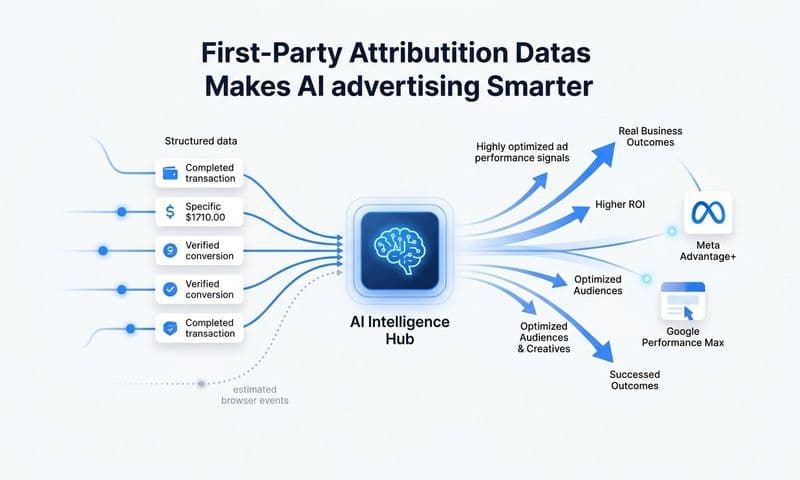
The server-side conversion tracking and Conversion API integration make it particularly well-suited for teams dealing with iOS privacy limitations and cookie deprecation. Instead of relying on browser-based pixels that increasingly miss conversions, Cometly captures events server-side and sends enriched data back to Meta, Google, and other ad platforms to improve their targeting and optimization algorithms.
Key Features
Multi-Touch Attribution: Tracks every touchpoint across all major ad channels so you can compare attribution models and understand which campaigns contribute at each stage of the funnel.
Server-Side Tracking and Conversion API: Maintains data accuracy in a privacy-first environment by capturing conversion events server-side rather than relying solely on browser pixels.
AI Ads Manager: Surfaces performance recommendations across your active campaigns, helping smaller teams act on data without needing a dedicated analyst.
Stripe and CRM Revenue Integration: Connects closed revenue and pipeline data directly to your ad campaigns, so attribution goes beyond lead volume to actual business outcomes.
Customer Journey Analytics: Provides full touchpoint visibility across the customer journey, from first ad impression to conversion, so you can see how channels work together.
70+ Native Integrations: Connects with major ad platforms, CRMs, and data tools out of the box, reducing setup friction for growing teams.
Best For
Cometly is the strongest fit for B2B SaaS marketing teams and growth leaders who are actively managing paid campaigns across multiple channels and need attribution data connected to real pipeline and revenue. It's particularly valuable for teams that have outgrown GA4 and need something purpose-built for B2B buying cycles.
Pricing
Pricing is available on request and is designed for SMB and mid-market B2B SaaS teams. Contact Cometly directly for a quote based on your team size and data volume.
2. HubSpot Marketing Hub
Best for: SMBs already using HubSpot CRM that want attribution natively tied to deals and pipelines.
HubSpot Marketing Hub is an all-in-one inbound marketing platform with built-in attribution reporting natively connected to HubSpot CRM.
 9 Best Campaign Attribution Tracking Solutions for B2B SaaS in 2026
Where This Tool Shines
If your team is already living inside HubSpot, the attribution reporting here is a natural extension of your existing workflow. Because it's natively connected to HubSpot CRM, contact-level attribution is tied directly to deal records, making it straightforward to see which campaigns influenced specific pipeline opportunities.
The key advantage is simplicity. You don't need to configure a separate integration layer or stitch together data from multiple tools. Attribution data, contact records, and revenue reporting all live in the same platform, which reduces the operational overhead that often trips up smaller marketing teams.
Key Features
Contact-Level Attribution: Attribution data is tied directly to individual CRM contact records, giving you visibility into which campaigns influenced each deal.
Multi-Touch Attribution Models: Supports first touch, last touch, linear, and other attribution models so you can analyze performance from multiple perspectives.
Revenue Attribution Reports: Links marketing activity directly to deal and pipeline data, so you can report on marketing-influenced revenue without manual data exports.
Native HubSpot Ecosystem Integration: Works seamlessly with HubSpot Sales Hub and Service Hub, making it a strong choice for teams using the full HubSpot suite.
Best For
Teams already using HubSpot CRM as their system of record. If you're not in the HubSpot ecosystem, the platform's attribution capabilities are harder to justify as a standalone investment given the pricing jump at the Professional tier.
Pricing
Marketing Hub Starter starts at $20 per month. Professional, which includes multi-touch attribution reporting, starts at $890 per month. Attribution features are gated to the Professional tier and above.
3. Triple Whale
Best for: DTC ecommerce brands running paid social on Meta, TikTok, and Google that need ROAS clarity.
Triple Whale is an ecommerce analytics and attribution platform focused on DTC brands running paid social campaigns across Meta, TikTok, and Google.
 9 Best Marketing Attribution Solutions for SMBs in 2026
Where This Tool Shines
Triple Whale was built specifically to address the attribution chaos that DTC brands experienced after iOS privacy changes disrupted Meta's pixel tracking. Its first-party pixel captures conversion data directly, giving brands a more accurate picture of which ads are actually driving purchases when platform-reported ROAS can no longer be trusted at face value.
The creative analytics dashboard is a standout feature for paid social teams. Rather than just reporting on campaign-level performance, Triple Whale surfaces ad-level creative data so you can understand which specific creatives are driving results and where to reallocate creative production budget.
Key Features
First-Party Pixel: Captures conversion data directly to maintain attribution accuracy in a post-iOS privacy environment where platform pixels often underreport.
Creative Analytics Dashboard: Breaks down performance at the individual ad creative level, helping teams identify winning creatives faster.
Blended Performance Dashboards: Combines ROAS data across platforms into a single view so you can see true blended performance rather than siloed platform metrics.
Cohort Analysis and LTV Tracking: Tracks customer lifetime value by acquisition cohort, helping brands understand the long-term return on their paid social investment.
Best For
Ecommerce and DTC brands with active paid social budgets on Meta and TikTok. Triple Whale is less suited to B2B SaaS teams or businesses with longer, multi-touch sales cycles.
Pricing
Starts at approximately $129 per month, with pricing scaling based on store revenue. Plans are tiered to accommodate growing DTC brands at different stages.
4. Northbeam
Best for: SMBs that need accurate channel-level attribution without cookie or pixel dependency.
Northbeam is an ML-driven attribution platform that uses media mix modeling to give SMBs accurate channel-level attribution without relying on cookies or pixels.
 9 Best Ad Tracking Software Solutions After iOS Privacy Updates in 2026
Where This Tool Shines
Northbeam takes a fundamentally different approach to attribution by leaning on machine learning rather than traditional pixel-based tracking. This makes it more resilient to the privacy changes that have degraded the accuracy of conventional attribution tools, and it allows the platform to model attribution even when direct tracking signals are incomplete.
The media mix modeling layer adds a strategic dimension that goes beyond standard attribution reporting. Instead of just telling you what happened, Northbeam helps you understand how to allocate budget across channels to maximize return, which is particularly valuable for teams managing spend across paid search, paid social, and email simultaneously.
Key Features
Machine Learning Attribution: Uses ML models to attribute conversions without relying on cookies or pixels, maintaining accuracy in a privacy-constrained environment.
Media Mix Modeling: Provides budget allocation recommendations based on channel-level performance modeling, not just historical click data.
Cross-Channel Reporting: Consolidates performance data across paid search, social, and email into a unified view.
Daily Budget Pacing: Surfaces spend recommendations and pacing alerts to help teams stay on track with their budget targets.
Best For
Mid-market SMBs managing meaningful ad spend across multiple channels who need attribution that holds up under privacy constraints. Northbeam tends to be a better fit for brands with established paid programs rather than teams just getting started.
Pricing
Custom pricing based on ad spend volume. Northbeam is typically positioned for mid-market teams; contact them directly for a quote aligned to your budget and channel mix.
5. Rockerbox
Best for: SMBs that want a unified view of paid, organic, and offline marketing spend in one place.
Rockerbox is a marketing attribution platform that centralizes multi-channel spend data and combines multi-touch attribution with marketing mix modeling.
 9 Best Marketing Attribution Solutions for SMBs in 2026
Where This Tool Shines
Rockerbox excels at solving the fragmentation problem. If your marketing data is spread across Google Ads, Meta, LinkedIn, email, and offline channels, Rockerbox pulls it all into a single, de-duplicated view. This is especially useful for teams that have struggled to reconcile conflicting attribution numbers from different ad platforms, each of which tends to claim more credit than it deserves.
The combination of multi-touch attribution and marketing mix modeling gives teams both tactical and strategic reporting. You can use MTA for day-to-day campaign decisions and MMM for longer-horizon budget planning, all within the same platform.
Key Features
Unified Spend View: Aggregates marketing spend and performance data across paid, organic, and offline channels into a single, consistent reporting layer.
De-Duplicated Conversion Tracking: Removes double-counting across channels so your conversion numbers reflect reality rather than inflated platform self-reporting.
Multi-Touch Attribution plus MMM: Combines click-based attribution with statistical modeling for both tactical and strategic decision-making.
Data Warehouse Integrations: Connects with major ad platforms, CRMs, and data warehouses, making it a solid option for teams building out a broader data infrastructure.
Best For
SMB to mid-market marketing teams running campaigns across multiple channels who need a single source of truth for spend and performance data. Works well for both B2B and B2C organizations.
Pricing
Custom pricing based on team size and data volume. Rockerbox is designed for SMB to mid-market teams; reach out directly for a tailored quote.
6. Ruler Analytics
Best for: B2B companies with long sales cycles that need offline conversion and call tracking tied to CRM revenue.
Ruler Analytics is a B2B marketing attribution platform that tracks offline conversions and call data, connecting marketing touchpoints to CRM revenue.
 8 Best Attribution Tools with Onboarding Support in 2026
Where This Tool Shines
Ruler Analytics addresses a gap that most attribution tools ignore: what happens after the form fill. For B2B companies where sales cycles involve phone calls, demos, and multiple offline touchpoints, standard digital attribution misses a significant portion of the customer journey. Ruler tracks calls, forms, and chat interactions and maps them back to the original marketing source.
The CRM revenue integration is what makes Ruler particularly powerful for B2B teams. When a deal closes in your CRM, Ruler attributes that revenue back to the marketing touchpoints that influenced the journey, giving you a true marketing-to-revenue picture rather than stopping at lead generation.
Key Features
Call Tracking and Offline Attribution: Captures phone call conversions and maps them back to the marketing campaigns and channels that drove the original inquiry.
Multi-Touch Attribution for Long Sales Cycles: Supports attribution models designed for B2B buying journeys that span weeks or months rather than days.
CRM Revenue Integration: Connects closed deal revenue in your CRM back to marketing touchpoints, closing the loop between marketing activity and business outcomes.
Form and Chat Attribution: Tracks form submissions and chat interactions alongside phone calls for a complete picture of offline conversion activity.
Best For
B2B SMBs in industries where phone calls and offline interactions are a significant part of the sales process. Particularly useful for professional services, agencies, and SaaS companies with high-touch sales motions.
Pricing
Starts at approximately $199 per month. Pricing scales based on call tracking volume and the number of domains being tracked.
7. Attribution
Best for: SMBs that want visual customer journey reporting without a complex technical setup.
Attribution is a straightforward multi-touch attribution platform designed for SMBs that want visual customer journey reporting without complex technical setup.
Where This Tool Shines
Attribution prioritizes clarity. The visual customer journey maps make it easy to see exactly how prospects moved through your funnel, which touchpoints they encountered, and where they converted. For marketing teams that struggle to communicate attribution data to non-technical stakeholders, this visual approach makes the data far more accessible and actionable.
The ability to compare multiple attribution models side by side in a single view is particularly useful for teams that are still figuring out which model best reflects their business reality. Rather than committing to one model and hoping it's right, you can see how first touch, last touch, and linear models tell different stories about the same data.
Key Features
Visual Customer Journey Maps: Displays every touchpoint in a customer's journey in a clear, visual format that's easy to interpret and share with stakeholders.
Multi-Model Comparison: Shows multiple attribution models simultaneously so you can understand how different methodologies affect your performance conclusions.
Funnel Reporting: Tracks conversion rates at each stage of the funnel, helping you identify where prospects are dropping off and where marketing can have the most impact.
Ad Platform and CRM Integrations: Connects with major ad platforms and CRM tools to pull in the data needed for accurate attribution without manual exports.
Best For
SMBs that want clear, visual attribution reporting without a heavy technical lift. A good fit for marketing teams that need to present attribution data to leadership or clients in a digestible format.
Pricing
Starts at $299 per month. Pricing scales based on the volume of tracked conversions and the number of connected integrations.
8. Wicked Reports
Best for: SMBs with longer buying cycles that need extended attribution windows connecting email and paid ad performance to revenue.
Wicked Reports is a marketing attribution tool built for SMBs with longer buying cycles, offering extended attribution windows that connect email and paid ad touchpoints to revenue.
Where This Tool Shines
Most attribution tools are optimized for short buying cycles where a click today leads to a purchase tomorrow. Wicked Reports is built for a different reality: businesses where a prospect might first see an ad, join an email list, receive a nurture sequence over several weeks, and then convert after multiple touchpoints spread across a long timeline. Its extended attribution windows capture this full journey accurately.
The integration of email attribution alongside paid ad data is a meaningful differentiator. For businesses where email marketing plays a significant role in nurturing leads toward conversion, having email touchpoints visible in the same attribution view as paid ads gives a much more complete picture of what's actually driving revenue.
Key Features
Extended Attribution Windows: Tracks conversions across long buying cycles where the gap between first touch and purchase can span weeks or months.
Email and Paid Ad Attribution: Combines email marketing touchpoints with paid ad data in a single attribution view, reflecting the full influence of your marketing mix.
Cohort-Based ROI Reporting: Analyzes return on investment by acquisition cohort, helping you understand the long-term value of different campaign investments.
Email Platform and CRM Integrations: Connects with major email marketing platforms and CRM tools to pull in the data needed for accurate multi-channel attribution.
Best For
SMBs in industries with longer consideration periods, such as B2B services, coaching, online education, or high-ticket ecommerce, where email nurture sequences play a significant role in the path to purchase.
Pricing
Starts at approximately $250 per month. Pricing scales based on the number of contacts being tracked and the volume of attribution data processed.
9. Google Analytics 4 (GA4)
Best for: SMBs that need a free attribution baseline with native Google Ads integration.
Google Analytics 4 is Google's free web analytics platform with built-in data-driven attribution modeling and native Google Ads integration.
Where This Tool Shines
GA4 is the most accessible starting point for SMBs that are new to attribution. The free price tag removes the barrier to entry, and the native Google Ads integration means that teams running search and display campaigns can connect ad performance to website behavior without any additional configuration.
The data-driven attribution model, powered by Google's machine learning, is a genuine step up from simpler last-click models. It distributes conversion credit across touchpoints based on actual contribution patterns rather than arbitrary rules, giving teams a more nuanced view of how their campaigns work together. That said, GA4's attribution is strongest for teams primarily running Google properties and becomes less comprehensive when cross-channel visibility across Meta, LinkedIn, and TikTok is needed.
Key Features
Free Data-Driven Attribution: Uses Google's machine learning to distribute conversion credit across touchpoints based on actual contribution data, available at no cost.
Native Google Ads Integration: Connects directly with Google Ads campaigns for seamless performance reporting without manual data imports.
Cross-Channel Path Analysis: Shows the sequence of touchpoints that led to conversions, including organic search, direct, and referral traffic alongside paid channels.
Event-Based Tracking: Uses a flexible event-based data model that allows teams to define and track custom conversion events relevant to their specific business goals.
Best For
SMBs that are just getting started with attribution and need a free, low-friction foundation. Also useful as a complementary layer alongside a dedicated attribution platform for teams that want to cross-reference Google's own attribution data.
Pricing
GA4 is free. GA4 360, the enterprise version with higher data limits and advanced features, starts at $50,000 per year and is typically relevant only to larger organizations.
Which Attribution Tool Is Right for Your SMB?
The right marketing attribution solution depends on your channel mix, sales cycle length, and how tightly you need to connect ad spend to revenue. There's no single answer that fits every SMB, but there are clear patterns based on how different teams operate.
For B2B SaaS teams that want full-funnel visibility from first touch to closed-won, Cometly is the strongest fit. It handles multi-touch attribution, server-side tracking, and revenue integration in one platform built specifically for growth-focused teams. The AI ads manager adds a layer of actionable insight that helps smaller teams move faster without needing a dedicated analyst on staff.
If you're already deep in the HubSpot ecosystem, Marketing Hub's native attribution is a natural starting point. Ecommerce brands running heavy Meta and TikTok budgets will find Triple Whale or Northbeam more tailored to their creative and ROAS reporting needs. B2B companies with long sales cycles and offline touchpoints should look closely at Ruler Analytics, which handles call tracking and CRM revenue integration in a way most platforms don't.
For teams where email nurture plays a major role in converting leads over extended timelines, Wicked Reports fills a niche that other platforms underserve. And if budget is the primary constraint, GA4 gives you a solid free foundation to build on before investing in a dedicated attribution platform.
Before committing to any platform, run a short pilot with your actual data. The best attribution tool is the one your team will actually use consistently, and one that reflects how your customers actually buy.
If you're ready to connect your ad spend to real pipeline and revenue, Get your free demo and see how Cometly gives your SMB a clear, accurate picture of what's working across every channel.