

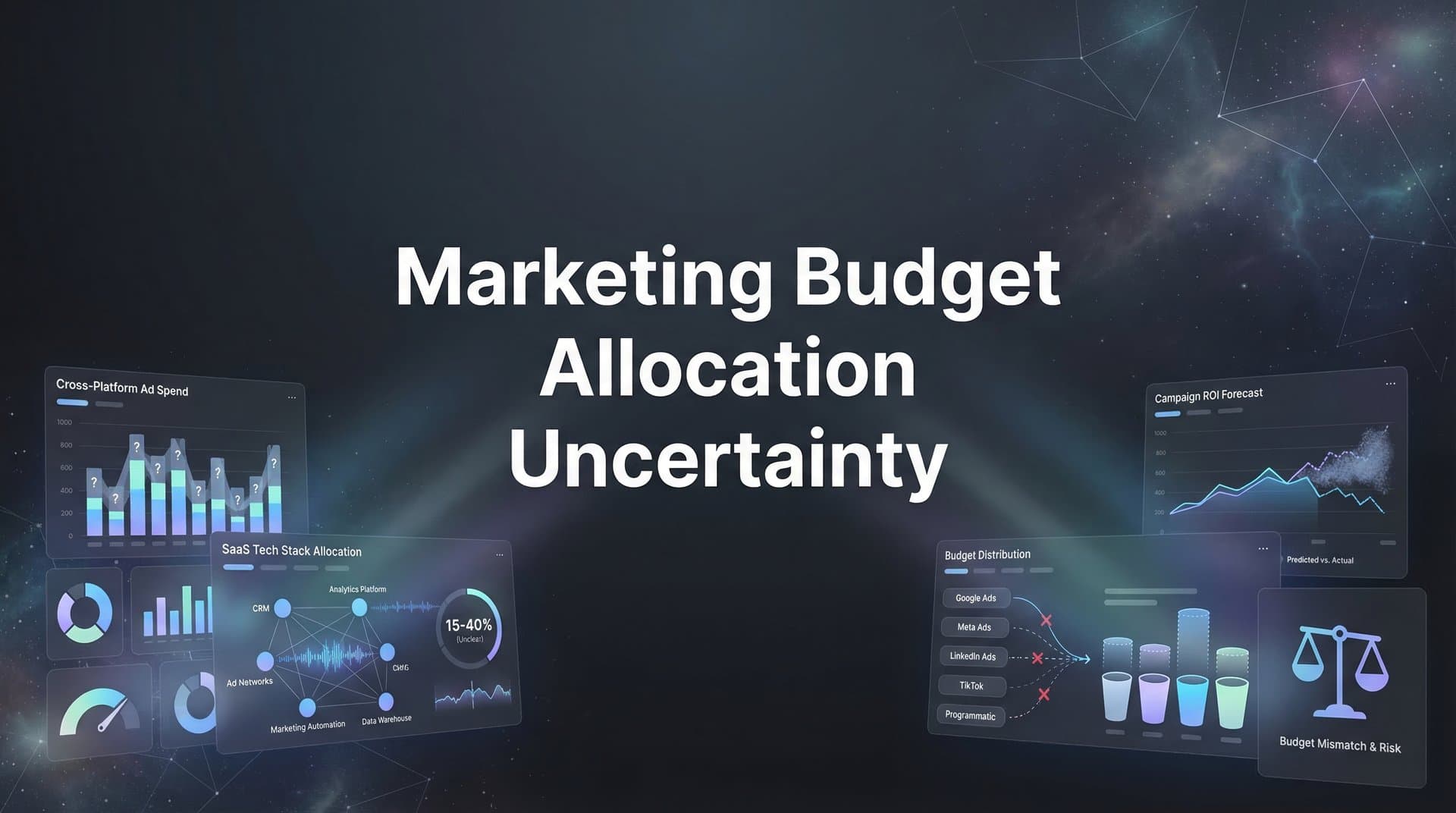
You're staring at your marketing dashboard at 11 PM, toggling between Meta Ads Manager, Google Analytics, and your CRM. Facebook says your campaign drove 47 conversions. Google Analytics shows 31. Your CRM records 22 actual sales, but half show "direct" as the source. Which number is real? Where should you actually put next month's budget?
This isn't just confusion—it's expensive confusion. Marketing budget allocation uncertainty forces you into impossible decisions with incomplete information. You end up spreading budget across channels like peanut butter on toast, hoping something works. Or worse, you chase vanity metrics that look impressive in reports but don't connect to actual revenue.
The core problem isn't your strategy or creativity. It's that your data infrastructure has gaps. iOS privacy changes block tracking. Customers switch between devices. Ad platforms optimize for clicks your CRM never sees as conversions. When 40% of your conversions show up as "unknown source" or "direct traffic," how can you possibly allocate budget with confidence?
This guide gives you a systematic framework to eliminate that uncertainty. You'll learn how to audit where your tracking breaks down, connect every touchpoint to actual revenue, implement attribution that reflects your real customer journey, and build decision rules that let you shift budget based on data instead of gut feeling.
The marketers who allocate budget confidently aren't smarter or luckier. They've simply built the data infrastructure that shows them exactly which ads and channels drive revenue. Here's how to do the same.
Step 1: Audit Your Current Attribution Gaps
Before you can fix your attribution, you need to know exactly where it's broken. Start by opening your analytics platform and filtering conversions from the past 30 days. Look at the source/medium column. What percentage shows up as "direct/none" or "unknown"?
If that number is above 20%, you have a significant blind spot. These aren't actually direct conversions—they're conversions where the tracking chain broke somewhere between the ad click and the purchase. Maybe the customer clicked a Facebook ad on mobile, researched on desktop, then converted three days later. Your system sees the final conversion but lost the original source.
Next, check for iOS-specific tracking degradation. Filter your conversions by device and operating system. Compare iOS conversion tracking rates to Android. Many businesses discover their iOS attribution is 40-60% less complete than Android, thanks to App Tracking Transparency. Those aren't fewer conversions—they're conversions your system can't properly attribute.
Now examine cross-device journeys. Pull a sample of 20 recent customers and manually trace their path through your CRM and analytics. How many touched multiple devices before converting? How many of those multi-device journeys are your analytics capturing versus missing? Understanding these attribution challenges in marketing analytics is the first step toward solving them.
Document your findings in a simple spreadsheet. List each channel you advertise on, the percentage of conversions properly attributed, and the specific gaps you've identified. For example: "Facebook Ads - 35% of conversions show as direct, iOS tracking appears 50% incomplete, cross-device journeys not captured."
The goal isn't to fix everything yet. It's to quantify the problem. If you're making budget decisions with 40% incomplete data, you need to know that number. It transforms attribution from a technical nice-to-have into a business-critical priority.
Pay special attention to cookie consent impacts. If you operate in regions with strict privacy regulations, check what percentage of users reject tracking cookies. Those users are invisible to your attribution system, even though they're converting. That's not a small edge case—it's a systematic blind spot affecting every channel equally.
Step 2: Connect All Revenue Touchpoints to a Single Source of Truth
Attribution gaps exist because your data lives in silos. Facebook knows about ad clicks. Google Analytics knows about website sessions. Your CRM knows about closed deals. But none of them talk to each other properly, so you're making budget decisions with three incomplete versions of reality.
The solution is a unified attribution system that connects every touchpoint—from initial ad click through final revenue—into one complete customer journey. Start by integrating your ad platforms directly with your attribution tool. This means connecting Meta, Google Ads, LinkedIn, TikTok, and any other channels where you spend money.
But here's the critical piece most marketers miss: you need to connect your CRM, not just your ad platforms. Ad platforms report conversions based on clicks and pixel fires. Your CRM knows which leads actually turned into paying customers and how much revenue they generated. Without CRM integration, you're optimizing for leads that might never close. This is why marketing revenue attribution has become essential for data-driven teams.
This is where the difference between reported performance and actual performance becomes stark. A channel might drive 100 leads according to its platform reporting, but only 8 of those leads close into customers. Another channel drives 30 leads, but 12 become customers. Which channel deserves more budget? You can't answer that question without connecting ad spend to actual closed revenue.
Implement server-side tracking alongside your standard browser-based tracking. Server-side tracking captures conversion data directly from your server, bypassing browser limitations, ad blockers, and iOS restrictions. When a customer converts, your server sends that data to your attribution system regardless of whether their browser allows tracking.
This dramatically improves data accuracy. Many businesses find that server-side tracking reveals 30-40% more conversions than browser-based tracking alone, especially from iOS users and privacy-conscious customers who block cookies.
Once everything is connected, run test conversions to verify data flows correctly. Create a test purchase or lead submission for each channel. Check that it appears in your attribution system with the correct source, campaign, and ad details. If test conversions aren't tracking properly, real conversions aren't either.
The goal is a single dashboard where you can see every customer's complete journey: which ad they clicked, which pages they visited, how many touchpoints they had, and exactly how much revenue they generated. When all your data connects to this single source of truth, budget allocation decisions become dramatically clearer.
Step 3: Choose the Right Attribution Model for Your Business
Now that you have complete journey data, you need to decide how to distribute credit across touchpoints. This is where attribution models come in, and choosing the wrong one can be just as misleading as having incomplete data.
Last-click attribution gives 100% credit to the final touchpoint before conversion. It's simple, but it systematically undervalues channels that introduce customers to your brand. Your Facebook awareness campaign might drive initial interest, but if customers convert days later through a Google search, last-click gives Facebook zero credit.
First-click attribution does the opposite—it gives all credit to the first touchpoint. This overvalues top-of-funnel channels while ignoring the nurturing and closing work done by other channels. It's useful for understanding acquisition sources but terrible for understanding what actually drives conversions.
Multi-touch attribution distributes credit across all touchpoints in the customer journey. A customer might see a Facebook ad, click a Google ad, read three blog posts, and then convert through an email. Multi-touch attribution gives each of those interactions appropriate credit based on their role in the journey. Understanding the different attribution models in digital marketing helps you select the right approach for your business.
Which model should you use? It depends on your sales cycle and buying complexity. If you sell low-consideration products with short sales cycles—think impulse purchases or simple SaaS tools—last-click might be sufficient because customers typically convert quickly after discovery.
But if you have a longer sales cycle, multiple decision-makers, or high-consideration purchases, multi-touch attribution is essential. B2B SaaS companies, high-ticket services, and complex products almost always need multi-touch models because customers interact with multiple channels over weeks or months before converting.
Here's the smart approach: set up multiple attribution model views and compare them. Look at the same data through last-click, first-click, and multi-touch lenses. Notice how credit shifts between channels. This reveals which channels are acquisition specialists, which excel at nurturing, and which close deals.
You'll often find surprising insights. That LinkedIn campaign that looks mediocre in last-click attribution might be your best first-touch performer, introducing high-quality leads who later convert through other channels. That email sequence that seems to drive tons of conversions in last-click might just be getting credit for closing deals that other channels initiated.
Compare your unified attribution data against what each ad platform reports. Platform-reported conversions are always last-click within that platform's ecosystem. When you see the full multi-touch picture, you'll understand why platform numbers often inflate their own importance.
Step 4: Establish Baseline Performance Metrics by Channel
With accurate attribution in place, you can finally calculate true performance metrics. This step is about establishing baseline numbers before you start shifting budget around. You need to know where you're starting from to measure whether changes actually improve results.
Calculate true cost-per-acquisition for each channel using attributed revenue data, not just platform-reported conversions. Take your total spend on Facebook, divide it by the number of customers Facebook actually contributed to (based on your attribution model), and you have true CPA. Do this for every channel.
You'll likely find significant differences from what platforms report. A channel claiming $50 CPA might actually be $120 when you account for conversions it's taking credit for that other channels initiated. Another channel reporting $200 CPA might actually be $140 when you properly credit its role in multi-touch journeys.
Calculate true ROAS the same way. Total attributed revenue from each channel divided by spend on that channel. This reveals which channels actually drive profitable growth versus which ones look good on paper but don't connect to real revenue. Effective measuring of marketing campaign effectiveness requires this level of granularity.
But don't stop at acquisition metrics. Analyze each channel's role in your funnel. Some channels excel at cold acquisition—introducing brand-new customers to your business. Others are better at nurturing—moving interested prospects toward purchase. Still others are closers—delivering the final touchpoint that converts ready buyers.
Document these patterns. You might discover that LinkedIn drives expensive clicks but introduces high-value enterprise customers who close at 30% rates. Facebook drives cheaper clicks but lower-value customers who close at 8% rates. Neither is "better"—they serve different strategic purposes, and you need both.
Create a baseline report showing current spend, attributed conversions, true CPA, true ROAS, and funnel role for each channel. This becomes your reference point. When you shift budget next month, you'll compare results against these baselines to see whether changes actually improved performance.
Step 5: Build a Data-Driven Budget Reallocation Framework
Now comes the practical part: creating decision rules that tell you when and how to shift budget. This framework removes emotion and guesswork from budget allocation by establishing clear, data-based triggers.
Start by defining your threshold metrics. What performance level triggers a budget increase? What level triggers a decrease? For example: "If a channel maintains ROAS above 4.0 for three consecutive weeks with at least 20 conversions, increase budget by 20%. If ROAS drops below 2.0 for two weeks, decrease by 30%." Following proven marketing budget allocation best practices helps you establish these thresholds effectively.
The specific numbers depend on your business economics, but the principle is universal: establish objective criteria that trigger budget conversations. This prevents reactive changes based on a single bad week or over-excitement about a temporary spike.
Set minimum test periods before making changes. Marketing performance fluctuates. A channel might have a weak week due to seasonal factors, creative fatigue, or random variance. Requiring two or three weeks of consistent underperformance before cutting budget prevents you from killing winners during temporary dips.
Similarly, require sustained strong performance before scaling aggressively. A single great week might be luck. Three consecutive weeks of strong ROAS with increasing volume suggests genuine scalability.
Create a decision matrix for different scenarios. If a channel is hitting target ROAS but volume is low, the answer might be creative refresh or audience expansion, not budget cuts. If a channel has declining ROAS but still profitable, you might maintain budget while testing new approaches. If a channel is unprofitable and declining, that's a clear signal to reallocate.
This is where AI-powered budget allocation recommendations become valuable. Rather than manually analyzing every channel's performance trends, AI can identify scaling opportunities you might miss. It spots patterns like "Facebook's ROAS improved 15% after you added video creative" or "Google Search performs 40% better on weekends" and suggests budget shifts accordingly.
The framework should also account for strategic goals beyond immediate ROAS. If you're launching in a new market, you might accept lower ROAS initially to build brand awareness. If you're focused on enterprise customers, you might allocate more to channels with longer sales cycles and higher customer values, even if immediate ROAS looks lower.
Step 6: Implement Continuous Optimization and Feedback Loops
Budget allocation isn't a one-time decision—it's an ongoing optimization process. The final step is building systems that continuously improve your allocation accuracy based on what the data reveals.
Schedule weekly attribution reviews. Every Monday, look at the previous week's performance across all channels. Check for significant changes in CPA, ROAS, conversion rates, or attribution patterns. Catching performance shifts early lets you respond before they significantly impact results.
These reviews don't need to be lengthy. Fifteen minutes examining key metrics and flagging anything unusual is sufficient. The goal is consistent attention, not exhaustive analysis. Using a marketing dashboard for multiple campaigns makes these reviews faster and more actionable.
Feed enriched conversion data back to your ad platforms. This is a critical step many marketers overlook. When you identify which leads actually became customers and generated revenue, send that data back to Meta, Google, and other platforms. This improves their algorithmic optimization.
Ad platforms optimize based on the conversion data they receive. If you only send them lead conversions, they optimize for leads. If you send them revenue data showing which leads actually closed into high-value customers, they can optimize for revenue instead. This creates a virtuous cycle where your attribution insights improve platform performance.
Track budget allocation changes against outcomes over 30, 60, and 90-day windows. When you shift 20% of budget from Facebook to Google, does revenue increase, decrease, or stay flat over the next month? Over the next quarter? This meta-analysis of your budget decisions helps you refine the decision framework itself.
You might discover that your threshold metrics need adjustment. Perhaps you've been too aggressive with budget cuts, killing channels before they had time to optimize. Or maybe you've been too conservative, leaving money in underperforming channels too long. The data from past allocation decisions informs better future decisions.
Continuously refine your attribution model as your business evolves. If your sales cycle lengthens, you might need to adjust attribution windows. If you add new channels, you need to understand how they interact with existing ones. Attribution isn't set-it-and-forget-it—it's a living system that adapts to your business reality. Implementing real-time marketing budget allocation strategies ensures you're always working with current data.
The compound effect of continuous optimization is dramatic. Small improvements each week—a 5% budget shift here, a creative refresh there, an audience expansion somewhere else—accumulate into major performance gains over quarters and years. The difference between marketers who allocate budget confidently and those who don't isn't one big decision. It's hundreds of small, data-informed decisions compounding over time.
Putting It All Together
Marketing budget allocation uncertainty disappears when you replace incomplete data with complete customer journey visibility. The six-step framework gives you a systematic path from confusion to confidence.
Start by auditing your attribution gaps—quantify exactly where your tracking breaks down and how much data you're missing. Then connect all revenue touchpoints to a single source of truth that links ad spend to actual closed revenue, not just platform-reported conversions. Choose attribution models that match your sales cycle complexity, and establish baseline performance metrics that reveal each channel's true contribution.
Build a decision framework with objective criteria for budget shifts, and implement continuous optimization loops that improve allocation accuracy over time. Feed enriched conversion data back to ad platforms so they can optimize for actual revenue, not just clicks or leads. The right marketing budget allocation software makes this entire process manageable.
The marketers who allocate budget with confidence aren't working with better instincts or more experience. They're working with better data. When you can see every touchpoint from initial ad click through final revenue, budget allocation becomes straightforward. You're not guessing which channels work—you're reading the data that shows exactly which ads and campaigns drive profitable growth.
Start this week with Step 1. Open your analytics and calculate what percentage of your conversions currently lack proper source attribution. That single number reveals the scale of your budget allocation uncertainty problem. If 30% of conversions show as "direct" or "unknown," you're making major budget decisions with 30% incomplete information.
Most businesses discover their attribution gaps are larger than expected. That's not a failure—it's an opportunity. Every percentage point of improved attribution clarity translates directly into better budget allocation decisions and higher marketing ROI. The investment in proper attribution infrastructure pays for itself quickly when it prevents even one major budget misallocation.
Ready to elevate your marketing game with precision and confidence? Discover how Cometly's AI-driven recommendations can transform your ad strategy—Get your free demo today and start capturing every touchpoint to maximize your conversions.


