You're spending $50,000 a month across Google Ads, Meta, LinkedIn, and a handful of other platforms. Each dashboard tells you a different story. Google says it drove 200 conversions. Meta claims 180. LinkedIn reports 95. Add them up and you've got 475 conversions—but your CRM shows only 220 actual sales.
Which platform is lying? None of them. They're all telling the truth from their limited perspective.
This is the maddening reality of modern digital marketing: you're making decisions with incomplete data. You know marketing drives revenue—you just can't prove which parts of your strategy actually work. Marketing revenue attribution solves this problem by connecting every touchpoint in the customer journey to actual sales, giving you a complete, accurate picture of what's really driving revenue.
Why Traditional Metrics Leave Marketers Flying Blind
Platform dashboards show you what happened inside their walled gardens. Google Ads tells you about clicks and conversions that happened after someone clicked your ad. Meta shows you results from people who saw or clicked your Facebook ads. Each platform operates in isolation, completely unaware of what else influenced the customer.
The result? You're optimizing for metrics that don't actually matter.
A thousand clicks means nothing if those visitors never buy. Ten thousand impressions won't pay your bills. Even "conversions" can be misleading when platforms count the same sale multiple times or credit actions that didn't lead to revenue. You end up chasing vanity metrics while your actual revenue drivers go unnoticed.
Here's where it gets worse: siloed data creates a fragmented view of how customers actually buy from you. Someone might see your LinkedIn ad, click a Google search result three days later, read your blog post, then convert through a retargeting ad on Meta two weeks after that. Each platform sees only its piece of the puzzle. LinkedIn thinks the LinkedIn ad drove the sale. Google credits the search click. Meta claims the retargeting ad closed the deal.
They're all partially right—and completely wrong.
This fragmented view costs you real money. You might be scaling a campaign that looks great in its platform dashboard but actually loses money when you factor in customer acquisition costs. Or you're cutting budget from a channel that plays a crucial supporting role in your customer journey, even though it rarely gets the final click.
The cost of misattributed revenue compounds over time. Every budget decision based on incomplete data moves you further from optimal performance. You're essentially flying blind, making million-dollar decisions based on guesswork dressed up as analytics. Understanding the differences between marketing attribution software and traditional analytics reveals why platform dashboards alone can't give you the complete picture.
How Revenue Attribution Connects Every Touchpoint to Sales
Marketing revenue attribution tracks the complete customer journey from the first moment someone encounters your brand to the final purchase—and beyond. Instead of relying on what each platform reports in isolation, attribution connects all the dots across every channel, interaction, and conversion point.
Think of it like GPS for your customer journey. You're not just seeing the destination (the sale). You're seeing every turn, every stop, every route they took to get there.
This works by capturing data from multiple sources and unifying it into a single view. When someone clicks your Meta ad, that gets tracked. When they later search for your brand on Google and click an organic result, that's captured too. Their website visits, content downloads, email opens, demo requests—every interaction gets logged and connected to the same individual.
The magic happens when you integrate your ad platforms, website tracking, and CRM data. Your attribution system sees that the person who clicked your Meta ad on Monday is the same person who filled out a contact form on Wednesday and became a $10,000 customer on Friday. Now you can trace that $10,000 in revenue back through every marketing touchpoint that influenced the decision. A robust marketing attribution platform with revenue tracking capabilities makes this integration seamless.
Modern attribution platforms use server-side tracking to capture this data accurately. Instead of relying solely on browser cookies (which get blocked or deleted), server-side tracking sends conversion data directly from your server to your attribution platform. This creates a more complete, reliable dataset that isn't affected by ad blockers or privacy settings.
Real-time tracking makes this even more powerful. You're not waiting until the end of the month to see which campaigns performed well. You can see revenue attribution data as it happens, allowing you to shift budget toward winning campaigns while they're still running. This speed matters because digital advertising moves fast—waiting a week for data means missing optimization opportunities.
The unified view also reveals patterns you'd never spot in siloed dashboards. You might discover that LinkedIn ads rarely drive direct conversions but consistently introduce prospects who later convert through search. Or that customers who interact with three or more touchpoints have twice the lifetime value of single-touch customers. These insights only become visible when you connect all the data through effective channel attribution in digital marketing.
Attribution Models Explained: Choosing the Right Lens for Your Data
Attribution models are different ways of assigning credit for a sale across the various touchpoints that influenced it. Think of them as different lenses for viewing the same data—each reveals something different about how your marketing actually works.
First-touch attribution gives all the credit to the first interaction. If someone clicked your Google ad, then later saw three retargeting ads before buying, first-touch says the Google ad deserves 100% of the credit. This model helps you understand what's bringing new prospects into your ecosystem. It's particularly useful for top-of-funnel analysis and understanding which channels are best at creating awareness.
Last-touch attribution does the opposite—it credits the final interaction before purchase. Using the same example, the last retargeting ad would get all the credit. This model shows you what's actually closing deals. Many businesses default to last-touch because it feels intuitive: the last thing someone did before buying must have been what convinced them.
But both single-touch models miss the bigger picture. Real customer journeys involve multiple touchpoints, and crediting only one ignores everything else that influenced the decision.
Multi-touch attribution models distribute credit across multiple touchpoints. Linear attribution splits credit evenly across every interaction. If there were five touchpoints, each gets 20% of the credit. This approach recognizes that every interaction mattered but assumes they all mattered equally—which often isn't true. For a deeper dive into how these models work, explore our guide on what a marketing attribution model is and how to select the right one.
Time-decay attribution gives more credit to interactions closer to the conversion. The logic: recent touchpoints had more influence on the immediate decision to buy. An ad someone saw yesterday gets more credit than one they saw three weeks ago. This works well for longer sales cycles where recent interactions carry more weight.
Position-based attribution (also called U-shaped) gives the most credit to the first and last touchpoints, with the remaining credit distributed among middle interactions. This recognizes that introducing someone to your brand and closing the sale are both crucial moments, while middle touchpoints play supporting roles.
The smartest approach? Compare multiple models. When you view your data through different attribution lenses, you gain a more complete understanding of campaign performance. A campaign might look mediocre in last-touch attribution but prove essential in first-touch, revealing its role as a top-of-funnel driver. Another might show strong last-touch performance, indicating it's great at converting warm prospects but terrible at generating new interest. Understanding the nuances of multi-touch attribution vs marketing mix modeling helps you choose the right approach for your business.
Overcoming Modern Attribution Challenges
Privacy changes have fundamentally altered how marketing attribution works. Apple's App Tracking Transparency framework, introduced in iOS 14.5, requires apps to ask permission before tracking users across other apps and websites. The result? Most users opt out, creating massive blind spots in your attribution data.
Cookie deprecation compounds this challenge. Third-party cookies—the technology that powered cross-site tracking for years—are being phased out across major browsers. Chrome, which holds the largest browser market share, has delayed full deprecation but the direction is clear: cookie-based tracking is ending.
These changes don't mean attribution is impossible. They mean you need to adapt your tracking strategy. Many marketers struggle with these common attribution challenges in marketing analytics, but solutions exist.
Server-side tracking offers a more reliable solution. Instead of relying on browser-based tracking that users can block, server-side tracking sends conversion data directly from your server to your attribution platform and ad networks. When someone completes a purchase on your website, your server sends that conversion event to your tracking system, bypassing browser restrictions entirely.
This approach provides more accurate data because it's not affected by ad blockers, cookie deletion, or privacy settings. You're tracking actions that happen on your server, not relying on what a user's browser allows you to see.
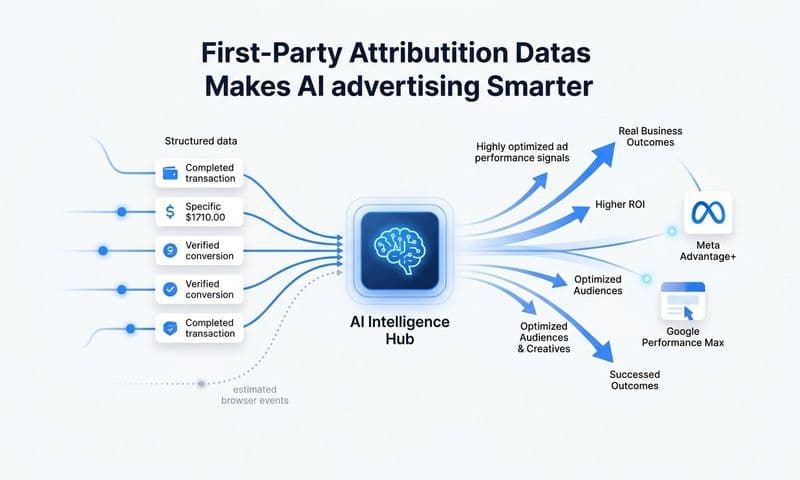
Server-side tracking also enables conversion sync—sending enriched conversion data back to ad platforms. Instead of letting Meta or Google guess which clicks led to valuable outcomes, you tell them exactly which conversions happened and how much revenue they generated. This feeds better data into their machine learning algorithms, improving targeting and optimization.
When ad platforms receive accurate conversion data, their AI can identify patterns in who converts and optimize toward similar audiences. Without this feedback loop, they're optimizing for clicks or platform-reported conversions that might not align with your actual business outcomes. With it, they're optimizing for the actions that actually matter to your bottom line.
Putting Revenue Attribution to Work: Practical Applications
Revenue attribution transforms from interesting data to competitive advantage when you use it to make better decisions. The most immediate application: identifying which campaigns deserve more budget and which need to be cut.
Traditional platform metrics might show Campaign A generating more conversions than Campaign B at a lower cost per conversion. But when you look at revenue attribution, you discover Campaign A attracts low-value customers who rarely buy again, while Campaign B brings in high-value customers with strong lifetime value. This insight completely flips your optimization strategy.
You can spot these patterns by analyzing revenue per touchpoint, not just conversion counts. A channel that drives fewer conversions but higher average order values might be more valuable than one that drives volume at lower price points. Attribution data reveals these quality differences that platform dashboards hide. Implementing cross-channel attribution for marketing ROI helps you see the true value each channel contributes.
AI-powered insights take this further by automatically identifying high-performing ads and campaigns across all your channels. Instead of manually comparing dozens of campaigns, AI can surface patterns like "ads with this creative style consistently drive 40% higher revenue" or "campaigns targeting this audience segment have 2x the conversion rate."
These recommendations become your roadmap for scaling. When AI identifies that a specific ad creative is outperforming others across multiple platforms, you can confidently increase budget knowing the recommendation is based on actual revenue data, not platform-reported metrics.
The feedback loop is where attribution creates compounding returns. As you send better conversion data back to ad platforms through conversion sync, their algorithms get smarter about who to target. This improves campaign performance, which generates more conversion data, which further improves targeting. You're not just optimizing campaigns—you're training ad platform AI to find your best customers.
This matters because ad platforms like Meta and Google use machine learning to optimize delivery. When you feed them accurate revenue data, they can optimize for high-value conversions instead of just any conversion. The difference in results can be dramatic: campaigns optimized for revenue often achieve better ROI even if they generate fewer total conversions. Staying current with the latest trends in marketing attribution technology ensures you're leveraging the most effective strategies.
Building Your Attribution Foundation
Getting started with marketing revenue attribution requires connecting three core data sources: your ad platforms, your website, and your CRM. Each provides a different piece of the puzzle.
Ad platform integrations pull in data about impressions, clicks, and platform-reported conversions. You'll want to connect every channel you advertise on—Google Ads, Meta, LinkedIn, TikTok, whatever platforms you use. Modern attribution platforms handle these integrations through APIs, automatically syncing your campaign data.
Website tracking captures what happens after someone clicks your ad. This includes page views, content interactions, form submissions, and on-site conversions. Server-side tracking ensures this data remains accurate despite browser restrictions and privacy changes. Our guide on attribution marketing tracking walks you through the technical setup.
CRM integration is where attribution connects to actual revenue. Your CRM knows which leads became customers, how much they spent, and their lifetime value. When your attribution platform can see this revenue data and connect it back to marketing touchpoints, you get true revenue attribution.
Setting up proper conversion events is crucial. You need to define what actions matter to your business—not just what's easy to track. A SaaS company might track free trial signups, paid conversions, and expansion revenue. An e-commerce brand tracks purchases, average order value, and repeat purchase rates. Define these events clearly and ensure they're tracked consistently across all systems.
Revenue tracking takes this further by attaching dollar values to conversions. Instead of just knowing that 50 people signed up for your product, you know that those 50 signups generated $75,000 in revenue. This transforms attribution from counting conversions to measuring business impact. When comparing marketing attribution software features, prioritize platforms that offer robust revenue tracking capabilities.
Moving from implementation to insights requires giving your system time to collect data. You need enough touchpoints and conversions to identify meaningful patterns. For most businesses, two to four weeks of data provides enough signal to start making optimization decisions. As your dataset grows, the insights become more reliable and the recommendations more precise.
Your Path to Data-Driven Marketing Decisions
Marketing revenue attribution transforms you from someone who spends money on ads to someone who invests in measurable growth. The difference isn't semantic—it's the gap between guessing which campaigns work and knowing exactly what drives sales.
When you can trace every dollar of revenue back through the complete customer journey, you stop wasting budget on channels that look good in isolation but don't contribute to your bottom line. You start scaling the campaigns that actually matter. You feed better data to ad platforms, improving their targeting and optimization. You make decisions based on complete, accurate data rather than fragmented platform reports.
This is the competitive advantage modern marketers need. While others optimize for vanity metrics and platform-reported conversions, you're optimizing for actual revenue. While they guess which campaigns deserve more budget, you know. While they struggle to justify marketing spend, you can prove exactly which investments drive growth.
The marketers who win in the privacy-first era aren't the ones with the biggest budgets—they're the ones with the best data. Revenue attribution gives you that data advantage.
Ready to elevate your marketing game with precision and confidence? Discover how Cometly's AI-driven recommendations can transform your ad strategy—Get your free demo today and start capturing every touchpoint to maximize your conversions.