Picture this: your marketing team is running campaigns across Meta, Google, TikTok, and LinkedIn simultaneously. The dashboards are full of numbers. Spend is going out the door every day. But when the CEO asks "where is our budget actually working?", the room goes quiet.
This is one of the most common and costly problems in modern digital marketing. You have data everywhere, but the data does not tell a coherent story. Each platform claims credit for conversions. Channels look efficient in isolation but the overall business results do not match. Budget decisions get made on gut feel or, worse, on whichever platform dashboard looks the most impressive that week.
Marketing spend efficiency analysis is the discipline that solves this problem. At its core, it is the practice of connecting every dollar you spend to measurable business outcomes across every channel and touchpoint, so you can see clearly what is working, what is not, and where your next dollar will generate the most return. This is not just about tracking return on ad spend. ROAS is one metric among many, and in isolation it can be dangerously misleading. True efficiency analysis builds a system for continuous optimization that accounts for the full customer journey, accurate attribution, and the natural limits of scaling any channel.
In this article, we will walk through what marketing spend efficiency analysis actually measures, the data foundation you need to do it right, a practical framework for running the analysis, the most common efficiency killers to watch for, how to translate insights into confident budget decisions, and how to build a recurring review cadence that keeps your strategy sharp over time.
Beyond ROAS: What Marketing Spend Efficiency Analysis Actually Measures
Return on ad spend gets a lot of attention, and for good reason. It is simple, it is fast, and every ad platform reports it natively. But if you are making budget decisions based on platform-reported ROAS alone, you are likely working with a distorted picture of reality. For a deeper dive into this metric, see our guide on what ROAS in marketing actually means and where it falls short.
Here is the core problem. Each ad platform operates with its own attribution logic, and each one is incentivized to claim as much credit as possible for your conversions. When a customer clicks a Facebook ad on Monday, sees a Google search ad on Wednesday, and converts on Friday, both platforms will often count that conversion as their own. The result is that your combined reported ROAS across platforms can add up to numbers that exceed your actual revenue. That is not efficiency analysis. That is double-counting dressed up as performance reporting.
Marketing spend efficiency analysis takes a different approach. Instead of accepting each platform's self-reported numbers at face value, it evaluates how effectively each portion of your budget converts into revenue, pipeline, or other meaningful business outcomes when measured against a single, consistent source of truth.
The core components of a proper efficiency analysis include several interconnected metrics and concepts. Cost per acquisition at the channel level tells you what it actually costs to generate a customer or lead from each source, calculated using your own conversion data rather than platform estimates. Incremental revenue contribution asks a harder question: how much revenue would you have lost if you had not run that channel at all? This is different from attributed revenue because it accounts for the fact that some customers would have converted through another path anyway.
Blended versus isolated efficiency is another important distinction. Isolated efficiency looks at a single channel in a vacuum. Blended efficiency looks at your total marketing investment relative to total revenue generated, which often tells a more honest story about portfolio performance. Neither view is complete on its own, but together they reveal where budget concentration is helping and where it is hiding problems.
Finally, diminishing returns thresholds are central to the entire discipline. Every channel has a point where additional spend yields progressively fewer incremental conversions. Identifying that inflection point for each channel in your mix is one of the most valuable outputs of spend efficiency analysis. It tells you not just where to invest more, but where you are already past the point of optimal return.
iOS App Tracking Transparency changes, cookie deprecation timelines, and the general erosion of browser-based tracking have made all of this more complex in recent years. Platform-reported data has become less reliable as signal loss increases, which makes having your own accurate attribution infrastructure more important than ever.
The Data Foundation You Need Before Running Any Analysis
Before you can analyze efficiency, you need data you can actually trust. This sounds obvious, but many marketing teams run efficiency analyses on top of fragmented, inconsistent data and then wonder why the conclusions do not match business reality. Understanding why marketing data accuracy matters for ROI is the first step toward building a reliable foundation.
Think of the data you need as three distinct layers that must connect cleanly to each other.
Layer one: Ad platform spend data. This includes your actual spend by campaign, ad set, and ad across every platform you run. Most teams have this layer covered, but the challenge is standardizing it. Different platforms use different naming conventions, attribution windows, and reporting currencies. Pulling this data into a unified view requires either manual normalization or a tool that handles it automatically.
Layer two: Website and conversion event tracking. This is where many teams have significant gaps. Browser-based tracking via pixels and cookies has become increasingly unreliable due to ad blockers, browser restrictions, and the downstream effects of iOS privacy changes. Server-side tracking has become the more reliable alternative because it captures conversion events directly from your server rather than depending on a user's browser to fire a pixel. When this layer is weak, you end up with missing conversions, misattributed touchpoints, and efficiency metrics that are built on incomplete data.
Layer three: CRM and revenue data. This is the layer that ties everything to actual business outcomes. A lead is not revenue. A free trial signup is not a paying customer. Without connecting your ad-driven conversions to what those conversions are actually worth in your CRM or billing system, you are optimizing for proxy metrics rather than the outcomes your business actually cares about. This connection is what allows you to calculate true cost per acquisition and revenue per dollar spent rather than cost per lead or cost per click.
The gaps between these layers are where efficiency analysis breaks down. If your pixel fires on a thank-you page but your CRM shows a different number of actual customers, you have a data integrity problem that will corrupt every efficiency metric downstream. Double-counted conversions make channels look more efficient than they are. Missing touchpoints make channels look less efficient than they are. Either way, budget decisions made on that data will be wrong.
Multi-touch attribution models are what allow you to distribute conversion credit across the full customer journey once your data layers are connected. Rather than giving all credit to the last click before conversion, marketing attribution modeling recognizes that a customer who saw a TikTok ad, clicked a Google search ad, and then converted via a retargeting campaign on Meta was influenced by all three touchpoints. Distributing credit across that journey gives you a far more accurate picture of what each channel is actually contributing to revenue, which is the foundation of any meaningful efficiency analysis.
A Step-by-Step Framework for Analyzing Your Marketing Spend
Once your data foundation is solid, the actual analysis follows a clear progression. Here is a practical framework you can apply to your own marketing mix.
Step 1: Aggregate spend and revenue data into a single unified view.
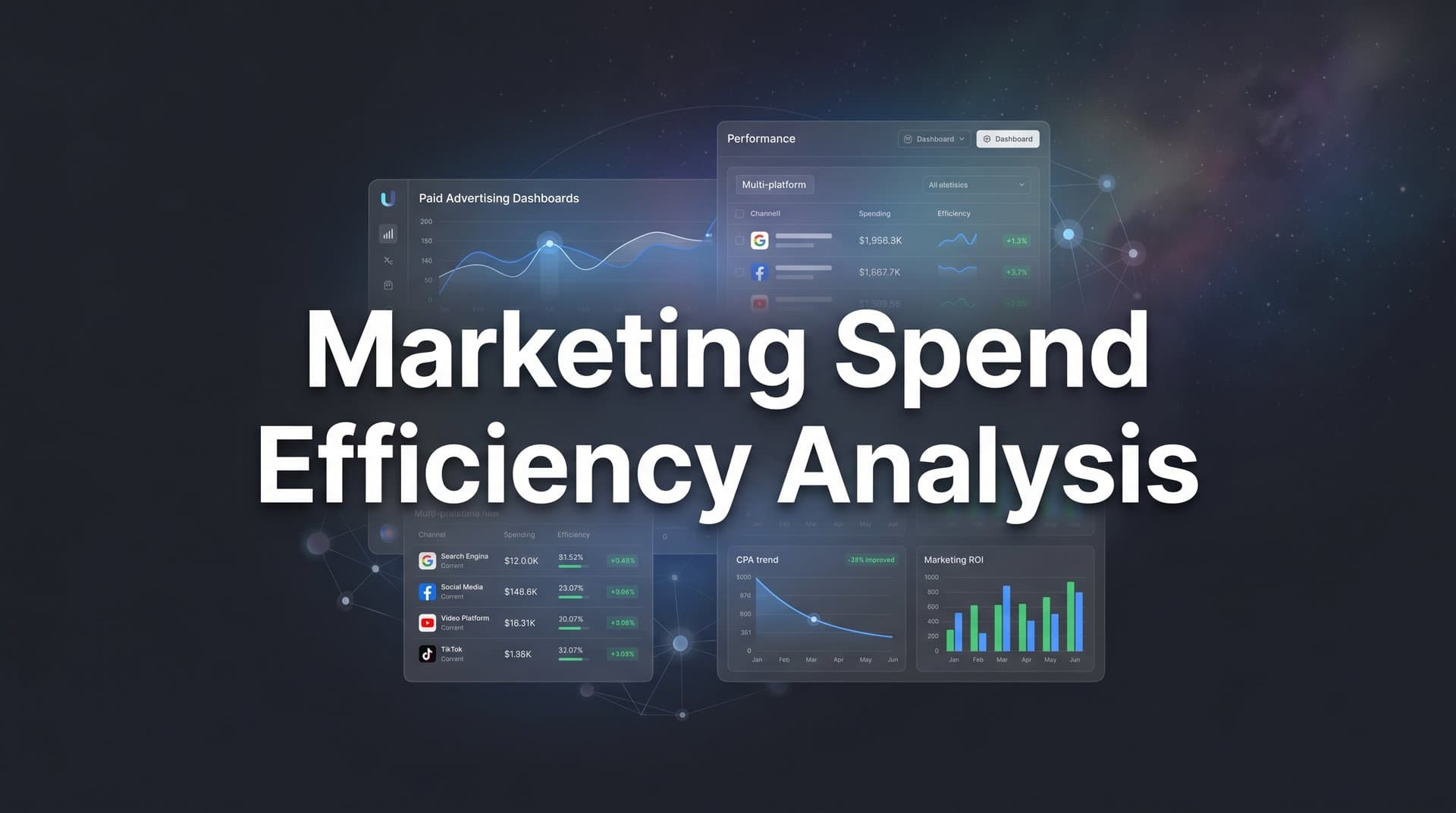
The first step is breaking down the silos. Pull your ad spend data from every platform, your conversion and revenue data from your CRM, and your attribution data from your tracking infrastructure into one place. This single view should allow you to see spend, conversions, and revenue by channel, by campaign, and by ad set without having to toggle between five different dashboards. Building unified dashboards for marketing and sales attribution is what makes this step scalable.
This aggregation step is where many teams lose momentum because doing it manually in spreadsheets is time-consuming and error-prone. Centralized analytics platforms that connect directly to your ad platforms, website tracking, and CRM solve this by automating the data pull and normalization. The goal is to reach a state where the unified view is always current and does not require manual assembly before every analysis.
Step 2: Calculate efficiency metrics at each level using consistent attribution logic.
With your unified data in place, calculate your key efficiency metrics at the channel level, then drill down to campaign and ad set. The primary metrics to calculate include cost per lead, cost per acquisition, revenue per dollar spent, and where possible, customer lifetime value relative to acquisition cost.
The critical word here is "consistent." You need to apply the same attribution model and the same attribution window across every channel when making comparisons. If you use a 7-day click attribution window for Meta but a 30-day window for Google, you are not comparing like with like. Standardizing this is one of the most important and most frequently overlooked steps in spend efficiency analysis.
Once you have these metrics calculated, compare them across channels. Which channels are generating acquisitions at the lowest cost? Which are generating the highest revenue per dollar spent? Which channels look efficient on cost per lead but fall apart when you connect leads to actual revenue in the CRM?
Step 3: Identify efficiency curves and diminishing returns by channel.
This is where the analysis gets genuinely strategic. For each channel, plot spend against incremental conversions over time or across different spend levels. What you are looking for is the shape of the efficiency curve: is it still climbing steeply (meaning more spend generates proportionally more conversions), or has it started to flatten (meaning you are approaching the diminishing returns zone)?
Channels where the curve is still steep are candidates for increased investment. Channels where the curve has flattened are candidates for budget reallocation. Channels where you are spending very little relative to their efficiency curve may be significantly underutilized. This analysis often reveals that the highest-spending channel in a portfolio is not actually the highest-efficiency channel, it is simply the one that got the most budget historically. Understanding SaaS marketing spend benchmarks can help you contextualize whether your allocation is in line with industry norms.
Plotting these curves also helps you identify where audience saturation is occurring. When you are reaching the same people repeatedly with the same creative and your cost per acquisition is climbing without a corresponding lift in conversions, that is a signal that you have hit a natural ceiling at your current audience and creative configuration.
Common Efficiency Killers (and How to Spot Them)
Even teams that understand the framework intellectually often fall into patterns that quietly erode their marketing efficiency over time. Here are the three most common culprits and how to identify them before they do serious damage.
Over-concentration based on inflated platform metrics. When one platform consistently reports strong ROAS, it tends to attract a disproportionate share of budget. The problem is that platform-reported ROAS is often inflated by attribution overlap, where the platform is claiming credit for conversions that were already counted elsewhere. Teams that concentrate budget based on these numbers often find that when they pull back spend on a supposedly high-performing channel, overall revenue barely moves. That is the clearest signal that the reported efficiency was not real. The fix is comparing platform-reported metrics against your own attribution data and your CRM revenue data to see where the gaps are largest. Learning about wasted ad spend on ineffective campaigns can help you recognize these patterns before they drain your budget.
Creative fatigue and audience saturation driving up costs invisibly. Creative fatigue is one of the most reliable efficiency killers in paid social, and it is easy to miss if you are only watching top-line spend and overall ROAS. The signal is in the per-unit efficiency trends over time: rising cost per click, declining click-through rates, and climbing cost per acquisition on the same audience and creative combination. Many teams notice these trends eventually, but by the time they act, weeks of degraded efficiency have already passed. Monitoring efficiency metrics at the ad level on a weekly basis, not just the campaign level, is the habit that catches this early.
Feeding ad platform algorithms bad conversion data. This is the efficiency killer that operates furthest from view. When your conversion tracking is incomplete or inaccurate, the data you send back to Meta, Google, and other platforms through their conversion APIs is also incomplete or inaccurate. Ad platform algorithms use this data to optimize targeting and bidding. When the data is poor, the algorithm optimizes toward the wrong signals, driving traffic that looks like it converts based on historical patterns but does not actually generate revenue. The result is wasted spend on audiences that will never become customers. Server-side tracking and proper conversion sync back to ad platforms are the technical solutions here, and the efficiency gains from fixing this layer are often substantial. Understanding where most marketing conversions drop off can help you pinpoint exactly where your tracking gaps exist.
Turning Analysis Into Action: Reallocating Budget With Confidence
Running a thorough efficiency analysis is only valuable if it leads to better decisions. The bridge between analysis and action is a structured reallocation plan grounded in what the data actually shows.
Start by ranking your channels by efficiency using the metrics you calculated in your framework: cost per acquisition, revenue per dollar spent, and position on the diminishing returns curve. Channels that are high-efficiency but under-scaled relative to their efficiency curve are your primary targets for increased investment. Channels that are past their diminishing returns threshold and consuming a disproportionate share of budget are candidates for reduction.
One important nuance: some channels that look inefficient in isolation are doing significant work earlier in the customer journey. A channel with a high cost per acquisition on a last-touch basis might be responsible for introducing a large portion of your eventual customers to your brand. Understanding types of marketing attribution models helps you account for this so you do not cut channels that are genuinely contributing to the funnel, just in ways that are not visible in last-click reporting.
When you are ready to reallocate, do it incrementally rather than all at once. Shift a portion of budget from a diminishing-return channel toward a high-efficiency opportunity, then re-measure efficiency after a meaningful period. Dramatic one-time reallocations are harder to learn from because too many variables change simultaneously. Incremental shifts let you isolate the effect of each change and build a clearer picture of how your efficiency curves respond to budget movement.
This is where AI-powered tools add meaningful value to the process. Rather than manually tracking efficiency trends across every channel and campaign, AI marketing analytics platforms can surface optimization recommendations automatically, flagging when a channel is approaching diminishing returns or when a campaign's efficiency is trending in the wrong direction. More importantly, these tools can sync enriched conversion data back to ad platforms like Meta and Google in real time, which improves the quality of the signals those platforms use for targeting and bidding. When ad platform algorithms have better data to work with, their optimization improves, and your spend efficiency improves with it.
Cometly's AI-powered features are built specifically for this workflow. The platform connects your ad spend, website tracking, and CRM data into a unified view, surfaces AI-driven recommendations for where to shift budget, and feeds enriched conversion events back to ad platforms so their algorithms work with accurate data rather than degraded signal. This closes the loop between analysis and action in a way that manual processes cannot match at scale.
Building a Recurring Efficiency Review Cadence
A single efficiency analysis is a snapshot. The market keeps moving, audience behavior shifts, platform algorithms update, and competitors adjust their spending. What was an efficient channel configuration in January may look very different by April. This is why building a recurring review cadence is as important as running the analysis in the first place.
Think of your efficiency review cadence as operating at three different time horizons, each serving a different purpose.
Weekly quick checks should focus on per-channel CPA trends and any significant movement in efficiency metrics at the campaign or ad set level. The goal is not a deep analysis but an early warning system. If cost per acquisition on a key campaign is climbing week over week, you want to catch that signal early rather than three weeks later when significant budget has already been spent at degraded efficiency. Leveraging real-time marketing analytics makes these weekly checks faster and more actionable. These weekly checks should take no more than 30 minutes if your data is centralized and current.
Monthly deep dives are where you compare attribution-weighted efficiency across your full funnel and look for patterns that are not visible in weekly snapshots. This is the cadence for evaluating multi-touch attribution data, comparing blended versus isolated channel efficiency, and identifying which channels are contributing most to pipeline at each stage of the customer journey. Monthly reviews are also a good time to assess creative performance trends and determine whether audience fatigue is beginning to affect efficiency on any channel.
Quarterly strategic reviews are for major budget decisions. This is when you take the insights from your weekly and monthly reviews and translate them into structural changes: reallocating meaningful budget between channels, testing new platforms, or sunsetting campaigns that have consistently underperformed. Quarterly reviews should also include a reassessment of your attribution model to ensure it still reflects how your customers actually make decisions.
The practical reality is that most marketing teams do not maintain this cadence because pulling the data together is too time-consuming when it requires manual spreadsheet work. Centralized analytics dashboards that unify ad platform, website, and CRM data solve this by making the data always available and always current. When the data is ready to review, the review actually happens. When it requires hours of manual assembly first, it gets skipped.
The Bottom Line on Marketing Spend Efficiency
Marketing spend efficiency analysis is not a quarterly audit you run when the CFO asks questions. It is an ongoing practice that separates high-growth marketing teams from those flying blind on inflated platform metrics and gut instinct.
The core insight is straightforward: accurate data, proper attribution, and a structured review cadence transform budget decisions from guesswork into a genuine competitive advantage. When you know which channels are generating real revenue, where your efficiency curves are flattening, and how to feed better data back to ad platform algorithms, you are not just spending smarter. You are building a system that compounds over time as your data quality improves and your optimization decisions get sharper.
The teams that win in paid advertising over the long term are not necessarily the ones with the biggest budgets. They are the ones who know exactly what each dollar is doing and have the systems in place to act on that knowledge consistently.
If you are ready to move beyond platform dashboards and spreadsheets and run this kind of analysis with confidence, Cometly is built for exactly that. It connects your ad spend, website tracking, and CRM data into a single attribution platform, surfaces AI-powered recommendations for where your budget will work hardest, and syncs enriched conversion data back to Meta, Google, and more so their algorithms improve alongside yours. Get your free demo today and start capturing every touchpoint to maximize your conversions.