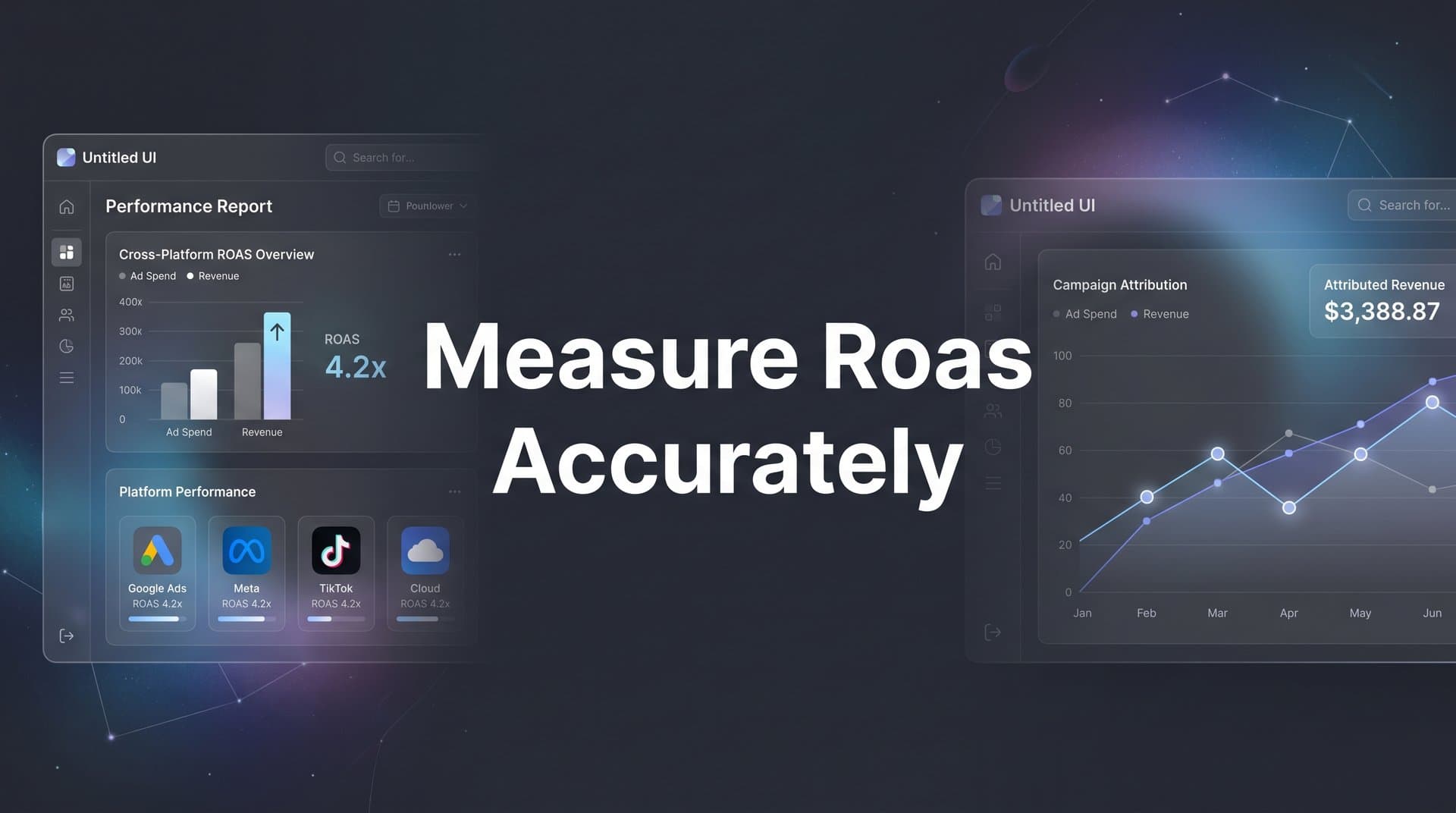
You check your ad platform dashboard and see a 4x ROAS. Your CFO pulls revenue reports and the numbers tell a different story. Sound familiar?
The gap between reported and actual return on ad spend frustrates marketers every day, leading to misallocated budgets and missed opportunities. You might be scaling campaigns that look profitable on paper while cutting budget from channels that actually drive revenue.
Accurate ROAS measurement requires more than trusting platform-reported metrics. It demands a systematic approach that connects ad spend to actual revenue across the entire customer journey. Without this foundation, you're making decisions based on incomplete data.
This guide walks you through the exact steps to measure ROAS accurately, from setting up proper tracking infrastructure to analyzing multi-touch attribution data. Each step builds on the previous one, creating a measurement framework that reveals which campaigns truly drive revenue and which ones just look good on platform dashboards.
By the end, you will have a clear framework for understanding where your ad dollars produce real returns. No more guessing. No more surprises when finance pulls the actual numbers. Just clarity on what works and what doesn't.
Step 1: Define Your Revenue Events and Attribution Window
Before you can measure ROAS accurately, you need to define exactly what counts as revenue and how long you'll credit ad interactions for driving that revenue.
Start by identifying which conversion events actually represent revenue. A purchase, closed deal, or subscription start generates revenue. An email signup, content download, or webinar registration does not. This distinction matters because many platforms optimize toward any conversion event you track, regardless of whether it produces revenue.
Document every revenue event in your business. For e-commerce, this might be straightforward: completed purchases. For B2B, you might track demo requests initially but only count closed deals as revenue events. For subscription businesses, both new subscriptions and renewals represent revenue.
Next, choose an attribution window that matches your sales cycle length. If customers typically purchase within a week of first seeing your ad, a 7-day attribution window makes sense. If you run a B2B business where deals close over months, you need a 30-day, 60-day, or even 90-day window.
Your attribution window determines which ad interactions receive credit for conversions. Too short, and you miss the campaigns that started customer journeys. Too long, and you credit ads that had minimal influence on purchase decisions.
Now define your ROAS formula precisely. Most marketers use: Revenue Generated divided by Ad Spend. But which costs count as ad spend? Just the media budget? Creative production costs? Agency fees? Platform subscription costs? Understanding what ROAS means in marketing helps you establish these foundational definitions.
There's no universal right answer, but consistency matters. If you include all marketing costs when calculating ROAS for one channel, you must do the same for all channels. Otherwise, you're comparing apples to oranges.
Write down your ROAS measurement framework in a document your entire team can access. Include your revenue event definitions, attribution window choices, and cost calculation method. Get agreement from marketing, finance, and leadership on these definitions.
This documentation becomes your source of truth when questions arise about measurement methodology. It prevents confusion when different team members calculate ROAS differently and get conflicting results.
You'll know this step succeeded when you can answer three questions clearly: Which events count as revenue? How long after seeing an ad can someone convert and still have that ad receive credit? What costs are included in the ad spend denominator of your ROAS calculation?
Step 2: Implement Server-Side Tracking for Complete Data Capture
Browser-based tracking pixels miss a significant portion of conversions. Ad blockers, iOS privacy restrictions, and cookie limitations create blind spots in your data. Server-side tracking solves this by sending conversion data directly from your server to ad platforms.
Server-side tracking works differently than browser pixels. Instead of relying on JavaScript code that runs in a user's browser, your server sends conversion events directly to platforms like Meta, Google, and TikTok. This approach bypasses browser limitations entirely.
Start by setting up a server-side tracking solution. You can build your own using platform APIs, use Google Tag Manager Server-Side, or implement a marketing attribution platform that handles server-side tracking automatically.
Configure your server to capture conversion events as they happen on your website or in your app. When someone completes a purchase, your server should log that event with all relevant details: transaction amount, products purchased, customer identifier, and the original ad click information.
Connect your ad platforms to receive this first-party data directly from your server. Meta's Conversions API, Google's Enhanced Conversions, and TikTok's Events API all accept server-side event data. Each platform provides documentation for sending properly formatted events.
The critical piece is maintaining the connection between ad clicks and conversions. When someone clicks your ad, platforms append click IDs to your landing page URL. Meta uses fbclid, Google uses gclid, and TikTok uses ttclid. Your server must capture and store these click IDs.
When a conversion happens, send the stored click ID back to the platform along with the conversion event. This tells the platform exactly which ad click led to this specific purchase or signup. Without this connection, platforms can't attribute conversions to the right campaigns. Following best practices for tracking conversions accurately ensures you capture this data reliably.
Set up proper UTM parameters on all your ad campaigns. Use consistent naming conventions: utm_source for the platform, utm_medium for the ad type, utm_campaign for the campaign name. Your server-side tracking should capture and store these parameters alongside click IDs.
Test your tracking setup thoroughly before trusting it with real data. Make test purchases or conversions on your site. Verify that these test events appear in your ad platform reporting within minutes. Check that the conversion values match exactly.
Run test conversions from different devices and browsers. Try it with an ad blocker enabled. Use an iPhone with App Tracking Transparency disabled. These edge cases reveal whether your server-side tracking truly captures conversions that browser pixels miss.
Compare your server-side conversion counts against browser pixel counts for the same time period. You should see more conversions reported through server-side tracking. If the numbers match exactly, your server-side implementation might not be working correctly.
Step 3: Connect Your CRM and Revenue Data Sources
Ad platforms show you which campaigns generate leads or initial conversions. Your CRM shows you which leads become customers and how much revenue they generate. Connecting these systems reveals your true ROAS.
Integrate your CRM with your attribution tracking system. Popular CRMs like HubSpot, Salesforce, and Pipedrive offer native integrations with marketing attribution platforms. These integrations sync lead and deal data automatically.
Map the complete customer journey from first ad click through final purchase. When someone clicks your ad, that interaction should be tracked. When they fill out a form, that lead enters your CRM. When they become a customer, that deal closes in your CRM. Your attribution system needs visibility into all these stages. Many marketers struggle because they can't track customer journey accurately without proper integrations.
Configure your CRM to pass revenue values back to your attribution platform. When a deal closes for ten thousand dollars, your attribution system should receive that exact amount. When a customer subscribes for ninety-nine dollars per month, that subscription value should flow through.
This revenue passback transforms your ROAS calculations. Instead of counting all conversions equally, you can calculate ROAS based on actual transaction amounts. A campaign that drives three high-value customers might outperform one that drives fifty low-value leads, even if the lead volume looks better.
Set up proper lead source tracking in your CRM. Every lead should capture the original UTM parameters, ad click IDs, and landing page that brought them to your site. This information connects CRM records back to specific campaigns.
Most CRMs support hidden form fields that automatically populate with tracking parameters. When someone submits a form, these hidden fields capture the UTM source, medium, and campaign without requiring manual entry. This prevents data loss from leads who don't remember which ad they clicked.
For businesses with offline conversions, implement a system to capture those events. If customers call your sales team after seeing an ad, use call tracking to connect phone conversions back to campaigns. If people visit physical stores, implement store visit tracking or promo codes that identify the marketing source.
Validate your data flow by comparing CRM revenue totals against what your tracking platform reports. Pull a report of all closed deals in your CRM for a specific time period. Compare that total revenue against the revenue your attribution system shows for the same period.
Small discrepancies are normal due to timing differences and attribution window edges. But if your CRM shows two hundred thousand dollars in revenue and your attribution system shows one hundred thousand, you have a data flow problem that needs immediate attention.
Check individual customer records to verify data accuracy. Pick a recent customer, find their CRM record, and trace their journey backward. Can you see their original ad click? Do the UTM parameters match the campaign they came from? Does the revenue amount match their purchase or contract value?
Step 4: Select and Configure Your Attribution Model
Attribution models determine how credit for conversions gets distributed across the multiple touchpoints in a customer journey. Your model choice significantly impacts which campaigns appear to drive the best ROAS.
Last-click attribution gives all credit to the final touchpoint before conversion. If someone clicks a retargeting ad and immediately purchases, that retargeting campaign gets full credit. This model makes retargeting and branded search look incredibly effective while undervaluing awareness campaigns.
First-click attribution does the opposite, crediting the initial touchpoint that started the customer journey. This model favors top-of-funnel campaigns and prospecting efforts but ignores the nurturing that happened afterward.
Linear attribution distributes credit evenly across all touchpoints. If someone interacts with five different campaigns before converting, each campaign receives twenty percent of the credit. This model provides a more balanced view but treats all touchpoints as equally important.
Time-decay attribution gives more credit to touchpoints closer to conversion. The theory is that recent interactions influenced the purchase decision more than older ones. This model works well for businesses where the final touchpoints truly drive purchase decisions.
Data-driven attribution uses machine learning to analyze your actual conversion patterns and assign credit based on which touchpoints statistically increase conversion probability. This model requires significant data volume but provides the most accurate picture of campaign impact. Learning how to measure marketing attribution properly helps you choose the right model for your business.
Choose an attribution model that reflects your actual customer journey. For impulse purchases with short consideration periods, last-click might be acceptable. For complex B2B sales with long cycles and multiple stakeholders, multi-touch attribution is essential.
Configure your attribution platform to apply your chosen model consistently across all channels. If you use linear attribution for Facebook campaigns, you must use linear attribution for Google campaigns too. Mixing models across channels creates incomparable data.
Run comparison reports showing ROAS under different attribution models. Most platforms let you view the same data through multiple attribution lenses. Look at how your top campaigns perform under last-click versus linear versus data-driven attribution.
You'll often discover that campaigns driving strong ROAS under last-click attribution perform poorly under multi-touch models, and vice versa. Retargeting campaigns typically show inflated performance under last-click because they target people already likely to convert. Prospecting campaigns look better under first-click or linear models.
Consider using multiple attribution models for different purposes. Use data-driven or linear attribution for budget allocation decisions since these models show the full customer journey. Use last-click for quick optimization checks since it's simpler to understand and matches how most ad platforms report conversions.
Document your attribution model choice in the same framework document you created in step one. Explain why you chose this model and when you might reconsider. This prevents confusion when team members see different ROAS numbers and don't realize they're looking at different attribution models.
Step 5: Reconcile Platform Data Against Actual Revenue
Ad platforms report their own version of ROAS based on the conversions they can track. Your attribution system shows a different picture based on verified revenue data. Reconciling these numbers reveals the truth about campaign performance.
Pull ROAS reports from each ad platform for a specific time period. Download Meta's breakdown of ROAS by campaign. Export Google Ads conversion value per cost data. Get TikTok's return on ad spend metrics. Collect all platform-reported ROAS numbers in one spreadsheet.
Now pull the same data from your unified attribution platform. For the same time period and campaigns, what ROAS does your attribution system show? Use the same attribution model consistently when comparing across platforms.
Identify discrepancies between platform-reported conversions and verified revenue events. Meta might report two hundred conversions while your attribution system confirms only one hundred fifty. Google might show fifty thousand dollars in conversion value while your CRM shows forty thousand in closed deals. These advertising ROI measurement challenges are common across all platforms.
These discrepancies happen for several reasons. Platforms use view-through attribution that credits ads someone saw but didn't click. Browser-based tracking captures bot traffic and fraudulent conversions. Platforms might count conversions that never completed payment processing. Attribution windows might differ between platform settings and your chosen window.
Calculate true ROAS using confirmed revenue data divided by verified ad spend. If you spent ten thousand dollars on Facebook ads and your attribution system confirms eight thousand dollars in revenue from those campaigns, your true ROAS is 0.8x, not the 3x Facebook might be reporting.
This reconciliation process often reveals uncomfortable truths. Campaigns you thought were profitable might be losing money. Channels you considered marginal might be driving significant revenue that platforms underreport.
Document the variance between platform ROAS and actual ROAS for each channel. Create a simple table showing platform-reported ROAS, your calculated true ROAS, and the percentage difference. Update this comparison monthly to track whether discrepancies are growing or shrinking.
Share these findings with your team and leadership. When everyone understands that platform dashboards show inflated numbers, you can make better decisions about budget allocation. You stop chasing vanity metrics and start optimizing for real revenue.
Step 6: Build Your ROAS Reporting Dashboard
Scattered data across multiple platforms creates confusion and slows decision-making. A centralized dashboard puts all your ROAS metrics in one place, making it easy to spot trends and opportunities.
Create a dashboard that shows ROAS by channel, campaign, and ad set. Include breakdowns by time period so you can see daily, weekly, and monthly trends. Add filters that let you view specific product lines, customer segments, or geographic regions.
Include both platform-reported metrics and your calculated true ROAS side by side. This comparison helps your team understand the gap between what platforms show and what's actually happening. Over time, you'll develop intuition for how much to discount platform numbers.
Add key supporting metrics that explain ROAS performance. Show cost per acquisition, conversion rate, and average order value alongside ROAS. When ROAS changes, these metrics reveal whether the shift came from efficiency improvements, higher-value customers, or pricing changes. Investing in marketing performance measurement software makes building these dashboards significantly easier.
Set up automated alerts for significant ROAS changes or tracking discrepancies. If ROAS for a major campaign drops by more than twenty percent day-over-day, you want to know immediately. If the gap between platform-reported and true ROAS suddenly widens, something might be broken in your tracking.
Schedule regular reporting cadence based on your ad spend volume. High-spend accounts running multiple campaigns daily need daily dashboard reviews. Smaller accounts with stable campaigns can review weekly. The key is consistency, not frequency.
Build your dashboard in a tool your entire team can access. Google Data Studio, Tableau, and specialized marketing analytics platforms all work well. Avoid building critical dashboards in individual spreadsheets that only one person can update or access.
Include annotations for major changes that affect ROAS. When you launch a new campaign, change your attribution model, or run a site-wide promotion, note it on the dashboard. These annotations help future you understand why ROAS spiked or dropped on specific dates.
Create separate views for different stakeholders. Your media buyers need granular campaign and ad set data. Leadership wants channel-level summaries and overall marketing ROAS. Finance needs revenue reconciliation reports. One dashboard with multiple views serves everyone without overwhelming anyone.
Step 7: Optimize Campaigns Using Accurate ROAS Data
Accurate ROAS measurement only creates value when you use it to make better decisions. Now that you know which campaigns truly drive revenue, you can optimize with confidence.
Reallocate budget from campaigns with inflated platform ROAS to those with verified high returns. That retargeting campaign showing 5x ROAS on Facebook might only deliver 2x when you account for proper attribution. Meanwhile, your cold prospecting campaign that looks mediocre at 1.5x platform ROAS might actually drive 3x when you credit it for starting customer journeys.
Use accurate attribution data to feed ad platform algorithms better conversion signals. When you send server-side conversion events that include actual purchase values, platforms can optimize toward high-value customers instead of just conversion volume. This improves campaign performance over time as algorithms learn what good customers look like.
Test scaling decisions based on true ROAS rather than platform-reported metrics. Before increasing budget on a campaign, verify that its true ROAS justifies the investment. A campaign showing 4x ROAS on the platform but only 1.5x in reality won't become profitable just because you spend more. Learn how to improve ROAS with better tracking to maximize your scaling potential.
Identify campaigns that drive strong assisted conversions even if their last-click ROAS looks weak. These campaigns might start customer journeys that other campaigns finish. Cutting budget from high-assist campaigns can hurt overall performance even though their direct ROAS appears poor. Understanding how to measure assisted conversions effectively reveals these hidden performers.
Experiment with different campaign structures now that you can measure true impact. Test longer attribution windows for top-of-funnel campaigns. Try new creative approaches and measure their effect on actual revenue, not just platform-reported conversions. Launch brand awareness campaigns and track their influence on conversion rates across other channels.
Establish an ongoing validation process to maintain measurement accuracy as campaigns evolve. Review your tracking setup monthly. Check that new campaigns have proper UTM parameters. Verify that CRM integration still flows data correctly. Test server-side tracking with sample conversions.
Your measurement infrastructure isn't set-it-and-forget-it. Platforms update their APIs. Your website changes. New products launch with different conversion flows. Regular validation catches issues before they corrupt your data and lead to bad decisions.
Share optimization wins with your team to build confidence in the new measurement approach. When you reallocate budget based on true ROAS and performance improves, document what happened. When you identify a tracking issue that was inflating numbers and fix it, show the before and after. These examples prove that accurate measurement drives better results.
Putting It All Together
Accurate ROAS measurement transforms how you make marketing decisions. Instead of guessing which campaigns drive revenue, you gain clarity on exactly where your ad dollars produce returns.
The difference between reported and actual ROAS can be dramatic. Campaigns that look profitable on platform dashboards might be losing money. Channels that seem marginal might be driving significant revenue that platforms underreport. Without accurate measurement, you're flying blind.
Quick checklist for measuring ROAS accurately: Define your revenue events and attribution window clearly so everyone measures the same way. Implement server-side tracking to capture conversions browser pixels miss due to privacy restrictions and ad blockers. Connect your CRM to track leads through to actual closed revenue, not just initial conversions. Configure multi-touch attribution that reflects your real customer journey instead of oversimplifying with last-click. Reconcile platform data against verified revenue regularly to understand where discrepancies exist. Build dashboards that show both reported and true ROAS for transparent decision-making. Use accurate data to optimize spend and feed better signals to ad platforms.
Start with step one today, and work through each phase systematically. You don't need to implement everything at once. Even improving one piece of your measurement infrastructure reveals insights you're currently missing.
Within weeks, you will have a measurement framework that shows exactly which ads and channels drive your business forward. You'll stop wasting budget on campaigns that look good but don't deliver. You'll scale the winners with confidence because you know the numbers are real.
The marketers who measure ROAS accurately make better decisions, deliver stronger results, and earn more trust from leadership. They can prove which campaigns work and defend their budget requests with data that finance actually believes.
Ready to elevate your marketing game with precision and confidence? Discover how Cometly's AI-driven recommendations can transform your ad strategy. Get your free demo today and start capturing every touchpoint to maximize your conversions.