
You're running Meta ads, Google campaigns, TikTok promotions, and LinkedIn sponsored content—all at the same time. Your dashboards light up with conversion notifications. Meta claims 150 conversions this month. Google reports 142. TikTok shows 89. LinkedIn says 67. Add them up and you get 448 conversions.
But your actual sales? Only 180.
This isn't a tracking error. It's the reality of self-attribution bias, where every platform takes credit for conversions they merely touched. The same customer who saw your Meta ad, clicked your Google search result, and engaged with your LinkedIn post gets counted three times. Each platform tells you they're your best performer, making it nearly impossible to know where your budget actually belongs.
Multiple ad platforms attribution solves this by creating a unified view of how your channels work together. Instead of trusting each platform's inflated numbers, you see the complete customer journey—from first awareness to final conversion. This guide will show you how to implement cross-platform attribution that reveals your true top performers and helps you allocate budget with confidence.
The Cross-Platform Attribution Challenge Every Marketer Faces
Every ad platform operates with a fundamental bias: it wants to prove its value to you. When Meta's pixel fires on your conversion page, Meta claims that conversion. When Google's tag fires milliseconds later, Google claims it too. Both platforms are technically correct that they had a touchpoint, but neither is telling you the complete story.
This self-attribution creates a mathematical impossibility. If you add up all the conversions reported across your platforms, you'll consistently see 200-300% more conversions than actually occurred. It's not fraud—it's just how platform-level tracking works. Each system only sees its own touchpoints and assumes causation. Understanding the multiple ad platforms tracking problem is the first step toward solving it.
The real cost shows up in your budget decisions. When you rely on platform-reported ROAS, you might see Meta showing 4.2x return while Google shows 3.8x. Based on that data, you shift more budget to Meta. But what if Google's search ads are actually closing sales that Meta initiated? You've just defunded the channel that was sealing the deal.
Customer journeys don't respect platform boundaries. A typical B2B buyer might see your LinkedIn ad during work hours, research you via Google that evening, revisit through a Meta retargeting ad the next day, and finally convert through a direct visit a week later. That's four touchpoints across three platforms, with each one playing a different role in the decision.
The problem intensifies with longer sales cycles. Enterprise software purchases might involve 15-20 touchpoints over three months. E-commerce customers researching big-ticket items might interact with your brand across five platforms before buying. When you only see platform-level data, you're making million-dollar decisions based on incomplete information.
How Multi-Touch Attribution Models Work Across Platforms
Attribution models are frameworks for distributing credit across the multiple touchpoints in a customer journey. Think of them as different lenses for viewing the same story—each one emphasizes different parts of the journey based on what you value most.
First-touch attribution gives 100% credit to the channel that started the relationship. If someone first discovered you through a TikTok ad, TikTok gets full credit even if they later clicked Google ads and Meta retargeting before converting. This model helps you understand which channels are best at generating new awareness and bringing fresh prospects into your funnel.
Last-touch attribution does the opposite—it credits whichever channel closed the deal. If that same customer's final click came from a Google search ad, Google gets 100% credit. This model shows you which channels are effective at converting ready-to-buy prospects, but it completely ignores everything that happened before that final click.
Linear attribution distributes credit evenly across all touchpoints. If a customer had five interactions across three platforms before converting, each touchpoint gets 20% credit. This model acknowledges that every interaction contributed, but it treats a brief ad impression the same as a 30-minute product demo—which rarely reflects reality.
Time-decay attribution weights recent touchpoints more heavily than earlier ones. The logic: interactions closer to the conversion had more influence on the final decision. If someone saw your ad three months ago but clicked a retargeting campaign yesterday before converting, the retargeting gets significantly more credit. This model works well for understanding which channels are effective at moving prospects toward conversion.
Data-driven attribution uses machine learning to analyze patterns across thousands of customer journeys. It identifies which touchpoints actually correlate with higher conversion rates and assigns credit accordingly. If the data shows that customers who engage with both LinkedIn and Google convert at 3x the rate of those who only see one channel, the model weights those combinations more heavily. For a deeper dive into these approaches, explore multi-touch attribution models for data-driven marketers.
Here's the critical distinction: platform-reported attribution and unified attribution tell completely different stories. When Meta reports conversions using last-touch attribution, they're only looking at journeys where Meta was the last click. They're not considering the Google ad that happened before it or the LinkedIn interaction that started the journey. Unified attribution sees all touchpoints across all platforms and applies your chosen model to the complete journey.
The model you choose should match your business reality. E-commerce brands with short sales cycles often benefit from last-touch or time-decay models because the decision happens quickly. B2B companies with three-month sales cycles need models that credit early awareness touchpoints, not just the final demo request. Subscription businesses might use data-driven models to understand the complex patterns that lead to long-term customer value.
Building a Unified View of Your Customer Journey
Creating accurate cross-platform attribution requires connecting three critical data sources: your ad platforms, your website tracking, and your CRM. Each piece captures different parts of the customer journey, and only by combining them can you see the complete picture.
Ad platform connections happen through APIs that pull campaign data, ad spend, impressions, and clicks. When someone clicks your Meta ad, that platform records the click and passes a unique identifier. When they later click a Google ad, Google records that too with its own identifier. Your attribution system needs to recognize that these two clicks came from the same person and connect them into one journey. A dedicated cross platform attribution tool handles this complexity automatically.
Website tracking captures what happens after the click—page views, form submissions, add-to-carts, and purchases. This is where server-side tracking becomes essential. Traditional pixel-based tracking relies on browser cookies, which are increasingly blocked by privacy features and iOS restrictions. Server-side tracking sends event data directly from your server to your analytics platform, bypassing browser limitations entirely.
The privacy-first world has made server-side tracking more than just a nice-to-have. When iOS 14.5 introduced App Tracking Transparency, it broke traditional pixel tracking for millions of users who opted out. Browser vendors are phasing out third-party cookies. Ad blockers strip tracking scripts. Server-side tracking solves these issues by collecting data on your server before it ever reaches a browser that might block it.
CRM integration completes the picture by connecting conversions to actual revenue. A lead form submission is one thing, but which leads became paying customers? Which customers generated the most lifetime value? Your CRM holds this information, and feeding it back into your attribution system transforms your analysis from tracking conversions to tracking actual business results. This is where marketing attribution platforms revenue tracking becomes essential.
The technical challenge is identity resolution—recognizing that the person who clicked your Meta ad, visited your site three times, filled out a form, and eventually purchased is the same individual across all those touchpoints. This requires matching identifiers like email addresses, phone numbers, and device IDs while respecting privacy regulations.
Once connected, you can start identifying which touchpoints actually influenced conversions versus those that just happened to appear in the path. This distinction matters enormously. If 80% of customers who see your TikTok ads eventually convert, but they all would have found you through Google anyway, TikTok isn't driving incremental value—it's just present in successful journeys.
The way to identify influence is by comparing conversion rates across different journey patterns. Do customers who interact with both LinkedIn and Google convert at higher rates than those who only see Google? That suggests LinkedIn is adding incremental value. Do customers who see your display ads convert at the same rate as those who don't? That suggests your display campaigns might not be influencing decisions as much as you thought.
Turning Attribution Insights Into Smarter Budget Decisions
Reading attribution data correctly means looking beyond surface-level metrics to understand true revenue contribution. When your attribution platform shows that Meta drove 45% of conversions, Google drove 35%, and LinkedIn drove 20%, that's just the starting point. The real question is: what would happen if you eliminated each channel?
Start by analyzing channel combinations rather than individual channels in isolation. Look at how often your top-converting customers interact with multiple platforms. If 70% of your highest-value customers touched both Meta and Google before converting, while only 30% touched just one platform, that tells you these channels work together. Cutting budget from either one doesn't just reduce that channel's contribution—it weakens the entire system.
Platform-reported ROAS often misleads because it doesn't account for overlap. Meta might report 4.5x ROAS, making it look like your best performer. But if 60% of those conversions also touched Google ads, and Google is reporting 3.8x ROAS on many of those same conversions, the real picture is more complex. Your unified marketing reporting for multiple platforms reveals which channel truly deserves credit for initiating, nurturing, or closing each sale.
Reallocating spend based on actual revenue contribution requires looking at incremental impact. Run this analysis: identify customers who converted after seeing only one channel versus those who saw multiple channels. If single-channel converters have lower average order values or higher churn rates, that suggests your multi-channel strategy is reaching higher-quality customers. Cutting budget from "supporting" channels might hurt your overall results even if they don't get last-touch credit.
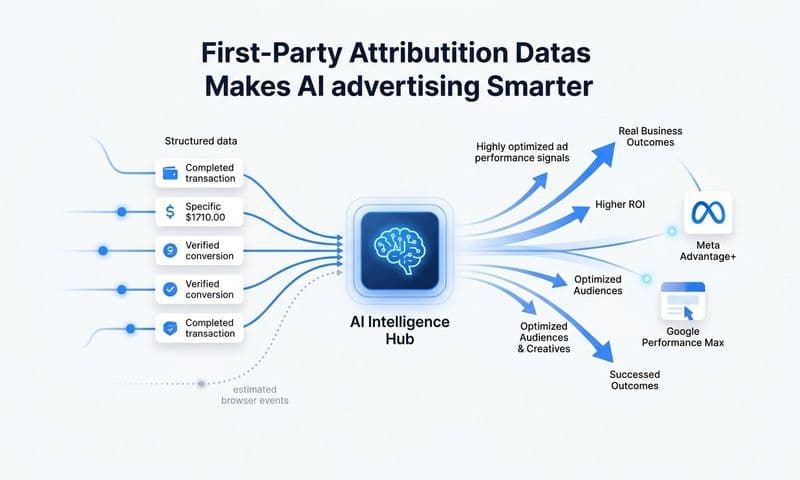
The most powerful application of attribution insights is improving ad platform algorithms through better conversion data. When you send unified conversion data back to Meta's Conversions API or Google's Enhanced Conversions, you're teaching their algorithms which users actually converted—not just which users triggered a pixel. This higher-quality signal helps the platforms optimize toward real results rather than proxy metrics.
Consider this scenario: your attribution data shows that customers who engage with your educational content before seeing product ads convert at 3x the rate of cold traffic. You can use this insight to create a two-stage campaign strategy—first, run awareness campaigns targeting broad audiences with educational content, then retarget engaged users with product offers. By feeding conversion data back to the platforms, their algorithms learn to find more people who match the "engaged with education first" pattern.
Common Attribution Pitfalls and How to Avoid Them
Branded search consistently gets over-credited in last-touch attribution models, creating a dangerous illusion. When someone searches for your company name and clicks your ad before converting, last-touch attribution gives that branded search campaign 100% credit. But that person already knew your brand—they were coming to you anyway. The real question is: which channel made them aware of you in the first place?
This leads to a common mistake: marketers see branded search showing incredible ROAS and increase budget there, while cutting spend from the awareness channels that actually drive branded search volume. The result? Branded search conversions drop because fewer people are learning about the brand through top-of-funnel campaigns. The high-performing branded campaign was never the driver—it was just the final click in journeys that other channels created. Learning how to fix attribution discrepancies in data helps you avoid these costly misinterpretations.
Attribution windows dramatically impact your data, yet many marketers ignore them entirely. A seven-day attribution window means conversions are only credited to touchpoints that occurred within seven days of the purchase. If your average sales cycle is 30 days, you're missing 75% of the journey. Your attribution data will systematically under-credit awareness channels and over-credit bottom-funnel tactics because that's all the window captures.
The solution is matching your attribution window to your actual sales cycle. B2B companies with 60-90 day sales cycles need 90-day attribution windows. E-commerce brands selling impulse purchases might use 7-14 day windows. Using the wrong window doesn't just skew your data slightly—it can completely reverse which channels appear to be working.
Switching attribution models without understanding the impact creates chaos in your reporting. If you've been using last-touch attribution for months and suddenly switch to linear attribution, every channel's reported performance will change dramatically. Awareness channels will show improved results, conversion-focused channels will show decreased results, and none of your historical comparisons will be valid. Before making changes, spend time comparing marketing attribution software features to understand what each approach reveals.
When you need to change attribution models, run both models in parallel for at least one full sales cycle. This lets you understand how the new model affects each channel's reported contribution before you make budget decisions based on it. Document the change clearly so everyone on your team understands why the numbers shifted.
Putting Your Attribution Strategy Into Action
Start with quick wins that improve your tracking accuracy today. Implement server-side tracking for your key conversion events—purchases, lead submissions, and demo requests. This immediately improves data quality by bypassing browser-based tracking limitations. Connect your CRM to your analytics platform so you can track which leads actually became customers, transforming conversion tracking into revenue tracking.
Set up UTM parameters consistently across all campaigns so you can identify which specific ads, campaigns, and channels drive each touchpoint. Create a naming convention document and make sure everyone on your team follows it. Inconsistent tracking is worse than no tracking because it creates false confidence in bad data. Reliable attribution tracking tools make this process significantly easier.
Build a culture of attribution-informed decision making by establishing regular review processes. Weekly meetings should examine which channel combinations are driving the highest-value customers. Monthly reviews should analyze how attribution insights have influenced budget decisions and what results those changes produced. Quarterly planning should incorporate attribution learnings into your overall strategy.
Train your team to ask the right questions when reviewing attribution data. Not "Which channel got the last click?" but "Which channels appear in the journeys of our best customers?" Not "Which platform reports the highest ROAS?" but "Which channel combinations drive the most actual revenue?" This shift in thinking transforms attribution from a reporting exercise into a strategic advantage.
Unified attribution platforms simplify this complexity by connecting all your data sources automatically, applying sophisticated attribution models, and presenting insights in dashboards you can actually use. Instead of manually pulling data from five platforms, running spreadsheet analyses, and trying to reconcile conflicting numbers, you get a single source of truth that shows exactly how your channels work together. If you're evaluating options, check out the best marketing attribution tools available today.
The goal isn't to achieve perfect attribution—that doesn't exist. Customer journeys are complex, some touchpoints happen offline, and privacy regulations limit what you can track. But you don't need perfection. You need a significantly more accurate picture than what individual platform dashboards provide. Even improving your attribution accuracy from 40% to 70% transforms your ability to make confident budget decisions.
Making Attribution Your Competitive Advantage
Accurate multiple ad platforms attribution isn't just a measurement improvement—it's a fundamental shift in how you understand and optimize your marketing. When you can see which channels truly drive revenue and how they work together, you stop wasting budget on tactics that look good in isolation but don't contribute to actual results.
The marketers who win in today's complex, multi-platform environment are those who move beyond platform-reported metrics to build unified attribution systems. They understand that the customer journey spans multiple touchpoints across different channels, and they make budget decisions based on complete data rather than fragmented platform views.
Your next step is implementing the tracking infrastructure that makes accurate attribution possible. Connect your ad platforms, implement server-side tracking, integrate your CRM, and establish the attribution model that matches your business reality. The insights you gain will transform how you allocate budget, optimize campaigns, and scale your marketing profitably.
Ready to elevate your marketing game with precision and confidence? Discover how Cometly's AI-driven recommendations can transform your ad strategy—Get your free demo today and start capturing every touchpoint to maximize your conversions.