Most marketing teams today run campaigns across five, six, sometimes eight or more channels simultaneously. Google Ads, Meta, TikTok, LinkedIn, email, organic search, retargeting networks — the list keeps growing. And yet, when it comes time to answer the most important question in marketing ("what actually drove that conversion?"), the answer is almost always murky.
Each ad platform tells its own story. Meta claims credit. Google claims credit. TikTok claims credit. Add them all up, and you're looking at conversion numbers that dwarf your actual sales. Sound familiar? This is the attribution crisis that modern marketing teams face every single day, and it's only gotten worse as privacy changes have degraded the reliability of platform-native reporting.
An omnichannel marketing attribution platform solves this by doing something none of those individual platforms can do on their own: it unifies every touchpoint from every channel into a single, coherent view of the customer journey. Instead of seeing fragments, you see the whole picture. Instead of guessing which channels work, you know. In this article, we'll break down exactly how these platforms work, what separates them from basic analytics tools, and how you can use them to make smarter, more confident budget decisions.
Beyond Single-Channel Tracking: The Omnichannel Difference
Let's start with a clear definition. An omnichannel marketing attribution platform is a system that collects, unifies, and analyzes data from every paid, organic, and offline marketing channel to assign credit for conversions across the full customer journey. It's not a reporting add-on. It's not a dashboard that pulls in some UTM data. It's a foundational data infrastructure that replaces the fragmented, siloed view of marketing performance with a single source of truth.
Compare that to how most teams currently track performance. They log into Meta Ads Manager to check Facebook and Instagram results. They open Google Ads to review search and display performance. They check TikTok Ads separately. Each platform reports its own conversions using its own attribution logic, and each one is incentivized to claim as much credit as possible. The result is that the sum of reported conversions across platforms routinely exceeds actual conversions, sometimes by a significant margin. This is called attribution overlap, and it's one of the most costly blind spots in digital marketing.
Single-channel or siloed tracking doesn't just inflate numbers. It actively distorts your understanding of what's working. If you're relying on last-click attribution inside Google Ads, you're giving all the credit to the final search ad that someone clicked before converting, completely ignoring the TikTok video that introduced them to your brand, the email that brought them back to your site, and the retargeting ad that closed the deal. That skewed picture leads to skewed budget decisions.
The shift toward omnichannel attribution has accelerated significantly in recent years, driven largely by privacy changes. Apple's App Tracking Transparency framework and the ongoing deprecation of third-party cookies have fundamentally undermined the accuracy of pixel-based, platform-native tracking. When browsers block cookies and users opt out of tracking, individual platforms lose visibility into the customer journey. Their reported numbers become less reliable, not more. An omnichannel attribution platform that uses server-side tracking and first-party data methods is far more resilient to these changes, which is why addressing attribution challenges in marketing analytics has become essential rather than optional.
The Core Components That Power Attribution Across Channels
Understanding what makes an omnichannel marketing attribution platform work requires looking under the hood at three core components: server-side tracking, multi-touch attribution models, and conversion sync.
Server-Side Tracking: Traditional pixel-based tracking relies on a snippet of JavaScript code running in the visitor's browser. When a browser blocks cookies, an ad blocker interferes, or a user opts out of tracking, that pixel fires incorrectly or not at all. Server-side tracking takes a fundamentally different approach. Instead of relying on the browser to send data, your server sends the data directly to the attribution platform and back to ad platforms. This method bypasses browser-level restrictions entirely, resulting in significantly more complete and accurate data capture. For marketers, this means fewer lost conversions, better signal quality, and a more accurate picture of what's actually happening across campaigns.
Multi-Touch Attribution Models: Not all attribution models are created equal, and the right model depends on your business goals and sales cycle. Here's how the most common models work:
1. First-touch attribution gives all credit to the first channel that introduced a prospect to your brand. This is useful for understanding what drives awareness and top-of-funnel growth.
2. Last-touch attribution gives all credit to the final touchpoint before conversion. It's simple, but it systematically undervalues the channels that built awareness and consideration earlier in the journey.
3. Linear attribution distributes credit equally across every touchpoint in the customer journey. It's more balanced but doesn't account for the fact that some touchpoints are more influential than others.
4. Time-decay attribution gives more credit to touchpoints that occurred closer to the conversion. This model reflects the idea that recent interactions are more influential in the final decision.
5. Data-driven attribution uses machine learning to analyze actual conversion patterns and assign credit based on the real contribution of each touchpoint. It's the most sophisticated and accurate model for teams with sufficient data volume.
Having access to multiple models matters because no single model tells the complete story. Comparing results across models reveals how different channels contribute at different stages of the funnel, which leads to smarter investment decisions. For a deeper dive, explore the types of marketing attribution models every marketer should understand.
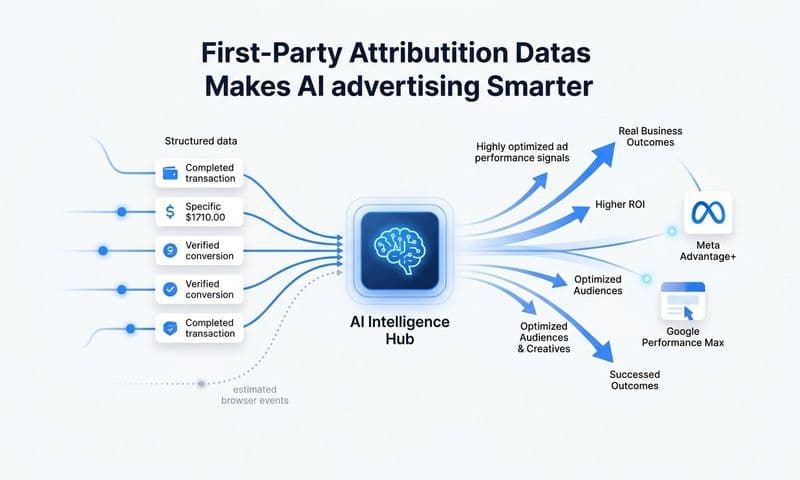
Conversion Sync and Ad Platform Feedback Loops: This is where omnichannel attribution creates compounding value. When your attribution platform captures enriched conversion data, it can send that data back to Meta, Google, TikTok, and other ad platforms through their conversion APIs. This feeds better signal to the platform's own machine learning algorithms, improving targeting, bidding, and audience optimization. The result is a virtuous cycle: better data in leads to better ad performance, which generates better data, and so on. Platforms that only consume data without feeding it back to ad networks are leaving significant optimization value on the table.
Mapping the Full Customer Journey in Real Time
To understand why omnichannel attribution matters in practice, it helps to walk through a realistic customer journey and see how a unified platform tracks it.
Imagine a prospect searching for project management software. They click a Google search ad and land on your site, browse a few pages, and leave without converting. A few days later, they see a TikTok video ad for your product while scrolling through their feed. They watch it but don't click. A week after that, they search your brand name organically, visit your blog, and sign up for a free trial through a retargeting display ad they see on another site. Finally, they convert to a paid plan after receiving a nurture email.
In a siloed tracking world, Google Ads claims the first click. TikTok gets no credit because there was no click. Organic search might get some credit. The display retargeting network claims the trial conversion. Email claims the paid conversion. Every platform tells a partial story, and no one sees the whole sequence. An omnichannel marketing attribution platform captures every one of those steps, stitches them together into a single journey, and applies your chosen attribution model to distribute credit accurately. This is exactly the kind of complexity that cross-channel marketing attribution software is designed to handle.
CRM integration is the piece that makes this picture complete, especially for B2B companies. Without connecting your attribution data to your CRM, you can track clicks and leads, but you can't see what happened after the lead was created. Did they close? How much revenue did they generate? What was the deal size? By integrating with platforms like HubSpot or Salesforce, an omnichannel attribution platform connects marketing touches to actual revenue outcomes. This allows marketing teams to prove their impact on pipeline and closed revenue, not just lead volume, which is the metric that actually matters to the business.
Real-time data makes all of this actionable rather than just informative. When attribution reporting is delayed by 24 to 48 hours, you're always making decisions based on yesterday's reality. Platforms offering real-time conversion analytics mean you can see a campaign underperforming this morning and pause it before burning through the rest of your daily budget. You can spot a channel outperforming expectations and shift spend toward it while the opportunity is still live. That kind of responsiveness is only possible when your attribution data updates continuously, not in daily or weekly batches.
How AI Elevates Omnichannel Attribution
Collecting and unifying cross-channel data is a major step forward. But the volume of data generated across multiple campaigns, channels, audiences, and time periods quickly exceeds what any human analyst can process manually. This is where AI becomes a genuine force multiplier.
AI-powered analysis can process massive volumes of cross-channel interaction data to surface patterns that would take a human analyst days or weeks to find. For example, an AI system might identify that prospects who first encounter your brand through a specific video ad format on TikTok and later click a branded search ad convert at significantly higher rates than those who follow other paths. That kind of insight is central to understanding cross-channel attribution and marketing ROI, and it's exactly the kind of signal that should be driving budget decisions.
AI-driven budget recommendations take this a step further. Rather than waiting for marketers to run their own analysis and draw conclusions, modern attribution platforms with AI capabilities can proactively surface recommendations: which campaigns to scale, which ad sets to pause, where budget is being wasted, and where there's untapped opportunity. This shifts the marketer's role from data analyst to decision-maker, which is a much better use of their time and expertise.
AI chat interfaces represent another dimension of this capability. Instead of building custom reports or digging through dashboards to answer a specific question, marketers can simply ask in plain language: "Which TikTok campaigns drove the most revenue last month?" or "What's my cost per acquisition on Google compared to Meta this quarter?" The platform interprets the question, queries the underlying data, and returns a clear answer. This removes a significant barrier between marketers and their data, making marketing attribution reporting accessible to the whole team rather than just the analysts who know how to build reports.
Choosing the Right Platform: What to Look For
Not all attribution platforms are built for omnichannel complexity. Choosing the right one requires evaluating several key criteria carefully before committing.
Channel Coverage: The platform needs to support every channel you're actively running. This includes major paid platforms like Google, Meta, TikTok, LinkedIn, and Pinterest, but also organic search, email, affiliate, and any other touchpoints in your customer journey. A platform that covers eight of your ten channels creates new blind spots rather than eliminating them. Reviewing a thorough marketing attribution software comparison can help you evaluate coverage across vendors.
Attribution Model Flexibility: You want the ability to run multiple attribution models simultaneously and compare them side by side. Locking you into a single model, especially last-click, is a red flag. Your business goals change over time, and your attribution perspective should be able to change with them.
CRM and Ecommerce Integrations: For B2B teams, CRM integration is non-negotiable. For ecommerce teams, deep integration with platforms like Shopify is equally critical. Without connecting to the systems where revenue is actually recorded, attribution stops at the click or lead stage and loses its ability to tie marketing spend to real business outcomes. Teams running on Shopify should explore dedicated Shopify marketing attribution software to ensure seamless data flow.
Data Accuracy Methodology: Ask specifically how the platform collects data. If the answer is primarily UTM parameters and client-side cookies, that's a significant limitation. UTM parameters break when users share links, switch devices, or navigate through redirects. Client-side cookies are increasingly blocked by browsers and privacy tools. Server-side tracking is the gold standard for accuracy and resilience.
Conversion Sync Capability: The ability to send enriched conversion data back to ad platforms is increasingly important for campaign performance. Platforms that only ingest data without closing the loop back to Meta, Google, and TikTok are missing a critical optimization layer.
Red flags to watch for include platforms that rely solely on UTM parameters, lack real-time reporting, require complex manual data exports, or cannot integrate with your existing tech stack without significant custom development.
Cometly is built to address all of these requirements directly. Its server-side tracking captures data accurately even in the face of browser restrictions and privacy changes. Its multi-touch marketing attribution engine lets you compare models and see how credit shifts across your customer journey. AI-powered insights surface recommendations without requiring manual analysis. And its conversion sync capabilities feed enriched data back to Meta, Google, TikTok, and other ad platforms, improving their targeting and optimization algorithms. For marketing teams that need a single platform to connect every channel and drive real performance improvements, Cometly provides that infrastructure.
Putting Omnichannel Attribution Into Action
Understanding the theory is one thing. Getting started is another. Here's a practical path forward.
Start with a tracking audit. Map out every channel you're currently running and identify how conversions are being tracked on each one. Look for gaps: channels that rely entirely on platform-native reporting, UTM parameters without server-side backup, or touchpoints that aren't being captured at all. These gaps are where your attribution data is leaking.
Next, connect your ad platforms, CRM, and website to a unified attribution system. This step is foundational. Without centralizing your data sources, you're still working with fragments. Once everything is connected, you'll have a complete data set to work with for the first time.
Then start comparing attribution models side by side. Look at how credit shifts between first-touch, last-touch, and linear models for the same set of conversions. Pay attention to which channels gain credit and which lose it depending on the model. Understanding attribution modeling for marketing will reveal which channels are genuinely driving awareness and which are capturing conversions that were already on their way. Use those insights to guide your next budget reallocation, shifting spend toward the channels that contribute most meaningfully across the full journey.
From there, let the data guide your optimization cadence. Real-time attribution means you can make meaningful adjustments weekly, or even daily, rather than waiting for end-of-month reports to tell you what happened.
The Bottom Line on Omnichannel Attribution
An omnichannel marketing attribution platform is no longer optional for teams running multi-channel campaigns. As privacy changes continue to erode the reliability of platform-native reporting, and as customer journeys grow more complex and nonlinear, the need for a unified, accurate view of marketing performance has never been greater.
The core value is straightforward: unified tracking across every channel, accurate data that reflects reality rather than platform self-reporting, smarter budget decisions grounded in the full customer journey, and AI-powered optimization that surfaces insights faster than any manual process could.
Teams that invest in this infrastructure gain a genuine competitive advantage. They know which channels are working together to drive revenue, not just which ones claim individual credit. They can reallocate budgets with confidence, scale what's working, and cut what isn't before it drains resources.
If you're ready to stop guessing and start knowing, Cometly brings all of these capabilities together in one platform. From server-side tracking and multi-touch attribution to AI-powered insights and conversion sync, it gives marketing teams the clarity they need to make every dollar count. Get your free demo today and start capturing every touchpoint to maximize your conversions.