You're spending thousands on paid ads, but your conversion numbers don't add up. Your CRM shows 50 sales this week, yet Meta reports 23 conversions and Google claims 18. Sound familiar?
Paid ads underreporting conversions is one of the most frustrating challenges facing digital marketers today. Between iOS privacy updates, cookie restrictions, ad blockers, and cross-device journeys, the gap between actual conversions and reported conversions keeps widening.
This disconnect isn't just annoying—it's costing you money. When your ad platforms can't see your real conversions, their algorithms optimize toward incomplete data, leading to poor targeting decisions and wasted ad spend.
The problem has gotten significantly worse since Apple introduced App Tracking Transparency in 2021. Many users decline tracking permissions, creating blind spots in your data. Add browser cookie restrictions, third-party cookie deprecation, and ad blockers to the mix, and you're left with a fragmented view of your customer journey.
Here's what makes this especially challenging: cross-device behavior breaks attribution when users research on mobile but convert on desktop. Long sales cycles exceed platform attribution windows that typically run 7-28 days. And privacy-conscious audiences actively block tracking technologies.
The result? Your ad platforms are making optimization decisions based on incomplete information, which means they're scaling the wrong campaigns and missing opportunities in channels that actually drive revenue.
In this guide, you'll learn exactly how to diagnose where your conversion data is leaking, implement fixes that capture more touchpoints, and set up systems that give you accurate attribution data you can actually trust for scaling decisions.
Step 1: Audit Your Current Tracking Setup to Find Data Leaks
Before you can fix your tracking problems, you need to understand exactly where your data is leaking. This starts with a comprehensive audit that compares what your ad platforms report versus what's actually happening in your business.
Pull conversion data from three sources: your ad platforms (Meta, Google, TikTok, etc.), your analytics tools (Google Analytics, analytics dashboards), and your source of truth—your CRM or backend system where actual transactions are recorded.
Create a simple spreadsheet with columns for each platform and rows for each conversion type. For the same date range, record how many conversions each system reports. The discrepancies will tell you where tracking is breaking down. A well-structured marketing campaign tracking spreadsheet can help you organize this data effectively.
Calculate your tracking gap percentage: Divide reported conversions by actual conversions, then subtract from 100%. If Meta reports 60 conversions but your CRM shows 100, that's a 40% tracking gap. This number becomes your baseline for measuring improvement.
The tracking gap typically varies by conversion type. You might find that purchase tracking is relatively accurate at 80%, while lead form submissions show only 50% accuracy, and phone call conversions barely register at 20%.
Next, check pixel firing rates in each platform's diagnostics tools. Meta's Events Manager shows pixel activity and highlights issues. Google Ads has a conversion tracking status column that indicates whether tags are firing correctly. Look for error messages, warnings about low event counts, or notifications about misconfigured tracking. If you're experiencing Facebook Ads tracking pixel issues, these diagnostics are your first troubleshooting step.
Pay special attention to attribution windows. Most platforms default to 7-day click and 1-day view attribution. If your sales cycle is longer than that, you're automatically underreporting conversions that happen outside those windows.
Document which user segments show the largest tracking gaps. iOS users typically have worse tracking than Android users due to App Tracking Transparency restrictions. Desktop conversions usually track better than mobile. Privacy-conscious audiences using VPNs or ad blockers create blind spots.
For B2B businesses or high-consideration purchases, track how many conversions happen beyond your platform's attribution window. If prospects typically research for 45 days before purchasing, but your attribution window is 28 days, you're missing significant conversions.
This audit gives you a clear picture of where tracking fails and which fixes will have the biggest impact. If you're losing 60% of iOS conversions but only 10% of desktop conversions, you know where to focus your efforts.
Step 2: Implement Server-Side Tracking to Bypass Browser Limitations
Browser-based pixels are fundamentally limited by user privacy settings, ad blockers, and browser restrictions. Server-side tracking solves this by sending conversion data directly from your server to ad platforms, bypassing the browser entirely.
Here's why browser-based tracking fails: Ad blockers prevent pixels from loading on 25-30% of web traffic. iOS App Tracking Transparency blocks tracking for users who decline permission. Cookie restrictions limit how long you can track returning visitors. Cross-domain tracking breaks when users move between your marketing site and checkout subdomain. Understanding why Facebook Ads stopped working after iOS 14 helps explain the urgency of server-side solutions.
Server-side tracking eliminates these issues because the data flow happens entirely on the backend. When a user converts, your server sends the conversion event directly to the ad platform's API. No browser involvement means no browser limitations.
Meta Conversions API (CAPI): This allows you to send conversion events from your server to Meta. You'll need to set up an endpoint that receives conversion data from your website or CRM, then formats it according to Meta's API specifications and sends it to their servers.
The setup requires capturing user identifiers (email, phone, external ID) at conversion points, hashing them for privacy, and including them in your API calls. Meta uses these identifiers to match server events with user profiles, even when browser tracking fails.
Google Ads Enhanced Conversions: Similar to CAPI, this sends first-party customer data (email, phone, address) from your server to Google. The data is hashed and matched to signed-in Google accounts, improving conversion accuracy by 5-15% on average. Learn how to properly configure enhanced conversions Google Ads to maximize your tracking accuracy.
Implementation varies by platform. Some businesses build custom integrations using platform APIs. Others use tag management systems with server-side capabilities. Marketing attribution platforms like Cometly can handle this automatically, sending server-side events to multiple ad platforms simultaneously.
After implementing server-side tracking, verify it's working correctly. Meta's Events Manager shows whether server events are being received and matched. Look for the "Server" indicator next to events. Check the Event Match Quality score—aim for "Good" or "Great" ratings, which indicate your data includes enough identifiers for accurate matching.
Google provides similar diagnostics in the conversion tracking interface. You'll see enhanced conversion data appear separately from standard conversions, allowing you to compare the two and measure improvement.
The combination of browser pixels and server-side tracking creates redundancy. When browser tracking fails, server-side tracking captures the conversion. Meta and Google use deduplication logic to avoid counting the same conversion twice, so you get more complete data without inflation.
Most businesses see a 20-40% increase in reported conversions after implementing server-side tracking. The improvement is largest for iOS users, privacy-conscious audiences, and mobile conversions where browser tracking faces the most limitations.
Step 3: Connect Your CRM and Backend Systems for Complete Journey Tracking
Your CRM holds the truth about which leads convert to customers and how much revenue they generate. Connecting it to your attribution system closes the loop between ad clicks and actual business outcomes.
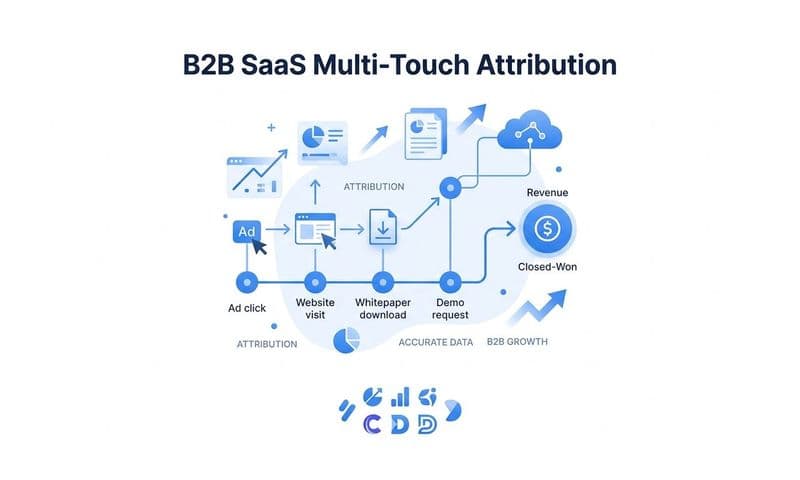
Start by mapping your complete customer journey. For e-commerce, this might be: ad click → website visit → add to cart → purchase → repeat purchase. For B2B, it's typically: ad click → content download → demo request → SQL → closed deal. Understanding where most marketing conversions drop off helps you identify which stages need the most attention.
Each stage needs to be tracked and connected back to the original ad source. This requires passing unique identifiers through your entire funnel so you can match a closed deal in Salesforce back to the Facebook ad they clicked three weeks ago.
Set up CRM integrations: Most attribution platforms offer native integrations with popular CRMs like HubSpot, Salesforce, Pipedrive, and Zoho. These integrations sync lead and customer data, allowing you to see which marketing touchpoints influenced each deal.
The integration typically works by matching email addresses, phone numbers, or custom user IDs between your attribution system and CRM. When a lead converts to a customer in your CRM, that revenue gets attributed back to the marketing channels that influenced them.
Configure offline conversion imports for sales that happen outside your website. If prospects call your sales team, attend in-person events, or convert through channels you can't track digitally, you need a system to manually import these conversions. For businesses that rely heavily on calls, learning to track phone call conversions from ads is essential.
Most ad platforms support offline conversion uploads via CSV files or API. You provide the conversion details (date, value, user identifier) and the platform matches it to the original ad interaction. This is crucial for B2B businesses where significant revenue happens via phone or in-person demos.
Establish consistent identifiers: Email addresses work best because they're unique, persistent, and captured at multiple touchpoints. Phone numbers are useful for mobile-heavy businesses. Customer IDs from your database provide the most reliable matching but require more technical setup.
Hash sensitive identifiers before sending them to third-party platforms. Most APIs require SHA-256 hashing of emails and phone numbers to protect user privacy while still enabling matching.
For businesses with long sales cycles, CRM integration is essential. A prospect might interact with five different campaigns over 60 days before requesting a demo. Without CRM data, your ad platforms only see the last touchpoint and miss the earlier interactions that built awareness and trust.
Once connected, you can analyze which campaigns generate the highest-quality leads, not just the most leads. A campaign might generate fewer form submissions but produce leads that close at 3x the rate of other sources. This insight is only possible when you connect ad data to CRM outcomes.
Step 4: Configure Multi-Touch Attribution to Credit the Right Channels
Last-click attribution gives 100% credit to the final touchpoint before conversion, completely ignoring the channels that built awareness and consideration. For any business with a multi-touch customer journey, this creates a distorted view of channel performance.
Multi-touch attribution distributes credit across all touchpoints in the customer journey, giving you a more accurate picture of how channels work together to drive conversions. Understanding the differences between Facebook Ads attribution vs Google Ads attribution helps you interpret cross-platform data correctly.
Linear attribution: Splits credit equally across all touchpoints. If a customer clicked three ads before converting, each gets 33.3% credit. This model works well when you believe all touchpoints contribute equally to the decision.
Time-decay attribution: Gives more credit to touchpoints closer to conversion. The first interaction might get 10% credit while the last gets 40%. This reflects the reality that recent interactions often have more influence on purchase decisions.
Position-based (U-shaped) attribution: Assigns 40% credit to the first touchpoint, 40% to the last, and splits the remaining 20% among middle interactions. This model recognizes that awareness (first touch) and conversion (last touch) are both critical.
Choose a model based on your sales cycle and customer behavior. B2B businesses with long research phases often prefer time-decay or position-based models. E-commerce with shorter cycles might find linear attribution sufficient. Review attribution window best practices for paid ads to select the right lookback period for your business.
Set lookback windows that match your typical time-to-conversion. If customers usually convert within 30 days, use a 30-day window. For longer B2B cycles, extend to 60 or 90 days. The window should capture the full customer journey without being so long that you attribute conversions to irrelevant old touchpoints.
Most attribution platforms let you compare different models side-by-side. Run the same data through linear, time-decay, and position-based models to see how credit shifts between channels. This comparison often reveals surprising insights about which channels are undervalued in last-click reporting.
For example, you might discover that Facebook drives significant first-touch awareness that leads to conversions credited to Google Search in last-click reporting. With multi-touch attribution, you see Facebook's true contribution and can justify increasing its budget.
Test different models over several weeks to understand how each channel contributes throughout the funnel. Some channels excel at awareness (first touch), others at consideration (middle touches), and some at conversion (last touch). Understanding these roles helps you build a balanced marketing mix.
Multi-touch attribution becomes increasingly valuable as your marketing becomes more sophisticated. If you're running campaigns across Meta, Google, TikTok, LinkedIn, email, and content marketing, you need to understand how these channels interact and influence each other.
Step 5: Feed Enriched Conversion Data Back to Ad Platforms
Accurate conversion tracking isn't just about knowing what's working—it's about giving ad platform algorithms the data they need to optimize effectively. When you feed enriched conversion data back to Meta, Google, and other platforms, their AI can make better targeting and bidding decisions.
This process, often called conversion sync, sends your complete, accurate conversion data from your attribution system back to the ad platforms. Instead of relying on their limited browser-based tracking, you're providing them with the full picture. Implementing conversion sync for Facebook Ads can dramatically improve your campaign optimization.
Include conversion values and customer lifetime value: Don't just tell platforms that a conversion happened—tell them how much it was worth. Send actual purchase amounts for e-commerce. For lead generation, assign values based on historical close rates and deal sizes.
Even better, include customer lifetime value (CLV) predictions. If you know that customers acquired from Facebook ads typically spend $500 over their lifetime while Google customers spend $800, feed that data back to the platforms. This allows their algorithms to optimize for long-term value, not just initial conversion.
The quality of data you send matters tremendously. Ad platforms score your data quality based on how many user identifiers you include (email, phone, address) and how well they can match events to user profiles.
In Meta's Events Manager, check your Event Match Quality score. Aim for "Good" or "Great" ratings by including multiple identifiers with each conversion event. Poor match quality means the platform can't use your data effectively for optimization.
Google provides similar feedback through enhanced conversion diagnostics. You'll see what percentage of conversions include enhanced data and how well that data matches to Google accounts.
Monitor performance improvements: Track how your cost per acquisition and ROAS change after implementing conversion sync. Most businesses see improvements within 2-4 weeks as platform algorithms adapt to the better data.
The improvement happens because algorithms can now see which audiences, placements, and creative variations drive real conversions, not just the ones that browser tracking captured. They stop wasting spend on segments that appeared to convert but actually didn't, and increase spend on segments that were undervalued due to tracking gaps.
For iOS campaigns specifically, feeding back server-side conversion data can dramatically improve performance. The platform's algorithm was previously optimizing based on incomplete iOS data. With complete data, it can properly evaluate iOS performance and scale what works.
Conversion sync also enables more sophisticated optimization strategies. You can create lookalike audiences based on your highest-value customers, not just the ones the platform could track. You can optimize for specific conversion events that happen deep in your funnel, even if browser tracking can't see them.
Tools like Cometly automate this entire process, continuously syncing accurate conversion data back to all your ad platforms. This ensures algorithms always have fresh, complete data for optimization decisions.
Step 6: Build a Monitoring Dashboard to Catch Future Discrepancies
Tracking infrastructure requires ongoing maintenance. Platforms update their APIs, privacy regulations change, and your own website or tech stack evolves. Without continuous monitoring, tracking accuracy degrades over time.
Create a weekly tracking health report that compares platform-reported conversions against your source of truth. Use the same spreadsheet format from your initial audit, but update it weekly to spot trends and sudden changes. Robust analytics for paid campaigns makes this monitoring process much more efficient.
A healthy tracking system should show consistent tracking gap percentages week over week. If your gap is normally 15% but suddenly jumps to 40%, something broke. Maybe a pixel stopped firing, an integration disconnected, or a platform API changed.
Set up automated alerts: Most attribution platforms can notify you when conversion tracking rates drop below a threshold. Configure alerts for 20% week-over-week drops in tracked conversions, sudden changes in match quality scores, or integration errors.
These alerts catch problems early, before they significantly impact your data quality or campaign performance. A disconnected integration might go unnoticed for weeks without alerts, causing you to make decisions based on incomplete data.
Document your tracking architecture in a simple diagram or document. Include: which pixels are installed where, what server-side integrations are active, how data flows from your website to your CRM to your ad platforms, and who's responsible for maintaining each piece.
This documentation becomes invaluable when troubleshooting issues or onboarding new team members. Without it, you're reverse-engineering your setup every time something breaks.
Schedule quarterly tracking audits to proactively identify issues before they become problems. Repeat the comprehensive audit from Step 1, checking pixel firing rates, event quality scores, integration health, and tracking gap percentages across all platforms and conversion types. If you notice Google Ads showing wrong conversions, these audits help you identify the root cause quickly.
Platform updates are a common source of tracking issues. When Meta or Google releases new API versions, deprecates old endpoints, or changes event specifications, your tracking can break. Quarterly audits catch these issues while they're still manageable.
Privacy regulations continue to evolve. As new laws take effect or existing laws expand, your tracking setup may need adjustments to remain compliant while maintaining accuracy. Regular audits ensure you're adapting to these changes.
Your own business changes also impact tracking. Launching new products, adding new conversion types, changing your checkout flow, or switching CRM systems all require tracking updates. Schedule audits around major business changes to ensure tracking stays accurate.
Your Path to Accurate Attribution
Paid ads underreporting conversions isn't a problem you solve once and forget. It's an ongoing challenge that requires the right systems, regular monitoring, and continuous optimization.
Here's your action checklist: Audit your current tracking setup to identify where data is leaking. Implement server-side tracking to bypass browser limitations that cause most tracking failures. Connect your CRM and backend systems so you can track the complete customer journey from ad click to closed revenue. Configure multi-touch attribution models that credit all the touchpoints that influence conversions, not just the last click. Feed enriched conversion data back to ad platforms so their algorithms can optimize based on complete, accurate information. Build monitoring dashboards and schedule regular audits to catch future discrepancies before they impact your decisions.
Each step builds on the previous one. Server-side tracking captures more conversions. CRM integration connects those conversions to revenue. Multi-touch attribution distributes credit accurately. Conversion sync improves platform optimization. Monitoring ensures everything keeps working.
The result? You finally have conversion data you can trust. You know which campaigns actually drive revenue, not just which ones get last-click credit. You can confidently scale what works and cut what doesn't. Your ad platform algorithms optimize toward real conversions, improving your cost per acquisition and return on ad spend.
Most importantly, you stop making decisions based on incomplete data. When your tracking captures 85-95% of conversions instead of 50-60%, you're operating with clarity instead of guessing.
Tools like Cometly streamline this entire process by connecting your ad platforms, CRM, and website to track the complete customer journey. From ad clicks to CRM events, Cometly captures every touchpoint and provides AI-driven recommendations to identify high-performing ads across every channel. The platform automatically syncs enriched conversion data back to Meta, Google, and other ad platforms, improving targeting and optimization while giving you the accurate attribution data you need to make confident scaling decisions.
Ready to elevate your marketing game with precision and confidence? Discover how Cometly's AI-driven recommendations can transform your ad strategy—Get your free demo today and start capturing every touchpoint to maximize your conversions.