

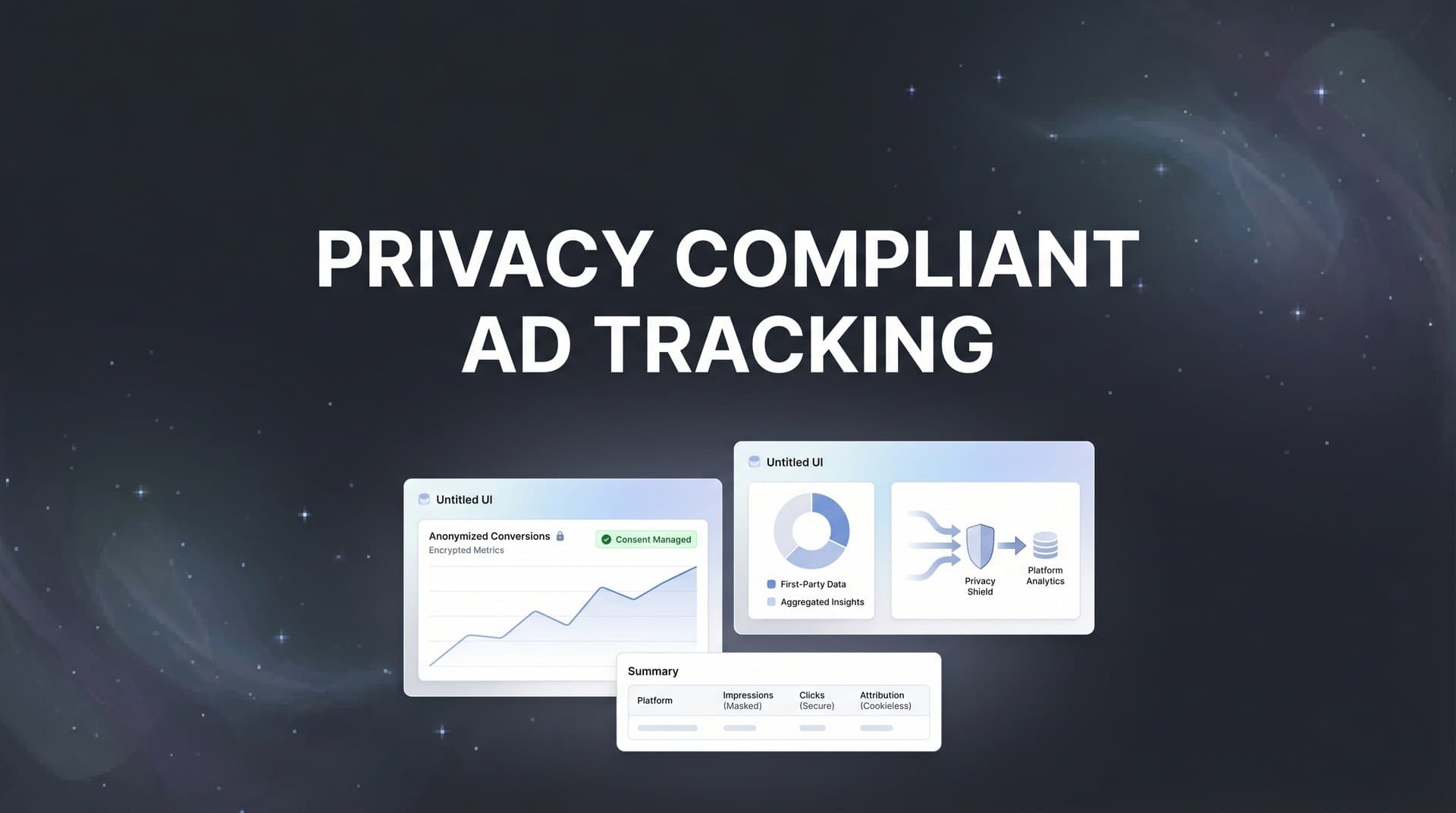
You're running ads across Meta, Google, TikTok, and half a dozen other platforms. Your dashboard shows clicks and impressions, but when it comes to connecting those ads to actual revenue, the picture gets blurry fast. iOS updates block your pixels. Browsers reject your cookies. And somewhere in the legal department, there's a stack of privacy regulations with your name on it.
This is the reality for modern marketers in 2026. The tools that powered digital advertising for the past decade are breaking down. Apple's App Tracking Transparency framework cut off visibility into millions of users. Google keeps pushing back its cookie deprecation timeline, but the writing is on the wall. Meanwhile, GDPR fines are getting steeper, and new privacy laws are popping up faster than you can update your consent banners.
Here's the thing: privacy compliance doesn't have to mean flying blind. The marketers who are winning right now aren't the ones clinging to old tracking methods or hoping regulations will go away. They're the ones who've realized that building a privacy-first measurement approach actually delivers more accurate attribution than the cookie-dependent systems we used to rely on. When you control your data collection from server to ad platform, you're not just checking compliance boxes. You're building a foundation that works regardless of what Apple, Google, or regulators do next.
The Privacy Landscape Reshaping Digital Advertising
Let's start with what changed and why it matters for your tracking setup. The shift didn't happen overnight, but the cumulative effect has fundamentally altered how digital advertising measurement works.
GDPR launched in 2018 and set the template: you need explicit consent before collecting personal data, users have the right to access and delete their information, and violations come with fines up to 4% of global revenue. California followed with CCPA in 2020, then strengthened it with CPRA. Now we're seeing similar laws in Virginia, Colorado, Connecticut, and more states rolling out their own versions. Each one has slightly different requirements, but they all share a common thread: marketers must obtain clear consent and give users control over their data.
The technical shifts hit even harder. When Apple released iOS 14.5 in 2021 with App Tracking Transparency, it required apps to ask permission before tracking users across other apps and websites. Most users said no. Suddenly, the Facebook Pixel and other tracking tools lost visibility into a massive portion of mobile traffic. Attribution windows shortened. Conversion data became incomplete. Marketers who'd built their entire measurement strategy around pixel tracking watched their data quality collapse.
Google's Privacy Sandbox initiative aims to replace third-party cookies with privacy-preserving alternatives, though the timeline keeps shifting. Originally planned for 2024, then 2025, the full deprecation is still in flux. But even without a firm deadline, the direction is clear: browser-based tracking through third-party cookies is ending.
Traditional pixel-based tracking relied on a simple premise: drop a cookie in someone's browser when they click your ad, then fire a pixel when they convert. Match the two, and you've got attribution. This worked when browsers and operating systems allowed unrestricted cookie access. Now? Safari blocks third-party cookies by default. Firefox does the same. Chrome is moving that direction. iOS limits tracking unless users opt in, and most don't.
The result is a measurement gap. Your pixel fires when someone converts, but it can't reliably connect that conversion back to the ad they clicked last week. Your attribution reports show "direct" or "unknown" traffic where there should be clear ad sources. You're making budget decisions based on incomplete data, which means you're either overspending on channels that don't work or cutting budget from channels that do.
This isn't about going back to the way things were. The privacy-first approach is here to stay, and it's accelerating. The question is whether you adapt your measurement strategy now or keep losing visibility quarter after quarter.
Core Principles of Privacy Compliant Tracking
Privacy compliance starts with understanding what you're allowed to collect and how you're allowed to use it. The regulations sound complex, but they boil down to a few core principles that should guide every tracking decision you make.
First-party data is the foundation. This is information users give you directly: email addresses from form fills, purchase data from your checkout, behavioral data from your own website or app. Unlike third-party data that comes from external sources or tracking users across the web, first-party data comes from your direct relationship with customers. It's more reliable, more accurate, and far less restricted by privacy regulations. When someone creates an account on your site or makes a purchase, they're actively choosing to share information with you. That consent is explicit and defensible.
Consent management is where many marketers stumble. It's not enough to have a cookie banner that users can click through without reading. GDPR and similar laws require informed, freely given consent before you collect personal data. That means clear language explaining what you're tracking and why. It means users can decline without losing access to your site. And it means storing their preferences and actually honoring them across your entire tracking infrastructure.
Think about your current consent flow. Does it explain that you're tracking ad interactions to attribute conversions? Can users opt out of marketing cookies while still using your site? Are you passing consent signals to your ad platforms so they know which users have agreed to tracking? If the answer to any of these is no, you've got a compliance gap.
Data minimization is the principle that you should only collect what you actually need and only keep it as long as necessary. This runs counter to the old "collect everything and figure out what to do with it later" approach. Under modern privacy laws, you need a legitimate business purpose for every data point you collect. If you're capturing IP addresses, device IDs, and browsing history but only using email and conversion value for attribution, you're collecting more than you need and creating unnecessary compliance risk.
The practical application: audit your tracking setup and identify what data points you're actually using versus what you're collecting out of habit. Shorten your data retention periods. Delete old conversion data that's no longer relevant for attribution. The less data you hold, the smaller your compliance surface area and the lower your risk if there's ever a breach or regulatory inquiry. For a deeper dive into compliant approaches, explore privacy compliant conversion tracking methods that align with current regulations.
Server-Side Tracking: The Foundation of Compliant Attribution
Server-side tracking represents a fundamental shift in how conversion data flows from your website to your ad platforms. Instead of relying on browser-based pixels that can be blocked, degraded, or restricted by privacy features, server-side tracking moves data collection to your own infrastructure where you control what gets sent and when.
Here's how traditional client-side tracking works: a user clicks your ad, lands on your site, and their browser loads a tracking pixel from Meta or Google. That pixel drops a cookie and sends data directly from the browser to the ad platform. The problem? Browsers are increasingly blocking this process. Safari's Intelligent Tracking Prevention limits cookie lifespans. Firefox blocks third-party trackers by default. iOS requires explicit permission. Even when pixels do fire, they often can't match conversions back to ad clicks because the cookie data is missing or expired.
Server-side tracking flips the model. When a user converts on your site, your server captures the conversion event and sends it directly to the ad platform's API. No browser pixels required. No reliance on third-party cookies. The data flows from your infrastructure to theirs through a secure server connection that browsers can't block. If you're experiencing issues with browser privacy features breaking tracking, server-side implementation is your solution.
This approach solves multiple problems at once. First, it's more reliable. Server-to-server connections don't get blocked by ad blockers or browser privacy features. You capture conversion data even from users who have tracking protection enabled. Second, it's more accurate. You control exactly what data gets sent, and you can enrich it with first-party information from your CRM or database that wouldn't be available to a browser pixel. Third, it's more compliant. You can implement consent checks on your server before sending data, ensuring you only track users who've agreed to it.
The role of first-party domains becomes critical here. When you use your own domain for tracking endpoints instead of third-party domains from ad platforms, browsers treat your cookies as first-party rather than third-party. This means they're not subject to the same blocking and deletion that affects third-party cookies. Your tracking cookie can persist longer, giving you a better chance of connecting conversions back to ad interactions days or weeks earlier.
Connecting conversion events to ad platforms without browser cookies requires a different matching approach. Instead of relying on cookie IDs, you send hashed user identifiers like email addresses or phone numbers. Meta's Conversions API and Google's Enhanced Conversions both use this method. When someone converts, your server sends the conversion event along with hashed customer information. The ad platform matches that information against their user database to attribute the conversion to the right ad interaction.
The match rates are often better than cookie-based tracking, especially for logged-in users. If someone clicks your Meta ad on their phone but converts on their laptop three days later, a cookie-based pixel likely wouldn't connect those events. But if they're logged in when they convert, your server can send their hashed email to Meta's API, and Meta can match it to the same user who clicked the ad on mobile.
Building a Privacy-First Measurement Stack
A compliant tracking infrastructure requires more than just switching on server-side tracking. You need multiple components working together to collect data, obtain consent, and deliver attribution insights without creating compliance gaps or data leaks.
Start with a consent management platform. This is the tool that presents cookie banners, captures user preferences, and ensures those preferences are enforced across your entire tracking stack. Your CMP needs to integrate with your analytics platform, your ad pixels, and your server-side tracking so that when a user opts out of marketing cookies, that preference is honored everywhere. Look for a CMP that supports IAB's Transparency and Consent Framework if you're operating in Europe, and make sure it can handle the different requirements of GDPR, CCPA, and other regulations you need to comply with.
Server-side infrastructure is your data pipeline. This could be a tag management system with server-side capabilities, a custom-built solution, or a platform that handles both client and server-side tracking. The key requirement is that it can capture conversion events from your website or app, enrich them with first-party data, check consent status, and route the data to your ad platforms and analytics tools. You need reliable uptime here because every dropped conversion event is lost attribution data you can't recover.
Your attribution solution ties it all together. This is the platform that receives conversion data from your server, matches it to ad interactions across channels, and shows you which campaigns are actually driving revenue. Modern attribution platforms can handle both cookie-based and cookieless tracking, apply different attribution models, and account for the data gaps created by privacy restrictions. They should integrate with your ad platforms to pull in click and impression data while sending back conversion events through server-side APIs. Learn more about attribution tracking best practices to maximize your measurement accuracy.
Integrating your CRM is where first-party data becomes powerful. When someone fills out a form or makes a purchase, your CRM captures their information. By connecting your CRM to your attribution platform, you can enrich conversion events with customer data before sending them to ad platforms. This means better match rates, more accurate attribution, and the ability to track customer lifetime value instead of just first conversions. The integration needs to respect consent preferences, so you're only syncing data for users who've agreed to tracking.
Ad platform connections work both ways. You're pulling in campaign data to analyze performance and pushing conversion data back through APIs to improve ad optimization. Meta's Conversions API, Google's Enhanced Conversions, TikTok's Events API—each platform has its own server-side solution. Your measurement stack should support all of them so you can maintain consistent tracking regardless of where you're running ads.
Balancing granular attribution with privacy-safe reporting means knowing when to aggregate data. You want user-level attribution for optimization and analysis, but you don't need to store personally identifiable information forever. Many platforms now offer aggregated reporting that shows campaign performance without exposing individual user journeys. This satisfies privacy requirements while still giving you the insights you need to make budget decisions.
Maintaining Accurate Attribution Without Compromising Privacy
Privacy constraints don't eliminate attribution. They change how you approach it. The marketers who maintain measurement accuracy in a privacy-first world are the ones who've adapted their attribution models and data strategies to work with first-party data instead of fighting against privacy restrictions.
Multi-touch attribution becomes more important, not less, when tracking data is incomplete. If you can only see part of the customer journey through browser-based tracking, you need a model that can account for multiple touchpoints and estimate the impact of interactions you can't directly observe. Linear, time-decay, and position-based models all have a place depending on your sales cycle and customer behavior. The key is choosing a model that acknowledges data limitations while still providing actionable insights about channel performance.
The shift from last-click to multi-touch matters more now because privacy restrictions often obscure the last click. If someone clicks your Facebook ad but converts later without a trackable cookie, last-click attribution would miss Facebook's contribution entirely. A multi-touch model that weights earlier interactions can still credit Facebook even when the final conversion appears as direct traffic. This isn't perfect, but it's far more accurate than assuming every "direct" conversion happened without any ad influence. For businesses struggling with inaccurate conversion tracking data, this shift in attribution approach is essential.
Conversion APIs and server-side events actually improve ad platform optimization compared to degraded cookie data. When you send conversion events directly from your server to Meta or Google, you're providing complete, accurate data that the platform can use to train its algorithms. This is better than the partial, delayed data that browser pixels deliver when they're being blocked or restricted. Advertisers who implement server-side tracking often report improved campaign performance because the ad platforms have better data to optimize against.
Enriched first-party data takes this further. When you send a conversion event through an API, you can include customer value, product categories, subscription tier, or any other information from your database. This helps ad platforms understand which conversions are most valuable and optimize toward similar users. A browser pixel can tell Meta that someone converted. Your server can tell Meta that someone converted with a $500 order for enterprise software, which is far more useful for optimization.
The match rates matter here. When you send hashed email addresses or phone numbers with your conversion events, ad platforms can match those to user profiles even when cookies are blocked. Companies using conversion APIs typically see match rates of 70-90% for logged-in users, compared to 40-60% for cookie-based pixels in privacy-restricted browsers. Higher match rates mean more complete attribution data and better ad optimization.
Think about your current attribution setup. How much of your conversion data is showing up as "direct" or "unknown" source? That's your measurement gap. Server-side tracking with enriched first-party data can close most of that gap by providing a direct connection between conversions and ad platforms that doesn't rely on browser cookies or pixels that can be blocked.
Putting It All Together: Your Privacy Compliant Tracking Roadmap
Moving to privacy compliant tracking isn't a single switch you flip. It's a series of upgrades to your measurement infrastructure, each one closing a compliance gap or improving data accuracy. Here's how to prioritize the work and build a roadmap that gets you to compliant, accurate attribution without overwhelming your team.
Start with an audit of your current setup. Map out every tracking pixel, cookie, and data collection point across your website and apps. Document what data each one collects, where it sends that data, and whether you have proper consent before collection. Check your cookie banner—does it actually prevent tracking if users decline, or does it just inform them that tracking is happening? Review your data retention policies. Are you holding conversion data longer than necessary? This audit will reveal your biggest compliance risks and data quality issues.
Prioritize fixes based on impact and effort. High-impact, low-effort changes go first: implementing a proper consent management platform, switching to first-party cookie domains, setting up basic server-side event forwarding for your highest-volume conversion events. These changes improve compliance and data quality without requiring a complete infrastructure rebuild. Medium-effort changes come next: full server-side tracking implementation, conversion API setup for your primary ad platforms, CRM integration to enrich conversion data. If you need guidance on first-party data tracking implementation, start with your highest-value conversion events first.
The typical roadmap looks like this: Month 1, get consent management in place and audit your data collection. Month 2, implement first-party domains and start transitioning high-value conversion events to server-side tracking. Month 3, connect conversion APIs for Meta and Google, integrate your CRM for data enrichment. Month 4, expand server-side tracking to all conversion events and secondary ad platforms. Month 5, optimize your attribution model and reporting to account for the improved data quality. Month 6, document everything and train your team on the new measurement approach.
Future-proofing means building flexibility into your infrastructure. Privacy regulations will keep evolving. Browser tracking restrictions will get stricter. Ad platforms will release new APIs and deprecate old ones. Your measurement stack needs to adapt without requiring a complete rebuild every time something changes. This means choosing platforms that support both current and emerging tracking methods, maintaining clean first-party data collection that isn't dependent on third-party cookies, and keeping your server-side infrastructure modular so you can swap components as requirements shift. Explore privacy compliant tracking solutions that offer this flexibility out of the box.
The marketers who thrive in this environment are the ones who stop viewing privacy compliance as a constraint and start seeing it as a forcing function for better data practices. When you're required to collect less data, you focus on collecting better data. When you can't rely on third-party cookies, you build stronger first-party relationships. When browser pixels get blocked, you implement server-side tracking that's more accurate anyway.
The Path Forward for Privacy-First Marketers
Privacy compliant ad tracking isn't about accepting lower quality data or giving up on accurate attribution. It's about building a measurement approach that works with the grain of privacy regulations and browser restrictions instead of fighting against them. The marketers who've made this transition aren't seeing worse results. They're seeing better data quality, higher match rates, and more reliable attribution than they ever got from cookie-dependent tracking that was already breaking down.
First-party data strategies deliver more accurate insights than third-party cookies ever did. When you control data collection from your own infrastructure and enrich it with customer information from your CRM, you get a complete picture of the customer journey that browser pixels could never provide. Server-side tracking gives you reliable conversion data even when browsers block pixels and users decline tracking permissions. Conversion APIs feed better data to ad platforms, which improves campaign optimization and ultimately drives better results from your ad spend.
The shift is already happening. The marketers who wait for clarity or hope that old tracking methods will keep working are falling behind the ones who've adapted their measurement infrastructure for the privacy-first reality. Every quarter that passes, browser restrictions get tighter and privacy regulations expand to new regions. The gap between marketers with modern attribution setups and those relying on degraded pixel data keeps widening.
You don't need to rebuild everything overnight, but you do need a plan. Start with the audit. Identify your biggest compliance gaps and data quality issues. Implement consent management and first-party domains. Move your high-value conversion events to server-side tracking. Connect your CRM to enrich the data you're sending to ad platforms. Each step improves both compliance and measurement accuracy.
The future of digital advertising measurement is first-party data, server-side infrastructure, and direct API connections to ad platforms. This isn't a temporary workaround until cookies come back. This is the foundation of how attribution will work for the next decade. The sooner you build it, the sooner you'll have reliable data to make confident budget decisions regardless of what privacy regulations or browser updates come next.
Ready to elevate your marketing game with precision and confidence? Discover how Cometly's AI-driven recommendations can transform your ad strategy. Get your free demo today and start capturing every touchpoint to maximize your conversions.



