

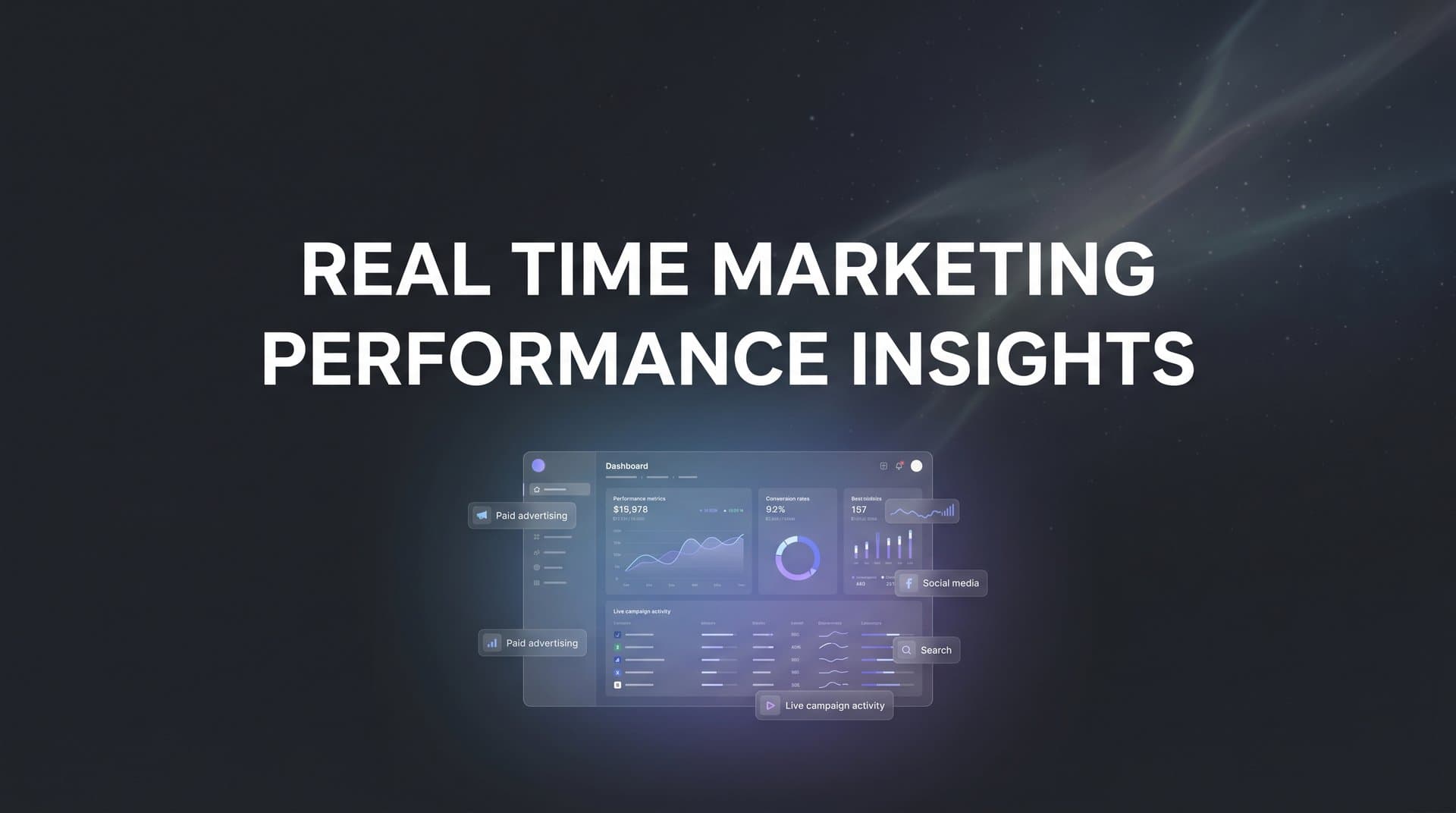
Modern marketing moves fast, and yesterday's data is often too late to act on. Campaigns can burn through budgets in hours, audience behaviors shift mid-week, and competitors launch new initiatives without warning. For digital marketers running paid campaigns across multiple platforms, the ability to see what's happening right now separates profitable campaigns from costly guesswork.
Real time marketing performance insights give you the power to spot winning ads before they plateau, catch underperforming campaigns before they drain your budget, and optimize your spend while opportunities are still live. This guide covers seven actionable strategies to build a real time insights system that actually drives better marketing decisions.
1. Unify Your Data Sources Into a Single Dashboard
The Challenge It Solves
Most marketing teams waste hours each week jumping between Meta Ads Manager, Google Ads, LinkedIn Campaign Manager, Google Analytics, and their CRM to piece together campaign performance. By the time you export CSVs, reconcile metrics, and build a spreadsheet, the data is already outdated. You cannot make confident optimization decisions when your view is fragmented across six different platforms, each with its own attribution logic and reporting delays.
The Strategy Explained
Data unification means connecting all your marketing data sources into a single platform that refreshes automatically. This includes paid ad platforms, website analytics, email marketing tools, and your CRM. The goal is not just to see everything in one place but to have that data update in real time so you can compare performance across channels instantly.
When your data lives in a unified dashboard, you can answer critical questions immediately: Which channel is driving the most qualified leads right now? How do Facebook conversions compare to Google conversions in terms of downstream revenue? Which campaigns are hitting your target cost per acquisition today versus yesterday? A real time marketing analytics dashboard makes these answers instantly accessible.
Implementation Steps
1. Audit every platform where marketing data currently lives, including ad platforms, analytics tools, CRM systems, and any email or SMS marketing software you use.
2. Choose a marketing attribution platform that integrates with all your key data sources and offers real time data syncing, not just daily batch updates.
3. Connect each data source using native integrations or API connections, ensuring that conversion events, ad spend, and customer data all flow into your unified dashboard automatically.
4. Build a primary dashboard view that displays your most critical metrics across all channels side by side, with the ability to drill down into individual platform performance when needed.
Pro Tips
Start by connecting your two highest-spend platforms first to prove the value quickly. Make sure your unified dashboard uses consistent conversion definitions across platforms so you are comparing apples to apples. Set your dashboard to auto-refresh every few minutes rather than requiring manual updates.
2. Track the Full Customer Journey, Not Just Last Click
The Challenge It Solves
Last-click attribution gives all the credit to whichever ad someone clicked right before converting, which makes your awareness and consideration campaigns look worthless. A customer might see your Facebook ad three times, click a Google search ad, read two blog posts, and then convert through an email link. Last-click attribution credits only that email, leaving you blind to the full journey that actually drove the conversion.
The Strategy Explained
Multi-touch attribution tracks every interaction a customer has with your brand before converting, then distributes credit across those touchpoints based on their influence. This gives you a complete picture of how different channels work together to drive results. You can see which ads start journeys, which ones nurture consideration, and which ones close deals.
With full customer journey tracking, you stop undervaluing top-of-funnel campaigns that introduce prospects to your brand. You also identify which channel combinations work best together, like how LinkedIn ads might generate awareness that later converts through Google search. Understanding performance marketing attribution is essential for accurate budget allocation.
We compare the leading options in our performance marketing software roundup.
Implementation Steps
1. Implement a tracking system that captures every customer interaction across all channels, including ad clicks, website visits, email opens, form submissions, and CRM activities.
2. Choose attribution models that make sense for your business, whether that is linear attribution that credits all touchpoints equally, time decay that gives more credit to recent interactions, or position-based that emphasizes first and last touches.
3. Compare multiple attribution models side by side to understand how different perspectives change your channel valuation and budget allocation decisions.
4. Review your attribution reports weekly to identify which channels play specific roles in your funnel, then adjust your creative and targeting strategies accordingly.
Pro Tips
Do not rely on a single attribution model as absolute truth. Compare at least three different models to see which channels consistently perform well regardless of methodology. Pay special attention to touchpoints that happen early in long sales cycles, as these often get undervalued but are critical for pipeline generation.
3. Set Up Automated Alerts for Performance Anomalies
The Challenge It Solves
Checking dashboards manually means you only catch problems when you happen to look, which could be hours or days after a campaign starts underperforming. A technical issue could break your conversion tracking, an ad could get disapproved, or costs could spike suddenly. Without automated monitoring, you discover these issues after they have already wasted significant budget.
The Strategy Explained
Automated alerts monitor your key metrics continuously and notify you immediately when something unusual happens. You set thresholds for metrics like cost per conversion, conversion rate, click-through rate, and daily spend. When performance crosses those thresholds in either direction, you get an instant notification via email, Slack, or SMS.
This strategy turns your analytics platform into an active monitoring system rather than a passive reporting tool. Implementing real time campaign performance monitoring helps you catch winning ads while they are still scaling effectively, and you stop losing campaigns before they drain your monthly budget.
Implementation Steps
1. Identify your five most critical metrics that indicate campaign health, such as cost per acquisition, conversion rate, return on ad spend, click-through rate, and daily conversion volume.
2. Set threshold ranges for each metric based on your historical performance, defining both upper and lower bounds that trigger alerts when crossed.
3. Configure notification channels that work for your team's workflow, whether that is email for daily summaries, Slack for immediate issues, or SMS for critical problems outside business hours.
4. Test your alerts by temporarily adjusting thresholds to ensure notifications are working and reaching the right team members with enough context to take action.
Pro Tips
Start with broader thresholds and tighten them over time to avoid alert fatigue from too many notifications. Include both positive and negative alerts so you can scale winning campaigns quickly, not just stop losing ones. Make sure your alerts include enough context to act immediately without needing to log into multiple platforms.
4. Implement Server-Side Tracking for Accurate Data
The Challenge It Solves
Browser-based tracking pixels face increasing limitations from iOS privacy features, browser cookie restrictions, and ad blockers. Many marketers see significant gaps between the conversions they know happened in their CRM and what their ad platforms report. This data loss makes optimization decisions unreliable and causes ad platform algorithms to work with incomplete information.
The Strategy Explained
Server-side tracking sends conversion data directly from your server to ad platforms, bypassing browser-level restrictions entirely. When someone converts on your website or in your CRM, your server sends that event data to Meta, Google, and other platforms without relying on browser cookies or client-side pixels.
This approach captures conversions that browser-based tracking misses, giving you more accurate attribution data and feeding better information to ad platform algorithms. Better data means better targeting, better optimization, and more reliable performance metrics. Addressing unreliable marketing performance data starts with proper server-side implementation.
Implementation Steps
1. Choose a marketing attribution platform that offers server-side tracking capabilities and integrates with your ad platforms and CRM system.
2. Set up server-side event forwarding for your most important conversion events, starting with purchases, leads, and sign-ups that directly impact revenue.
3. Configure your server-side tracking to send enriched event data that includes customer value, product details, and other contextual information beyond basic conversion signals.
4. Run parallel tracking with both browser-based and server-side methods initially to compare data quality, then gradually shift reliance to server-side as you verify accuracy.
Pro Tips
Server-side tracking works best when combined with first-party data from your CRM, as this lets you send conversion events with customer identifiers that ad platforms can match accurately. Make sure your server-side implementation includes proper event deduplication to avoid counting the same conversion twice when both browser and server tracking fire.
5. Feed Enriched Conversion Data Back to Ad Platforms
The Challenge It Solves
Ad platforms like Meta and Google optimize toward the conversion events you send them, but basic conversion tracking only tells them that someone converted. It does not tell them whether that conversion was a high-value customer who spent $500 or a low-value lead who never purchased. Without this context, ad algorithms optimize for conversion volume rather than conversion quality.
The Strategy Explained
Conversion enrichment means sending detailed event data back to ad platforms that includes customer value, product categories, lead quality scores, and other business context. When Meta knows which conversions generated $1,000 in revenue versus $50, its algorithm can optimize specifically for high-value customers rather than just any conversion.
This strategy creates a feedback loop where your ad platforms get smarter over time. Platforms offering real time conversion analytics help you learn which audience segments, creative approaches, and placements drive your most valuable customers, then automatically shift budget toward those winning combinations.
Implementation Steps
1. Identify which conversion attributes matter most for your business, such as customer lifetime value, product category, lead quality score, or purchase frequency.
2. Set up your tracking system to capture these attributes at the point of conversion and pass them through to your attribution platform in real time.
3. Configure conversion value syncing to send enriched event data back to your ad platforms, including revenue values, custom parameters, and customer segments.
4. Monitor how your ad platform optimization changes as it receives better data, watching for improvements in average order value, customer quality, and return on ad spend.
Pro Tips
Start by sending purchase value data for e-commerce conversions or lead score data for B2B campaigns. Use custom conversion events to segment high-value versus low-value conversions so you can create separate optimization goals. Give your ad platform algorithms at least two weeks to adapt after you start sending enriched data before judging performance changes.
6. Build Custom Metrics That Match Your Business Goals
The Challenge It Solves
Standard platform metrics like cost per click and click-through rate do not always align with what actually matters for your business. A campaign might have a terrible click-through rate but drive highly qualified leads that close at three times your average rate. Another campaign might have impressive engagement metrics but generate zero revenue. Optimizing toward platform metrics instead of business outcomes leads to misallocated budgets.
The Strategy Explained
Custom metrics are calculated measures that reflect your specific business goals, such as cost per qualified lead, revenue per visitor, customer acquisition cost including sales team time, or lifetime value to cost ratio. These metrics combine data from multiple sources to give you visibility into what actually drives business results.
When you build metrics around business outcomes, your optimization decisions align with revenue growth rather than vanity metrics. Learning how to evaluate marketing performance metrics helps you compare channels based on their true economic impact rather than surface-level engagement numbers.
Implementation Steps
1. Define the three to five metrics that best indicate marketing success for your business, considering factors like sales cycle length, customer lifetime value, and operational costs.
2. Map out which data sources you need to calculate each custom metric, such as combining ad spend data with CRM revenue data to calculate true customer acquisition cost.
3. Build these custom metrics in your attribution platform using calculated fields that automatically update as new data flows in from connected sources.
4. Create dashboard views that prioritize your custom business metrics over standard platform metrics, training your team to optimize toward these measures instead.
Pro Tips
Include time lag in your custom metrics for businesses with longer sales cycles, such as measuring cost per opportunity created this month that closed within 90 days. Build comparison metrics that show current performance against your targets, making it immediately clear whether campaigns are meeting goals. Update your custom metric definitions quarterly as your business model evolves.
7. Use AI-Powered Recommendations for Faster Optimization
The Challenge It Solves
Analyzing performance data across dozens of campaigns, hundreds of ad sets, and thousands of individual ads takes hours of manual work. By the time you identify optimization opportunities, market conditions may have already shifted. Human analysis also introduces bias and inconsistency, as different team members might interpret the same data differently or miss patterns that are not immediately obvious.
The Strategy Explained
AI-powered analytics tools continuously analyze your campaign data to surface optimization opportunities automatically. These systems identify patterns like which audiences are responding best to specific creative approaches, which campaigns are trending toward inefficiency before they cross your threshold, and which budget reallocation moves would improve overall performance. An AI powered marketing insights platform can transform how quickly you identify opportunities.
Rather than replacing human decision-making, AI recommendations accelerate it by doing the heavy analytical work and presenting actionable insights. You review recommendations, apply your strategic judgment, and execute optimizations in minutes rather than hours.
Implementation Steps
1. Choose a marketing attribution platform with built-in AI recommendation capabilities that analyze your specific campaign data rather than generic best practices.
2. Configure the AI system with your business context, including your goals, constraints, and strategic priorities so recommendations align with your actual objectives.
3. Start by reviewing AI recommendations daily without acting on them immediately, building confidence in the system's logic and accuracy over a few weeks.
4. Implement a testing process where you act on select AI recommendations while tracking results, gradually increasing adoption as you validate the system's impact.
Pro Tips
AI recommendations work best when fed complete, accurate data from all your marketing sources, which is why data unification and server-side tracking are foundational. Look for AI systems that explain their reasoning rather than just presenting conclusions, as this helps you learn and make better manual decisions over time. Track which types of AI recommendations drive the best results for your business, then prioritize similar suggestions in the future.
Putting It All Together
Building a real time marketing performance insights system is not a single project but an ongoing capability. Start with strategy one by unifying your data sources, as everything else depends on having complete, accurate data in one place. Next, prioritize server-side tracking to ensure your data foundation is solid despite browser-level tracking challenges.
From there, layer in multi-touch attribution, automated alerts, and AI recommendations based on your team's capacity. The marketers who win in paid advertising are not those with the biggest budgets but those who see performance shifts first and act on them fastest.
With these seven strategies in place, you will have the visibility needed to make confident, data-driven decisions in real time. You will catch opportunities while they are still profitable, stop problems before they waste budget, and continuously improve your marketing effectiveness through faster feedback loops.
Ready to elevate your marketing game with precision and confidence? Discover how Cometly's AI-driven recommendations can transform your ad strategy. Get your free demo today and start capturing every touchpoint to maximize your conversions.


