Your marketing dashboard shows a conversion. Meta Ads claims credit. Google Ads claims credit. Your email platform claims credit. Same conversion, three different stories—and you're left wondering which channel actually drove the sale.
This isn't just frustrating. It's costing you money every time you make budget decisions based on incomplete data.
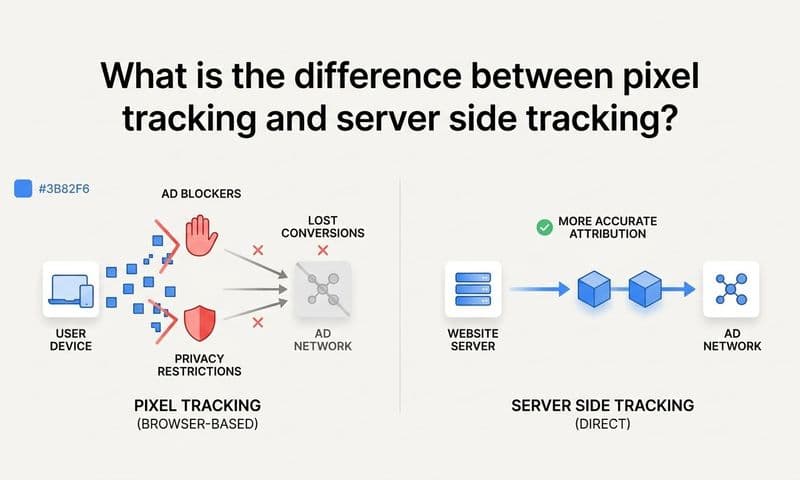
The problem runs deeper than attribution confusion. Browser-based tracking—the foundation most marketers still rely on—is breaking down. iOS updates block tracking pixels. Ad blockers eliminate scripts before they fire. Cookie restrictions erase user journeys. By some estimates, traditional tracking now misses 30-40% of conversions that actually happen.
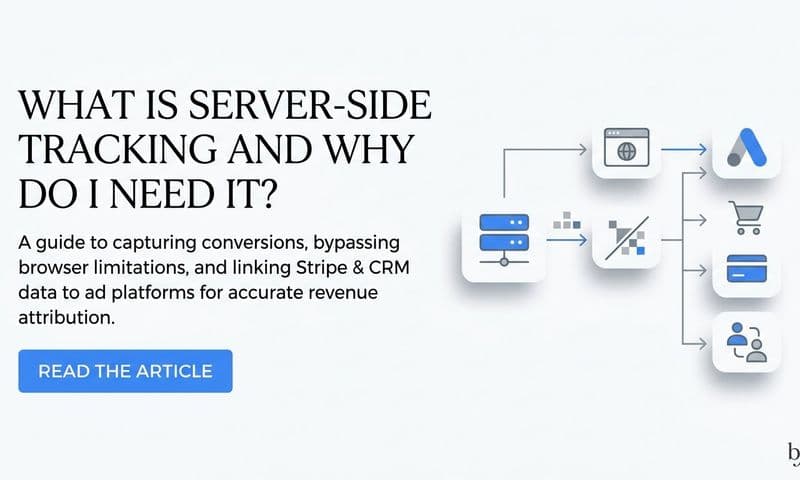
Server side tracking warehouse architecture offers a fundamentally different approach. Instead of relying on browsers to collect and report data, you capture events on your server, store them in a centralized warehouse, and control exactly how that data flows to every platform in your stack. Your data lives in your infrastructure. You decide what gets sent where, when, and how.
This guide breaks down how server side tracking warehouse systems work, why marketing teams are making the shift, and how to evaluate whether this approach fits your needs. We'll walk through the technical architecture in plain language, explore the practical benefits for campaign optimization, and examine what it takes to implement this approach successfully.
The Breakdown of Browser-Based Tracking
Traditional client-side tracking seemed simple: drop a JavaScript pixel on your website, and it reports user actions directly to your analytics and advertising platforms. For years, this worked reliably enough that most marketing stacks were built entirely around it.
Then the foundation started cracking.
Apple's iOS 14 update in 2021 introduced App Tracking Transparency, requiring apps to ask permission before tracking users across other apps and websites. Safari's Intelligent Tracking Prevention now limits cookie lifespans to seven days—or just 24 hours for cross-site tracking. Firefox Enhanced Tracking Protection blocks third-party cookies by default. Chrome announced plans to phase out third-party cookies entirely, though the timeline keeps shifting.
The impact on data collection is severe. When a user blocks tracking or their browser restricts cookies, client-side pixels simply fail to fire. The conversion happens, but your tracking never sees it. Your attribution reports show a mysterious gap between ad clicks and recorded conversions. Your platform algorithms optimize based on incomplete data, missing the full picture of what's actually working.
Ad blockers compound the problem. Browser extensions like uBlock Origin and Privacy Badger actively prevent tracking scripts from loading. Users who care about privacy—often your most valuable, tech-savvy customers—become invisible to your analytics. You're making decisions about audience targeting and creative performance while missing a significant segment of your actual audience.
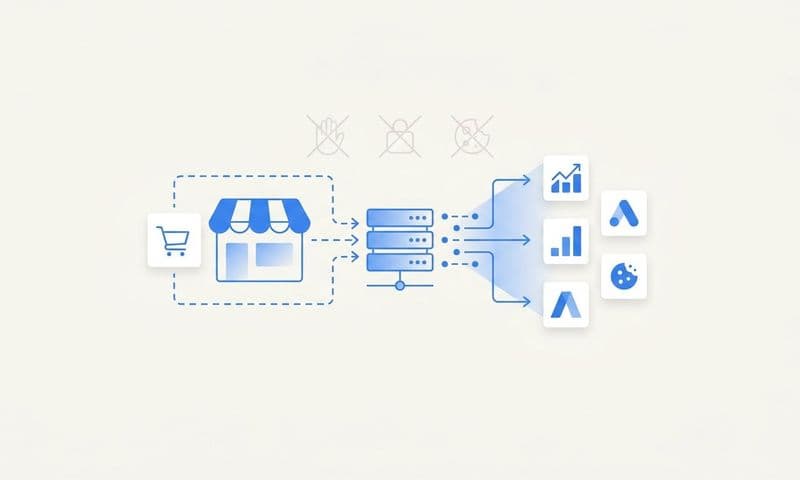
Server side tracking sidesteps these browser-level restrictions entirely. Instead of relying on JavaScript that runs in the user's browser (where it can be blocked or restricted), events are captured on your server—infrastructure you control. When a user completes a purchase, your server records the event directly, then sends that data to your chosen destinations. No browser involvement means no browser-based blocking.
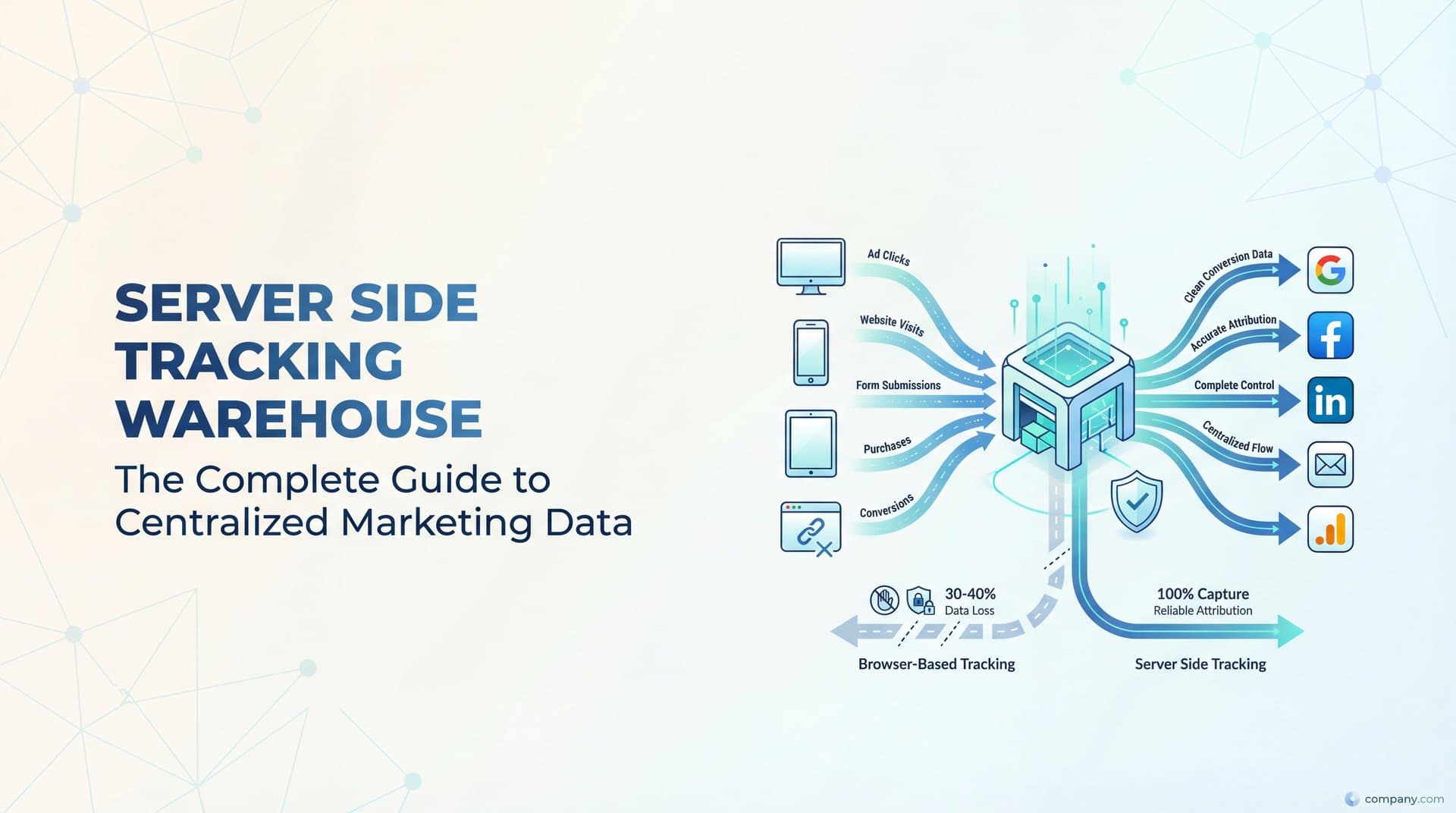
The warehouse component transforms this from a tracking improvement into a complete data infrastructure shift. Rather than sending events directly from your server to individual platforms (which still leaves data scattered), you route everything through a centralized data warehouse first. Every event—ad clicks, page views, form submissions, purchases, CRM updates—gets stored in one place, with one consistent format, under your complete control.
This becomes your single source of truth. Instead of trying to reconcile different conversion counts across platforms, you have one definitive record of what happened, when, and in what sequence.
Understanding the Data Architecture
A server side tracking warehouse system has four core layers that work together to capture, process, store, and activate your marketing data.
Event Collection Layer: This is where data enters your system. When a user takes an action—visits a page, clicks an ad, submits a form, completes a purchase—your server captures that event. Unlike browser-based tracking where each platform gets its own pixel, you're collecting once at the source. The server-side SDK or API endpoint records the event details: user identifier, timestamp, event type, and associated properties like product purchased or form fields submitted.
This collection happens server-to-server, meaning the user's browser restrictions don't interfere. Your server sees the event because it's processing the actual transaction or page request. The data capture is reliable and consistent.
Transformation and Enrichment: Raw events need processing before they become useful. This layer takes incoming data and transforms it into a standardized format, enriches it with additional context, and validates data quality. You might join a purchase event with customer lifetime value data from your CRM, append geographic information based on IP address, or calculate time-since-last-visit based on previous events.
This is where data becomes intelligent. Instead of just knowing someone made a purchase, you know they're a repeat customer, they came from a Facebook ad three days ago, they browsed four product pages before converting, and their total account value is now $847.
Data Warehouse Storage: The processed events land in your data warehouse—typically solutions like Google BigQuery, Amazon Redshift, Snowflake, or Databricks. This becomes your permanent, queryable record of all marketing activity. Every event is stored with full detail, maintaining the complete customer journey across all touchpoints.
The warehouse structure allows complex analysis that scattered platform data can't support. You can query across channels to understand true multi-touch attribution. You can segment audiences based on behavior patterns that span your website, CRM, and product usage. You can build custom reports that answer questions specific to your business model.
Reverse ETL and Activation: Data sitting in a warehouse doesn't improve campaigns. The final layer sends processed, enriched data back to your marketing platforms—what's called reverse ETL (Extract, Transform, Load). You're taking data from your warehouse and syncing it to destinations like Meta Ads, Google Ads, email platforms, and analytics tools.
This is where the architecture shows its power. You can send Meta Ads only high-intent conversion events, filtered and enriched with customer value data. You can sync audience segments to Google Ads based on complex behavior patterns. You can update your email platform with enriched customer profiles that include cross-channel activity. Each platform receives exactly the data it needs, in the format it expects, controlled entirely by you.
The Strategic Advantages of Centralized Data Control
Moving to a warehouse-centric tracking model fundamentally changes your relationship with marketing data. Instead of being a consumer of platform-provided reports, you become the owner of a complete data infrastructure.
True Data Ownership: When you rely on platform pixels, your data lives in those platforms. Meta owns your Meta data. Google owns your Google data. Each platform defines what gets tracked, how it's measured, and what you can access. If a platform changes its reporting methodology or restricts API access, you're stuck with whatever they provide.
With warehouse-centric tracking, your data lives in your infrastructure. You decide the event schema. You control data retention. You define how conversions are attributed. If you want to change analytics platforms or add new destinations, your historical data comes with you. The warehouse is portable—your data isn't locked into any single vendor's ecosystem.
This matters especially as platforms evolve their measurement approaches. When Meta shifted to modeled conversions and aggregated reporting, marketers with their own server-side data could compare platform reports against their source-of-truth warehouse data. You can validate what platforms tell you rather than accepting it on faith.
Capturing Data That Browser Tracking Misses: Server-side collection sees events that client-side tracking never captures. When iOS blocks a tracking pixel, the conversion still happens on your server—you process the payment, fulfill the order, update your database. Your server knows about it even if the browser pixel doesn't fire.
This dramatically improves data completeness. Marketing teams implementing server-side tracking often discover they've been missing 20-40% of actual conversions in their platform reports. Those missed conversions weren't just invisible in reports—they were invisible to platform algorithms, which means the AI was optimizing based on incomplete signal.
Better data completeness means better optimization. When ad platforms receive more complete conversion data, their algorithms can identify patterns more accurately. They understand which audiences actually convert, which creative elements drive action, and which placements deliver results. The feedback loop improves.
Future-Proofing Against Privacy Evolution: Privacy regulations and browser restrictions will continue tightening. Third-party cookies are disappearing. Device identifiers face increasing limitations. Browser-based tracking will only get harder.
Server-side tracking with first-party data collection positions you ahead of these changes. You're collecting data based on direct user interactions with your properties—your website, your app, your checkout process. This first-party data collection is more privacy-compliant and more durable than third-party tracking methods.
The warehouse architecture also makes it easier to implement privacy controls. You can build consent management directly into your data pipeline, filtering or anonymizing data based on user preferences. You can implement data retention policies that automatically delete user data after specified periods. You control the entire data lifecycle in ways that scattered platform pixels never allowed.
Feeding Better Data Back to Ad Platforms
The most immediate performance impact of warehouse-centric tracking comes from conversion sync—sending enriched, accurate conversion data back to your advertising platforms. This closes the loop between what actually happens in your business and what ad platforms use to optimize campaigns.
Ad platform algorithms are only as good as the data they receive. When Meta's AI optimizes for conversions, it's looking for patterns in the conversion events you send it. If those events are incomplete (because browser tracking missed them), delayed (because pixels fire slowly), or lack context (because you only send basic conversion data), the algorithm works with a degraded signal.
Server-side conversion sync solves all three problems simultaneously.
Completeness: Your warehouse captures every conversion that happens, regardless of browser restrictions. When you sync this complete data back to ad platforms, they see the full picture. A campaign that appeared to drive 100 conversions in platform reporting might actually have driven 150—and now the platform knows about all 150. The algorithm can identify what actually works instead of optimizing based on partial data.
Speed: Server-to-server event transmission is faster and more reliable than browser-based pixels. The conversion event reaches the ad platform within seconds of happening, giving algorithms real-time signal to optimize against. This matters especially for platforms like Meta that use 7-day click attribution windows—faster event delivery means more conversions fall within the optimization window.
Enrichment: This is where warehouse data shows its real power. You're not just sending "a conversion happened"—you're sending enriched events with business context. You can include customer lifetime value, so the algorithm optimizes for high-value customers, not just any conversion. You can include product category, so campaigns can optimize for specific product lines. You can include whether this was a new customer or repeat purchase, enabling different optimization strategies for acquisition versus retention.
The feedback loop this creates is substantial. When ad platforms receive better data, they make better decisions about who to show ads to, which creative to serve, and how much to bid. You're essentially upgrading the intelligence of the optimization algorithms by giving them higher-quality input.
This applies across platforms. Google Ads uses conversion data to optimize Smart Bidding strategies. TikTok's algorithm learns from conversion patterns to improve audience targeting. LinkedIn uses conversion data to refine its professional audience targeting. Every platform benefits from more complete, faster, enriched conversion data.
The practical result: campaigns often see improved efficiency within days of implementing server-side conversion sync. The algorithms had been working with degraded signal—now they're working with complete data, and performance improves accordingly.
Assessing Fit for Your Marketing Operation
Server side tracking warehouse architecture isn't universally necessary. For some marketing operations, traditional tracking still works adequately. For others, the shift is essential for accurate measurement and effective optimization.
Signs You've Outgrown Basic Tracking: If you're running campaigns across multiple platforms—Meta, Google, TikTok, LinkedIn, email, affiliates—and struggling to understand which channels actually drive revenue, you're dealing with an attribution problem that warehouse-centric tracking solves. When platform reports conflict and you can't determine true performance, centralized data collection gives you one source of truth.
Significant ad spend amplifies the value. If you're spending $50,000+ monthly on paid advertising, even small improvements in ad tracking accuracy and optimization efficiency create substantial return. Missing 30% of conversions in your tracking means the algorithms are optimizing with 30% less signal—fixing that gap improves performance.
Complex customer journeys also indicate need. If customers typically interact with multiple touchpoints before converting—seeing ads, visiting your site multiple times, reading content, joining your email list, then finally purchasing—browser-based tracking struggles to connect these dots. Warehouse-centric tracking maintains the complete journey in one place.
If you're experiencing specific tracking issues—iOS conversions not appearing in platform reports, significant discrepancies between platform data and actual sales, or difficulty measuring offline conversions—server-side tracking directly addresses these problems. Understanding fixing conversion tracking gaps becomes essential for accurate measurement.
Resource and Technical Considerations: Implementing server-side tracking with a data warehouse requires more technical infrastructure than dropping pixels on your website. You need server-side event collection, a data warehouse instance, transformation logic, and reverse ETL capabilities.
The build-it-yourself approach requires engineering resources: developers who can implement server-side SDKs, data engineers who can design warehouse schemas and transformation logic, and ongoing maintenance as your tracking needs evolve. This makes sense for large companies with dedicated data teams, but represents significant overhead for smaller operations.
Managed solutions have emerged that handle much of this complexity. Platforms provide the infrastructure—event collection, warehouse integration, transformation tools, and reverse ETL—as a service. You configure what data to collect and where to send it, but you're not building and maintaining the underlying infrastructure. Exploring server side tracking tools can help you evaluate your options.
The tradeoff is flexibility versus simplicity. Building your own infrastructure gives you complete control and customization. Using a managed platform means faster implementation and less maintenance, but you work within the platform's capabilities.
Questions to Guide Your Evaluation: Start by auditing your current tracking gaps. How much conversion data are you likely missing due to browser restrictions? Compare your platform-reported conversions against actual sales or leads in your CRM. The gap indicates how much signal your ad algorithms are missing.
Assess your attribution needs. Do you need to understand multi-touch journeys across channels, or is last-click attribution sufficient for your business? If you're trying to measure the contribution of content, email nurturing, and multiple ad touchpoints, warehouse-centric tracking enables analysis that platform silos can't support. A comprehensive attribution marketing tracking guide can help clarify your requirements.
Consider your team's technical capabilities and bandwidth. Do you have engineering resources to build and maintain server-side tracking infrastructure, or would a managed solution better fit your team structure? Neither approach is inherently better—the right choice depends on your specific resources and priorities.
Evaluate cost against expected value. Data warehouse storage costs money, as do managed tracking platforms. But if better data accuracy improves ad efficiency by even 10-15%, the return on that investment is often substantial. Calculate what improved attribution and optimization could mean for your marketing ROI.
Making the Shift to Centralized Marketing Data
Server side tracking warehouse represents more than a technical upgrade—it's a fundamental shift in how marketing teams relate to their data. Instead of accepting fragmented platform reports and working around tracking limitations, you're building owned infrastructure that captures complete, accurate data and activates it across your entire marketing stack.
The practical server side tracking benefits compound over time. Better data accuracy means more reliable reporting and clearer understanding of what's actually working. Complete conversion data improves ad platform algorithms, leading to better targeting and more efficient spend. Centralized storage enables sophisticated analysis that scattered platform data can't support. Future-proofed collection methods protect against ongoing privacy restrictions and browser limitations.
This approach isn't just for enterprise teams with massive budgets. As managed platforms make server-side tracking more accessible, marketing teams of all sizes can implement warehouse-centric data collection without building everything from scratch. The key is understanding your specific tracking gaps, attribution needs, and resource constraints—then choosing an implementation path that fits your situation.
Start by auditing your current tracking accuracy. Compare what your platforms report against what actually happens in your business. Identify where data gets lost, where attribution breaks down, and where you're making decisions based on incomplete information. Those gaps define the value of moving to centralized, server-side data collection.
Ready to elevate your marketing game with precision and confidence? Discover how Cometly's AI-driven recommendations can transform your ad strategy—Get your free demo today and start capturing every touchpoint to maximize your conversions.