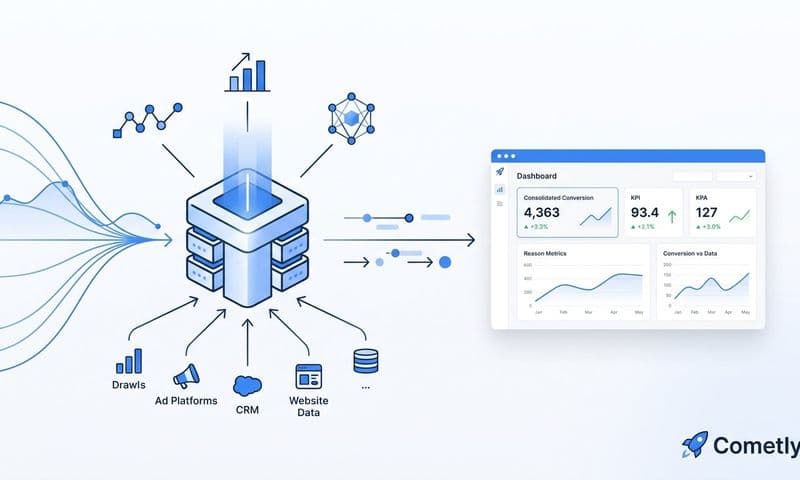
Getting accurate marketing data shouldn't feel like solving a puzzle. Yet many marketers struggle with fragmented analytics across platforms, making it nearly impossible to know which ads actually drive revenue. You're running campaigns on Meta, Google, maybe TikTok and LinkedIn—but each platform tells a different story about what's working. Your Google Analytics shows one conversion number, your ad platforms report another, and your CRM has its own version of reality.
Signing up for marketing analytics is your first step toward clarity—but choosing the right platform and setting it up correctly makes all the difference. This isn't just about installing another tracking tool. It's about building a unified view of your entire customer journey, from first ad click to final purchase, with the accuracy needed to make confident budget decisions.
This guide walks you through the entire process, from evaluating your tracking needs to connecting your first data sources. By the end, you'll have a fully functional marketing analytics setup that captures every touchpoint and shows you exactly where your conversions come from. Whether you're running campaigns across Meta, Google, TikTok, or multiple platforms simultaneously, these steps will help you build a foundation for data-driven decisions that actually move the needle on ROI.
Step 1: Assess Your Current Tracking Gaps and Goals
Before signing up for any platform, you need to understand exactly what's broken in your current setup. Start by auditing your existing analytics infrastructure. Open your Google Analytics, your ad platform dashboards, and your CRM side by side. Now ask yourself: Do these numbers tell the same story?
Most marketers discover significant discrepancies. Your Facebook Ads Manager might show 50 conversions while Google Analytics reports 35 and your CRM only logged 28 actual sales. These gaps aren't just annoying—they're costing you money because you're optimizing campaigns based on incomplete information. If you're noticing these patterns, you may be experiencing signs you need better marketing analytics in your current setup.
Document your specific tracking gaps. Common issues include: no visibility into which ads drive leads that eventually convert days or weeks later, inability to track users across devices, missing data from iOS users due to privacy restrictions, and zero connection between your ad spend and actual revenue in your CRM. Write these down because they'll guide your platform selection.
Next, define what success looks like for your business. Do you need multi-touch attribution to understand the full customer journey? Are you focused on real-time reporting so you can adjust budgets throughout the day? Do you need to feed better conversion data back to ad platforms to improve their algorithms? Different goals require different capabilities.
Create a comprehensive list of everything that needs to connect. Include all ad platforms where you spend money: Meta, Google Ads, TikTok, LinkedIn, Pinterest, or others. Add your CRM system—Salesforce, HubSpot, Pipedrive, whatever you use to track leads and customers. Don't forget your website analytics, email marketing platform, and any other tools in your marketing stack.
Finally, identify the specific pain points you're trying to solve. Maybe iOS tracking limitations have destroyed your Facebook campaign visibility. Perhaps delayed reporting means you're making budget decisions based on yesterday's data. Or you simply can't track the full customer journey from first ad impression through multiple touchpoints to final purchase. Understanding common attribution challenges in marketing analytics helps you articulate exactly what you need from a new platform.
These pain points become your non-negotiables. Any platform you consider must solve them, or you'll end up with another tool that doesn't actually fix your problems. This assessment typically takes 30-60 minutes, but it's the most important step because it prevents you from signing up for a platform that looks impressive but doesn't address your actual needs.
Step 2: Choose the Right Marketing Analytics Platform
Now that you know what you need, it's time to evaluate platforms. Not all marketing analytics tools are created equal, and the wrong choice means starting over in six months when you realize it can't handle your requirements.
Start with server-side tracking capabilities. This is non-negotiable in 2026. Browser-based tracking alone misses significant portions of your conversion data due to cookie restrictions, ad blockers, and privacy updates. Server-side tracking captures events directly from your server, bypassing these limitations and giving you far more accurate data.
Multi-touch attribution should be your next priority. If a platform only offers last-click attribution, it's telling you an incomplete story. Customers rarely convert from a single ad impression—they see multiple ads across different platforms before making a decision. A comprehensive multi-touch marketing attribution platform can show you the entire journey and credit each touchpoint appropriately.
Evaluate ad platform integrations carefully. The platform should connect seamlessly with every network where you advertise. But here's the critical part: it's not just about pulling data from ad platforms. You need conversion sync capabilities—the ability to send enriched conversion data back to Meta, Google, and other platforms to improve their optimization algorithms.
CRM connectivity separates good platforms from great ones. Your marketing analytics should connect directly to your CRM so you can track leads all the way through your sales pipeline. This connection reveals which ads generate leads that actually close, not just which ads generate form submissions. Platforms that offer revenue tracking capabilities provide this crucial visibility into actual business impact.
Ask these specific questions during your evaluation: Does the platform handle cross-platform attribution, or does it treat each channel in isolation? Can it track users across devices and sessions? Does it provide real-time data, or will you be making decisions based on yesterday's numbers? How does it handle data from iOS users given Apple's privacy restrictions?
Consider scalability before you commit. Your ad spend might be $10,000 per month now, but what happens when it's $100,000? Will the platform handle that data volume without performance issues? Can it accommodate additional ad platforms, team members, and complexity as you grow?
AI capabilities have become increasingly important for marketing analytics. Look for platforms that offer automated insights—systems that proactively identify which campaigns are underperforming, which audiences show the strongest conversion rates, and where you should reallocate budget. Manual analysis works when you're running a few campaigns, but AI recommendations become essential as complexity increases.
Don't just read feature lists—test the actual interface. Most platforms offer demos or trials. Spend time clicking through the dashboard, running sample reports, and evaluating whether the interface makes sense for how your brain works. The most powerful platform is useless if you can't figure out how to extract the insights you need. A thorough marketing analytics platform comparison can help you evaluate options side by side.
Compare pricing structures carefully. Some platforms charge based on ad spend, others on conversion volume, and some use flat monthly fees. Calculate what you'll actually pay at your current scale and at 2-3x growth. A platform that seems affordable now might become prohibitively expensive as you scale.
Step 3: Create Your Account and Configure Initial Settings
Once you've selected your platform, it's time to sign up and configure the foundation. Have your business information ready before you start: company name, website URL, business email address, and any relevant tax or billing information. Using a generic email like "info@company.com" is fine, but a dedicated email for the primary account owner is better for security and communication purposes.
Most platforms will ask for your website URL during signup. Enter your primary domain exactly as it appears in your browser—include "https://" and use the version you actually want to track. If you use "www.yoursite.com" in your marketing materials, use that version, not the non-www alternative. This consistency matters for accurate tracking.
You'll need ad account IDs or access credentials for the platforms you want to connect. Don't worry if you don't have these immediately—you can add them after account creation. But having them ready speeds up the process. For Meta, you'll need your Facebook Business Manager ID. For Google Ads, you'll need your customer ID. Most platforms provide clear instructions on where to find these identifiers.
Timezone configuration is more important than it seems. Choose the timezone where you actually make business decisions, not necessarily where your server is located. If you're reviewing reports and adjusting campaigns at 9 AM Eastern, set your timezone to Eastern. This ensures your "daily" reports align with your actual business day, making data interpretation far more intuitive.
Currency settings should match how you track revenue internally. If your CRM and accounting systems use USD, configure your analytics platform for USD. Mixing currencies creates confusion when you're trying to calculate ROI or compare ad spend to revenue. If you operate in multiple markets, choose your primary currency and note that conversion rates may apply for international campaigns.
Attribution window preferences require careful consideration. An attribution window determines how long after an ad interaction you'll credit that ad for a conversion. A 7-day click window means if someone clicks your ad and converts within 7 days, you credit that ad. A 1-day view window means if someone sees your ad (but doesn't click) and converts within 1 day, you still give partial credit.
Industry standards typically use a 7-day click and 1-day view window, but your business might require different settings. If you sell high-consideration products with longer sales cycles, a 28-day or even 60-day click window might be more appropriate. If you run flash sales or time-sensitive promotions, shorter windows make more sense.
Configure user permissions if you're working with a team or agency. Most platforms offer role-based access: administrators who can change settings and billing, managers who can view all data and create reports, and viewers who can only see specific campaigns or data sets. Choosing the right analytics tools for marketing teams means ensuring everyone has appropriate access levels from day one.
Before moving to the next step, verify your account is fully activated. Check for any verification emails that need confirmation. Ensure your payment method is accepted if you're starting a paid plan. Confirm that you can access the main dashboard and that all basic navigation works as expected. This verification prevents frustrating interruptions when you're trying to connect data sources.
Step 4: Connect Your Ad Platforms and Data Sources
With your account configured, it's time to connect the data sources that will power your analytics. Start with your primary ad platforms—the channels where you spend the most money and need the clearest visibility. For most marketers, that means Meta and Google Ads, but your priorities might differ based on your business model.
Integrating Meta requires accessing your Facebook Business Manager. Navigate to the integrations section of your analytics platform and select Meta or Facebook. You'll be prompted to log in to Facebook and grant permissions. The platform needs access to view your ad accounts, read campaign data, and in most cases, send conversion data back through the Conversions API.
Grant all requested permissions during this process. Some marketers hesitate to give broad access, but limiting permissions breaks functionality. Your analytics platform can't show you accurate attribution data if it can only see partial information. These integrations use secure OAuth protocols—you're not sharing your password, just granting controlled access that you can revoke anytime.
Google Ads integration follows a similar pattern. You'll authenticate with your Google account and select which ad accounts to connect. If you manage multiple Google Ads accounts, you can typically connect them all to see consolidated reporting. This is particularly useful for agencies managing multiple clients or businesses running separate campaigns for different product lines.
For TikTok, LinkedIn, Pinterest, or other platforms, repeat the integration process. Each platform has slightly different authentication flows, but the concept remains the same: grant access so your analytics platform can pull campaign data and send conversion information back. Most integrations take 2-3 minutes once you have your login credentials ready.
Server-side tracking setup is your next critical step. This typically involves installing a tracking script or pixel on your website. The platform will provide specific code that needs to be added to your site's header or footer. If you use WordPress, Shopify, or another common platform, there's usually a plugin or built-in integration that simplifies this process.
Place the tracking code on every page of your website, not just your homepage or conversion pages. You need to track the entire user journey to understand how visitors navigate before converting. The code should load early in the page rendering process to capture as much activity as possible, but not so early that it slows down your site's perceived performance.
Test your tracking installation immediately after deploying the code. Most platforms provide a real-time event debugger that shows you when tracking fires. Open your website in a new browser window, navigate through a few pages, and verify that page views appear in the debugger. This real-time validation catches installation errors before they cost you days of lost data.
CRM integration completes your data ecosystem. Connect your CRM system—whether it's Salesforce, HubSpot, Pipedrive, or another platform—so you can track leads through your entire sales funnel. This connection is what transforms marketing analytics from "which ads get clicks" to "which ads generate revenue."
The CRM integration typically requires API credentials or OAuth authentication similar to ad platforms. Once connected, configure which CRM events should sync to your analytics platform. At minimum, sync new lead creation, opportunity stages, and closed deals. More sophisticated setups might also sync lead scores, custom fields, or specific workflow triggers.
Map your CRM fields to your analytics platform carefully. Your CRM might call something "Contact" while your analytics platform expects "Lead." Correct field mapping ensures data flows accurately and you can properly attribute revenue to specific campaigns. Take time to verify that customer emails, phone numbers, and other identifiers match between systems—these fields enable proper attribution matching.
Step 5: Configure Attribution Models and Conversion Events
Now that data is flowing into your platform, you need to configure how that data gets analyzed and attributed. Attribution models determine how credit is distributed across the multiple touchpoints in a customer's journey. Choosing the right model dramatically affects which campaigns appear successful and where you allocate budget.
First-touch attribution gives all credit to the initial ad or channel that introduced someone to your brand. This model makes sense if your primary goal is awareness and new customer acquisition. It answers the question: "What made people discover us?" But it ignores everything that happened between that first touch and the final conversion.
Last-touch attribution does the opposite—it credits only the final interaction before conversion. This model is simple and shows you what closed the deal, but it completely ignores the awareness and consideration phases. If someone saw five of your ads across three platforms before finally converting from an email, last-touch only credits the email.
Linear attribution distributes credit equally across all touchpoints. If someone interacted with your brand four times before converting, each interaction gets 25% credit. This model acknowledges that multiple touchpoints matter, but it assumes they all matter equally—which isn't always accurate.
Time-decay attribution gives more credit to touchpoints closer to conversion. The logic: recent interactions had more influence on the decision than early awareness touches. This model often reflects reality better than linear attribution, especially for businesses with longer sales cycles where early touches might have less impact than final decision-stage interactions.
Data-driven attribution uses machine learning to analyze your actual conversion patterns and assign credit based on statistical impact. This is the most sophisticated approach and typically the most accurate, but it requires significant data volume to work effectively. Understanding how data science powers marketing attribution helps you appreciate why these models require substantial conversion data to function properly.
Most marketers benefit from comparing multiple attribution models rather than committing to just one. Run reports using first-touch, last-touch, and data-driven attribution simultaneously. When all three models agree that a campaign is performing well, you can be confident in that assessment. When models disagree, dig deeper to understand why.
Next, define your key conversion events. These are the specific actions that matter for your business. For e-commerce, that's obviously purchases. For B2B companies, it might be demo bookings, trial signups, or contact form submissions. For lead generation businesses, it could be phone calls, quote requests, or consultation bookings. If phone calls are important to your business, implementing marketing attribution for phone calls ensures you capture every conversion channel.
Configure each conversion event with appropriate values. If you sell products, the conversion value should be the actual purchase amount. For lead generation, assign estimated values based on your average customer lifetime value or typical deal size. These values enable ROI calculations and help you understand which campaigns generate the most revenue, not just the most conversions.
Set up conversion sync to feed accurate data back to your ad platforms. This is where marketing analytics becomes truly powerful. When you send enriched conversion data back to Meta, Google, and other platforms, their algorithms get better information for optimization. Instead of just knowing "someone converted," they learn "someone converted and spent $500" or "someone converted and became a high-value customer."
This enriched data helps ad platforms find more people like your best customers, not just more people who convert at all. The difference in campaign performance can be substantial. Platforms that offer real-time conversion data optimize toward the signals you send them—better signals produce better results.
Test that conversion events fire correctly before launching new campaigns. Complete a test transaction or conversion action on your website. Verify that the event appears in your analytics platform with the correct value and attribution. Check that the conversion also appears in your connected ad platforms if you've enabled conversion sync.
This testing phase catches configuration errors that would otherwise corrupt your data. A misconfigured conversion event might fire multiple times for a single purchase, inflating your conversion numbers and making campaigns appear more successful than they actually are. Or it might not fire at all, leaving you blind to actual performance. Spend 30 minutes testing now to avoid weeks of bad data later.
Step 6: Verify Your Setup and Run Your First Report
Your marketing analytics platform is now connected and configured, but before you start making business decisions based on this data, you need to verify everything works correctly. Start with test conversions that let you trace data flow from ad click through to your CRM.
Create a test campaign in your ad platform with a tiny budget—$5-10 is enough. Run an ad that targets a very specific audience, perhaps a narrow geographic area or a custom audience of just your team members. Click your own ad, navigate through your website, and complete a conversion action. Now trace that conversion through your entire data ecosystem.
Check your analytics platform first. The conversion should appear within minutes, attributed to the test campaign you just ran. Verify that the conversion value is correct, the attribution looks accurate, and all relevant details captured properly. If something looks wrong, troubleshoot before proceeding.
Next, verify that the conversion appeared in your ad platform through conversion sync. Open your Meta Ads Manager or Google Ads and check the conversions column. The test conversion should appear there, confirming that data flows bidirectionally—into your analytics platform and back to your ad platforms for optimization.
Finally, check your CRM. If you completed a lead form or other CRM-triggering action, that lead should appear in your CRM with proper source attribution. The CRM record should indicate which campaign and ad drove this lead. This end-to-end verification confirms your entire attribution system works as intended.
With verification complete, check that all connected platforms show data in your dashboard. Navigate to your main analytics overview and confirm you see data from Meta, Google Ads, and any other connected platforms. If a platform shows zero data, revisit that integration—permissions might not be properly granted or the connection might have failed.
Now run your first attribution report. Most platforms offer pre-built report templates for common questions like "Which campaigns drive the most conversions?" or "What's my ROAS by channel?" Understanding marketing analytics and reporting fundamentals helps you interpret these initial results and turn data into actionable insights.
Look for data consistency as you review results. Do the conversion numbers roughly align with what you see in your ad platforms? Small discrepancies are normal due to different attribution windows and tracking methodologies, but large gaps indicate a configuration problem. If your analytics platform shows 100 conversions while your ad platforms show 50, investigate immediately.
Pay attention to which campaigns and channels show the strongest performance under different attribution models. A campaign that looks mediocre under last-touch attribution might be a top performer under first-touch or data-driven models. These insights reveal which campaigns drive awareness versus which ones close deals—both are valuable, but in different ways.
Set up automated reports or alerts for ongoing monitoring. Configure daily or weekly email reports that show key metrics: total conversions, revenue, ROAS by channel, and any other metrics critical to your business. Automated reports ensure you stay informed without needing to log in constantly.
Create alerts for significant changes or anomalies. If conversions drop by more than 30% day-over-day, you want to know immediately. If a campaign's cost per acquisition suddenly spikes, that's worth investigating. Alerts catch problems early, before they consume significant budget.
As you accumulate a few days of data, patterns will emerge. You'll start seeing which ad creatives resonate, which audiences convert best, and which platforms deliver the strongest ROI for your specific business. This is where marketing analytics transforms from a setup project into a daily decision-making tool.
Your Analytics Foundation Is Ready
With your marketing analytics platform now connected and configured, you're ready to make decisions based on real data instead of guesswork. Here's your quick verification checklist: all ad platforms connected, CRM integrated, tracking pixels installed, attribution model selected, and conversion events defined. If you can check all these boxes, your foundation is solid.
The next step is letting data accumulate for a few days, then diving into your attribution reports to see which channels truly drive results. Don't make major budget decisions based on a single day of data—let the system collect enough information to reveal meaningful patterns. Typically, 7-14 days provides enough data for initial insights, though longer periods offer more confidence.
As you scale your campaigns, your analytics setup will reveal optimization opportunities you'd never spot with platform-native reporting alone. You'll discover that certain ad creatives perform better at specific stages of the customer journey. You'll identify which audiences convert fastest and which require more touchpoints. You'll see which platforms work best for awareness versus conversion.
Start with one campaign, validate your tracking accuracy, and expand from there. Run your test conversions, verify the data flows correctly, and confirm your reports make sense. Once you're confident in the system's accuracy, gradually expand tracking to more campaigns, more platforms, and more conversion events.
Remember that marketing analytics is not a "set it and forget it" system. As your business evolves, your tracking needs will change. New products require new conversion events. New platforms need integration. New team members need access. Plan to revisit your analytics configuration quarterly to ensure it still serves your current needs.
The difference between marketers who scale profitably and those who burn through budget often comes down to data quality. With accurate, comprehensive marketing analytics, you'll know exactly which investments drive results and which ones waste money. That clarity transforms how you approach every campaign decision.
Ready to elevate your marketing game with precision and confidence? Discover how Cometly's AI-driven recommendations can transform your ad strategy—Get your free demo today and start capturing every touchpoint to maximize your conversions.