Picture this: a prospect sees your Facebook ad on Monday and stops scrolling for a moment. On Wednesday, they search Google, find your blog post, and spend ten minutes reading it. By Friday, a retargeting ad pulls them back in and they convert. So which touchpoint gets the credit?
If you're running last-click attribution, the answer is the retargeting ad. The Facebook ad that sparked the initial interest? Invisible. The blog post that built trust and moved them closer to a decision? Also invisible. You're making budget decisions based on one moment in a journey that actually spanned an entire week and three different channels.
This is the attribution problem that quietly costs marketers real money. When you can only see the final step, you make decisions that defund the campaigns doing the heavy lifting at the top and middle of the funnel. You over-invest in channels that capture demand and starve the channels that create it.
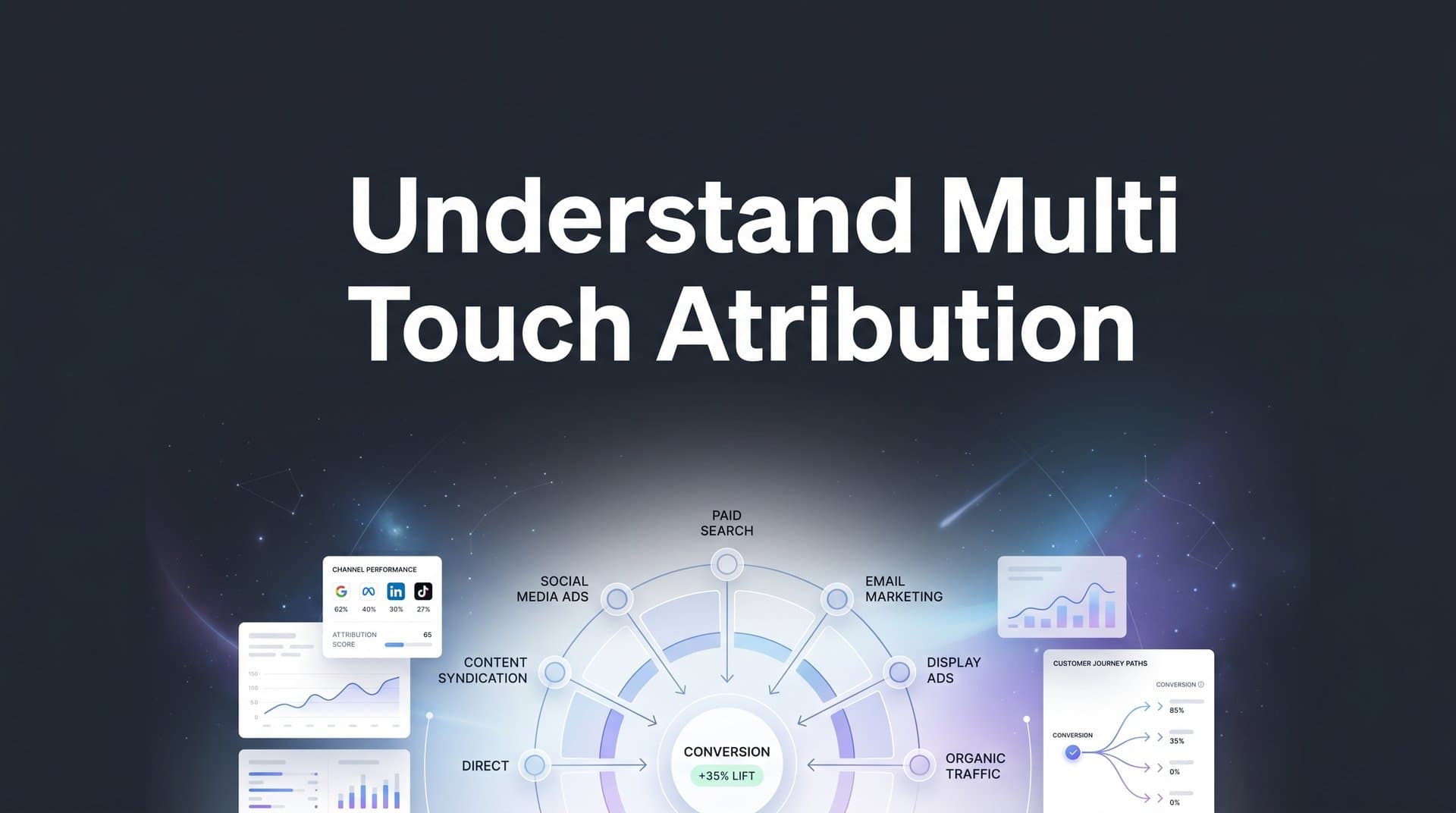
Multi-touch attribution changes that entirely. Instead of giving all the credit to one interaction, it distributes credit across every meaningful touchpoint in the customer journey. The result is a complete picture of what's actually driving conversions, which channels are pulling their weight, and where your budget will have the most impact. This guide breaks down how to understand multi-touch attribution from the ground up: how it works, which models fit which businesses, and how to translate attribution data into smarter campaign decisions.
Why Single-Touch Models Leave Money on the Table
Before diving into multi-touch attribution, it helps to understand exactly what single-touch models are doing and why they fall short in today's cross-platform environment.
First-click attribution gives all the credit to the very first touchpoint a prospect interacted with. If someone clicked a LinkedIn ad six weeks ago and then converted through a Google search ad today, LinkedIn gets 100% of the credit. Last-click attribution does the opposite: it credits the final interaction before conversion, regardless of everything that came before it. Both models are simple, easy to implement, and deeply misleading.
The problem is that modern buyers rarely convert after a single interaction. In B2B, a prospect might engage with paid social, organic search, email nurture sequences, and direct traffic before ever talking to sales. In ecommerce, a customer might see a display ad, visit the site organically, and then convert through a branded search. The journey is rarely linear and almost never one step.
When you use first-click attribution, you over-credit awareness channels and ignore the nurturing touchpoints that move prospects through the funnel. When you use last-click, you do the opposite: you over-invest in bottom-funnel channels like branded search and retargeting while cutting the awareness and consideration campaigns that actually filled the pipeline in the first place.
Here's where the real damage happens. Let's say you're running Facebook prospecting campaigns and Google retargeting in parallel. Last-click attribution shows Google driving most of your conversions. You cut Facebook spend. Conversions drop. You're confused because Google is still running. What happened? You starved the top of the funnel that was feeding the bottom.
This is a pattern many marketing teams fall into without realizing it. The campaigns that look like they're underperforming on a last-touch attribution basis are often the ones doing the most work earlier in the journey. Single-touch models make it nearly impossible to see that relationship.
Multi-touch attribution solves this by distributing credit across every touchpoint that contributed to a conversion. Instead of asking "which channel closed the deal," it asks "which channels contributed to this customer's journey, and how much?" That shift in framing changes everything about how you read performance data and allocate budget.
The Building Blocks of Multi-Touch Attribution
At its core, multi-touch attribution is a measurement framework that assigns weighted credit to each touchpoint a customer interacts with before converting. Rather than picking a winner, it acknowledges that multiple interactions contributed to the outcome and tries to quantify each one's role.
Understanding how it works means understanding its four key components: touchpoint identification, data collection, journey mapping, and credit distribution logic.
Touchpoint Identification: A touchpoint is any interaction a prospect has with your brand that can be tracked and attributed. This includes paid ad clicks, organic search visits, email opens and clicks, social media interactions, direct visits, and CRM-logged events like demo requests or sales calls. Identifying which touchpoints matter and which should be included in your attribution model is the first design decision you'll make.
Data Collection Across Platforms: This is where many attribution setups break down. Collecting accurate touchpoint data across channels requires a tracking infrastructure that can capture events from multiple sources and stitch them together into a single customer journey. UTM parameters help tag traffic sources so you can identify where visitors came from. First-party data, collected directly from your own website and CRM, gives you reliable event data that isn't subject to the same privacy restrictions as third-party cookies.
Journey Mapping: Once you're collecting data from all your channels, you need to connect those events to individual users across time. Journey mapping is the process of linking touchpoints together into a coherent sequence: this user clicked this ad, then visited this page, then opened this email, then converted here. Without accurate journey mapping, you end up with a collection of disconnected events rather than a meaningful picture of how customers move through your funnel. Effective customer attribution tracking is essential to making this process work.
Credit Distribution Logic: This is the attribution model itself. Once you have a mapped journey, the model determines how much credit each touchpoint receives. Different models distribute credit differently, which is why choosing the right model for your business matters so much.
Underpinning all of this is your tracking infrastructure. Server-side tracking has become increasingly important as browser-based pixels face restrictions from ad blockers, iOS privacy settings, and third-party cookie limitations. Server-side tracking sends event data directly from your server to ad platforms and analytics tools, bypassing the browser entirely. This means you capture more events, more accurately, with fewer gaps. Combined with first-party data strategies and consistent UTM tagging, server-side tracking gives your multi-touch attribution model the clean, complete data it needs to produce reliable insights.
Common Multi-Touch Attribution Models Compared
Not all multi-touch attribution models are built the same. Each distributes credit differently, and each has a context where it works best. Here's a breakdown of the main models and how to think about choosing between them.
Linear Attribution: Every touchpoint in the journey receives equal credit. If a customer interacted with five touchpoints before converting, each gets 20% of the credit. This model is easy to understand and ensures no touchpoint is ignored, but it treats a quick social scroll the same as a detailed product demo, which isn't always a fair reflection of influence. Linear attribution works well when you're just starting out with multi-touch measurement and want a balanced baseline view across all channels.
Time-Decay Attribution: Touchpoints closer to the conversion receive more credit than earlier ones, based on the assumption that recent interactions had more influence on the decision. This model makes intuitive sense for short sales cycles where the most recent interactions are genuinely the most persuasive. For ecommerce brands with quick purchase decisions, time-decay can be a good fit. For longer B2B sales cycles, it can undervalue the early-stage content and campaigns that first brought a prospect into your world.
U-Shaped (Position-Based) Attribution: This model gives heavy credit to the first and last touchpoints, typically 40% each, with the remaining 20% distributed across everything in between. The logic is that the first touch (what introduced the prospect to your brand) and the last touch (what closed the deal) are the most strategically important moments. This works well for businesses that care deeply about understanding both acquisition channels and conversion channels, which is common in lead generation and mid-market B2B. For a deeper dive into how these frameworks compare, explore this multi-touch attribution models guide.
W-Shaped Attribution: An extension of the U-shaped model, W-shaped attribution adds a third point of emphasis at the mid-funnel stage, typically the lead creation event. Credit is distributed with emphasis at first touch, lead creation, and last touch, with the remainder spread across other interactions. This is particularly useful for B2B SaaS companies with defined pipeline stages, where the moment a prospect becomes a marketing-qualified lead is a meaningful milestone worth crediting.
Data-Driven (Algorithmic) Attribution: This is the most sophisticated approach. Instead of applying a fixed rule for how credit is distributed, data-driven attribution uses machine learning to analyze your actual conversion data and determine which touchpoints statistically contributed most to conversions. It looks at patterns across thousands of customer journeys, compares converting paths to non-converting paths, and assigns credit based on demonstrated impact rather than assumption.
Data-driven attribution is the most accurate model available, but it requires sufficient conversion volume to produce statistically meaningful results. It's best suited for businesses with high conversion rates or large data sets. For companies earlier in their growth or with lower conversion volumes, a rules-based model like U-shaped or W-shaped often provides a more practical and reliable starting point.
The right model for your business depends on your sales cycle length, the number of channels you're running, and what decisions you're trying to make. Start with a model that matches your current data maturity and refine as your attribution program matures.
Turning Attribution Data Into Smarter Budget Decisions
Understanding multi-touch attribution is only valuable if it changes how you make decisions. The real payoff comes when attribution data directly informs where you put your budget.
The most immediate insight multi-touch attribution provides is identifying which channels assist conversions versus which channels only capture them. Assist channels are the touchpoints that appear consistently in converting journeys but rarely as the last click. These are often awareness-stage campaigns: paid social prospecting, display, content marketing, and organic search. Last-click models make these channels look like they're not working. Multi-touch attribution reveals that they're often the reason conversions happen at all.
When you can see which channels are consistently showing up in high-value customer journeys, you can shift budget toward them with confidence. Conversely, you can identify channels that appear frequently but don't correlate with higher-value conversions, and trim spend accordingly. This is the shift from gut-feel budgeting to evidence-based allocation, and understanding multi-channel attribution for ROI is central to making it work.
There's another dimension to this that's often overlooked: feeding accurate attribution data back to ad platform algorithms. Platforms like Meta, Google, and TikTok use the conversion signals you send them to optimize targeting, bidding, and audience selection. If you're only sending last-click conversions, you're giving those algorithms an incomplete and distorted picture of what a valuable customer looks like.
When you feed enriched, multi-touch conversion data back to ad platforms, their algorithms get a more accurate signal. They can identify which users are more likely to complete the full journey, not just click the last ad. Over time, this improves targeting quality, reduces wasted spend, and drives better return on ad spend across every platform you're running.
This is where the connection between attribution and performance optimization becomes a feedback loop. Better attribution data informs better budget decisions. Better budget decisions drive more conversions. More conversions generate more data. That data improves attribution accuracy. Each cycle makes your marketing more efficient.
The practical implication is that multi-touch attribution isn't just a reporting tool. It's a growth lever. Marketers who use it well don't just understand their past performance better; they make smarter forward-looking decisions about where to scale and where to pull back.
Overcoming the Biggest Challenges in Multi-Touch Attribution
Multi-touch attribution is powerful, but it's not without its challenges. Understanding the obstacles upfront helps you build a more resilient measurement strategy from the start.
The most significant technical challenge today is data accuracy. iOS privacy changes introduced through Apple's App Tracking Transparency framework have limited the ability of mobile apps and browsers to track users across platforms. Third-party cookie deprecation in major browsers has further reduced the reliability of pixel-based tracking. The result is that traditional client-side attribution setups are seeing more gaps in their data, particularly for mobile traffic and cross-device journeys. For a deeper look at these issues, read about common attribution challenges in marketing analytics.
Server-side tracking addresses much of this. By moving event tracking from the browser to your server, you bypass many of the restrictions that affect client-side pixels. Events are captured more consistently, data is more complete, and you maintain visibility into customer journeys that would otherwise fall through the cracks. Pairing server-side tracking with a strong first-party data strategy, collecting email addresses, CRM data, and logged-in user behavior, gives you a foundation that's far more durable than relying on third-party cookies alone.
Cross-device tracking is another persistent challenge. A prospect might see an ad on their phone, research on their laptop, and convert on a tablet. Without a way to connect those sessions to the same user, you end up with fragmented journeys that look like separate, unrelated visits. First-party identifiers, like email addresses captured through forms or login events, are the most reliable way to stitch cross-device journeys together.
Beyond the technical side, there's an organizational challenge that's just as real: getting buy-in from teams accustomed to platform-reported metrics. Google Ads, Meta, and other platforms report attribution using their own models, which often leads to double-counting and inflated numbers. When your independent attribution platform shows different results, it can create friction with stakeholders who trust what they see in the native dashboards. Learning how to fix attribution discrepancies can help bridge that gap.
The solution is establishing a single source of truth for attribution data and aligning your team around it. This means agreeing on which attribution model you're using, which platform reports it, and how you'll reconcile discrepancies with platform-native numbers. It takes alignment work, but the clarity it creates is worth the effort.
Putting Multi-Touch Attribution to Work With the Right Tools
Having the right attribution framework is only as effective as the tools you use to implement it. When evaluating an attribution platform, there are a few capabilities that separate genuinely useful tools from ones that only scratch the surface.
Look for cross-platform tracking that captures touchpoints from every channel you're running, not just the ones where the platform has a native integration. You need CRM integration so that offline events like sales calls, demo completions, and closed deals can be tied back to the marketing touchpoints that started the journey. Real-time data matters because waiting days for attribution reports means you're making budget decisions with stale information. Support for multiple attribution models lets you compare how different frameworks tell different stories about the same data. And AI-powered recommendations take attribution from a reporting function to an active optimization tool. If you're evaluating options, this roundup of top multi-touch attribution tools is a useful starting point.
This is exactly where Cometly is built to help. Cometly captures every touchpoint from the first ad click through to CRM events, connecting the full customer journey in one place. Its analytics dashboard gives you a clear, cross-platform view of how your campaigns are performing across every channel, with the ability to compare attribution models and drill into individual customer journeys.
Cometly's AI doesn't just report on what happened. It surfaces actionable recommendations by identifying which ads and campaigns are consistently contributing to revenue and which ones are underperforming relative to their spend. Instead of spending hours manually analyzing attribution data, you get clear signals about where to scale and where to pull back.
One of the most impactful features is Cometly's Conversion Sync. It feeds enriched, conversion-ready event data back to Meta, Google, and other ad platforms, closing the loop between your attribution insights and the algorithms that power your campaigns. When those platforms receive better data, they optimize better. Targeting improves, bidding becomes more efficient, and your ad spend goes further.
For marketers running campaigns across multiple platforms who want a complete, accurate picture of what's driving revenue, having the right attribution modeling software in place makes the difference between guessing and knowing.
The Bottom Line on Multi-Touch Attribution
Understanding multi-touch attribution is not just a reporting upgrade. It's a fundamental shift in how you make marketing decisions. When you move from single-touch guesswork to a complete view of the customer journey, you stop defunding the campaigns that matter and start investing with evidence behind every decision.
The progression is straightforward. Start by recognizing the limitations of last-click and first-click models. Build the tracking infrastructure needed to capture clean, complete data across all your channels. Choose an attribution model that fits your sales cycle, channel mix, and data maturity. Use the insights to reallocate budget toward channels that consistently contribute to revenue. And feed that enriched data back to ad platforms so their algorithms can optimize more effectively over time.
Each step compounds. Better data leads to better decisions. Better decisions drive better performance. Better performance generates more data to learn from. This is how multi-touch attribution becomes a competitive advantage rather than just a measurement exercise.
The marketers who win in today's cross-platform, privacy-first landscape are the ones who invest in understanding the full customer journey, not just the last click. The tools and frameworks to do this exist. The question is whether you're using them.
Ready to elevate your marketing game with precision and confidence? Discover how Cometly's AI-driven recommendations can transform your ad strategy. Get your free demo today and start capturing every touchpoint to maximize your conversions.