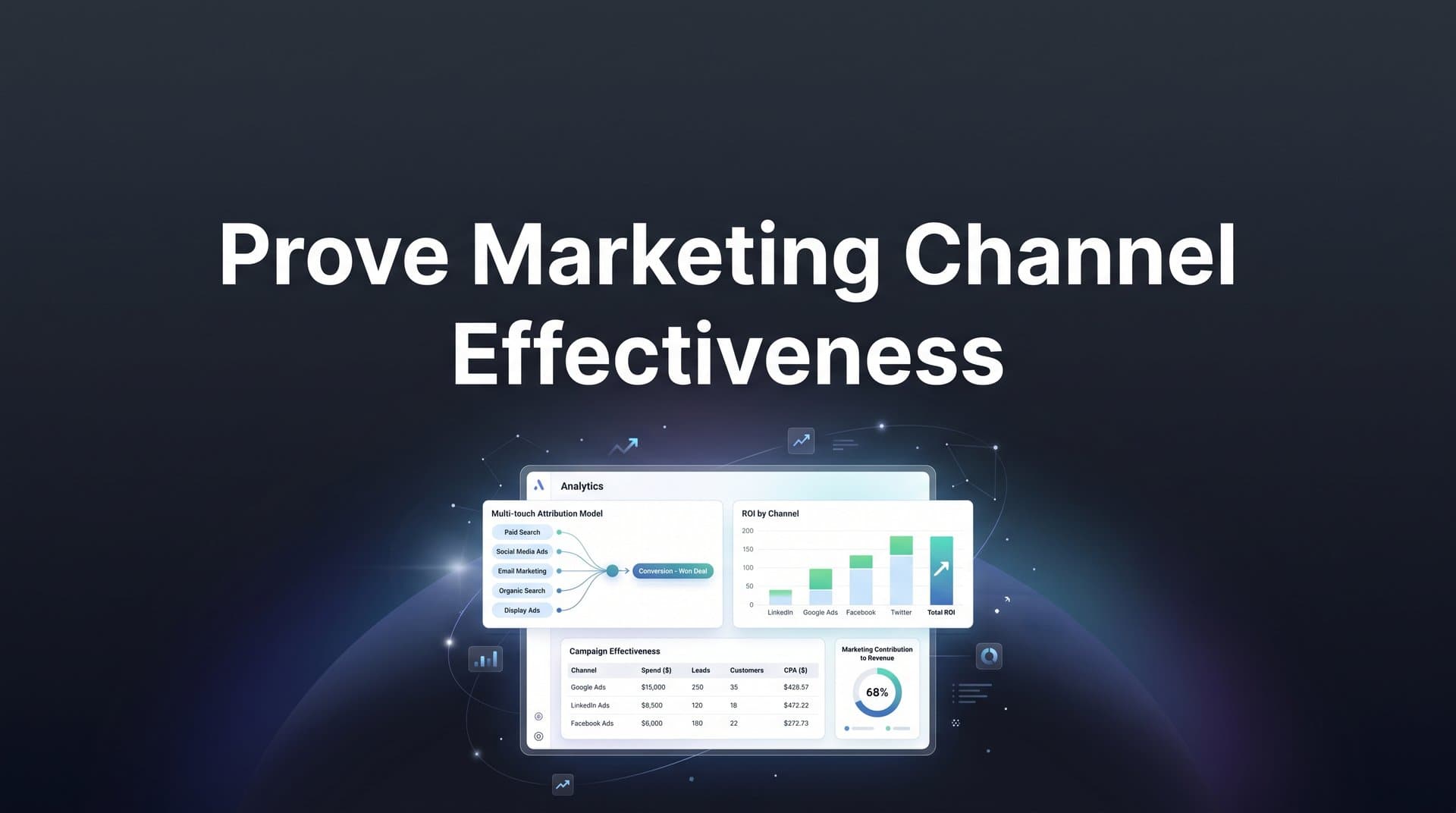
Every marketing team faces the same pressure: justify your budget or risk losing it. Leadership wants to know which channels actually drive revenue, not just clicks or impressions. Yet for many marketers, proving marketing channel effectiveness remains one of the hardest parts of the job.
Siloed data, inconsistent tracking, and platform-reported metrics that inflate results all make it difficult to answer a deceptively simple question: is this channel actually working? Ad platforms each claim credit for the same conversions, your pixel misses half the activity after iOS privacy changes, and your CRM data never quite lines up with what Google Ads is reporting. Sound familiar?
The good news is that proving channel effectiveness is not guesswork. It is a structured process that starts with clear goals, reliable tracking, and the right attribution approach. When done well, it gives you the confidence to double down on what works, cut what does not, and present data your CFO will actually trust.
In this guide, you will walk through six concrete steps to build an airtight case for (or against) any marketing channel in your mix. Whether you are running paid ads across Meta, Google, TikTok, and LinkedIn, or balancing paid with organic and email, these steps will help you move from gut feelings to data-backed proof.
Step 1: Define What "Effective" Actually Means for Your Business
Before you can prove a channel works, you need to agree on what "working" looks like. This sounds obvious, but it is where most effectiveness audits fall apart. Teams default to whatever metrics are easiest to pull, which usually means impressions, clicks, and platform-reported conversions. Those numbers feel productive, but they rarely answer the question leadership is actually asking.
The first thing to do is draw a clear line between vanity metrics and business-impact metrics. Vanity metrics like impressions, reach, and click-through rates measure activity. Business-impact metrics like revenue attributed, pipeline generated, customer acquisition cost, and return on ad spend measure outcomes. Your effectiveness case needs to be built on the second category. Learning how to evaluate marketing channels beyond surface-level numbers is essential to getting this right.
Here is where many teams make a critical mistake: applying the same KPI to every channel regardless of its role in the funnel. A brand awareness campaign on YouTube should not be judged by direct conversions. A retargeting campaign on Google should not be celebrated for reach. Each channel plays a different role, and your measurement framework needs to reflect that.
A practical way to think about this is by funnel stage. Top-of-funnel channels focused on awareness get measured by metrics like branded search lift, new audience reach, and cost per new visitor. Mid-funnel channels nurturing consideration get measured by engagement quality, lead volume, and cost per qualified lead. Bottom-of-funnel channels driving decisions get measured by cost per acquisition, ROAS, and revenue contribution.
Once you have mapped each channel to its funnel role, set specific benchmarks before you start evaluating. What is your target ROAS for paid search? What cost per acquisition is acceptable for paid social? What pipeline contribution percentage do you expect from email? These targets give you something to measure against rather than just measuring in the abstract. A solid marketing effectiveness measurement framework makes this process repeatable across every planning cycle.
Common pitfall: Waiting until after a campaign runs to decide how you will judge it. Set your benchmarks upfront so there is no room for post-hoc rationalization when the data comes in.
Success indicator: You have a written document mapping each active channel to its primary KPI, funnel stage, and target benchmark. Every stakeholder has reviewed and agreed to it before evaluation begins.
Step 2: Build a Unified Tracking Foundation Across All Channels
You cannot prove what you cannot measure. And right now, there is a good chance your measurement setup has more gaps than you realize.
Platform-reported metrics are a starting point, but they are not a reliable source of truth. Here is why: every ad platform has an incentive to show you strong results, and their attribution windows are designed to claim credit generously. Meta might claim a conversion that Google also claims. Both platforms count it as a win. Your actual revenue grows by one customer, but your dashboards show two attributed conversions. This self-attribution bias is a well-documented challenge in digital marketing, and it means that adding up platform-reported conversions will almost always give you an inflated picture of results.
Beyond platform bias, the accuracy of pixel-based tracking has eroded significantly. Since Apple's App Tracking Transparency changes with iOS 14.5, browser-based pixels miss a meaningful portion of conversion events from iOS users. Add the ongoing deprecation of third-party cookies across major browsers, and you have a tracking environment where a significant share of conversions simply go unrecorded in your standard setup. Investing in reliable marketing campaign tracking software is critical to closing these gaps.
The solution to both problems starts with server-side tracking. Instead of relying on a browser pixel that can be blocked, delayed, or stripped of data, server-side tracking sends conversion events directly from your server to your analytics and ad platforms. This approach captures events that would otherwise be lost, improving data accuracy and giving you a more complete picture of what is actually happening across your funnel.
Beyond the technical tracking layer, consistency in your campaign naming and UTM structure is non-negotiable. If one campaign uses "utm_source=meta" and another uses "utm_source=facebook" and a third uses "utm_source=FB," you will end up with fragmented data that is impossible to analyze cleanly. Establish a naming convention and enforce it across every campaign, every platform, and every team member who touches your ad accounts.
The final piece is connecting your data sources into a single system. Your ad platforms, website analytics, and CRM each hold part of the story. Toggling between dashboards to piece it together manually introduces errors and eats time. Connecting these sources into one place lets you trace the full customer journey from ad click to closed deal without losing data in the handoffs. Understanding how to track marketing campaigns end-to-end is what separates teams with clean data from those constantly reconciling spreadsheets.
Cometly is built specifically for this problem. It connects your ad platforms, CRM, and website to track the entire customer journey in real time, so you have one accurate data source instead of three conflicting ones.
Success indicator: Every touchpoint from ad click to CRM event is being captured and routed to one central system. You can pull a report that shows the full path a lead took before converting, without manually stitching data from multiple tools.
Step 3: Map the Full Customer Journey for Each Channel
Once your tracking is solid, the next step is to actually look at how customers move through your funnel, not how you assume they do.
Most purchases, especially in B2B and high-consideration categories, involve multiple touchpoints across multiple channels before a conversion happens. A prospect might discover your brand through a LinkedIn post, click a Google search ad two weeks later, read a comparison article from organic search, and finally convert after seeing a retargeting ad on Meta. If you only look at the last click, Meta gets all the credit. LinkedIn, Google, and organic search get nothing. That is not an accurate picture of what drove the sale. This is exactly why cross channel marketing attribution has become essential for modern marketing teams.
Journey mapping means tracing how leads from each channel actually move through your funnel from first touch to closed deal or purchase. When you do this systematically, you start to see patterns. Some channels consistently introduce new prospects who later convert through other channels. Those are assist channels. Other channels tend to show up at the moment of decision. Those are closing channels. Both types have value, but they need to be measured and managed differently.
Identifying assist channels is particularly important because they are the most likely to get cut in a last-click world. If LinkedIn never gets last-click credit but consistently appears as the first touch for your highest-value customers, cutting your LinkedIn budget based on last-click data would be a costly mistake. Journey mapping makes that pattern visible before you make the wrong call.
Journey mapping also helps you spot drop-off points and handoff problems between channels. If a large portion of leads from paid social engage with your site but never make it into your CRM, there may be a form, landing page, or follow-up gap that is costing you pipeline. Fixing that handoff can improve the apparent effectiveness of the channel without changing the channel itself.
Common pitfall: Cutting a channel that appears ineffective on last-click attribution without first checking whether it plays a consistent first-touch or mid-funnel assist role. Always map the journey before making budget decisions.
Success indicator: You can visualize the typical path to conversion for your business and see clearly where each channel contributes, whether as an introducer, a nurturer, or a closer.
Step 4: Apply the Right Attribution Model to Reveal True Channel Impact
Here is where the analysis gets more precise. Attribution models are the rules that determine how conversion credit gets distributed across the touchpoints in a customer journey. The model you choose dramatically changes what the data tells you about each channel.
To understand why this matters, consider a simple example. A customer sees a Facebook ad, clicks a Google search ad three days later, and converts after clicking an email link. Under last-click attribution, email gets 100% of the credit. Under first-click attribution, Facebook gets 100%. Under a linear model, each touchpoint gets roughly 33%. Under a time-decay model, email gets the most and Facebook gets the least. Under a data-driven model, the distribution is based on actual patterns in your conversion data. Same customer journey, five completely different stories. Exploring the differences between attribution modeling vs marketing mix modeling can help you determine which approach fits your business best.
Choosing the right model starts with understanding your business model and sales cycle. If you have a short sales cycle where customers typically convert on their first or second visit, simpler models like last-click may be less distorting. If you have a long B2B sales cycle with multiple touchpoints over weeks or months, last-click attribution will systematically undervalue your awareness and nurture channels. Multi-touch attribution models are broadly recommended for these scenarios because they distribute credit across the entire journey rather than awarding it all to one touchpoint.
The practical approach is not to pick one model and commit to it permanently. Instead, compare results across at least two models to find consistent patterns. If paid search looks strong under both last-click and linear attribution, that is a more defensible finding than if it only looks strong under one model. Where models diverge, investigate why. Those divergences often reveal the most interesting insights about how your channels interact. The right channel marketing attribution strategy ensures every touchpoint gets the credit it deserves.
Cometly lets you compare attribution models side by side and analyze which channels truly drive conversions. Instead of being locked into a single view of your data, you can see how credit shifts across models and build a more nuanced, honest picture of channel contribution.
Success indicator: You have run your conversion data through at least two attribution models and can clearly articulate where they agree, where they diverge, and what that tells you about each channel's role in the customer journey.
Step 5: Run Controlled Tests to Validate What the Data Shows
Attribution data is powerful, but it has a fundamental limitation: it shows correlation, not causation. A channel might appear in many conversion paths simply because it is everywhere in your media mix, not because it is actually driving decisions. Testing is how you confirm that the relationship is real.
The most rigorous method for proving channel causation is incrementality testing, sometimes called lift testing. The concept is straightforward: pause or reduce a channel in a specific region, audience segment, or time period, and measure whether overall conversions change as a result. If conversions drop when you pause the channel, that is evidence the channel was contributing incrementally. If conversions stay flat, the channel may not be adding as much value as your attribution data suggested. This kind of testing is a cornerstone of measuring marketing campaign effectiveness with real confidence.
A/B budget allocation tests are another practical approach. Shift spend between channels over a defined period and track whether total revenue changes proportionally. If moving budget from Channel A to Channel B increases total conversions, you have real evidence that Channel B is more incremental. If total conversions drop, you have learned something valuable about Channel A's role.
For channels that are difficult to isolate, such as brand campaigns or always-on awareness activity, geo-holdout testing is a useful method. You run the channel normally in some geographic markets and pause it in comparable markets, then compare conversion rates between the two groups. This approach controls for external variables and gives you a cleaner read on the channel's actual impact.
Rigorous documentation is essential for any test you run. Record your test parameters, the duration, the audience or geographic scope, and the baseline metrics before the test begins. Without this documentation, your findings will be difficult to defend when you present them to leadership. A well-documented test is a credible test.
Common pitfall: Running tests for too short a period or with too small a sample size to draw statistically meaningful conclusions. Give tests enough time to account for natural variation in your conversion data, and size your test and control groups appropriately before you start.
Success indicator: You have at least one completed incrementality or holdout test per major channel in your mix, with documented parameters and results that you can present to stakeholders.
Step 6: Build a Channel Effectiveness Report That Stakeholders Trust
You have done the hard analytical work. Now you need to communicate it in a way that actually changes decisions. A technically rigorous analysis that no one understands is not useful. The final step is translating your findings into a clear, visual report that connects channel performance to business outcomes.
Structure the report around the benchmarks you set in Step 1. For each channel, show the target KPI alongside the actual result. Did paid search hit its ROAS target? Did email hit its pipeline contribution goal? Did LinkedIn stay within its acceptable cost per qualified lead? This structure makes the report immediately actionable because every stakeholder can see at a glance which channels are performing and which are not. Leveraging the right tools for marketing analytics makes building these reports far more efficient.
Include both your multi-touch attribution findings and your incrementality test results. Attribution data shows the pattern of channel contribution across the customer journey. Incrementality data confirms which contributions are causal. Together, they make a much stronger case than either source alone. When both your attribution model and your holdout test point to the same conclusion about a channel, that finding is highly defensible.
Do not stop at historical performance. The most valuable reports also include forward-looking recommendations. Which channels should receive more budget based on their incremental contribution? Which are underperforming against their benchmarks and need creative or targeting changes before more spend is justified? AI-powered marketing analytics can surface these insights automatically, highlighting optimization opportunities that might take hours to identify manually.
Cometly's analytics dashboard and AI recommendations are built for exactly this purpose. They help surface which ads and campaigns to scale, making your reporting actionable rather than just retrospective. Instead of presenting a chart and leaving leadership to draw their own conclusions, you can walk in with specific, data-backed recommendations for where to shift budget and why.
Finally, establish a regular reporting cadence. Channel effectiveness is not something you audit once and forget. Markets shift, creative fatigues, audience behavior changes, and platform algorithms evolve. A weekly pulse check on key metrics, a monthly deep-dive on attribution and channel performance, and a quarterly review of incrementality tests will keep your strategy sharp and your budget allocations current.
Success indicator: Leadership can look at your report and immediately see which channels are generating ROI, which are falling short of benchmarks, and where budget should shift in the next planning cycle.
Putting It All Together: Your Channel Effectiveness Checklist
Proving marketing channel effectiveness is not a one-time project. It is an ongoing discipline that keeps your strategy honest and your budget working harder. Here is a quick-reference summary of the six steps covered in this guide.
Step 1: Define effectiveness with business-aligned KPIs. Map each channel to its funnel role, assign appropriate metrics, and set specific benchmarks before evaluation begins.
Step 2: Unify tracking with server-side data and consistent naming. Eliminate platform self-attribution bias, close the gaps left by iOS changes and cookie deprecation, and connect your ad platforms, website, and CRM into one source of truth.
Step 3: Map the full customer journey per channel. Identify assist channels versus closing channels, trace how leads actually move through your funnel, and spot handoff gaps before they cost you pipeline.
Step 4: Compare attribution models for honest credit distribution. Run your data through at least two models, look for consistent patterns, and use multi-touch attribution to give every touchpoint its fair share of credit.
Step 5: Validate with incrementality and holdout tests. Confirm that the channels your attribution data highlights are actually driving conversions, not just correlating with them. Document everything so your findings are defensible.
Step 6: Report results tied to revenue and benchmarks. Build a report that connects channel performance to business outcomes, includes both attribution and testing data, and delivers forward-looking recommendations your team can act on.
As channels evolve, privacy rules shift, and budgets change, this process keeps your strategy grounded in real evidence rather than platform promises. The teams that prove channel effectiveness consistently are the ones that earn the budget to keep growing.
Cometly helps marketing teams capture every touchpoint, compare attribution models side by side, and get AI-powered recommendations so they can prove channel value with confidence and scale what works. If you are ready to move from fragmented data to a clear, complete picture of your marketing performance, Get your free demo today and start building the attribution foundation your strategy deserves.