

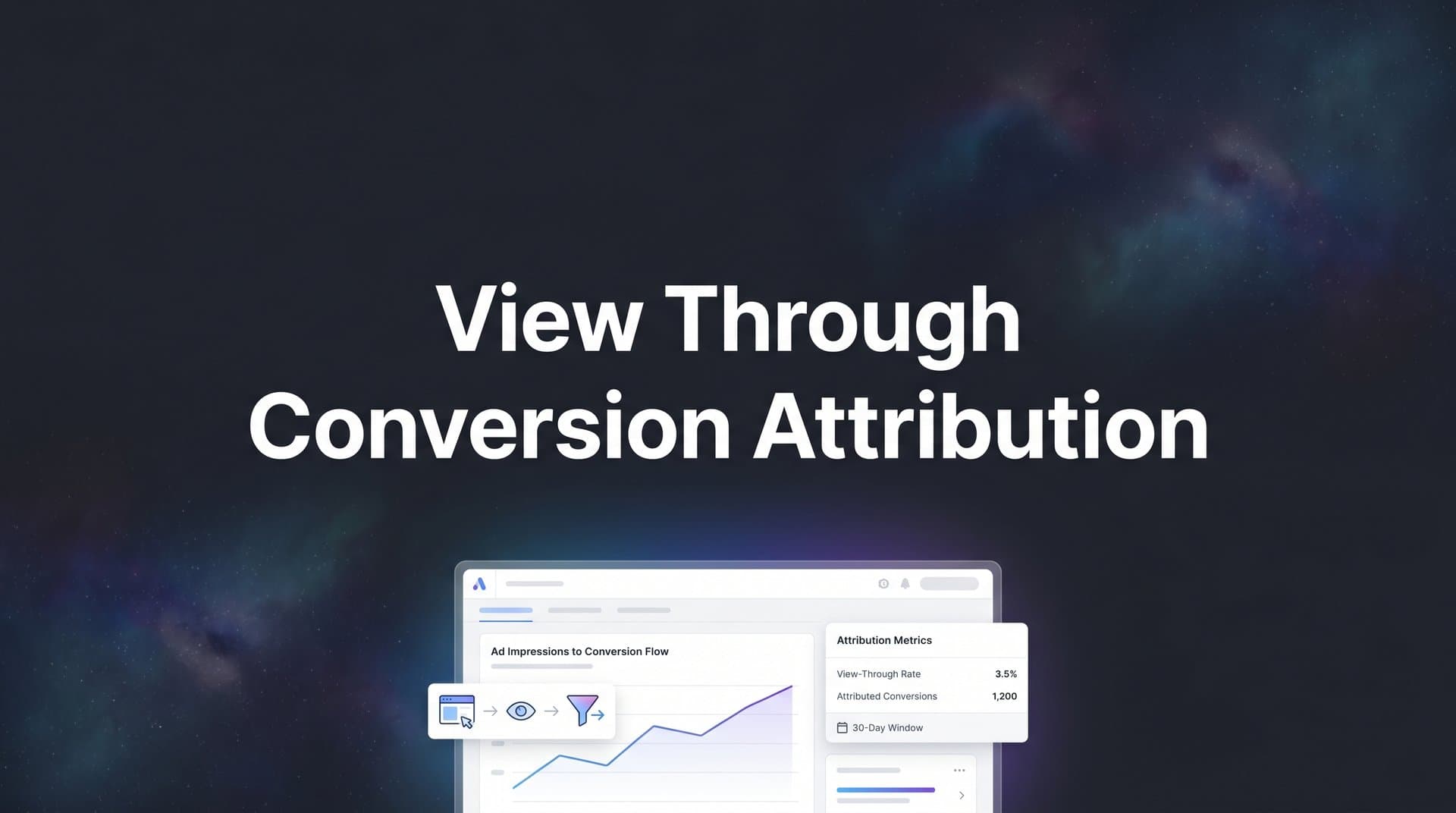
You're running a display campaign that's generating thousands of impressions. The click-through rate looks decent, but when you check your analytics, the direct conversions from those clicks seem underwhelming. Your instinct tells you to cut the budget and reallocate to search campaigns that show clear conversion paths. But here's what you might be missing: a prospect saw your ad while scrolling through an industry blog, didn't click, but your brand stuck in their mind. Three days later, they searched for your company by name and converted through that search ad. Your current attribution model credits the search campaign entirely, while the display ad that planted the seed gets zero recognition.
This scenario plays out thousands of times across marketing campaigns every day. Without view through conversion attribution, you're flying blind to a significant portion of your advertising's actual impact. You're potentially cutting campaigns that are doing exactly what they're supposed to do: building awareness and initiating customer journeys that convert through other channels later.
Understanding how ad impressions influence conversions, even without immediate clicks, changes everything about how you evaluate campaign performance and allocate budget. This guide will show you exactly how view through attribution works, when it provides genuine insight versus misleading data, and how to implement it across your campaigns to make smarter scaling decisions backed by complete data.
The Hidden Influence of Ad Impressions on Buyer Behavior
View through conversions represent purchases or leads that happen after someone sees your ad without clicking it, then converts within a defined attribution window. Think of it as the advertising equivalent of planting seeds. You place the ad, the prospect registers it consciously or subconsciously, and later when they're ready to act, your brand comes to mind.
This differs fundamentally from click through conversions, where someone clicks your ad and converts in that same session or shortly after. Click through attribution is straightforward: the user took a direct action, and you can draw a clear line from ad to conversion. View through attribution captures the more subtle influence of exposure itself.
Both matter because they represent different stages of the customer journey. Click through conversions typically happen when someone is already in buying mode, actively searching for solutions. View through conversions often reflect earlier-stage awareness building that creates the conditions for later conversion.
Consider how you actually make purchasing decisions in your own life. You see a software tool mentioned in a display ad while reading an article. You don't click because you're not actively shopping right now. But the brand registers. Two weeks later, when you actually need that type of solution, you remember seeing it and search for it directly. Or maybe you see a retargeting ad that reminds you, and that's when you click through and convert.
The display impression did real work in that journey. It introduced you to the solution, built initial awareness, and positioned the brand in your consideration set. Without view through attribution, that entire contribution disappears from your reporting. You'd only see the final click that converted, missing the crucial role the earlier impression played.
This matters enormously for campaign evaluation. Upper-funnel campaigns like display advertising, video ads, and broad-reach social campaigns often generate significant view through value even when their direct click-through conversion numbers look modest. If you're only measuring click-through performance, you're systematically undervaluing awareness-building efforts and potentially cutting campaigns that are actually driving substantial business results.
The challenge is that view through attribution introduces complexity. Not every impression that precedes a conversion actually influenced it. Someone might have seen your ad, ignored it completely, and converted anyway based on other factors. Distinguishing genuine influence from coincidental correlation becomes critical, which is why understanding how attribution windows work and how to validate impression impact matters so much.
How View Through Attribution Windows Actually Work
An attribution window defines how long after seeing an ad impression a conversion can be credited to that impression. If you set a 7-day view through window, any conversion that happens within seven days of someone seeing your ad can potentially be attributed to that impression, even if they never clicked the ad.
Different platforms use different default windows. Meta typically uses a 1-day view through window by default, meaning conversions that happen within 24 hours of seeing an ad get credited. Google Ads offers configurable windows, with options ranging from 1 day to 30 days for Display campaigns. These defaults reflect different philosophies about how long impression influence reasonably lasts.
The technical tracking works through a combination of cookies, device IDs, and platform-specific identifiers. When someone sees your ad, the ad platform drops a cookie or records a device identifier associated with that impression. If that same user later converts on your website within the attribution window, the platform matches the conversion event back to the impression using that identifier.
This is where things get technically interesting. For browser-based tracking, third-party cookies have traditionally enabled this matching. The ad platform sets a cookie when the impression fires, then when you fire a conversion pixel on your site, that cookie allows the platform to connect the dots. But with increasing cookie restrictions and privacy changes, this method has become less reliable.
Server-side tracking offers a more robust alternative. Instead of relying on browser cookies, conversion events get sent directly from your server to the ad platform's server. This approach bypasses browser restrictions and provides more accurate data about which users saw impressions and later converted. For marketers serious about attribution accuracy in 2026, server-side implementation has become essential rather than optional.
Cross-device tracking adds another layer of complexity. A prospect might see your display ad on their mobile phone during their morning commute, then convert on their desktop computer at work three days later. Connecting these touchpoints requires the ad platform to recognize that both devices belong to the same person. Platforms use various signals for this: logged-in accounts, device graphs, and probabilistic matching based on behavioral patterns.
Meta has an advantage here because users typically stay logged into Facebook and Instagram across devices, making cross-device matching more reliable. Google can leverage account logins across Chrome browsers and Android devices. But no platform achieves perfect cross-device attribution, which means some view through influence inevitably goes untracked.
The conversion window attribution length you choose dramatically affects what gets counted. A 1-day window captures only conversions that happen very quickly after impression exposure. This reduces false attribution (crediting impressions that didn't actually influence behavior) but misses legitimate influence that takes longer to manifest. A 30-day window captures more genuine influence but also includes more conversions that would have happened anyway, even without the impression.
Your optimal window length depends on your sales cycle. If you're selling a low-consideration product that people buy impulsively, a shorter window makes sense. If you're marketing enterprise software with a 60-day average sales cycle, a longer window better captures how impressions influence eventual conversions, even though it introduces more noise into your data.
Different ad platforms handle view through tracking with varying levels of sophistication. Meta's attribution system integrates view through data into its overall conversion reporting, allowing you to see both click-through and view-through conversions in the same dashboard. Google Ads separates these metrics more explicitly, giving you distinct columns for view-through conversions. Programmatic platforms vary widely in their view through capabilities, with some offering robust tracking and others providing minimal visibility.
When View Through Data Helps (And When It Misleads)
View through attribution provides genuine value for specific campaign types and objectives. Brand awareness campaigns, where the goal is exposure rather than immediate action, benefit enormously from view through tracking. You're intentionally building familiarity and consideration, knowing that conversions will happen later through other channels. View through data shows whether those impressions are actually contributing to downstream conversions.
Video campaigns similarly rely on impression impact rather than immediate clicks. Someone watches your video ad, absorbs the message, and later takes action. The video view itself is the engagement that matters, not a click-through. View through attribution captures this delayed conversion effect that makes video advertising valuable despite often having low direct response rates.
Retargeting campaigns live in an interesting middle ground. You're targeting people who already visited your site, so view through conversions might represent someone who saw your retargeting ad, remembered they were interested, and came back directly rather than clicking the ad. That impression served as a valuable reminder even without generating a click.
But here's where view through data can mislead you: the overcounting problem. Just because an impression preceded a conversion doesn't mean it caused the conversion. Someone might have seen your display ad while browsing a news site, completely ignored it, and then converted three days later based entirely on other factors like a Google search or a colleague's recommendation. The impression gets credit even though it did nothing.
This problem gets worse as you expand attribution windows and run campaigns with broad reach. If you're showing ads to millions of people and using a 30-day window, you'll inevitably capture conversions that would have happened anyway. Your view through conversion numbers will look impressive, but they're inflated with false positives.
So how do you evaluate whether your view through conversions represent genuine influence? Start by comparing view through conversion rates against baseline conversion rates for people who weren't exposed to your ads. If your view through conversion tracking tool shows a 2% rate and your overall site conversion rate is also 2%, those impressions likely aren't driving incremental value. You're just capturing people who would have converted anyway.
Look at the timing distribution of your view through conversions. If most happen within the first day or two after impression exposure, that suggests genuine influence. If they're evenly distributed across your entire attribution window with a spike right at the end, that's more likely coincidental correlation.
Consider the campaign context. Are you running highly targeted campaigns to warm audiences, or broad awareness campaigns to cold prospects? Warm audiences already know your brand, so view through conversions might represent genuine reminder value. Cold audiences seeing your brand for the first time are less likely to convert purely from a single impression without clicking.
The campaign creative matters too. Compelling, memorable creative has a better chance of generating genuine view through influence than generic banner ads that blend into the background. If your view through conversion numbers are high but your creative is forgettable, question whether those impressions are really doing the work your data suggests.
Setting Up View Through Tracking Across Major Ad Platforms
Configuring view through attribution in Meta Ads Manager starts in your attribution settings. Navigate to your ad account settings, then find the attribution section. You'll see options for both click-through and view-through windows. Meta's default is 7-day click and 1-day view, but you can adjust based on your sales cycle.
For most businesses, the 1-day view through window works well as a starting point. It captures immediate impression influence without introducing excessive overcounting. If you have a longer consideration cycle, test a 7-day view through window, but monitor your data closely for signs of inflated attribution.
In Google Ads, view through conversion settings live in your conversion action setup. When you create or edit a conversion action, you'll see an option to set the view-through conversion window. Google offers windows ranging from 1 to 30 days. For Display campaigns specifically, you can also adjust these settings at the campaign level.
Google's interface separates view through conversions as a distinct metric, which makes analysis easier. You'll see columns for "Conversions" (click-through) and "View-through conversions" separately, allowing you to evaluate each contribution independently.
The key decision is matching your attribution window to your actual sales cycle. If your average time from first touch to conversion is 14 days, a 7-day view through window will miss some legitimate influence. A 21-day or 30-day window captures more of that journey but introduces more noise.
Run a simple analysis to inform this decision: look at your existing conversion data and map the time from first website visit to conversion. If 80% of conversions happen within 7 days of the first visit, a 7-day view through window makes sense. If conversions are more evenly distributed across 30 days, a longer window is appropriate.
Server-side tracking implementation provides significantly more accurate view through data, especially as browser-based tracking faces increasing restrictions. The technical setup involves sending conversion events from your server directly to ad platform APIs rather than relying on browser pixels.
For Meta, this means implementing the Conversions API alongside or instead of the Meta Pixel. The Conversions API receives conversion events from your server, matches them to user profiles using identifiers like email addresses or phone numbers, and attributes them to ad impressions more reliably than browser-based tracking can achieve. Understanding Facebook conversion attribution becomes much clearer with proper server-side implementation.
Google offers a similar server-side solution through enhanced conversions and the Google Ads API. These implementations require more technical setup than dropping a pixel on your site, but they deliver substantially better data quality, particularly for view through attribution where browser restrictions have the biggest impact.
If you're working with a platform like Cometly, the server-side tracking setup becomes much simpler. The platform handles the technical complexity of sending conversion data to multiple ad platforms while maintaining data accuracy and ensuring proper attribution across view through and click through touchpoints.
Analyzing View Through Data Without Double Counting
The fundamental challenge with view through attribution is distinguishing real influence from coincidental correlation. Incrementality testing provides the answer. This approach compares conversion rates between a group exposed to your ads and a control group that wasn't exposed, revealing whether your impressions actually drive lift.
Geographic holdout tests offer the most practical incrementality testing method. You run your campaign in most markets but deliberately exclude certain geographic regions as a control group. After your campaign runs for a sufficient period, you compare conversion rates between exposed and unexposed regions. If the exposed regions show meaningfully higher conversion rates, your impressions are driving real lift.
The math is straightforward. If your exposed regions convert at 3% and your control regions convert at 2.5%, your campaign is generating a 0.5 percentage point lift, or 20% relative improvement. That lift represents genuine incremental value from your advertising, including both click-through and view-through influence.
Time-based holdout tests work similarly. You run your campaign for two weeks, pause it for two weeks, then restart it. Compare conversion rates during on periods versus off periods. If conversions drop significantly when ads are paused, your impressions are contributing real value. If conversions remain stable, your view through attribution is likely overcounting.
These tests require discipline and patience. You need sufficient sample size to reach statistical significance, which might mean running tests for several weeks or months. But the insight you gain is invaluable: you'll know with confidence whether your impression-based campaigns are worth the investment.
When reporting on campaign performance, weight view through conversions differently than click through conversions. A click represents stronger intent and more direct influence than an impression. A reasonable starting point is to count view through conversions at 30-50% of the value of click through conversions in your internal reporting.
This weighting acknowledges that view through influence is real but less certain than click through influence. If a click through conversion is worth $100 in your reporting, count a view through conversion as $30-50. This prevents view through data from overwhelming your analysis while still recognizing its contribution.
Multi-touch attribution models provide the most sophisticated approach to incorporating impression touchpoints alongside clicks. These models analyze the entire customer journey, identifying all the touchpoints that contributed to a conversion and assigning fractional credit to each based on their relative influence.
In a position-based attribution model, the first touch (which might be a display impression) gets credit for initiating the journey, the last touch (often a click) gets credit for closing the conversion, and middle touches get smaller credit for nurturing the relationship. This approach naturally handles both impression and click touchpoints, giving each appropriate weight based on their role in the journey.
Data-driven attribution models use machine learning to determine optimal credit allocation. These models analyze thousands of conversion paths, identify patterns in what combinations of touchpoints lead to conversions, and assign credit accordingly. If the model learns that display impressions followed by search clicks have high conversion rates, it will give meaningful credit to those display impressions.
The key is moving beyond last-click attribution, which systematically undervalues impression-based touchpoints, while avoiding the trap of giving full credit to every impression that precedes a conversion. Multi-touch attribution, weighted view through conversions, and incrementality testing together provide a realistic picture of impression influence.
Optimizing Campaigns Using View Through Insights
View through data reveals which upper-funnel campaigns deserve continued investment even when their direct click-through conversion numbers look modest. Look for campaigns with strong view through conversion rates combined with reasonable impression costs. These campaigns are doing valuable awareness work that pays off through other channels.
A display campaign generating 10 click-through conversions and 50 view-through conversions at a $20 CPM is likely more valuable than it appears from click data alone. Even if you weight those view-through conversions at 40% value, you're looking at 30 effective conversions (10 click-through plus 20 weighted view-through) rather than just 10. That changes your cost per acquisition calculation dramatically.
Use view through data to identify high-performing creative and audience combinations. If certain ad variations generate substantially higher view through conversion rates, they're creating stronger impression impact. That memorable creative is worth scaling even if click-through rates are similar to other variations.
Budget allocation becomes more sophisticated when you account for view through value. Instead of simply moving budget toward campaigns with the highest direct ROAS, consider total attributed value including weighted view through conversions. A campaign with 3x direct ROAS and strong view through contribution might deserve more budget than a campaign with 4x direct ROAS but minimal view through impact.
The sequential targeting strategy leverages view through insights particularly well. Run broad awareness campaigns to cold audiences, then retarget people who saw those impressions with more direct response creative. Your initial campaign builds familiarity through impressions, and your retargeting campaign harvests the demand those impressions created.
Track view through conversion rates as a leading indicator of campaign health. If view through rates decline while impression volume stays constant, it might signal creative fatigue or audience saturation. Refresh your creative or expand your audience before direct response metrics start declining. Addressing view through conversion tracking issues early prevents larger problems down the line.
Feeding accurate conversion data back to ad platforms improves their optimization algorithms substantially. When you properly track and report both click through and view through conversions, platforms like Meta and Google can better identify which impressions lead to valuable outcomes. Their algorithms learn to show your ads to people more likely to convert after seeing them, even without clicking.
This feedback loop is where server-side tracking and comprehensive attribution really pay off. Platforms optimize based on the conversion data they receive. If you're only reporting click-through conversions, you're teaching the algorithm to optimize for immediate clicks. When you include view through conversions, you're teaching it to optimize for total conversion influence, including impression impact.
Making View Through Attribution Work for Your Business
View through conversion attribution fills a critical gap in understanding how your advertising actually influences customer behavior. The prospect who sees your ad without clicking, then later searches for your brand and converts, represents a real advertising success. Without view through tracking, that success disappears from your data, leading to systematic underinvestment in awareness-building campaigns.
The key considerations come down to three areas. First, choose attribution windows that match your sales cycle length. Shorter windows reduce false attribution but miss legitimate influence. Longer windows capture more influence but introduce more noise. Test different windows and validate your data through incrementality testing to find the right balance.
Second, validate that your view through conversions represent genuine influence rather than coincidental correlation. Use geographic holdout tests, compare view through conversion rates against baseline rates, and analyze timing distributions. Not every impression that precedes a conversion actually drove it, and distinguishing real influence from correlation is essential for making good decisions.
Third, integrate view through data into holistic multi-touch attribution rather than treating it as a standalone metric. Weight view through conversions appropriately relative to click through conversions, use attribution models that assign fractional credit across touchpoints, and consider total attributed value when making budget allocation decisions.
The advertising landscape has shifted toward privacy-focused tracking and away from third-party cookies, making server-side implementation increasingly important for accurate view through attribution. Platforms that handle this technical complexity while maintaining data accuracy across all touchpoints enable you to see the complete picture of what's driving conversions.
When you understand the full customer journey, including the impression touchpoints that plant seeds and the click touchpoints that harvest results, you can allocate budget with confidence. You'll invest appropriately in awareness campaigns that build your brand, optimize based on complete data rather than partial visibility, and scale campaigns that deliver real business results across the entire funnel.
Ready to elevate your marketing game with precision and confidence? Discover how Cometly's AI-driven recommendations can transform your ad strategy. Get your free demo today and start capturing every touchpoint to maximize your conversions.



