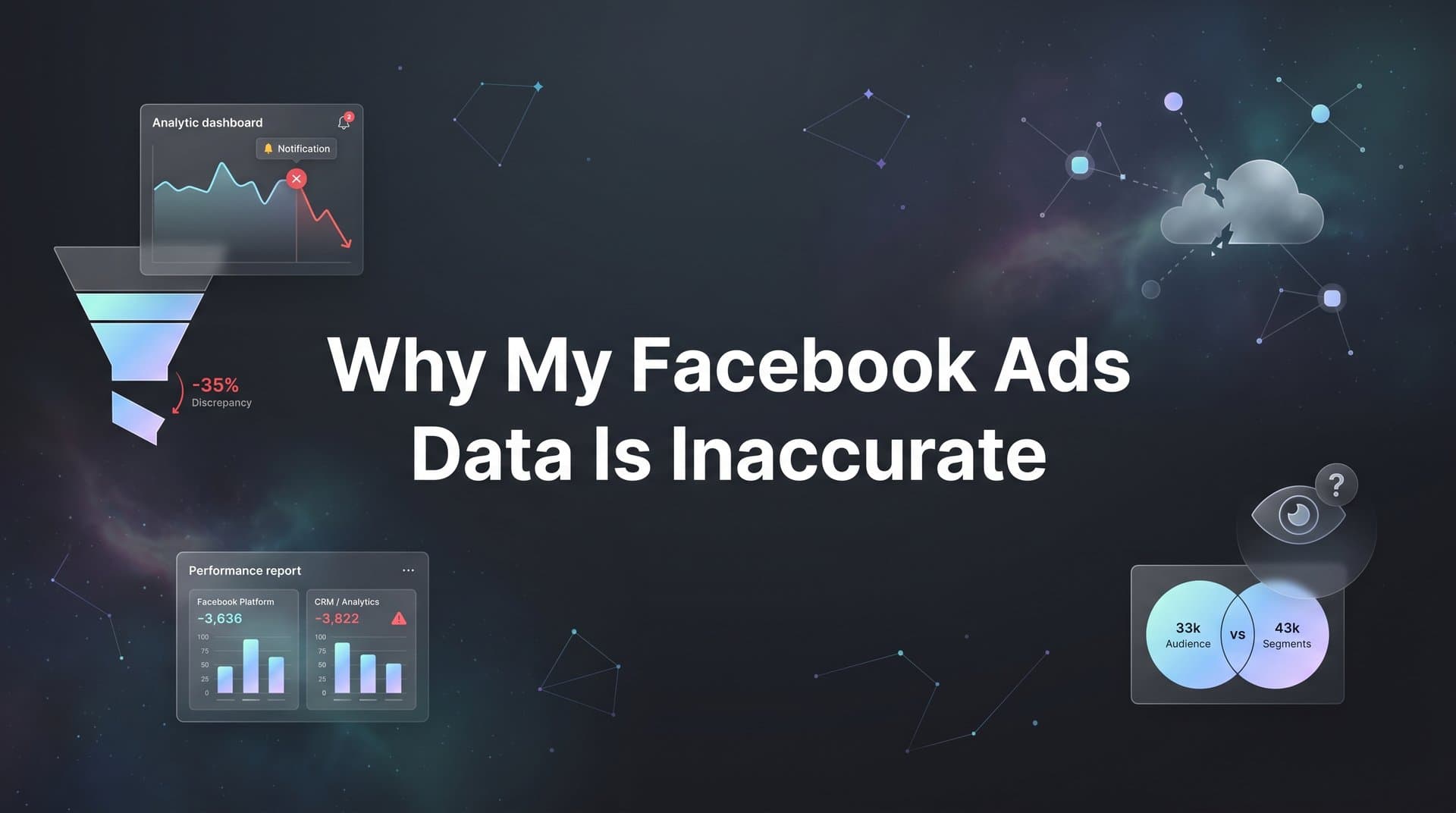
You log into Facebook Ads Manager and see a solid number of conversions reported. You feel good about the campaign. Then you open your CRM and the numbers tell a completely different story. Fewer leads, different sources, and revenue that doesn't line up with what Facebook is claiming. Sound familiar?
This disconnect is one of the most frustrating experiences in digital marketing. You're spending real money, making real decisions, and yet the data you're relying on may be telling you a story that's only partially true. The temptation is to assume it's a glitch, a setup error, or something you can fix with a quick pixel audit. But the reality is more complicated than that.
Facebook ads data inaccuracy is not a one-off technical hiccup. It's a systemic problem driven by multiple overlapping forces: sweeping privacy changes that have fundamentally altered how tracking works, attribution models that are designed to make Facebook look good rather than reflect reality, technical gaps in how conversion data is collected, and the messy truth of how customers actually move across devices and channels before they buy.
The good news is that understanding exactly why your Facebook ads data is inaccurate is the first step toward fixing it. This article walks through each of the root causes clearly and honestly, and then outlines what you can actually do to get back to data you can trust.
The Privacy Earthquake That Changed Everything
If you want to understand why your Facebook ads data is inaccurate today, you have to start with April 2021, when Apple released iOS 14.5 and introduced the App Tracking Transparency (ATT) framework. For the first time, iPhone and iPad users were prompted with a direct question: do you want this app to track your activity across other apps and websites? The answer, for the vast majority of users, was no.
Mobile analytics firms tracked opt-out behavior in the weeks and months following the rollout, and the data was striking. Most US users chose to decline tracking when prompted. This wasn't a niche privacy concern held by a small segment of tech-savvy users. It was a mainstream behavioral shift that cut Facebook off from one of its most valuable data streams: the ability to observe what users did after clicking an ad. Understanding why Facebook ads stopped working after iOS 14 requires grasping the full scale of this disruption.
Before ATT, Facebook could follow a user from an ad click through to a purchase on a third-party website or app, connecting the dots with high confidence. After ATT, that thread was severed for a large portion of iOS users. Facebook lost visibility into what those users did after leaving the platform.
The impact didn't stop with iOS. Browser-level privacy restrictions have been tightening for years. Safari's Intelligent Tracking Prevention (ITP) blocks third-party cookies by default, meaning any Facebook Pixel tracking that relies on those cookies is either limited or entirely blocked for Safari users. Firefox's Enhanced Tracking Protection works similarly. And while Google Chrome has moved more slowly, its Privacy Sandbox initiative signals the broader direction the industry is heading.
To compensate for these gaps, Facebook shifted toward statistical modeling. When it can't directly observe a conversion, it estimates whether one likely occurred based on patterns in the data it does have access to. Meta has acknowledged this modeling approach in its own documentation. The result is that a portion of the conversions you see reported in Ads Manager are not directly observed events. They are educated guesses, aggregated and modeled to fill in the gaps left by privacy restrictions. This is a major reason why tracking paid ads after the iOS update has become so challenging for advertisers.
This is where the core problem begins. You're making budget decisions based on numbers that include a layer of estimation, and Facebook doesn't always make it obvious which conversions are modeled and which are directly tracked. The gap between reported conversions and actual conversions captured in your CRM or backend systems is often a direct result of this modeling layer.
How Attribution Windows and Platform Bias Distort Your Numbers
Even setting aside privacy changes, Facebook's attribution model has its own built-in distortions that are worth understanding clearly.
Facebook's default attribution window is typically set to 7-day click and 1-day view. This means that if someone clicks your ad and converts within seven days, Facebook takes credit. If someone simply views your ad without clicking and then converts within one day, Facebook also takes credit. This is a generous window, and it has real consequences for how your data looks.
Think about what happens in a typical customer journey. A user clicks your Facebook ad on a Tuesday, doesn't convert, then searches for your brand on Google on Thursday, clicks an organic result, and purchases on Friday. Facebook claims that conversion because the click happened within the seven-day window. Google might also claim it if the user clicked a Google ad at any point. Your email platform might claim it if you sent a promotional email that week. Every platform is playing the same game, and the result is that your total attributed conversions across all platforms can add up to far more than your actual conversions. This is precisely why Facebook overreports conversions in so many accounts.
This is the fundamental problem with self-reported platform attribution. Every ad platform has an incentive to show you the best possible version of its own performance. Facebook is no different. Its attribution model is designed to maximize the number of conversions it can reasonably claim credit for, not to give you an accurate picture of how your marketing mix is actually working together.
Aggregated Event Measurement (AEM) adds another layer of complexity. Introduced in response to iOS 14.5, AEM limits advertisers to eight prioritized conversion events per domain. If you're running campaigns optimized for multiple conversion types (purchases, leads, add-to-carts, subscriptions), you have to choose which events matter most and rank them. Events that don't make the cut may be underreported or dropped entirely. This prioritization process means your data is shaped by constraints rather than reality.
The contrast with independent multi-touch attribution is significant. Instead of letting each platform self-report its own contribution, multi-touch attribution looks at the full sequence of touchpoints a customer interacted with before converting, and distributes credit across them based on actual influence. A thorough understanding of Facebook ads attribution helps you see why this independent approach is essential for accurate measurement.
Pixel Fires, Data Gaps, and Tracking Blind Spots
Beyond privacy and attribution model issues, there's a third category of problems that lives at the technical level: your tracking setup itself may be silently corrupting your data.
The Facebook Pixel is a piece of JavaScript that fires in a user's browser when they visit a page or take an action on your site. When it works correctly, it sends conversion data back to Facebook. When it doesn't work correctly, you often won't know. There's no alert that says "your pixel missed 30% of conversions today." The data just quietly disappears.
Common technical failures include improperly installed pixels that fire on some pages but not others, duplicate event firing that inflates your conversion counts, missing events on critical pages like order confirmation pages, and misconfigured custom conversions that track the wrong actions entirely. Each of these issues introduces noise into your data, and they can coexist in the same account without being obvious. If you're seeing conversions reported but no actual sales, this is often why ads show conversions but no sales in your backend.
Then there's the broader problem of client-side tracking limitations. The Pixel runs in the user's browser, which means anything that interferes with that browser environment can prevent it from firing. Ad blockers are used by a meaningful portion of internet users globally. VPNs can interfere with tracking scripts. Browser privacy settings beyond the major ones mentioned earlier can block pixel calls. The result is that a real segment of your audience is effectively invisible to client-side tracking, and those conversions go unreported.
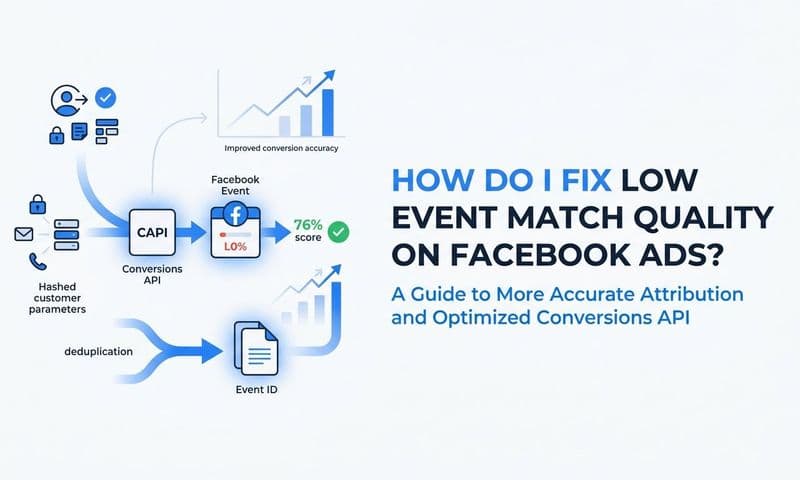
This is exactly why Meta recommends implementing the Conversions API (CAPI) alongside the browser Pixel. CAPI sends conversion data directly from your server to Facebook, bypassing the browser entirely. It doesn't matter if the user has an ad blocker installed or if their browser is restricting cookies. A detailed Conversion API implementation tutorial can walk you through the technical setup step by step.
Server-side tracking through CAPI doesn't eliminate all tracking challenges, but it closes a significant gap. When implemented correctly alongside the Pixel, it creates redundancy: if the browser-side event is blocked, the server-side event can still capture the conversion. Platforms like Cometly automate this server-side tracking setup, making it practical for marketing teams to implement without deep engineering resources. The result is a more complete picture of what's actually happening after someone clicks your ad.
The Cross-Device and Cross-Platform Problem
Here's a scenario that plays out constantly in modern buying behavior. A user scrolls through Instagram on their phone during lunch, sees your ad, and taps through to your website. They browse for a few minutes but don't buy. That evening, they're on their laptop, they search for your brand directly, visit your site again, and complete a purchase.
From Facebook's perspective, depending on whether it can connect those two sessions to the same user, it may or may not claim credit for that conversion. Without full tracking consent, stitching together a mobile session and a desktop session belonging to the same person becomes difficult or impossible. The conversion might go unattributed entirely, or it might be attributed to direct traffic on the desktop side while Facebook gets no credit at all. This is a core reason why attribution data doesn't match across your platforms and CRM.
Cross-device journeys are not edge cases. They're the norm. Customers move between phones, tablets, and desktops throughout their day, and they don't think about which device they're "supposed" to convert on. The tracking infrastructure, however, often treats each device session as a separate user, which creates gaps and misattribution throughout the funnel.
The multi-platform reality makes this even more complex. A customer might encounter your brand through a Facebook ad, later see a retargeting ad on Google, receive an email from your nurture sequence, and finally convert through a link in that email. Each platform in that chain has some legitimate claim to influence. But if your attribution is limited to what Facebook can observe, you're only seeing one piece of a much larger picture. Implementing unified tracking for Facebook and Google ads is essential for connecting these fragmented journeys.
Long sales cycles amplify this problem significantly, particularly in B2B or high-ticket consumer categories. If your average customer takes three weeks from first touch to purchase, Facebook's seven-day click window will miss a large portion of the conversions your ads actually influenced. Those customers are real, and your ads played a real role in their decision, but the data won't reflect it.
Real-World Impact: What Bad Data Costs You
It's easy to treat data inaccuracy as an abstract problem, something uncomfortable to acknowledge but not immediately urgent. The actual cost, though, is very concrete.
The most direct consequence is budget misallocation. When Facebook reports strong ROAS on a campaign that your CRM shows is generating low-quality leads or minimal revenue, you're likely to scale that campaign. You pour more money into it based on what the numbers appear to say. Meanwhile, a campaign that's genuinely driving revenue might look mediocre in Ads Manager because of attribution gaps, so you reduce its budget or turn it off entirely. You're essentially making investment decisions based on a distorted map. This is exactly how businesses end up wasting money on Facebook ads without realizing it.
There's also a feedback loop problem that's less visible but equally damaging. Facebook's algorithm optimizes based on the conversion signals you send it. When the conversion data you're feeding back to Facebook is incomplete or inaccurate, the algorithm trains itself on bad information. It optimizes toward users who look like your reported converters, but those reported converters may not actually represent your best customers. Over time, this degrades targeting quality, increases your cost per acquisition, and makes your campaigns progressively less efficient. Bad data going in means worse performance coming out.
The third consequence is decision paralysis. When your team can't reconcile what Facebook is reporting with what your CRM shows, trust in the data erodes. Marketers start relying on gut instinct rather than metrics. Scaling decisions get delayed. Campaigns run longer than they should because no one is confident enough to make a call. Understanding why marketing data accuracy matters for ROI is critical for breaking out of this cycle and restoring confidence in your decision-making.
This is why understanding why your Facebook ads data is inaccurate matters so much. It's not just a reporting problem. It's a business performance problem with real financial consequences.
Fixing the Data: A Practical Roadmap to Accurate Attribution
The good news is that this is a solvable problem. Not perfectly, and not overnight, but meaningfully and practically. Here's how to approach it.
Start with server-side tracking: Implementing the Conversions API is the single highest-impact technical step you can take to improve your Facebook data quality. By sending conversion events from your server directly to Meta, you capture conversions that browser-based tracking misses entirely. This means users with ad blockers, privacy-focused browsers, or iOS restrictions are no longer invisible. Platforms like Cometly handle this implementation automatically, connecting your website, CRM, and ad platforms through server-side event tracking without requiring a custom engineering build.
Build independent multi-touch attribution: Don't rely on Facebook to tell you how well Facebook is performing. An independent attribution platform connects your ad click data with your CRM outcomes and actual revenue, giving you a single source of truth that no individual ad platform controls. You can see the full customer journey, understand which touchpoints genuinely influenced a conversion, and compare Facebook's self-reported numbers against what actually happened in your business. Cometly's multi-touch attribution does exactly this, pulling together data from every channel into one unified view so you can make decisions based on complete information rather than platform-specific spin. Learning how to focus on tracking Facebook ads accurately is the foundation of this entire approach.
Sync enriched conversion data back to Facebook: This step is often overlooked, but it's critical for improving performance over time. When you capture more complete conversion data through server-side tracking and connect it with downstream outcomes from your CRM, you can send that enriched data back to Facebook's algorithm. Instead of training on partial, browser-only signals, Facebook's optimization engine gets a fuller picture of who actually converted and what they were worth. This improves targeting, reduces wasted spend, and creates a positive feedback loop where better data leads to better Facebook ads performance. Cometly's Conversion Sync feature automates this process, feeding enriched conversion events back to Meta, Google, and other platforms continuously.
Audit your pixel and event setup regularly: Even with server-side tracking in place, it's worth periodically verifying that your pixel is firing correctly, that events aren't duplicating, and that the right conversion actions are being tracked and prioritized under AEM. This isn't a one-time fix. It's ongoing maintenance that keeps your data foundation solid.
The combination of server-side tracking, independent attribution, and enriched conversion syncing addresses the core reasons why Facebook ads data is inaccurate. It won't make every number perfect, but it will give you a dramatically more accurate and actionable view of what your advertising is actually doing.
Taking Back Control of Your Marketing Data
Facebook ads data inaccuracy is not something you should accept as an unavoidable cost of running paid social campaigns. It's a real problem with identifiable causes and practical solutions, and the marketers who take it seriously gain a genuine competitive advantage over those who simply trust the numbers in Ads Manager.
The root causes are clear: privacy changes like iOS ATT and browser-level restrictions have forced Facebook to rely on modeled conversions. Attribution windows and self-reported platform data create systematic overcounting. Technical gaps in client-side tracking leave real conversions unrecorded. And the cross-device, multi-platform nature of modern buying behavior stretches beyond what any single platform can accurately observe.
The solution is equally clear: take ownership of your data through server-side tracking, build an independent source of attribution truth that connects ad activity to actual revenue, and feed enriched conversion signals back to the platforms to improve their optimization.
When you have accurate data, you scale what works and cut what doesn't. You make decisions with confidence instead of hesitation. And your ad platforms get better inputs, which means better outputs over time.
If you're ready to stop guessing and start seeing exactly which ads and campaigns are driving real revenue, Get your free demo of Cometly today and discover how AI-driven attribution can give you the complete, accurate picture your marketing decisions deserve.