

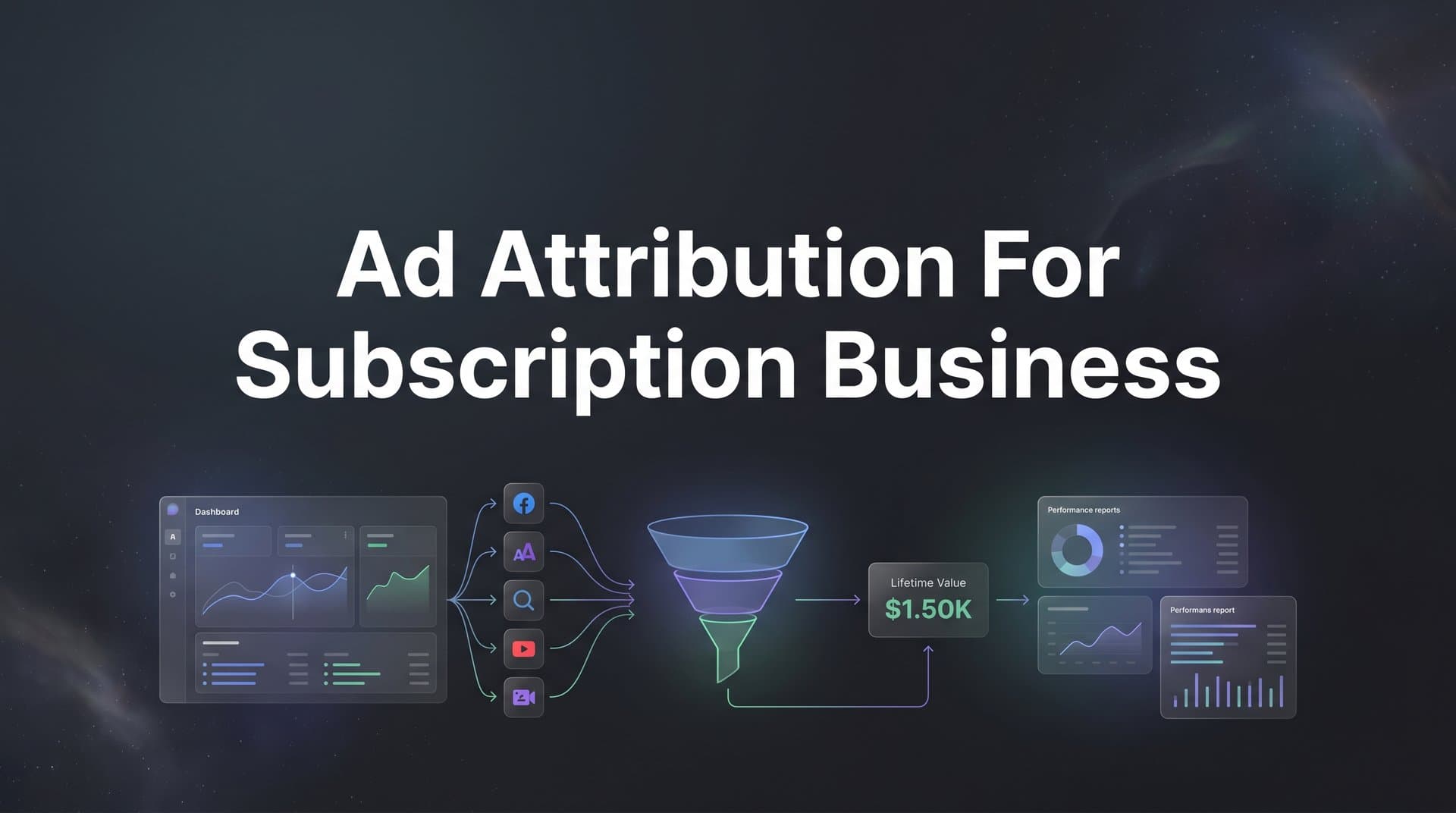
Subscription businesses face a unique attribution challenge: the moment someone clicks your ad and the moment they become a paying customer can be separated by days, weeks, or even months. Free trials, freemium models, and multi-step onboarding flows create complex customer journeys that traditional last-click attribution simply cannot track accurately.
When you cannot connect ad spend to actual recurring revenue, you end up scaling campaigns that look good on paper but fail to deliver profitable subscribers. You might celebrate 500 trial signups from a Facebook campaign, only to discover weeks later that those users converted at half the rate of your Google Search traffic.
The problem gets worse when you consider that subscription value compounds over time. A customer who stays for 24 months generates dramatically more revenue than one who churns after the first billing cycle, yet both look identical in your ad platform's conversion reporting on day one.
This guide covers seven strategies specifically designed for subscription business models, helping you track the full journey from first ad impression to paying customer and beyond. These approaches account for extended sales cycles, multiple touchpoints, and the critical difference between a signup and a valuable, long-term subscriber.
1. Track Beyond the Signup to Actual Subscription Conversions
The Challenge It Solves
Most ad platforms optimize for the conversion event you send them. If you only track trial signups, your campaigns will get really good at generating trial signups, regardless of whether those users ever become paying customers. This creates a dangerous disconnect between what looks like campaign success and what actually drives recurring revenue.
For subscription businesses, the signup is just the beginning of the customer journey. The real conversion happens when someone enters their payment information and completes their first billing cycle. Without tracking this actual subscription event, you are making budget decisions based on incomplete data.
The Strategy Explained
Connect your billing system or payment processor directly to your attribution platform so you can track when trial users convert to paid subscribers. This allows you to measure true subscription conversions rather than misleading signup metrics that do not correlate with revenue.
The key is creating a clear line of sight from ad click to paid subscription. When someone moves from trial to paid status in your billing system, that event should flow back to your attribution platform and ideally to your ad platforms as well. This gives you accurate data about which campaigns, ad sets, and creative assets actually drive paying customers.
Many subscription businesses discover that their best signup sources are not their best subscription sources. A channel might deliver high trial volumes but terrible conversion rates, while another brings fewer trials that convert at much higher rates. You cannot see this pattern without implementing proper conversion tracking for subscription business models.
Implementation Steps
1. Identify the exact moment in your customer journey that represents a true subscription conversion, whether that is first payment, end of trial with payment method added, or completion of first billing cycle.
2. Set up tracking to capture this conversion event from your billing system, CRM, or payment processor and send it to your attribution platform.
3. Configure your ad platforms to receive this subscription conversion data so their algorithms can optimize for actual paying customers rather than just trial signups.
Pro Tips
Track multiple conversion milestones if your funnel has distinct stages. You might track trial start, payment method added, first payment, and first renewal as separate events. This granular data helps you identify exactly where different traffic sources excel or struggle in your conversion funnel.
2. Implement Multi-Touch Attribution for Long Sales Cycles
The Challenge It Solves
Subscription purchases rarely happen on the first interaction. A potential customer might see your Facebook ad, visit your site, leave, search for reviews, click a retargeting ad, start a trial, receive email nurture sequences, and finally convert to paid weeks later. Last-click attribution credits only that final touchpoint, completely ignoring the journey that led there.
This creates a distorted view of campaign performance. The awareness campaigns that introduced your brand get zero credit, while retargeting campaigns that simply reminded already-interested users get all the credit. You end up under-investing in top-of-funnel channels that actually drive discovery and consideration.
The Strategy Explained
Multi-touch attribution models distribute conversion credit across multiple touchpoints in the customer journey. Instead of giving 100% credit to the last click, these models recognize that awareness, consideration, and conversion touchpoints all play important roles in driving subscriptions.
Different attribution models weight touchpoints differently. Linear models give equal credit to every interaction. Time-decay models give more weight to recent touchpoints. Position-based models emphasize first and last touches while acknowledging middle interactions. Understanding choosing attribution model for business needs depends on your typical customer journey length and the balance of awareness versus conversion campaigns you run.
For subscription businesses with trial periods of 14 to 30 days, multi-touch attribution is essential. The touchpoints that happen during the trial period, like educational emails or product tours, often influence the subscription decision as much as the original ad click.
Implementation Steps
1. Map your typical customer journey from first awareness through subscription conversion, identifying all the touchpoints where prospects interact with your brand.
2. Choose an attribution model that reflects how your customers actually make subscription decisions, considering your sales cycle length and the relative importance of awareness versus conversion touchpoints.
3. Implement tracking that captures all touchpoints across channels, including paid ads, organic search, email, direct traffic, and any other sources that influence subscription decisions.
Pro Tips
Compare multiple attribution models side by side rather than committing to just one. Looking at last-click, first-click, and linear attribution together gives you a more complete picture of channel performance. Channels that perform well across all models are genuinely strong performers, while those that only look good in last-click may be getting inflated credit.
3. Connect Your CRM Data to Ad Platform Optimization
The Challenge It Solves
Ad platforms use machine learning to find more people like your converters. But if you only send them trial signup data, their algorithms optimize for finding more trial signups, not more valuable subscribers. The platforms have no way to distinguish between a user who churned immediately and one who became a loyal customer for years.
This limitation means your ad platforms are training on incomplete success signals. They treat all conversions equally when, in reality, some conversions are worth 10 times more than others based on subscription length, plan tier, and engagement level.
The Strategy Explained
Feed subscription status and customer value data from your CRM back to your ad platforms. This enhanced conversion data helps platform algorithms understand the difference between high-value and low-value conversions, allowing them to optimize for the users most likely to become long-term subscribers.
Modern ad platforms like Meta and Google accept conversion value parameters that let you pass revenue amounts or custom value scores. You can send the actual subscription plan value, the predicted lifetime value, or engagement scores that indicate subscription quality. The algorithms use this information to find more users who match the profile of your best subscribers.
This approach is particularly powerful for subscription businesses because the value difference between customers is so significant. Implementing subscription business revenue attribution ensures your ad platforms know that a subscriber who stays for 36 months might be worth 36 times more than one who churns after month one.
Implementation Steps
1. Set up conversion value tracking that sends subscription plan amounts or customer value scores to your ad platforms when conversions occur.
2. Configure your CRM to update conversion values over time as customers renew, upgrade, or churn, giving ad platforms increasingly accurate signals about conversion quality.
3. Use these enhanced conversion events to create value-based lookalike audiences and allow value-based bidding strategies that prioritize high-value subscriber acquisition.
Pro Tips
Start with simple value signals like subscription plan tier or first-payment amount, then evolve to more sophisticated metrics like predicted LTV or engagement scores as your attribution system matures. Even basic value data dramatically improves ad platform optimization compared to treating all conversions as equal.
4. Build Attribution Around Customer Lifetime Value
The Challenge It Solves
First-payment metrics tell you which campaigns drive initial conversions, but they completely miss the retention picture. A campaign might deliver customers who convert quickly but churn after one month, while another brings subscribers who take longer to convert but stay for years. Standard attribution makes these campaigns look equally successful when their actual business impact is radically different.
For subscription businesses, customer lifetime value is the metric that actually matters. A campaign that delivers 100 subscribers with 90% monthly churn is far less valuable than one that brings 50 subscribers with 95% retention, even though the first campaign shows better initial conversion numbers.
The Strategy Explained
Shift your attribution focus from first-payment metrics to cohort-based lifetime value analysis by acquisition source. Track not just how many subscribers each campaign delivers, but how long those subscribers stay, which plans they choose, and what revenue they generate over time.
This means analyzing subscriber cohorts based on their acquisition channel and date. You might track the 6-month LTV of all subscribers acquired from Facebook ads in January versus those from Google Search in the same period. Robust revenue tracking for subscription businesses reveals which sources consistently deliver high-retention, high-value subscribers.
The insight often surprises marketers. Channels that look expensive on a cost-per-acquisition basis sometimes deliver the highest LTV subscribers, making them actually the most profitable sources. Meanwhile, cheap acquisition channels might bring subscribers who churn quickly, making their true cost-per-valuable-customer much higher than it appears.
Implementation Steps
1. Define your key LTV time horizons based on your business model, such as 3-month, 6-month, and 12-month LTV, choosing periods that balance data maturity with decision-making speed.
2. Tag all new subscribers with their acquisition source data so you can track cohort performance over time, ensuring this source attribution persists throughout the customer lifecycle.
3. Build reporting that shows LTV metrics by acquisition channel, campaign, and cohort, allowing you to compare the long-term value of subscribers from different sources rather than just their initial conversion metrics.
Pro Tips
Create a simple LTV scorecard that updates monthly, showing which acquisition sources delivered the highest-value subscriber cohorts over the past quarter. Use this to inform budget allocation decisions rather than relying solely on real-time conversion metrics that do not account for retention differences.
5. Use Server-Side Tracking to Overcome Privacy Limitations
The Challenge It Solves
Browser-based tracking faces increasing limitations from iOS privacy features, browser cookie restrictions, and ad blockers. These changes create attribution blind spots where you cannot track the full customer journey, leading to incomplete data about which campaigns drive subscriptions.
For subscription businesses with longer consideration periods, these tracking gaps are particularly damaging. If someone clicks your ad on their iPhone, researches your product over several days, and finally subscribes on their laptop, traditional browser tracking might miss the connection entirely. You lose visibility into the customer journey and cannot properly attribute the subscription to the original ad interaction.
The Strategy Explained
Server-side tracking collects conversion data directly from your servers rather than relying on browser cookies and pixels. When someone subscribes, your server sends that conversion event directly to your attribution platform and ad platforms, bypassing browser restrictions that would normally block or limit tracking.
This approach uses first-party data that you collect directly from user interactions with your platform. Because the data flows from your servers rather than through browser-based tracking scripts, it is not affected by cookie blocking, iOS privacy restrictions, or browser tracking prevention features.
Server-side tracking is especially valuable for subscription businesses because the most important conversion events, like trial-to-paid conversion and subscription renewals, happen in your backend systems anyway. Proper attribution tracking for subscription business models naturally suits server-side implementation since these events occur in your billing or CRM systems rather than in the user's browser.
Implementation Steps
1. Implement server-side tracking for your critical conversion events, starting with subscription conversions and trial starts that occur in your backend systems.
2. Set up conversion APIs for your major ad platforms so your server can send conversion data directly to Meta, Google, and other channels where you advertise.
3. Ensure your server-side tracking includes the necessary identifiers to match conversions back to ad clicks, such as click IDs or user identifiers that persist across the customer journey.
Pro Tips
Run browser-based and server-side tracking in parallel initially to validate that your server-side implementation captures conversions accurately. Once you confirm the data matches, you can rely primarily on server-side tracking for more complete, privacy-resistant attribution.
6. Create Custom Conversion Events for Each Subscription Milestone
The Challenge It Solves
Subscription funnels have multiple critical milestones between initial awareness and long-term customer retention. If you only track the final subscription conversion, you miss valuable insights about where different traffic sources excel or struggle within your funnel.
One campaign might drive users who start trials at high rates but rarely add payment methods. Another might bring fewer trials but those users complete onboarding steps at much higher rates. Without tracking these intermediate milestones, you cannot identify these patterns or optimize accordingly.
The Strategy Explained
Map and track the full subscription funnel from trial start through renewal as distinct conversion events. Create custom events for each meaningful milestone in your customer journey, such as trial started, onboarding completed, payment method added, first payment, and first renewal.
This granular event tracking lets you analyze funnel performance by traffic source. Comprehensive marketing analytics for subscription businesses shows which campaigns drive users who complete onboarding, which sources bring subscribers who add payment methods during trials, and which channels deliver customers who renew at the highest rates.
These insights reveal optimization opportunities that aggregate conversion metrics miss entirely. You might discover that your Facebook campaigns excel at driving trial starts but struggle at payment method addition, suggesting a need for better trial-period nurture sequences for that traffic source.
Implementation Steps
1. Map your complete subscription funnel, identifying every meaningful milestone from first visit through renewal that indicates progress toward becoming a valuable subscriber.
2. Implement tracking for each milestone as a distinct conversion event, ensuring each event includes source attribution data so you can analyze performance by campaign and channel.
3. Build funnel reports that show conversion rates between each milestone by traffic source, revealing where different campaigns and channels excel or underperform in your subscription journey.
Pro Tips
Use milestone conversion rates to calculate predicted subscription value for traffic sources. If you know that Facebook traffic converts from trial to paid at 15% while Google Search converts at 25%, you can adjust your bidding and budgets to account for these quality differences even before users reach the final subscription conversion.
7. Leverage AI Recommendations to Scale Winning Campaigns
The Challenge It Solves
Even with perfect attribution data, analyzing performance across multiple campaigns, ad sets, audiences, and creative variations becomes overwhelming. You have the data showing which campaigns drive valuable subscribers, but identifying the specific patterns and making confident scaling decisions requires analyzing hundreds of variables.
Manual analysis leads to delayed decisions and missed opportunities. By the time you identify a winning campaign pattern, market conditions may have shifted. You need a way to continuously analyze attribution data and surface actionable insights about what to scale and what to pause.
The Strategy Explained
Use AI-powered attribution platforms that analyze your conversion data and provide automated recommendations for campaign optimization. These systems identify high-performing campaigns across channels, suggest budget reallocation opportunities, and highlight underperforming ad spend that should be redirected.
AI recommendations work by analyzing patterns across your entire marketing mix, identifying campaigns that consistently deliver high-LTV subscribers, strong conversion rates, and efficient customer acquisition costs. When managing marketing attribution for multiple ad platforms, the system can spot trends that human analysis might miss, like specific audience and creative combinations that drive exceptional retention.
For subscription businesses, AI recommendations are particularly valuable because they can account for the time lag between ad click and subscription value. The system can identify campaigns that are currently driving strong trial starts and predict their likely subscription conversion and LTV based on historical patterns from similar cohorts.
Implementation Steps
1. Connect all your marketing channels and conversion data to an attribution platform that offers AI-powered recommendations and analysis.
2. Configure the AI system with your business goals and constraints, such as target customer acquisition cost, minimum LTV thresholds, and budget limits for different channels.
3. Review AI recommendations regularly and implement suggested optimizations, tracking the impact of changes to refine the system's understanding of what works for your specific subscription business.
Pro Tips
Start by implementing AI recommendations for budget reallocation between campaigns before moving to more complex optimizations. This builds confidence in the system while delivering immediate impact through better budget distribution across your proven winners and underperformers.
Putting These Strategies Into Action
Start by ensuring you can track conversions beyond the initial signup. Connect your billing system or CRM to your attribution platform so you are measuring actual subscription conversions rather than misleading trial metrics. This single change often reveals that your best signup sources are not your best subscription sources, fundamentally shifting where you should invest.
Then implement multi-touch attribution to understand which touchpoints actually influence subscription decisions throughout your extended sales cycle. For subscription businesses, the journey from first ad impression to paying customer involves multiple interactions, and last-click attribution misses most of that story.
As you gather data, shift your focus from first-payment metrics to lifetime value analysis. Build cohort reports that show which acquisition sources deliver subscribers who stay longest and generate the most revenue. This LTV-focused approach prevents you from over-investing in channels that drive cheap acquisitions but terrible retention.
Implement server-side tracking to maintain attribution accuracy despite increasing privacy restrictions. Browser-based tracking faces growing limitations, and server-side approaches ensure you can still connect ad clicks to subscription conversions even as cookies and pixels become less reliable.
With accurate attribution in place, you can confidently scale the campaigns that bring valuable, long-term subscribers rather than chasing vanity metrics that fail to translate into recurring revenue. The difference between optimizing for signups versus optimizing for high-LTV subscribers compounds dramatically over time, making attribution accuracy one of the highest-leverage improvements you can make.
Ready to elevate your marketing game with precision and confidence? Discover how Cometly's AI-driven recommendations can transform your ad strategy. Get your free demo today and start capturing every touchpoint to maximize your conversions.


