You're running a campaign that should be crushing it. The creative is sharp, the targeting is dialed in, and the landing page converts. But when you check your dashboard, the numbers tell a different story—conversions look weak, ROAS is underwhelming, and you're second-guessing decisions that should be working.
Here's the twist: your campaign might actually be performing exactly as planned. The problem isn't your strategy. It's that ad blockers are silently intercepting the signals that prove it's working.
In 2026, ad blocking has evolved from a niche browser extension into a mainstream privacy tool. Millions of users browse with some form of tracking protection enabled—whether through dedicated ad blockers, browser privacy features, or network-level filtering. Each blocked script creates a blind spot in your attribution data. Conversions happen, but your analytics never sees them. Touchpoints vanish from the customer journey. Your ad platforms optimize campaigns based on incomplete information, making progressively worse decisions.
This isn't a small problem affecting a handful of tech-savvy users. This is a systematic erosion of the data infrastructure that modern marketing depends on. And if you're still relying exclusively on client-side tracking methods, you're flying blind more often than you realize.
The good news? This is a solvable problem. Understanding exactly how ad blockers interfere with tracking—and which modern solutions can reclaim your data accuracy—is the difference between guessing and knowing what's actually driving revenue.
The Hidden Data Gap: How Ad Blockers Intercept Your Marketing Signals
Ad blockers don't just hide banner ads. They systematically identify and neutralize the tracking mechanisms that marketers rely on to measure campaign performance. Understanding how they work reveals why so much of your attribution data goes missing.
At the technical level, ad blockers operate through filter lists—massive databases of known tracking domains, script patterns, and pixel URLs. When your browser requests a resource, the ad blocker checks it against these lists. If it matches a known tracking pattern, the request gets blocked before it ever executes. Your Facebook pixel? Blocked. Your Google Analytics script? Intercepted. Your UTM parameters? Potentially stripped.
The most widely used filter lists, like EasyList and EasyPrivacy, contain hundreds of thousands of rules specifically designed to identify marketing and analytics scripts. They recognize common patterns: pixel.js files, tracking subdomains, conversion endpoints. Even if you're using a relatively obscure analytics platform, chances are it's already on someone's blocklist.
Beyond static filter lists, modern ad blockers employ heuristic detection—analyzing script behavior in real time to identify tracking activity even from sources not yet cataloged. If a script sets cookies, sends data to third-party domains, or monitors user behavior, heuristic engines flag it as potential tracking and block execution.
Browser-Based Blocking: Safari's Intelligent Tracking Prevention (ITP) and Firefox's Enhanced Tracking Protection (ETP) are built directly into the browser. These aren't optional extensions users need to install—they're default privacy features that millions of people use without even knowing it. ITP limits third-party cookie lifespans and blocks cross-site tracking. ETP blocks known trackers from loading entirely.
Extension-Based Blocking: Tools like uBlock Origin, Privacy Badger, and Ghostery give users granular control over what executes in their browser. These extensions are more aggressive than browser defaults, often blocking first-party analytics alongside third-party trackers. They update their filter lists constantly, staying ahead of new tracking techniques.
Network-Level Blocking: DNS-based ad blockers like Pi-hole and NextDNS operate at the network level, blocking tracking requests before they ever reach the browser. This means even mobile apps and smart TV ads can be filtered. For marketers, this is the most comprehensive form of blocking—and the hardest to work around with traditional tracking methods.
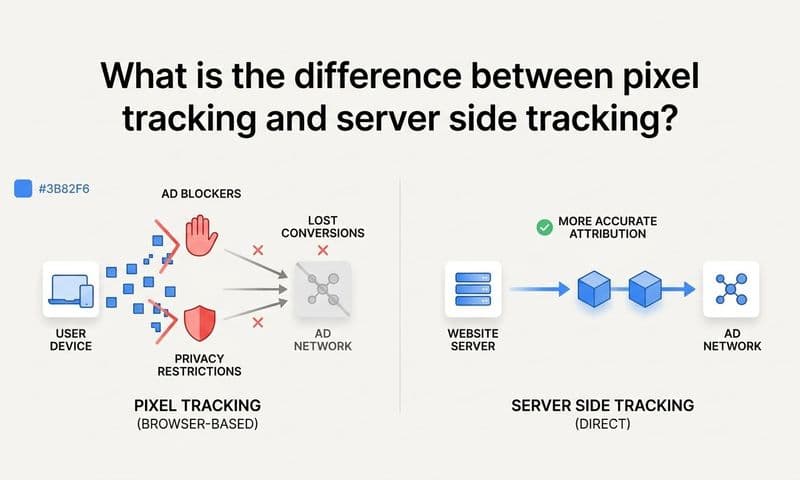
The tracking methods most vulnerable to these blocking techniques are precisely the ones marketers have relied on for years. Client-side pixels that fire JavaScript in the user's browser get blocked first. Third-party cookies that track users across domains are either blocked outright or severely limited in lifespan. Even first-party analytics scripts can be caught if they match known tracking patterns or exhibit suspicious behavior.
The result is a systematic data gap. Every blocked script represents a conversion you can't see, a touchpoint you can't attribute, and a signal your ad platforms never receive. Your attribution models run on incomplete data. Your optimization algorithms make decisions based on a fraction of actual performance. And you're left wondering why campaigns that should be winning look like they're barely breaking even.
If you're evaluating vendors, our AI banner ad generator breakdown can help.
The Real Cost to Your Marketing Attribution
When ad blockers prevent tracking scripts from firing, the immediate consequence is obvious: conversions go unreported. But the downstream effects ripple through your entire marketing operation in ways that are harder to spot and more damaging than missing data points.
Start with the basics. A user clicks your Facebook ad, browses your site, and converts. But if their ad blocker prevented your pixel from loading, that conversion never gets reported back to Meta. Your dashboard shows the click but not the sale. Your ROAS calculation is wrong. You're undervaluing a campaign that's actually profitable.
Multiply this across hundreds or thousands of conversions, and suddenly you're making budget decisions based on fiction. You cut spend on channels that are working. You scale campaigns that are underperforming. You optimize toward metrics that don't reflect reality.
The problem compounds when you consider how ad platform algorithms work. Meta's algorithm, Google's Smart Bidding, TikTok's optimization engine—they all depend on conversion signals to learn what's working. When ad blockers prevent those signals from reaching the platform, the algorithm optimizes based on incomplete data. It thinks certain audiences don't convert when they actually do. It deprioritizes ad variations that are performing well. It makes worse decisions with every iteration.
This creates a vicious cycle. Incomplete data leads to poor optimization. Poor optimization leads to worse results. Worse results lead to budget cuts. And the campaigns that were actually driving revenue get starved of resources because the data never proved their value.
Attribution Model Breakdown: Multi-touch attribution suffers most from blocked tracking because it depends on capturing every touchpoint in the customer journey. When ad blockers prevent mid-funnel interactions from being recorded, your attribution model can't connect the dots between awareness and conversion. Understanding touchpoint tracking analytics becomes critical for identifying these gaps.
A customer might see your YouTube ad, click a Facebook retargeting ad, read your blog post, and then convert through organic search. But if ad blockers prevented the YouTube and Facebook touchpoints from being tracked, your attribution model only sees the blog visit and organic search. You credit SEO for a conversion that was actually driven by paid campaigns. Your budget shifts toward organic content when you should be scaling paid ads.
Last-click attribution models fare slightly better because they only need to capture the final touchpoint. But they still miss conversions entirely when ad blockers prevent the conversion pixel from firing. And they systematically undervalue upper-funnel campaigns that introduce users to your brand but don't get credit under a last-click model.
The financial impact is real. Companies often discover they've been underspending on profitable channels by 30-50% because their tracking made those channels appear less effective than they were. Conversely, they've been overspending on channels that appeared profitable but were actually just capturing the last click on journeys driven by other sources.
Beyond budget allocation, incomplete tracking erodes confidence in your data. When you can't trust your metrics, you can't make decisive moves. You hesitate to scale winning campaigns. You second-guess creative decisions. You waste time in meetings debating data discrepancies instead of optimizing performance.
Server-Side Tracking: Moving Data Collection Beyond the Browser
The fundamental problem with traditional tracking is that it happens in the user's browser—exactly where ad blockers have complete control. Server-side tracking solves this by moving data collection to your server, where ad blockers can't interfere.
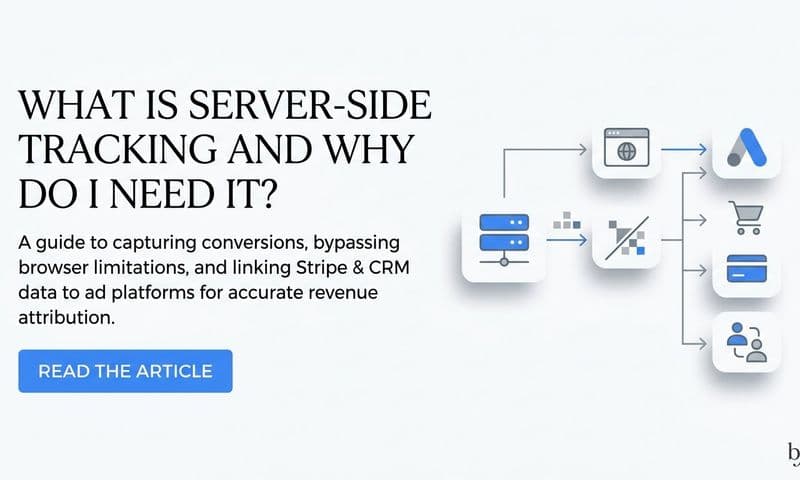
Here's how it works. Instead of loading a tracking pixel directly in the user's browser, your website sends conversion data to your own server first. Your server then forwards that data to analytics platforms and ad networks through server-to-server connections. From the user's perspective, they're only interacting with your first-party domain. No third-party scripts. No suspicious tracking pixels. No red flags for ad blockers to identify.
This approach bypasses browser-based blocking entirely because the data collection happens server-side, after the user's browser has already sent the initial request to your domain. Ad blockers can't block what they never see. The tracking request appears as normal first-party traffic—indistinguishable from any other communication between your website and your server.
First-Party Data Collection: Server-side tracking aligns perfectly with first-party data tracking strategies. You're collecting information directly through your own infrastructure, not relying on third-party cookies or cross-domain tracking. This data is more accurate, more complete, and far more resilient to privacy restrictions.
When a user submits a form, makes a purchase, or triggers any meaningful action on your site, your server captures that event along with relevant context—referral source, campaign parameters, user identifier. You control the data. You decide what to share with ad platforms. And you can enrich it with additional information from your CRM or database before sending it downstream.
This creates a more complete picture of the customer journey. Instead of relying on fragmented browser cookies that expire or get blocked, you're building a unified customer profile based on server-side events. You can track users across sessions, devices, and channels—as long as they're logged in or identifiable through your first-party systems.
Implementation Considerations: Server-side tracking isn't a flip-the-switch solution. It requires technical infrastructure and careful planning. You need a server environment capable of handling tracking requests in real time. You need to implement proper data routing to send events to the right platforms. And you need to ensure compliance with privacy regulations while collecting and transmitting user data. A comprehensive server-side tracking implementation guide can help you navigate these requirements.
For companies with significant ad spend and complex attribution needs, the investment is worth it. Server-side tracking dramatically improves data accuracy, reduces the impact of ad blockers, and provides more control over how your data is collected and used. For smaller operations with simpler tracking needs, the technical overhead might outweigh the benefits—at least until ad blocking becomes even more prevalent.
The key is understanding when server-side tracking makes sense for your marketing stack. If you're running multi-channel campaigns with complex attribution requirements, if you're seeing significant data discrepancies between platforms, or if you're in an industry where ad blocker usage is particularly high, server-side tracking should be a priority. If you're running simple campaigns with straightforward conversion tracking, you might get by with hybrid approaches that combine client-side and server-side methods.
Feeding Ad Platforms Better Data Despite Blocking Challenges
Even with server-side tracking in place, you still need to get conversion data to the ad platforms running your campaigns. This is where conversion APIs become essential—they maintain the data flow that ad platform algorithms depend on, regardless of what's happening in the user's browser.
Meta's Conversions API, Google's Enhanced Conversions, TikTok's Events API—these tools allow you to send conversion data directly from your server to the ad platform. No browser involvement. No pixels to block. Just server-to-server communication that ad blockers can't intercept.
The advantage goes beyond just bypassing ad blockers. Conversion APIs let you send enriched conversion events that include additional context your pixel could never capture. Customer lifetime value, subscription tier, product category, offline purchases—all of this can be included in the conversion event you send to the ad platform. The algorithm gets a richer signal to optimize against, leading to better targeting and more efficient spending.
Algorithm Optimization: Ad platform algorithms are only as good as the data they receive. When you feed them complete, accurate conversion data through conversion APIs, they can identify patterns more effectively. They learn which audiences actually convert, which creative resonates, which placements drive results. The optimization loop tightens, and your campaigns perform better.
This is particularly important for campaigns using automated bidding strategies. Smart Bidding, Campaign Budget Optimization, automated targeting—these features depend entirely on conversion signals to function. When ad blockers prevent those signals from reaching the platform, automation fails. The algorithm can't optimize what it can't see. But when you're sending conversion data through server-side APIs, the algorithm gets the complete picture and can make smarter decisions.
The data you send through conversion APIs can also be matched back to specific ad interactions using parameters like click IDs and user identifiers. This allows the ad platform to attribute conversions accurately even when browser-based tracking fails. You're essentially building a redundant attribution system that doesn't depend on pixels or cookies.
Building Redundancy: The most resilient tracking infrastructure combines multiple attribution tracking methods. Client-side pixels capture data when they can. Server-side tracking picks up what client-side methods miss. Conversion APIs ensure ad platforms receive conversion signals regardless of browser restrictions. And CRM-based attribution ties everything together with first-party customer data.
This redundancy is critical because no single tracking method is bulletproof. Client-side pixels get blocked. Server-side implementations can have technical issues. Conversion APIs require proper setup and maintenance. But when you layer these methods together, you create a tracking system that's far more reliable than any individual approach.
The goal isn't to track users more aggressively—it's to ensure that the tracking you're already doing actually works. When someone converts, you want that conversion counted. When a campaign drives results, you want those results attributed correctly. Redundant tracking infrastructure makes that possible even as privacy features and ad blockers become more sophisticated.
Building a Resilient Tracking Strategy for the Privacy-First Era
The trajectory is clear: browsers are adding more privacy features, ad blocker adoption is growing, and regulatory pressure is increasing. The tracking methods that worked in 2020 are less effective in 2026, and they'll be even less effective in 2027. Building a resilient tracking strategy means accepting this reality and adapting your infrastructure accordingly.
The foundation of a resilient strategy is diversification. Don't rely on any single tracking method. Combine client-side pixels for users who allow them, server-side tracking for more reliable data collection, and CRM-based attribution for the complete customer view. Each method has strengths and weaknesses. Together, they create a more complete picture than any single approach.
First-Party Data Prioritization: The most future-proof tracking strategy is one that prioritizes first-party data. Collect information directly through your own touchpoints—website interactions, email engagement, CRM records, customer service interactions. This data is inherently more reliable because it doesn't depend on third-party cookies or cross-domain tracking. Learn more about first-party data tracking setup to build this foundation.
Building direct relationships with customers becomes a competitive advantage. When users create accounts, subscribe to newsletters, or make purchases, you gain the ability to track their journey using first-party identifiers that aren't affected by ad blockers or browser restrictions. You can connect their behavior across devices and sessions. You can attribute conversions accurately even when traditional tracking methods fail.
This shift requires rethinking how you collect data. Instead of passively tracking anonymous visitors, you're actively building relationships that give users a reason to identify themselves. Gated content, loyalty programs, personalized experiences—these tactics aren't just about engagement, they're about creating opportunities to collect first-party data that powers more accurate attribution.
Privacy-First Doesn't Mean Data-Blind: Some marketers interpret privacy restrictions as meaning they can't track anything. That's not true. Privacy-first tracking means being transparent about what you collect, giving users control over their data, and respecting their choices. It doesn't mean abandoning measurement altogether.
You can still track conversions, measure campaign performance, and optimize based on data—you just need to do it in ways that respect user privacy and work within modern browser restrictions. Server-side tracking, first-party data collection, and conversion APIs all accomplish this. They provide the measurement you need without relying on invasive cross-site tracking or third-party cookies. Exploring cookieless attribution tracking solutions is essential for this transition.
The key is building infrastructure that works with privacy features rather than fighting against them. Use first-party domains for tracking. Implement server-side data collection. Leverage conversion APIs. Focus on measuring outcomes rather than surveilling behavior. These approaches give you the data you need while respecting the privacy expectations of modern users.
Future-Proofing Your Attribution: Browser privacy features will continue evolving. Ad blockers will get more sophisticated. Regulatory requirements will become stricter. Your tracking strategy needs to anticipate these changes rather than reacting to them after they break your measurement.
That means investing in infrastructure that's built for the long term. Server-side tracking isn't just a workaround for current ad blocker limitations—it's a fundamental shift toward more reliable, privacy-compliant data collection. First-party data strategies aren't just about compliance—they're about building direct customer relationships that provide better data than anonymous tracking ever could.
The companies that thrive in this environment are the ones that see privacy restrictions not as obstacles but as forcing functions for better marketing. They build tracking systems that are more accurate, more transparent, and more resilient. They focus on measuring what matters rather than tracking everything possible. And they use their data to create better customer experiences, not just to optimize ad campaigns. Understanding best practices for tracking conversions accurately helps ensure your data remains reliable.
Reclaiming Your Attribution Accuracy
Ad blockers affecting tracking isn't a problem you can ignore or wish away. It's a fundamental challenge that requires a fundamental shift in how you approach measurement. The good news is that this shift—toward server-side tracking, first-party data, and privacy-compliant measurement—makes your attribution more accurate, not less.
Traditional client-side tracking was never as reliable as marketers believed. Cookies expired. Pixels failed to load. Cross-domain tracking broke. Ad blockers just made these existing weaknesses more obvious. The solution isn't to fight harder to preserve old tracking methods. It's to build new infrastructure that's more resilient from the ground up.
Server-side tracking captures data that client-side methods miss. Conversion APIs maintain the data flow to ad platforms regardless of browser restrictions. First-party data strategies build direct customer relationships that provide richer insights than anonymous tracking ever could. And when you layer these approaches together, you create a tracking system that's far more reliable than anything you had before. The right attribution tracking tools make this integration seamless.
The companies winning in 2026 aren't the ones clinging to legacy tracking methods. They're the ones that embraced the privacy-first era early, invested in modern measurement infrastructure, and built attribution systems that actually reflect reality. They're making better decisions because they have better data. They're scaling campaigns with confidence because they know what's actually driving results.
Ready to elevate your marketing game with precision and confidence? Discover how Cometly's AI-driven recommendations can transform your ad strategy—Get your free demo today and start capturing every touchpoint to maximize your conversions.