

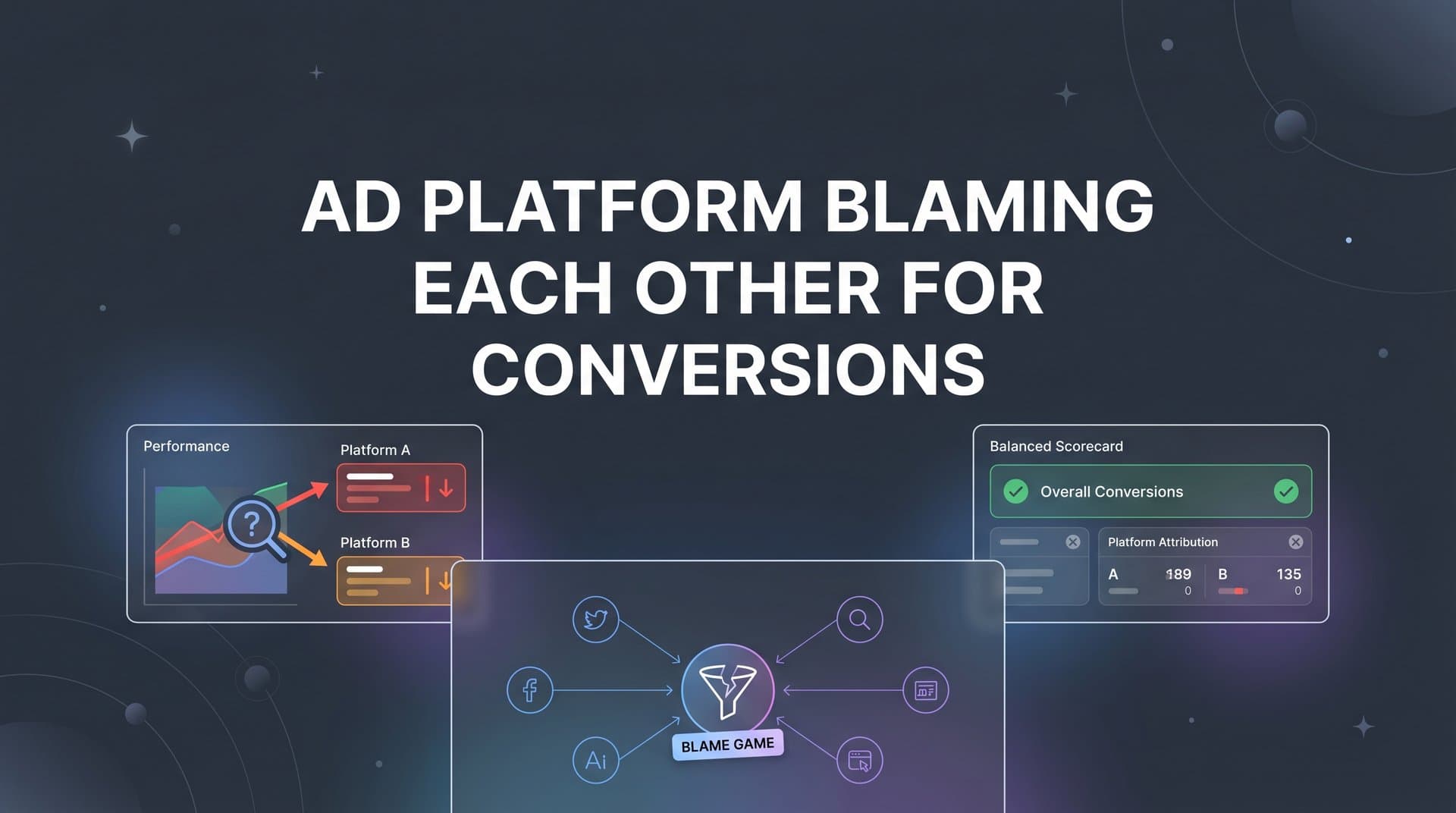
You open your Meta Ads Manager and see 50 conversions. Feeling good, you switch tabs to Google Ads—45 conversions there too. Then you check TikTok: 30 conversions. That's 125 conversions total across your platforms. You're about to celebrate until you open your CRM and see the reality: only 60 actual sales came in.
What just happened?
Welcome to the ad platform blame game, where every channel claims credit for conversions they may or may not have actually driven. This isn't a glitch in the system. It's exactly how ad platforms are designed to work. Each one uses its own attribution rules, its own lookback windows, and its own definition of what counts as a conversion. The result? A credit war that leaves you with inflated numbers, conflicting data, and no clear path to making smart budget decisions.
This article breaks down why ad platforms keep blaming each other for conversions, how their self-reporting creates chaos in your analytics, and most importantly, how to cut through the noise to find the truth about what's actually driving revenue.
The Self-Reporting Problem: Why Every Platform Claims the Win
Here's the uncomfortable truth: ad platforms are not neutral observers. They're salespeople for their own advertising inventory. When Meta reports conversions, it's showing you data through a lens designed to make Meta look valuable. Same with Google. Same with TikTok. Same with every platform you're running ads on.
Each platform uses its own attribution model, and these models are built to maximize the platform's perceived contribution to your results. Meta defaults to a 7-day click and 1-day view attribution window. That means if someone clicked your Meta ad anytime in the past week, or even just saw it yesterday, Meta will claim credit for that conversion. Google Ads offers various attribution models with lookback windows that can stretch up to 90 days. TikTok has its own rules. LinkedIn has different ones.
Think about what this means in practice. A potential customer sees your Meta ad on Monday. They don't click. On Wednesday, they search for your product on Google and click your search ad. On Friday, they come back directly to your site and make a purchase. Meta counts that conversion because of the view on Monday. Google counts it because of the click on Wednesday. Your direct traffic gets credit too because that's where the final session came from.
One conversion. Three platforms claiming full credit.
This isn't a bug. It's a feature. Platforms have no incentive to share credit or acknowledge when another channel influenced the conversion. Their business model depends on you believing that their platform drives results. The more conversions they can claim, the more confident you feel increasing your ad spend with them. This is exactly why ad platforms taking credit for the same conversion has become such a widespread problem.
The problem compounds when you're running campaigns across multiple platforms simultaneously. Every platform is tracking users with its own pixel or tag, applying its own attribution rules, and reporting conversions that overlap significantly with what other platforms are claiming. There's no coordination between them. No shared understanding of who actually deserves credit. Just separate dashboards, each telling you a different story about the same customers.
This creates a fundamental trust problem. When every platform is designed to over-report its contribution, which one do you believe? The answer is none of them, at least not in isolation.
How Attribution Windows Create Duplicate Conversions
Let's walk through exactly how attribution windows turn one real conversion into multiple claimed conversions across your ad platforms.
Meet Sarah. She's your ideal customer, and she's about to buy your product. Here's her journey:
Monday: Sarah scrolls through Instagram and sees your carousel ad. She doesn't click, but she notices your brand. Meta's pixel fires and logs this as an impression.
Wednesday: Sarah searches "best [your product category]" on Google. Your search ad appears at the top. She clicks through to your landing page, browses for a few minutes, but doesn't buy yet. Google's tracking code captures this click.
Thursday: Sarah sees your TikTok video ad while scrolling before bed. Again, no click, but TikTok logs the view.
Friday: Sarah types your URL directly into her browser, lands on your site, and completes a purchase.
One customer. One purchase. One conversion in your CRM. But here's what your ad platforms report:
Meta claims the conversion because Sarah saw the Instagram ad within their 1-day view attribution window. Even though she didn't click, Meta's model gives them credit for creating awareness that led to the eventual purchase.
Google claims the conversion because Sarah clicked the search ad within their default click attribution window. From Google's perspective, that click was the decisive moment that drove the conversion.
TikTok claims the conversion because the video view happened within their attribution window. They see themselves as the final touchpoint before the purchase.
Even your direct traffic gets counted as a conversion source in Google Analytics because that's where the final session originated. Many marketers find they simply can't track conversions across multiple platforms accurately using native tools alone.
This is where view-through attribution versus click-through attribution becomes critical. Click-through attribution only counts conversions when someone actually clicked your ad. View-through attribution counts conversions when someone simply saw your ad, even if they never interacted with it. Platforms default to settings that include view-through attribution because it inflates their numbers significantly.
The situation has gotten worse since iOS 14.5 introduced App Tracking Transparency. When users opt out of tracking, platforms lose visibility into significant portions of the customer journey. To compensate, many platforms have adjusted their modeling and estimation techniques, which can lead to even more discrepancies between what platforms report and what actually happened.
Browser restrictions on third-party cookies have created similar blind spots. Safari's Intelligent Tracking Prevention and Firefox's Enhanced Tracking Protection limit how long platforms can track users across the web. When tracking breaks down, platforms often fill in gaps with modeled conversions—educated guesses based on aggregate data patterns.
The result? Platform data has become less reliable precisely when you need it most. You're making budget decisions worth thousands or millions of dollars based on incomplete, biased, and often contradictory information.
The Hidden Cost of Trusting Platform Data
The ad platform blame game isn't just an annoying analytics problem. It has real financial consequences that compound over time.
Budget Misallocation: When you trust platform-reported data, you often shift budget toward channels that appear to perform well but actually rely heavily on other touchpoints to close conversions. A channel that looks like your top performer might just be good at taking credit for conversions that other channels set up. You increase spend there, expecting proportional returns, but instead see diminishing results because the attribution was misleading from the start.
Many marketers experience this when they scale a "winning" channel only to discover that it doesn't maintain its efficiency at higher budgets. The channel wasn't actually driving those conversions independently. It was part of a multi-touch journey, and when you cut budget from other channels to feed it, the whole ecosystem suffers. Understanding underreporting conversions in ad platforms is just as critical as recognizing over-reporting.
Scaling Failures: This misattribution creates a dangerous feedback loop. You see strong performance in one platform's dashboard, so you double down. The platform claims even more conversions as your spend increases, reinforcing your belief that you made the right call. But your overall business metrics tell a different story. Revenue doesn't scale proportionally. Customer acquisition costs creep up. The math stops working.
The problem is that you're optimizing for a metric that doesn't reflect reality. You're chasing phantom conversions, making decisions based on inflated numbers that don't connect to actual business outcomes.
Decision Paralysis: Perhaps the most insidious cost is the erosion of confidence in your own decision-making. When every platform tells you a different story, and none of them match your CRM data, how do you move forward? Marketing teams often find themselves unable to make decisive optimization moves because they cannot trust any single data source.
This leads to analysis paralysis. You spend more time trying to reconcile conflicting reports than actually improving your campaigns. Team meetings devolve into debates about which platform to believe rather than strategic discussions about growth. The inability to establish a single source of truth slows down your entire marketing operation.
There's also an opportunity cost. While you're stuck trying to figure out which platform is telling the truth, your competitors who have solved this attribution problem are moving faster, optimizing more confidently, and gaining market share.
Independent Attribution: The Only Way to End the Blame Game
The solution to the ad platform blame game isn't picking which platform to trust. It's implementing a neutral third party that tracks the entire customer journey from first touch to final conversion, independent of any single platform's bias.
This is where independent attribution platforms fundamentally change the game. Instead of relying on Meta's version of events or Google's perspective, you track every touchpoint yourself. You capture when someone sees a Meta ad, when they click a Google ad, when they visit from TikTok, and when they finally convert—all in one unified system that connects to your actual revenue data in your CRM.
The key difference is that independent attribution isn't trying to sell you more ad spend on any particular platform. It's simply showing you what happened. No bias toward claiming credit. No incentive to inflate numbers. Just a clear, accurate record of how customers actually found you and what sequence of touchpoints led to revenue. Learning how to track cross platform conversions is the first step toward ending the blame game.
Server-Side Tracking Changes Everything: Traditional platform pixels rely on browser-based tracking, which has become increasingly unreliable. Ad blockers strip them out. Privacy settings block them. Browser restrictions limit them. Server-side tracking solves this by capturing conversion data on your server and sending it directly to your attribution platform, bypassing the limitations of client-side tracking.
This means you capture conversions that platform pixels miss. When someone opts out of tracking on iOS, your server still knows they converted. When a browser blocks third-party cookies, your server-side implementation continues working. You get a complete picture of the customer journey, not the fragmented view that platforms see through their increasingly restricted pixels.
Multi-Touch Attribution Reveals True Contribution: Independent platforms enable multi-touch attribution models that show the actual contribution of each channel rather than giving 100% credit to whoever touched last or whoever has the most generous attribution window.
Linear attribution divides credit equally across all touchpoints. Time-decay models give more credit to recent interactions. Position-based models emphasize first and last touch while still acknowledging middle interactions. Data-driven models use machine learning to assign credit based on actual conversion patterns in your specific data.
The model you choose matters less than the fact that you're finally seeing the full journey. You can understand which channels create awareness, which ones drive consideration, and which ones close deals. This reveals the true role each platform plays in your marketing ecosystem.
You might discover that Meta is exceptional at top-of-funnel awareness but rarely closes deals on its own. Google search might be the channel that converts prospects who were already warmed up by other touchpoints. TikTok might drive impulse purchases for certain products but require retargeting for others. These insights are invisible when you only look at last-click attribution or trust platform-reported numbers.
Turning Accurate Data Into Better Ad Performance
Accurate attribution isn't just about understanding the past. It's about making better decisions going forward and actually improving your ad performance across all platforms.
Once you know true attribution, you can confidently reallocate budget to channels that actually drive revenue. This doesn't mean cutting channels that don't get last-click credit. It means understanding each channel's role and investing appropriately. If Meta is your awareness engine, you fund it at the level needed to fill your funnel. If Google search converts those aware prospects, you ensure you're capturing that demand. If TikTok drives impulse purchases for specific products, you scale it strategically for those SKUs.
Budget decisions become strategic rather than reactive. You're no longer shifting money around based on which platform claimed the most conversions this week. You're investing based on how channels work together to drive actual business outcomes. Implementing cross platform attribution software makes this level of strategic planning possible.
The Feedback Loop That Improves Everything: Here's where it gets really powerful. When you feed enriched conversion data back to ad platforms through their Conversion APIs, you improve their algorithms and targeting capabilities. Platforms like Meta and Google use conversion data to train their machine learning models. The more accurate and complete your conversion data, the better their algorithms become at finding similar high-value customers.
This creates a positive feedback loop. Your independent attribution captures conversions that platform pixels miss. You send that enriched data back to the platforms through server-side connections. Their algorithms learn from better data. They target more effectively. Your campaigns perform better. You capture even more accurate data. The cycle continues. Understanding how to sync conversions to ad platforms is essential for maximizing this feedback loop.
Many marketers find that their cost per acquisition decreases and return on ad spend improves after implementing this approach, not because they changed their creative or targeting, but simply because ad platforms finally had accurate data to optimize against.
AI-Powered Pattern Recognition: Modern attribution platforms use AI to identify patterns across channels that humans would never spot manually. Which combinations of touchpoints convert best? What sequence of interactions leads to the highest lifetime value customers? Which channels work synergistically, and which ones cannibalize each other?
AI can analyze thousands of customer journeys simultaneously and surface insights about channel interaction effects. You might discover that customers who see both a Meta ad and a Google search ad convert at twice the rate of those who only interact with one channel. Or that TikTok ads work exceptionally well for cold traffic but perform poorly for retargeting. These insights let you orchestrate your multi-channel strategy rather than managing each platform in isolation.
The competitive advantage here is significant. While other marketers are still arguing about which platform to believe, you're making data-driven decisions based on complete, accurate information about what actually drives revenue.
Your Path to Attribution Clarity
The solution to ad platforms blaming each other for conversions comes down to three essential steps.
First, implement independent tracking that captures every touchpoint across all your marketing channels. This means deploying server-side tracking that works regardless of browser restrictions, ad blockers, or privacy settings. You need a system that connects to your CRM and attributes conversions to actual revenue, not just platform-defined conversion events. Investing in conversion tracking software for multiple ad platforms is the foundation of accurate attribution.
Second, adopt multi-touch attribution models that show the real contribution of each channel. Stop relying on last-click attribution or trusting platform-reported numbers. Use models that reveal how channels work together throughout the customer journey. Understand which touchpoints create awareness, which ones drive consideration, and which ones close deals.
Third, sync accurate conversion data back to your ad platforms through their Conversion APIs. Feed enriched data to Meta, Google, TikTok, and every other platform you advertise on. This improves their targeting algorithms and creates better campaign performance across your entire marketing ecosystem. The right approach can dramatically improve ad platform algorithm performance across all your channels.
The competitive advantage of this approach is clear. You make decisions based on truth rather than platform spin. You allocate budget strategically instead of reactively. You improve ad performance by giving platforms better data to optimize against. And you move faster because you're not paralyzed by conflicting reports.
Marketing teams that solve attribution can scale with confidence. They know which channels drive revenue. They understand how their marketing ecosystem works as a whole. They make optimization decisions quickly because they trust their data. This operational advantage compounds over time.
Stop Guessing, Start Knowing
Ad platforms will always claim credit for conversions. That's how they're designed. Their attribution models, their lookback windows, and their reporting dashboards all exist to make their platform look as valuable as possible. This isn't going to change. The blame game is a permanent feature of the advertising landscape.
The question isn't which platform to believe. The question is whether you're going to keep making decisions based on biased, incomplete data, or whether you're going to implement independent attribution that shows you the truth.
Every day you operate without accurate attribution, you're misallocating budget, missing optimization opportunities, and leaving money on the table. Your competitors who have solved this problem are moving faster and scaling more efficiently. The gap widens with every passing quarter.
Cometly provides the unified view you need across all channels. Our platform captures every touchpoint from first impression to final conversion, connects directly to your CRM to track actual revenue, and uses AI to identify which combinations of channels drive the best results. We show you exactly which ads and touchpoints contribute to conversions, so you can make confident decisions about where to invest your budget.
Ready to elevate your marketing game with precision and confidence? Discover how Cometly's AI-driven recommendations can transform your ad strategy—Get your free demo today and start capturing every touchpoint to maximize your conversions.



