

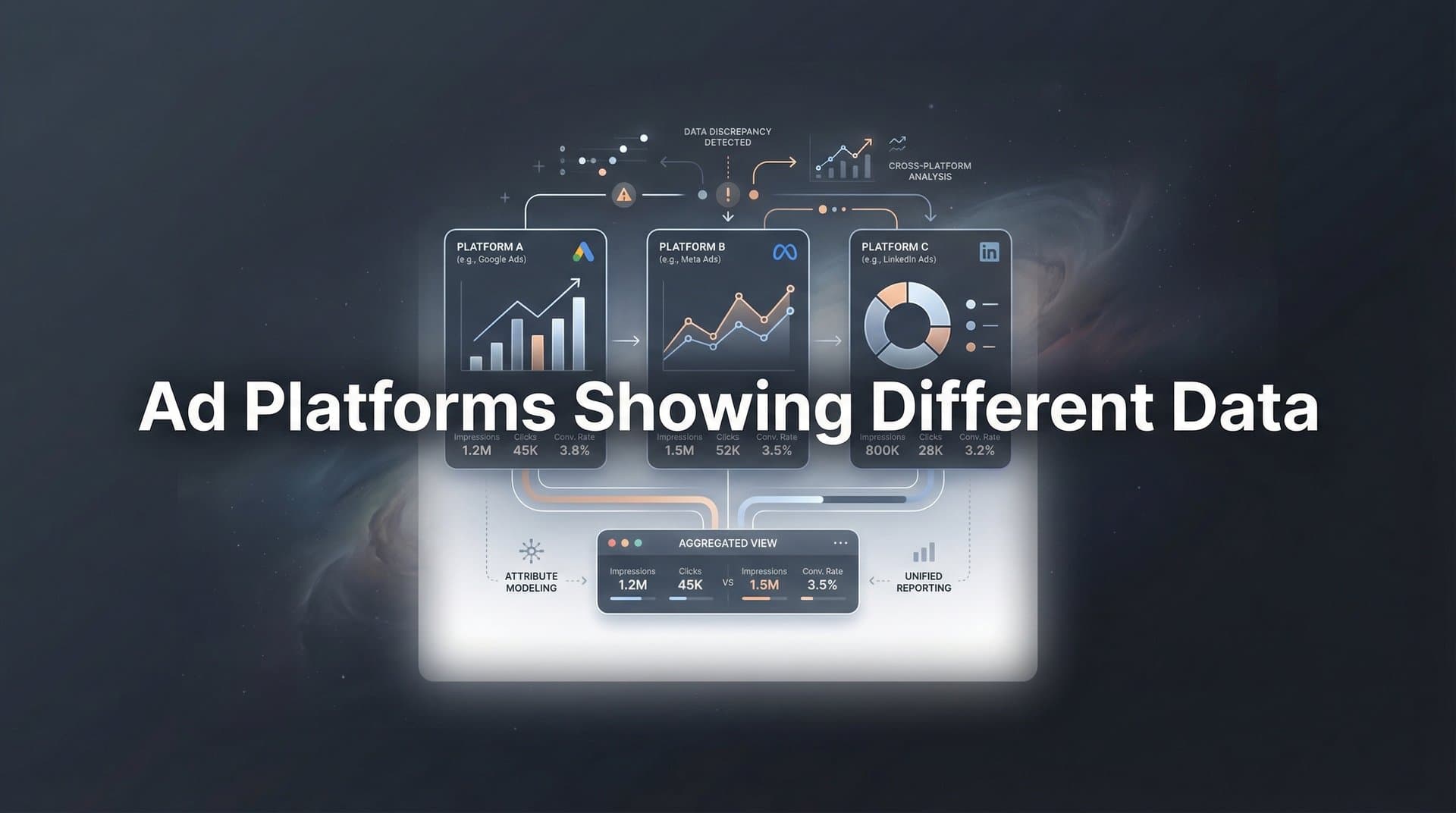
You open Meta Ads Manager. Your campaign shows 127 conversions. You switch to Google Ads. Same campaign, same time period—93 conversions. You check Google Analytics. It reports 84 conversions. Three dashboards, three different numbers, one campaign.
Sound familiar?
If you've ever stared at conflicting data across your ad platforms wondering which number to trust, you're not alone. This isn't a glitch in the matrix or a tracking error that needs fixing. These discrepancies are the natural result of fundamental differences in how each platform tracks, attributes, and reports your marketing data.
The frustrating part? Each platform genuinely believes it's showing you accurate information. They're all telling the truth—just different versions of it. Understanding why this happens is the first step toward making confident marketing decisions despite the confusion. Let's demystify the data chaos and show you exactly what's going on behind those conflicting dashboards.
The Attribution Model Maze: Why Each Platform Claims Credit Differently
Here's where it gets interesting. When a customer converts, multiple platforms can legitimately claim credit for that same conversion—and they often do.
Meta Ads Manager defaults to a 7-day click and 1-day view attribution window. This means if someone clicks your Facebook ad and converts within seven days, Meta counts it. If they just see your ad without clicking and convert within 24 hours, Meta counts that too. Google Ads, meanwhile, operates with different default windows and offers multiple attribution models including last-click, first-click, linear, time decay, and data-driven attribution.
Let's say a potential customer sees your Facebook ad on Monday but doesn't click. On Tuesday, they search for your brand on Google, click your search ad, and visit your site. On Wednesday, they return directly to your website and make a purchase.
What happens? Meta claims the conversion because the customer saw your ad within the 1-day view window before their Google search. Google claims the conversion because the customer clicked their ad within Google's attribution window. Your analytics platform might attribute it to direct traffic since that was the final touchpoint before conversion.
They're all technically correct based on their own rules.
The difference between click-through and view-through attribution adds another layer of complexity. Click-through attribution only counts conversions from users who actually clicked your ad. View-through attribution counts conversions from users who simply saw your ad, even if they never clicked it. Some platforms weigh these differently. Others don't track view-through conversions at all.
This creates a scenario where the sum of conversions across all your platforms can exceed your actual total conversions. You might see 127 conversions in Meta, 93 in Google Ads, and 84 in Analytics—but you only actually had 84 real customers convert. The overlap happens because multiple ad platforms attribution confusion stems from each platform claiming credit for the same conversions based on their attribution rules.
Understanding this overlap is crucial. When you're trying to calculate return on ad spend or determine which campaigns are truly driving results, you need to know that these numbers represent different perspectives on the same customer journeys, not separate conversion events.
Tracking Technology Gaps: Cookies, iOS Changes, and Data Loss
Even if every platform used identical attribution models, you'd still see different numbers. The way data gets collected in the first place is fundamentally broken in today's privacy-focused digital landscape.
In April 2021, Apple released iOS 14.5 with App Tracking Transparency. This update requires apps to ask users for permission before tracking their activity across other apps and websites. The result? Many users opt out, creating massive blind spots in your advertising data. When someone opts out of tracking on their iPhone, ad platforms lose the ability to follow that user's journey from ad click to conversion.
This means conversions are happening that your ad platforms simply cannot see or attribute correctly. A user might click your Facebook ad on their iPhone, browse your site, and convert days later—but because they opted out of tracking, Meta has no way to connect that conversion back to the original ad click. The conversion happened. You got the sale. But your dashboard shows nothing. Understanding why you're losing tracking data from iOS users is essential for accurate reporting.
Browser-based cookie tracking faces similar limitations. Third-party cookies, which advertisers have relied on for years to track users across websites, are being phased out. Safari and Firefox already block them by default. Chrome has announced plans to eliminate third-party cookie support entirely. This creates a fragmented tracking environment where some browsers allow tracking and others don't.
Add ad blockers to the mix, and the problem compounds. Users running ad blocking extensions prevent tracking pixels from firing entirely. Your analytics code never loads. Your conversion tracking pixel never triggers. These users are invisible to your standard tracking setup, even though they're visiting your site and potentially converting.
Privacy-focused browsers like Brave take this even further, blocking virtually all tracking by default. Cross-device tracking becomes nearly impossible when users browse on their phone but convert on their laptop, especially if they're not logged into an account that connects those sessions.
The result? Every platform is working with incomplete data. They're all missing different pieces of the puzzle based on which tracking methods they rely on and which users have blocked those methods. This data loss is permanent and unavoidable with traditional browser-based tracking approaches. Many marketers are losing tracking data from cookies without even realizing the full extent of the problem.
Timing and Reporting Windows: When Numbers Refuse to Match
Even when platforms track the same conversion, they might report it on different dates, creating discrepancies that persist across your reporting.
Some platforms report conversions based on the conversion date—the actual day the purchase or lead submission happened. Others report based on the click date—the day the user originally clicked the ad that eventually led to the conversion. If someone clicks your ad on March 28th but doesn't convert until April 2nd, one platform might count that conversion in March while another counts it in April.
This becomes particularly confusing when you're comparing month-over-month performance or trying to close out monthly reports. Your March numbers in one platform won't match March numbers in another because they're measuring different things. One is measuring "conversions that happened in March" while the other is measuring "conversions from clicks that happened in March." These marketing data discrepancies between platforms can significantly impact your reporting accuracy.
Time zone settings add another wrinkle. Your ad account might be set to Pacific Time. Your analytics might be set to Eastern Time. Your actual business operates in Central Time. A conversion that happens at 11:30 PM Pacific Time gets recorded on different dates depending on which time zone each platform uses for reporting.
Real-time reporting versus delayed reporting creates temporary discrepancies that can last for days. Some platforms update conversion data in real-time as events happen. Others batch process data and update reports every few hours or even once daily. Google Ads conversions can take up to three days to fully populate in reports due to delayed conversion tracking.
This means the numbers you see today for yesterday's performance might not match what you see tomorrow when you look at that same day again. The data is still coming in, being processed, and being attributed. What looks like 50 conversions today might show as 58 conversions when you check the same date next week after all delayed conversions have been processed.
Platform Self-Interest: The Bias Built Into Every Dashboard
Let's address the elephant in the room. Every ad platform has a vested interest in showing you strong performance for ads run on their platform. They want you to keep spending money with them.
This doesn't mean platforms are lying or manipulating data maliciously. But their attribution models, default settings, and reporting interfaces are designed to highlight their value in your marketing mix. When there's ambiguity about which touchpoint deserves credit for a conversion, each platform's attribution model tends to resolve that ambiguity in its own favor.
Platform-native analytics operate in a silo. Meta Ads Manager only sees the touchpoints that happen within Meta's ecosystem. It doesn't know what happened on Google, TikTok, or your email campaigns. From Meta's perspective, if someone clicked a Facebook ad and later converted, that's a Facebook-driven conversion—even if they also clicked three other ads from other platforms during their journey. This is why ad platforms reporting different numbers is such a common frustration for marketers.
The same logic applies across every platform. Google Ads believes Google drove the conversion. LinkedIn believes LinkedIn drove it. Each platform is reporting accurately based on what it can see, but none of them can see the complete picture of how all your marketing channels work together.
This creates a natural over-attribution problem. When you add up the conversions claimed by all your platforms, the total often exceeds your actual conversion count by a significant margin. Every platform is taking full or partial credit for conversions that other platforms are also claiming.
The solution requires a neutral third-party source of truth. Something that sits outside any single ad platform, tracks the complete customer journey across all channels, and attributes conversions based on what actually happened rather than what any individual platform can see. Without this neutral perspective, you're always making decisions based on biased data that each platform presents through its own lens.
Building Your Single Source of Truth: Practical Solutions
So how do you cut through the confusion and get accurate data you can actually trust? The answer lies in moving beyond browser-based tracking and creating a unified view of your customer journey.
Server-side tracking fundamentally changes how conversion data gets captured. Instead of relying on browser pixels that can be blocked, deleted, or prevented from loading, server-side tracking sends conversion data directly from your server to ad platforms and analytics tools. When a conversion happens on your website, your server communicates that event directly to the platforms that need to know about it.
This approach bypasses many of the limitations that plague browser-based tracking. Ad blockers can't interfere with server-to-server communication. iOS privacy settings don't prevent your server from sending data. Cookie restrictions become irrelevant because you're not relying on cookies to track conversions. Implementing first-party data tracking solutions is essential for accurate attribution in today's privacy-focused landscape.
But server-side tracking alone isn't enough. You need to connect all your data sources into a complete picture. This means integrating your ad platforms with your CRM, connecting your website analytics with your advertising data, and bringing together every touchpoint where customers interact with your brand. When these systems talk to each other, you can see the full customer journey from first ad impression through final conversion.
This is where marketing data unification platforms provide real value. They act as the central hub that receives data from all your marketing channels, stitches together individual touchpoints into complete customer journeys, and provides a unified view of what's actually driving conversions. Instead of checking five different dashboards with five different conversion numbers, you have one place that shows the true picture.
Here's where it gets even more powerful. Once you have accurate, enriched conversion data that captures the complete customer journey, you can feed conversion data back to ad platforms. This process, often called conversion sync or conversion API implementation, sends better quality conversion events back to Meta, Google, and other platforms. Their algorithms use this enriched data to improve targeting and optimization, which actually improves your ad performance over time.
The platforms get more accurate conversion data than they could collect on their own. Their machine learning models work better. Your campaigns perform better. Everyone wins. But it requires setting up the infrastructure to capture, enrich, and sync that data correctly.
Making Confident Decisions Despite Data Discrepancies
Understanding why your numbers don't match is important. But you still need to make marketing decisions today, even with imperfect data. Here's how to move forward with confidence.
First, accept that your platform numbers will never perfectly align. Stop trying to reconcile every discrepancy down to the exact conversion. Instead, focus on trends and directional insights. If Meta shows 127 conversions and Google shows 93, the exact numbers matter less than understanding which campaigns and audiences are driving growth within each platform.
Establish a primary source of truth for business decisions. This might be your CRM system if you're tracking leads, your e-commerce platform if you're tracking purchases, or a dedicated attribution data platform that connects everything. Whatever you choose, use it consistently for calculating ROI, setting budgets, and evaluating performance. Let platform dashboards inform tactical optimization decisions, but make strategic decisions based on your unified data source.
When comparing data across platforms, look at relative performance rather than absolute numbers. If Campaign A shows 50 conversions in Meta and Campaign B shows 30 conversions, Campaign A is likely performing better—even if the absolute numbers are inflated by attribution overlap. The relative comparison within a single platform's data is still meaningful.
Multi-touch attribution reveals which channels actually drive revenue by assigning appropriate credit across the entire customer journey. Instead of arguing about whether Facebook or Google deserves full credit for a conversion, multi-touch attribution acknowledges that both played a role and distributes credit accordingly. This gives you a more nuanced understanding of how your marketing channels work together.
Audit your current tracking setup regularly. Check that your conversion tracking pixels are firing correctly. Verify that your attribution windows match your actual sales cycle. Confirm that data is flowing properly between your various platforms. Many discrepancies stem from simple technical issues like broken tracking codes or misconfigured integrations. Using conversion tracking software for multiple ad platforms can help identify and resolve these issues.
Test your attribution assumptions. Run controlled experiments where you pause one channel entirely and measure the impact on overall conversions. This reveals how much of that channel's claimed conversions were truly incremental versus conversions that would have happened anyway through other channels. The results often surprise marketers who discover their most expensive channel was taking credit for conversions driven primarily by other sources.
Document your methodology and stick with it. If you decide to use 7-day click attribution for all platforms when comparing performance, document that decision and apply it consistently. If you choose to measure conversions by conversion date rather than click date, make sure everyone on your team knows and follows that standard. Consistency in how you analyze data matters more than which specific methodology you choose.
Moving Forward with Clarity
Data discrepancies between ad platforms are inevitable. They're not going away. Attribution models will continue to differ. Tracking technology will keep evolving. Privacy regulations will become stricter, not looser. Platform biases are built into the system.
But these challenges don't have to paralyze your marketing decisions. The marketers who succeed are the ones who understand why these discrepancies happen and build systems to work around them. They accept that no single platform shows the complete truth. They invest in creating unified customer journey data that reveals what's really driving conversions. They make decisions based on comprehensive attribution rather than siloed platform reports.
The solution lies in capturing every touchpoint across your entire marketing ecosystem. When you track the complete customer journey from initial awareness through final conversion, you gain clarity that individual platform dashboards can never provide. You see which channels work together to drive results. You understand the true value of each marketing investment. You make confident scaling decisions backed by accurate data.
This is exactly what modern marketing attribution platforms are built to solve. By connecting your ad platforms, CRM, and website data into a single source of truth, you eliminate the confusion of conflicting dashboards. Server-side tracking captures conversions that browser-based pixels miss. Enriched conversion data fed back to platforms improves their optimization algorithms. Multi-touch attribution reveals the real story behind your marketing performance.
Ready to elevate your marketing game with precision and confidence? Discover how Cometly's AI-driven recommendations can transform your ad strategy—Get your free demo today and start capturing every touchpoint to maximize your conversions.


