
You pull up your Google Ads dashboard. It shows 47 conversions for last week's campaign. Great news. Then you check Meta Ads Manager. Same campaign, same timeframe. 62 conversions. Even better, right? But wait. You open your CRM to confirm the actual leads that came in. The number staring back at you? 38.
Which number is real? Which platform should you trust? And more importantly, how are you supposed to make smart budget decisions when your data tells three completely different stories?
This isn't a rare glitch or a one-time technical hiccup. Advertising data discrepancies are one of the most persistent challenges facing digital marketers today. These mismatches create confusion, erode confidence in your reporting, and worst of all, they can lead to costly decisions based on incomplete or misleading information. When you can't trust your numbers, how can you confidently scale what's working or cut what's not?
The good news? These discrepancies aren't random chaos. They follow predictable patterns with identifiable causes. Once you understand why your numbers don't match, you can take concrete steps to fix them. This article will walk you through exactly what causes advertising data discrepancies, why every marketer deals with them, and most importantly, how to build a data foundation you can actually trust.
The Anatomy of a Data Mismatch: Understanding What's Actually Happening
Before we can fix data discrepancies, we need to understand what they actually are. An advertising data discrepancy occurs when different platforms or tools report different numbers for what should be the same metric. This could be conversions, clicks, impressions, or revenue. The platforms aren't necessarily wrong. They're just measuring different things, at different times, in different ways.
Think of it like three people describing the same car accident from different street corners. Each witness saw something real, but their perspectives create three versions of the truth. Ad platforms work the same way.
Here's what happens in a typical customer journey. Someone sees your Facebook ad on their phone during their morning commute. They don't click, but they remember your brand. Later that day, they search for your product on Google using their work laptop. They click your Google ad, browse your site, but don't convert yet. That evening, they return directly to your website on their tablet and finally make a purchase.
Now the counting begins. Facebook claims credit because the customer saw the ad first. Google claims credit because the customer clicked their ad and visited the site. Your analytics platform records a direct visit as the conversion source. Your CRM logs the conversion but might not connect it to any ad at all if tracking broke somewhere along the way.
Each system is technically correct based on its own logic. But when you're trying to understand which channel actually drove that sale, you're left with conflicting stories. The fundamental issue is that ad platforms, analytics tools, and CRMs each have different jobs to do, which means they track and attribute conversions differently. Understanding these marketing data discrepancies between platforms is essential for any marketer trying to make sense of their numbers.
Ad platforms like Meta and Google are built to prove their value. They want to show you that their ads work, so their attribution models are designed to capture as much credit as possible. Analytics platforms like Google Analytics focus on website behavior and traffic sources. CRMs track actual business outcomes like closed deals and revenue, but they often miss the marketing context of how those leads arrived.
The data flow from ad click to conversion has multiple breaking points. The click happens on the ad platform. Then tracking needs to survive the journey to your website, through various pages, possibly across multiple devices, and finally connect to a conversion event. At each stage, something can go wrong. Cookies get blocked. Tracking scripts fail to load. Users switch devices. Privacy settings prevent data collection. Time passes and attribution windows expire.
Understanding this anatomy is the first step toward fixing it. Once you recognize that discrepancies are structural rather than accidental, you can start building systems that account for these differences instead of being surprised by them.
Attribution Model Conflicts: When Platforms Fight Over Credit
One of the biggest culprits behind advertising data discrepancies is attribution model conflicts. Every platform uses a different rulebook for deciding which ad gets credit for a conversion. These aren't bugs. They're intentional design choices that reflect each platform's priorities and measurement philosophy.
Let's start with attribution windows, which determine how long after someone interacts with your ad you can still claim credit for their conversion. Meta defaults to a 7-day click and 1-day view attribution window. This means if someone clicks your ad, Meta will claim any conversion that happens within the next seven days. If they just viewed your ad without clicking, Meta claims credit for conversions within 24 hours.
Google Ads uses different windows depending on your campaign type and settings. Search campaigns often default to a 30-day click window. Display campaigns might use 30-day click and 1-day view. YouTube has its own set of windows. TikTok, LinkedIn, and every other platform each have their own standards.
Now imagine a customer journey that spans 10 days. They click your Meta ad on day one, then click your Google ad on day eight, and convert on day nine. Meta claims the conversion because it happened within their 7-day window. Wait, no. Actually it happened on day nine, which is outside Meta's window. But Google definitely claims it because it's within their 30-day window. See how quickly this gets messy?
Then we have attribution models themselves. First-touch attribution gives all credit to the first interaction a customer had with your brand. Last-touch attribution gives all credit to the final touchpoint before conversion. Linear attribution spreads credit evenly across all touchpoints. Time-decay gives more credit to recent interactions. Position-based models emphasize both the first and last touch while giving some credit to middle interactions. These attribution data discrepancies are at the heart of why your platforms never agree.
Each platform defaults to different models. Many ad platforms favor last-click attribution because it makes their performance look stronger. Analytics tools often use last non-direct click, which ignores direct traffic and gives credit to the last marketing channel. Your CRM might not use any attribution model at all, simply recording conversions without marketing context.
Here's where it gets really interesting. A single conversion can legitimately be claimed by multiple platforms simultaneously. That customer who saw your Facebook ad, clicked your Google ad, and then converted? Both platforms will count that conversion in their dashboards. Neither is lying. They're just using different attribution rules.
This creates a phenomenon where the sum of conversions across all your platforms exceeds your actual total conversions. You might see 100 conversions in Facebook, 80 in Google, and 50 in LinkedIn, but your actual business only generated 150 conversions total. The platforms aren't fabricating data. They're overlapping in their credit assignment.
The only way to resolve attribution conflicts is to choose a single source of truth and stick with it. That means picking one attribution model, applying it consistently across all your data, and using a platform that can track the complete customer journey rather than relying on each ad platform's self-reported numbers.
Tracking Gaps: The Technical Culprits Behind Missing Data
Even when attribution models align, technical tracking failures create massive data discrepancies. The way we've tracked digital advertising for the past decade is fundamentally breaking down, and privacy changes are accelerating that breakdown.
The traditional approach relied on browser cookies and pixels. When someone clicked your ad, a cookie was placed in their browser. When they converted on your website, a pixel fired and matched that conversion back to the original cookie. Simple, reliable, and increasingly impossible. These advertising campaign tracking gaps are becoming more severe with each privacy update.
Apple's iOS updates changed everything. When iOS introduced App Tracking Transparency, users gained the ability to opt out of tracking across apps and websites. Many did. Suddenly, a huge portion of mobile traffic became invisible to traditional tracking methods. Facebook couldn't see what happened after users clicked ads and landed on websites. Google lost visibility into cross-app behavior. Attribution windows that relied on persistent cookies simply stopped working for opted-out users.
But iOS wasn't the only culprit. Safari's Intelligent Tracking Prevention limits cookie lifespans to seven days for first-party cookies and blocks third-party cookies entirely. Firefox blocks third-party cookies by default. Chrome announced plans to phase out third-party cookies, though they've delayed the timeline multiple times. Even when cookies work, they only last as long as the user stays on the same browser and device.
Ad blockers add another layer of tracking prevention. Users who install ad blocking extensions don't just block ads. They block the tracking pixels and scripts that measure ad performance. Your conversion might happen, but your ad platform never sees the signal because the tracking code never loaded.
Cross-device journeys break tracking chains in ways that are nearly impossible to fix with client-side tracking alone. Someone clicks your ad on their phone but converts on their laptop. Unless you can connect those two devices to the same user, that conversion appears as a direct visit or organic search rather than a paid ad conversion. The ad platform loses credit for a conversion it actually influenced.
Server-side tracking emerged as the solution to these client-side limitations. Instead of relying on browser cookies and pixels that users can block, server-side tracking sends conversion data directly from your server to the ad platforms. When a conversion happens on your website, your server communicates with Meta's server, Google's server, and any other platform you're using. This happens behind the scenes, independent of browser settings or user privacy choices. Implementing first-party data tracking for ads is now essential for accurate measurement.
The advantage is resilience. Server-side tracking isn't affected by cookie blockers, ad blockers, or iOS privacy settings. It works across devices because you're identifying users through logged-in data or your own first-party identifiers rather than relying on cookies. It provides more accurate, complete data because the signal goes directly from source to destination without passing through potentially hostile browser environments.
Server-side tracking also gives you more control. You decide exactly what data gets sent to each platform. You can enrich conversion events with additional context like customer lifetime value, product categories, or CRM status. This enriched data doesn't just improve attribution accuracy. It also feeds better information to ad platform algorithms, helping them optimize for the conversions that actually matter to your business.
The shift from client-side to server-side tracking represents a fundamental change in how digital advertising measurement works. Marketers who make this transition gain a significant accuracy advantage over those still relying on fragile pixel-based systems.
Time Zone and Reporting Window Misalignments
Sometimes the most frustrating discrepancies come from the simplest causes. Time zones and reporting windows create phantom mismatches that make your data look broken when it's actually just misaligned.
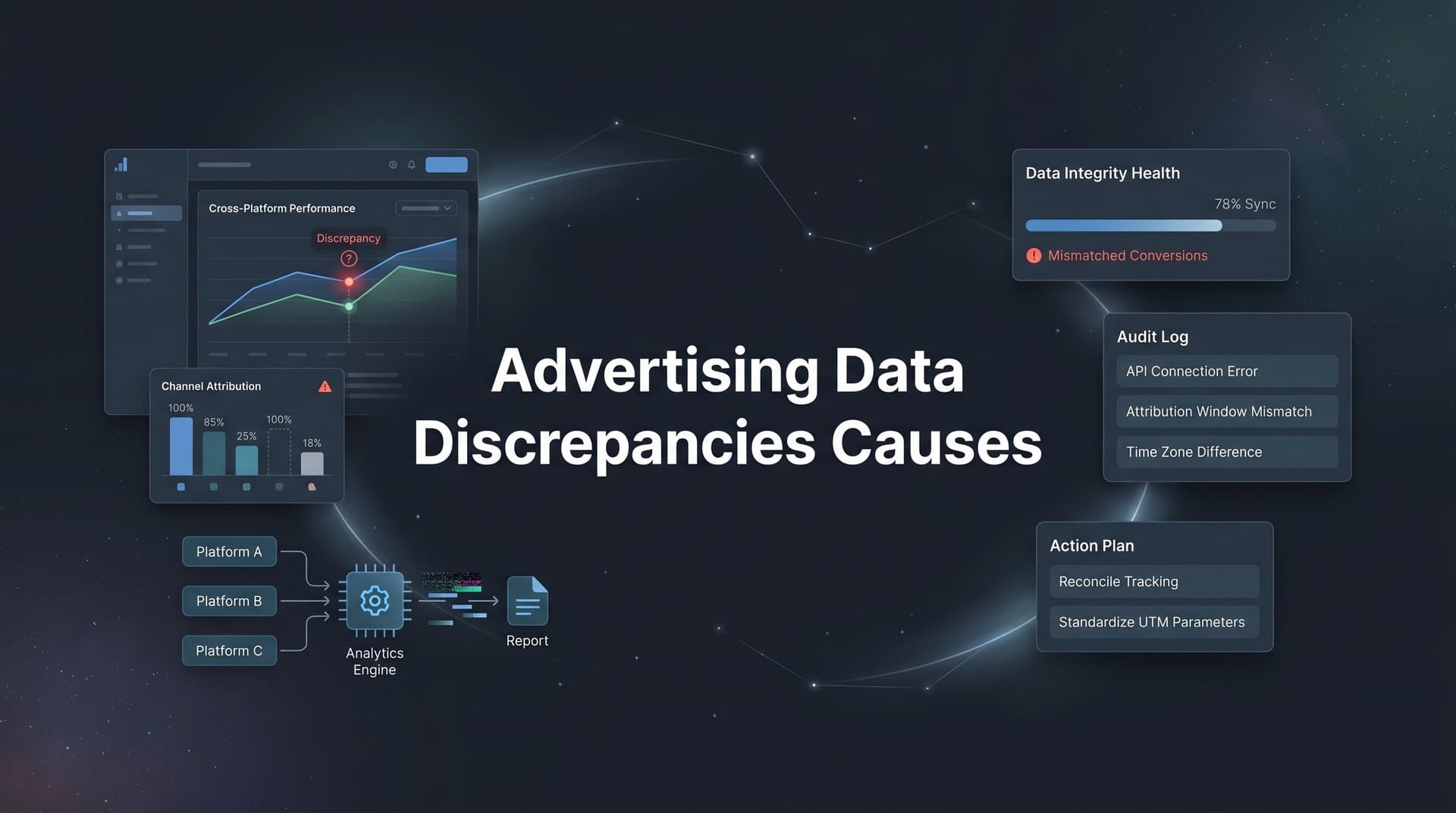
Every platform has a time zone setting. Google Ads might be set to Pacific Time. Meta Ads Manager might default to Eastern Time. Your analytics platform could be using UTC. Your CRM might use your local business time zone. When a conversion happens at 11 PM Pacific Time, that's 2 AM Eastern Time the next day. One platform records it on Tuesday. Another records it on Wednesday. Your weekly reports don't match because the same conversion appears in different time periods.
This sounds trivial until you're trying to reconcile campaign performance across platforms. You run a one-day flash sale. Google shows strong performance on the sale date. Meta shows weak performance on that date but a spike the following day. You assume Meta's traffic converted slower, when in reality, the discrepancy is just a three-hour time difference pushing late-night conversions into the next calendar day. These types of marketing analytics data inconsistencies are surprisingly common yet often overlooked.
The solution is standardization. Pick one time zone and configure every platform to use it. Your business time zone makes the most sense because it aligns with how you actually operate. Go through each ad platform, analytics tool, and reporting dashboard. Change the time zone settings to match. This won't eliminate all discrepancies, but it removes one unnecessary source of confusion.
Reporting windows add another layer of complexity. Some platforms report based on click date, meaning they attribute conversions to the day the ad was clicked. Others report based on conversion date, attributing to the day the conversion actually happened. These two approaches create automatic discrepancies for any campaign with a conversion lag.
Imagine someone clicks your ad on Monday but doesn't convert until Thursday. A click-date report shows that conversion under Monday's performance. A conversion-date report shows it under Thursday. Neither is wrong, but if you're comparing Monday's performance across platforms that use different reporting methods, the numbers won't match.
Understanding which platforms use which method helps you interpret discrepancies correctly. When you see a mismatch, check whether it's explainable by the difference between click date and conversion date reporting. Often, the discrepancy resolves itself when you account for this timing difference.
For alignment, most marketers prefer conversion-date reporting because it reflects when revenue actually entered the business. It's easier to reconcile with CRM data and financial reports. Configure your platforms to use conversion date where possible, and document which platforms don't offer that option so you know where to expect timing-based discrepancies.
Building a Single Source of Truth for Your Ad Data
The ultimate solution to advertising data discrepancies is creating a single source of truth that sits above all your individual platforms. Instead of trying to reconcile conflicting reports after the fact, you need a system that captures every touchpoint, applies consistent attribution logic, and provides one unified view of campaign performance.
This starts with centralizing data collection. Rather than relying on each ad platform to track its own conversions in isolation, you need a layer that sees the complete customer journey across all channels. This means connecting your ad platforms, website analytics, CRM, and any other systems that touch customer data. When all these sources feed into one place, you can finally see how touchpoints work together instead of competing for credit. A robust marketing data analytics platform makes this centralization possible.
The strategy involves tracking every interaction a customer has with your brand. Ad clicks from Meta, Google, TikTok, and LinkedIn. Website visits and behavior. Email opens and clicks. CRM activities like sales calls and demos. Every touchpoint gets logged with consistent identifiers so you can connect them to the same customer journey. This complete view reveals patterns that individual platforms can't see.
But collection is only half the battle. You also need to feed data back to your ad platforms. This is where conversion sync becomes powerful. When you send enriched conversion data back to Meta and Google, you're not just improving your own reporting. You're giving their algorithms better information to optimize against. Learning how to feed conversion data to Google Ads properly can dramatically improve your campaign performance.
Ad platforms use conversion data to train their targeting and bidding algorithms. The more accurate and complete your conversion data, the better they can identify which audiences and placements actually drive results. When you're relying on pixel-based tracking with gaps and blind spots, the algorithm is learning from incomplete information. When you sync server-side conversion data that captures touchpoints the pixel missed, the algorithm gets smarter.
This creates a virtuous cycle. Better data leads to better optimization, which leads to better performance, which generates more conversions to learn from. Marketers who implement conversion sync often see ad platform performance improve not because they changed their creative or targeting, but simply because the algorithm finally had accurate data to work with.
AI-powered attribution takes this a step further by automatically reconciling conflicting data sources and identifying which touchpoints actually drive conversions. Instead of manually trying to figure out whether Meta or Google deserves credit for a conversion, AI can analyze the complete journey and distribute credit appropriately. It can spot patterns like "customers who see Meta ads and then click Google ads convert at 3x the rate of those who only see one channel," giving you insights that single-platform reporting could never reveal.
AI recommendations go beyond just reporting what happened. They can identify which campaigns and ad sets are genuinely high-performing across your entire marketing stack, not just within one platform's self-serving metrics. They can suggest budget reallocation based on true incremental impact rather than last-click attribution. They can flag when a campaign looks strong in one platform's reporting but weak in actual business outcomes.
The goal is to move from platform-specific metrics to business-level metrics. Instead of asking "how many conversions did Meta report," you ask "how much revenue did Meta-influenced customers generate." Instead of comparing Google's click-through rate to TikTok's, you compare their contribution to actual pipeline and closed deals. This shift in perspective only becomes possible when you have a unified view that connects ad data to business outcomes.
Putting It All Together: Your Data Accuracy Action Plan
Advertising data discrepancies stem from predictable causes: attribution model conflicts, tracking gaps, time zone misalignments, and fragmented data collection. Each cause has a solution, but fixing them requires a systematic approach rather than one-off patches.
Start with an audit. Pull reports from every platform you use for the same date range. Document the discrepancies. Identify which platforms show the biggest differences and which metrics are most affected. This baseline helps you prioritize where to focus your efforts. Understanding ad platform data discrepancies at a granular level is the foundation for fixing them.
Standardize your time zones across all platforms. This simple step eliminates one common source of phantom discrepancies and makes cross-platform comparison much cleaner.
Implement server-side tracking to fix the technical tracking gaps that client-side pixels can't solve. This is especially critical for campaigns targeting iOS users or privacy-conscious audiences. Server-side tracking gives you resilience against browser restrictions and provides more complete conversion data.
Choose one attribution model and apply it consistently. Document which model you're using and why. Train your team to interpret results through that lens rather than jumping between different attribution perspectives. If you're struggling with this step, our guide on how to fix attribution data discrepancies provides a detailed framework.
Centralize your data collection so you can see complete customer journeys instead of fragmented touchpoints. Connect your ad platforms, analytics, CRM, and other systems into a unified view. This is the foundation for accurate attribution and confident decision-making.
Feed enriched conversion data back to your ad platforms through conversion sync. This improves both your reporting accuracy and your campaign performance by giving algorithms better information to optimize against.
The competitive advantage of accurate attribution is significant. When your competitors are making budget decisions based on incomplete or conflicting data, you're scaling campaigns with confidence because you know what's actually working. You're not wasting spend on channels that look good in their own dashboards but don't contribute to real business outcomes. You're not under-investing in channels that get overlooked by last-click attribution but play crucial roles in customer journeys.
Accurate data isn't just about cleaner reports. It's about making better decisions faster, reducing wasted spend, and scaling what genuinely drives revenue.
The Path to Data Clarity
Advertising data discrepancies are frustrating, but they're not unsolvable mysteries. They follow predictable patterns with identifiable causes and concrete solutions. Understanding why your numbers don't match is the first step. Implementing the technical and strategic fixes is how you build a data foundation you can trust.
The shift from fragmented, platform-specific reporting to unified, business-level attribution represents a fundamental upgrade in how you understand marketing performance. It's the difference between guessing which channels work and knowing with confidence where to invest your next dollar.
When you eliminate data discrepancies, you eliminate doubt. You stop second-guessing your reports and start making decisions based on complete, accurate information. You scale campaigns that genuinely drive revenue rather than campaigns that simply claim credit in their own dashboards. You optimize for real business outcomes rather than vanity metrics.
The marketers who master attribution and data accuracy gain a lasting competitive advantage. They move faster, waste less, and scale smarter because their decisions are grounded in truth rather than conflicting stories from competing platforms.
Ready to elevate your marketing game with precision and confidence? Discover how Cometly's AI-driven recommendations can transform your ad strategy. Get your free demo today and start capturing every touchpoint to maximize your conversions.