

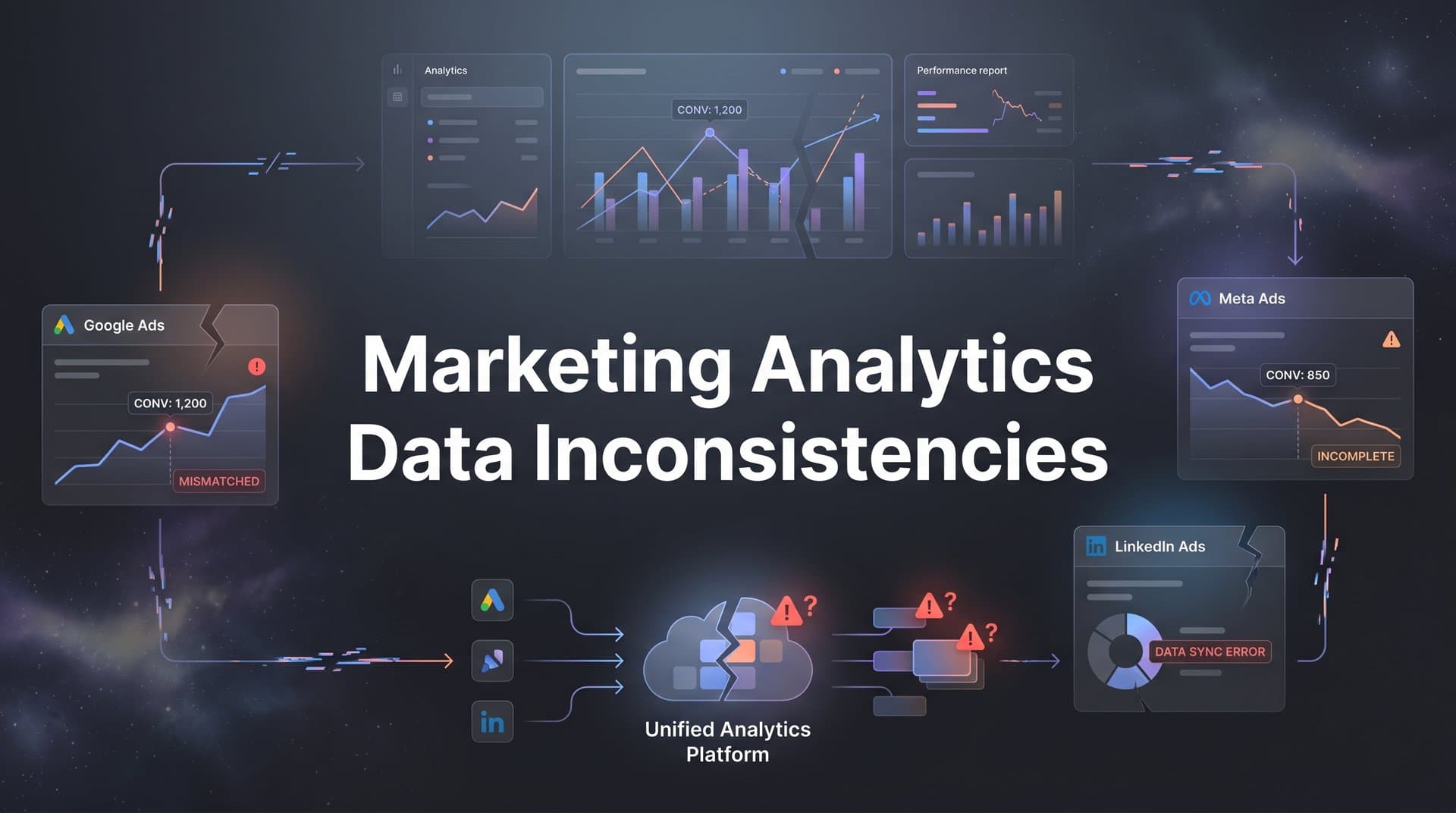
You pull your Monday morning reports. Google Ads says your campaign generated 47 conversions last week. Meta claims 62. Google Analytics shows 35. Your CRM? Only 28 closed deals with source data attached.
Same campaign. Same time period. Four completely different numbers.
This is not a glitch. It is not user error. It is the reality of modern marketing analytics, where data inconsistencies have become so common that many marketers simply shrug and pick whichever number supports their narrative. But when your budget decisions, platform optimizations, and executive reports all depend on accurate data, "close enough" is not good enough.
The truth is that marketing analytics data inconsistencies affect virtually every team running multi-platform campaigns. The numbers do not match because each platform sees a different slice of your customer journey, uses different rules to count conversions, and operates within different technical constraints. Understanding why these discrepancies happen is the first step toward building a measurement system you can actually trust.
The Anatomy of Mismatched Marketing Data
Marketing analytics data inconsistencies are discrepancies between platforms reporting different values for the same metrics. Your Meta Ads Manager shows one conversion count. Google Analytics shows another. Your CRM shows a third. These are not rounding errors or minor variations. We are talking about differences of 20%, 40%, sometimes more than double depending on the metric and platforms involved.
These discrepancies fall into three main categories, each with distinct causes and implications for your decision-making.
Platform-to-Platform Discrepancies: This is when ad platforms report different performance for the same campaign. Meta might claim 50 conversions while Google Ads reports 38 for campaigns running simultaneously. These gaps emerge because each platform has its own tracking pixel, attribution rules, and definition of what counts as a conversion. They are literally measuring different things and calling them by the same name. Understanding marketing data inconsistencies between platforms is essential for accurate reporting.
Platform-to-CRM Gaps: Your ad platforms report conversions, but your CRM shows fewer actual customers or deals. This disconnect happens because ad platforms count conversion events (form submissions, button clicks, page visits), while your CRM tracks business outcomes (qualified leads, paying customers, closed revenue). The gap represents people who converted in the tracking sense but never became actual customers.
Time-Based Reporting Differences: Pull the same report on Monday and Tuesday, and the numbers from last week might change. This occurs because platforms process conversion data at different speeds and apply attribution retroactively as delayed conversions trickle in. What looked like 40 conversions on Friday might show as 47 by Monday once all the data syncs.
Here is what this looks like in practice. You run a product launch campaign across Meta and Google. Meta's dashboard shows $12,000 in attributed revenue. Google Analytics shows $8,500. Your Shopify backend shows $9,200 in actual sales from tracked sources. Your finance team asks which number to use for ROI calculations. You have three different answers and no clear path to the truth.
The frustrating part is that none of these platforms are necessarily wrong. They are just measuring different aspects of reality using different rules. But for you, the marketer trying to make budget decisions, this creates a measurement problem that undermines everything downstream.
Five Root Causes Behind Your Data Discrepancies
Understanding why your numbers do not match requires looking at the technical and methodological differences between tracking systems. These are not simple fixes. They are fundamental challenges built into how digital marketing measurement works today.
Attribution Model Differences: Every platform uses its own attribution model, and these models produce wildly different results. Meta uses a 7-day click and 1-day view attribution window by default. Google Ads uses data-driven attribution that weighs touchpoints differently based on machine learning. Google Analytics 4 uses its own data-driven model with different logic.
Think about what this means for a customer who clicks a Meta ad, then clicks a Google ad two days later, then converts. Meta counts that conversion because it happened within seven days of the click. Google counts it because it was the last click. Both platforms claim credit for the same sale. Add them up across all your campaigns, and suddenly your total attributed conversions exceed your actual customer count. These attribution challenges in marketing analytics affect virtually every multi-channel campaign.
View-through attribution creates even bigger gaps. Meta counts conversions from people who saw your ad but never clicked, as long as they convert within 24 hours. Most other platforms do not count these at all. If someone sees your Meta ad, ignores it, then converts through organic search, Meta takes credit while Google Analytics attributes it to organic. Same conversion, two different sources.
Tracking Limitations and Privacy Changes: Browser-based tracking pixels are increasingly blocked or limited. iOS privacy updates restrict how long cookies persist and what data can be collected. Ad blockers strip tracking parameters from URLs. Users browse on their phone and convert on their laptop, breaking the tracking chain.
These limitations mean conversions happen that your tracking systems simply cannot see. Someone clicks your ad on their iPhone, browses your site, then returns three days later on their work computer to purchase. Most tracking systems will miss the connection between the ad click and the purchase because they cannot link the two devices or because the cookie expired.
The impact compounds across your customer journey. Every blocked pixel, every cleared cookie, every cross-device interaction creates a gap where conversion data gets lost. Your platforms report what they can see, but they are working with incomplete information. These marketing analytics data gaps undermine your ability to optimize effectively.
Conversion Window and Timing Mismatches: Platforms attribute conversions at different points in time and use different lookback windows. Some count conversions based on when the click happened. Others use when the conversion occurred. These timing differences create discrepancies that grow larger over time.
Google Ads might use a 30-day conversion window while Meta uses 7 days. A customer who clicks your ad and converts on day 10 shows up in Google's reports but not Meta's. Pull reports comparing the two platforms, and you will see different conversion counts even though you are looking at the same calendar period.
Then there is the question of when data gets processed. Some platforms update conversion counts in real time. Others batch process overnight. A conversion that happens at 11 PM might appear in today's report on one platform and tomorrow's report on another. Multiply this across hundreds of conversions per week, and your daily reports become nearly impossible to reconcile.
Technical Implementation Variations: Even when platforms use similar tracking methods, implementation differences create gaps. Your Meta pixel might fire on the confirmation page while your Google tag fires on the thank-you page. If some users close the browser before reaching the thank-you page, Google misses conversions that Meta captures.
Tag loading speed matters too. If your Google Analytics tag loads slowly and users navigate away quickly, you lose data. Different platforms have different requirements for what constitutes a valid conversion event. One might require a minimum page dwell time. Another might count any page load. These technical nuances add up to significant measurement differences.
Conversion Definition Inconsistencies: Your team might call something a conversion that the platform does not count, or vice versa. You consider a demo request a conversion, but your tracking only fires on form submissions, missing people who book through your calendar link. Your CRM counts a lead as converted when they enter the pipeline, while your ad platforms count them when they submit the form.
These definitional mismatches mean you are comparing apples to oranges even when the tracking works perfectly. One system measures top-of-funnel actions. Another measures closed deals. Both call them conversions, but they represent completely different stages of your customer journey.
The Real Cost of Operating on Inconsistent Data
Data inconsistencies are not just an annoyance for your reporting meetings. They directly undermine your ability to scale campaigns profitably and make confident marketing decisions.
Budget Misallocation: When you cannot trust which channels actually drive revenue, you risk making expensive mistakes. Maybe Meta appears to have a better cost per acquisition than Google, but that is only because Meta's attribution model is more generous. You shift budget toward Meta based on inflated numbers, while your actual best-performing channel gets starved of investment.
This happens constantly. Marketers optimize toward the metrics they can see, not the metrics that matter. If your dashboards show Channel A outperforming Channel B, you scale A and cut B. But if those metrics are based on inconsistent tracking, you might be scaling the wrong channel entirely. The opportunity cost is enormous when you are spending thousands or millions on paid advertising. Learning how to connect marketing data to revenue helps prevent these costly misallocations.
The problem compounds when you try to forecast or set targets. How do you plan next quarter's budget when this quarter's performance data is unreliable? You end up either being overly conservative, leaving growth on the table, or overly aggressive, burning budget on campaigns that do not actually perform as well as the data suggests.
Weakened Ad Platform Optimization: Modern ad platforms rely on conversion data to optimize delivery. Meta's algorithm learns which audiences convert. Google's Smart Bidding adjusts bids based on conversion likelihood. When the conversion data you feed these platforms is incomplete or inaccurate, their optimization suffers.
Think about what happens when tracking limitations cause you to miss 30% of your conversions. The ad platform's algorithm thinks your campaigns are performing worse than they actually are. It might pull back on audiences that are converting but not being tracked. It might bid less aggressively because it underestimates true conversion rates.
The feedback loop breaks down. You are trying to teach the algorithm what works, but you are teaching it with bad data. The result is campaigns that never reach their full potential because the platform is optimizing toward an incomplete picture of reality.
Eroded Stakeholder Confidence: Present conflicting numbers to your CEO or board, and watch credibility evaporate. When your executive summary shows different conversion counts than your detailed platform reports, leadership starts questioning everything. Are we actually growing? Is marketing working? Can we trust these projections?
This erosion of trust slows decision-making and limits your ability to secure budget increases. If your CFO cannot reconcile your marketing reports with financial data, they will default to conservative budget decisions. If your CEO sees wildly different numbers every time you present, they will stop trusting your recommendations. Improving your marketing analytics and reporting processes is essential for maintaining stakeholder confidence.
The impact extends beyond internal politics. When you cannot confidently answer "which campaigns are working?" you hesitate on scaling decisions. You second-guess channel investments. You waste time in meetings trying to explain discrepancies instead of discussing strategy. The organizational cost of unreliable data is measured in missed opportunities and slowed growth.
Building a Single Source of Truth for Marketing Data
Solving data inconsistencies requires moving beyond platform-specific reporting to a unified measurement system that captures the complete customer journey. This is not about picking which platform to trust. It is about building infrastructure that sees what individual platforms cannot.
Implement Server-Side Tracking: Browser-based pixels are increasingly unreliable due to privacy restrictions and ad blockers. Server-side tracking solves this by capturing conversion data on your server before sending it to platforms, bypassing browser limitations entirely.
Here is how it works. When a conversion happens, your server logs the event with complete data including the customer's journey history, then sends verified conversion signals to Meta, Google, and your analytics tools. Because the data is processed server-side, it is not affected by cookie blocking, iOS restrictions, or ad blockers that plague client-side tracking.
The result is more complete data capture. Conversions that would be lost to tracking limitations now get recorded and attributed correctly. Your platforms receive cleaner signals, improving their optimization. Your reports reflect actual performance instead of whatever your pixels managed to catch.
Implementation requires technical work. You need to set up server-side tracking infrastructure, configure conversion events properly, and ensure data flows correctly to all your platforms. But the payoff is measurement that actually works in today's privacy-focused environment.
Adopt a Unified Attribution Platform: Individual ad platforms will always prioritize their own attribution models because they are designed to prove their value. A unified attribution platform sits above these individual systems, connecting your ad platforms, website, and CRM to track the complete customer journey in one place. Investing in a dedicated marketing data analytics platform provides the foundation for accurate measurement.
This approach captures every touchpoint. A customer sees your Meta ad, clicks a Google ad, visits through organic search, and converts. Your unified system logs all these interactions and applies consistent attribution logic across the entire journey. You can compare different attribution models, see multi-touch paths, and understand how channels work together instead of competing for credit.
The key is independence. Your attribution platform is not trying to prove that any particular channel deserves credit. It is showing you what actually happened based on complete data. This gives you a neutral view that platform-specific reporting cannot provide.
Look for platforms that offer server-side tracking integration, multi-touch attribution modeling, and direct connections to your ad platforms and CRM. The goal is one system that ingests data from everywhere and provides unified reporting you can trust.
Establish Data Governance Practices: Technology alone will not solve inconsistencies if your team is not aligned on how to measure and report. Data governance means creating standards and processes that ensure consistency across your marketing operations.
Start with UTM conventions. Standardize how your team tags campaigns so that traffic sources are classified consistently across platforms. If one person uses "facebook" and another uses "meta" in UTM source parameters, your reporting will fragment. Document your naming conventions and enforce them.
Align conversion definitions across teams. Make sure marketing, sales, and finance agree on what counts as a conversion, a qualified lead, and a closed customer. When everyone uses the same definitions, your reports tell a coherent story instead of conflicting narratives.
Create regular data reconciliation processes. Schedule weekly or monthly reviews where you compare platform data, identify discrepancies, investigate causes, and document explanations. Over time, you will spot patterns and fix systemic issues instead of fighting the same data problems repeatedly.
Document everything. Write down your attribution methodology, conversion definitions, reporting standards, and reconciliation procedures. When new team members join or stakeholders ask questions, you have clear documentation explaining how your measurement works and why numbers might differ between systems.
Feeding Better Data Back to Ad Platforms
Accurate attribution is not just about better reporting. It directly improves campaign performance by giving ad platforms the clean conversion signals they need to optimize effectively.
The Feedback Loop: Ad platforms use machine learning to optimize delivery. Meta's algorithm learns which users are likely to convert based on who has converted previously. Google's Smart Bidding adjusts bids based on real-time conversion probability. Both systems are only as good as the data you feed them.
When your conversion tracking is incomplete, the algorithm learns from bad data. It thinks certain audiences do not convert when they actually do. It underbids on valuable traffic because conversions are not being captured. The optimization loop breaks down, and your campaigns underperform their potential. Understanding marketing analytics for Google Ads helps you maximize the effectiveness of your paid search campaigns.
Clean, complete conversion data fixes this. When platforms receive accurate signals about who converted and from which touchpoints, their algorithms can identify patterns and optimize accordingly. Targeting improves. Bidding becomes more efficient. Campaign performance increases because the platform is working with reliable information.
Enriched Conversion Events: Modern ad platforms support enhanced conversion tracking that sends richer data beyond basic conversion counts. Instead of just telling Meta that a conversion happened, you can send customer value, purchase details, and attribution context that helps the algorithm optimize more precisely.
Meta's Conversions API and Google's Enhanced Conversions both allow server-side data transmission with enriched event parameters. You can include customer lifetime value, product categories, purchase amounts, and custom event data that give platforms deeper insight into conversion quality.
This enrichment improves optimization in specific ways. Value-based bidding strategies work better when platforms know actual purchase values instead of treating all conversions equally. Audience targeting improves when platforms can identify patterns in high-value customer behavior. Campaign budget optimization allocates spend more effectively when it understands conversion quality, not just quantity.
Practical Implementation Steps: Connecting your attribution system to ad platforms requires technical setup, but the process is straightforward once you understand the components.
First, configure server-side connections to your ad platforms. Set up Meta's Conversions API and Google's server-side tag implementation. These allow your server to send conversion data directly to platforms, bypassing browser-based tracking limitations.
Next, map your conversion events to platform-specific formats. Define which events should sync to which platforms and what parameters to include. A purchase event might sync to both Meta and Google with full transaction details, while a newsletter signup might only go to your email platform. Leveraging data science marketing attribution techniques can help you build more sophisticated event mapping.
Then, implement conversion syncing from your attribution platform. Configure your unified system to send verified conversions back to ad platforms with accurate attribution. This closes the loop, ensuring platforms receive complete data about which ads and audiences are actually driving results.
Monitor the impact on campaign performance. After implementing better conversion tracking, watch for improvements in key metrics. You should see more stable conversion counts, better optimization from platform algorithms, and improved ROI as campaigns receive cleaner signals.
The technical work pays off in tangible performance gains. Campaigns that were optimizing toward incomplete data start performing better when they receive accurate signals. Platforms that were guessing about audience quality start targeting more precisely. Your entire paid advertising operation becomes more efficient because it is built on reliable measurement.
Moving From Guesswork to Confidence
Data inconsistencies are not a minor reporting annoyance. They are a fundamental obstacle to scaling paid advertising effectively. When your platforms show different numbers, when conversions go untracked, when attribution conflicts across systems, you cannot make confident decisions about where to invest your budget.
The solution is not picking which platform to trust or accepting that marketing measurement will always be imperfect. It is building measurement infrastructure that captures the complete customer journey, applies consistent attribution logic, and feeds accurate data back to the platforms optimizing your campaigns.
This means moving beyond siloed platform reporting to unified, server-side tracking that works despite privacy restrictions and browser limitations. It means adopting attribution systems that sit above individual platforms and provide an independent view of performance. It means establishing data governance practices that ensure consistency across your marketing operations.
The marketers who solve this measurement problem gain a decisive advantage. They know which channels actually drive revenue. They optimize campaigns based on reliable data. They present consistent numbers to stakeholders. They scale with confidence because their decisions are built on truth, not guesswork.
Ready to elevate your marketing game with precision and confidence? Discover how Cometly's AI-driven recommendations can transform your ad strategy. Get your free demo today and start capturing every touchpoint to maximize your conversions.



