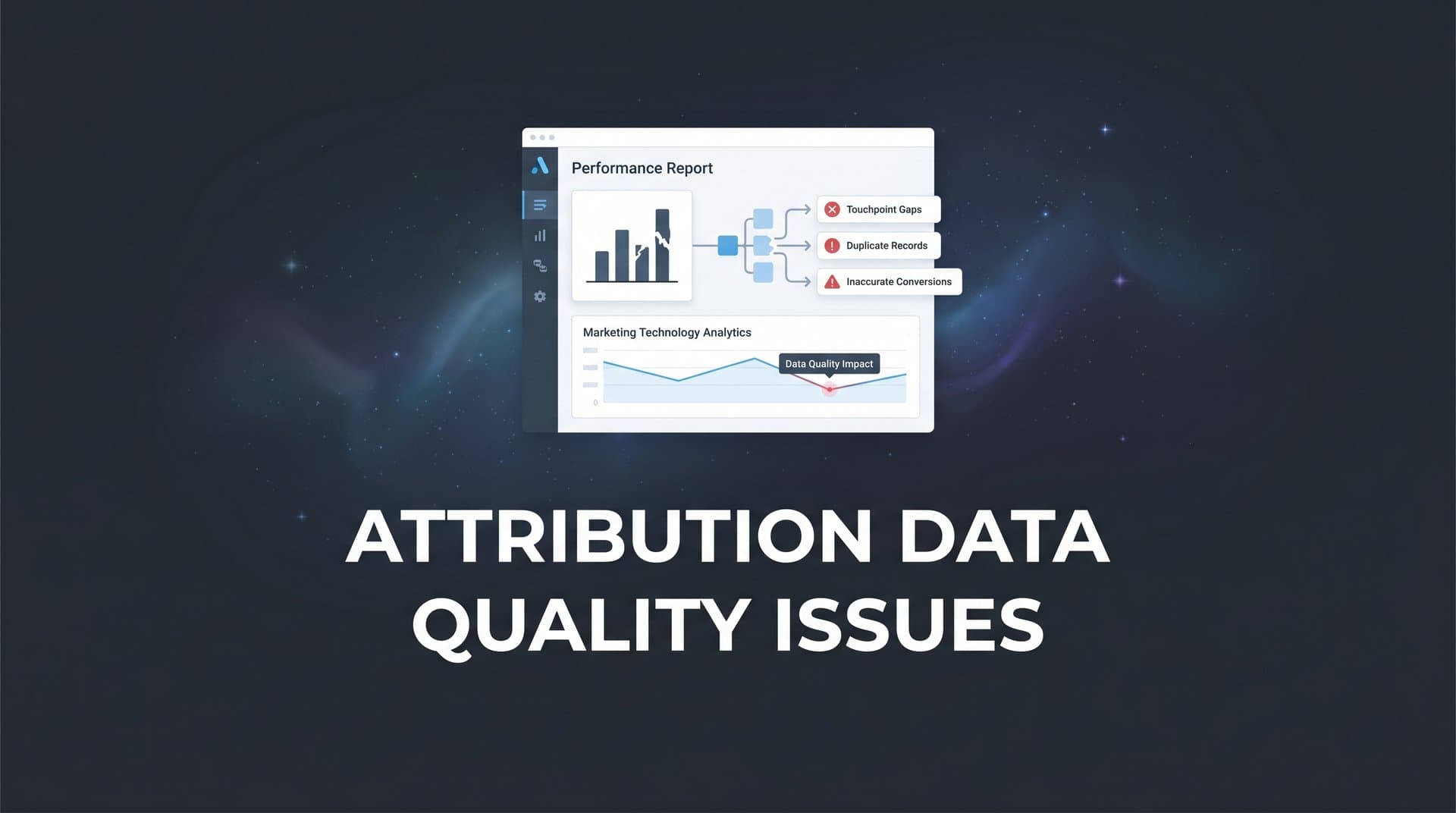
Picture this: your marketing team sits down for the weekly performance review. Meta's dashboard shows 200 conversions for the week. Google Ads claims 180. You add those up, feel pretty good about the number, and then open your CRM to find just 250 actual sales. The math simply does not work. Where did the other 130 conversions go? Were they real? Which platform actually drove the revenue?
This is not a rare edge case. It is the everyday reality of attribution data quality issues, and most marketing teams are navigating it without fully understanding how much money it is costing them. When the numbers you rely on to make budget decisions are fundamentally unreliable, every optimization call you make is built on a shaky foundation.
Attribution data quality refers to how accurate, complete, consistent, and timely your data is when it comes to crediting marketing touchpoints with conversions. It is the difference between knowing which campaigns are actually driving revenue and just guessing with extra steps. In a world where ad spend is under constant scrutiny and every dollar needs to justify itself, the quality of your attribution data is not a technical detail. It is a business-critical issue.
In this article, we will break down exactly what causes attribution data to go wrong, why you cannot trust platform-reported numbers as your single source of truth, and what a reliable attribution setup actually looks like. If you have ever looked at your reporting and thought "something seems off," this is the article you need.
The Hidden Cost of Bad Attribution Data
Before we get into the specific problems, it is worth understanding what attribution data quality actually means in practice. At its core, it comes down to four dimensions: accuracy (are the numbers correct?), completeness (are all touchpoints being captured?), consistency (does the data align across systems?), and timeliness (is the data current enough to act on?).
Most marketing teams have a lot of data. Dashboards are full of it. The problem is not volume. The problem is confidence. When you cannot trust that your data reflects reality, having more of it does not help. You end up in analysis paralysis or, worse, making confident decisions based on numbers that are quietly wrong. This is why marketing data accuracy matters for growth more than most teams realize.
The business consequences are significant. When your attribution data overstates the performance of one channel, you naturally shift more budget toward it. That sounds rational, but if the inflated numbers are the result of double-counting or a generous attribution window rather than genuine performance, you are scaling a channel that may not deserve the investment. Meanwhile, a channel that is genuinely contributing to revenue but getting under-credited in your reporting might get its budget cut entirely.
This is how bad attribution data leads to misallocated budgets. You are not making irrational decisions. You are making rational decisions based on irrational inputs.
There is also a compounding problem that often goes unnoticed. Ad platforms like Meta and Google use the conversion signals you send them to power their optimization algorithms. When those signals are inaccurate, the algorithms learn the wrong patterns. They start targeting users who look like your reported converters, even if many of those reported conversions were duplicates or misattributed events. Over time, campaign performance can degrade in ways that feel mysterious but actually trace back to poor ad attribution data upstream.
The distinction worth drawing here is between having attribution data and having reliable attribution data. Reliable data is data you would bet your budget on. Most teams are working with something far less certain, and the gap between what they think they know and what is actually true is where budget gets wasted at scale.
Six Common Data Quality Problems Undermining Your Attribution
Understanding the specific ways attribution data breaks down is the first step toward fixing it. These are the issues that show up most consistently across marketing teams of all sizes.
Duplicate conversions and over-counting: This is the most common culprit behind the scenario we opened with. When a customer clicks a Meta ad and then a Google ad before purchasing, both platforms fire their conversion pixels and claim full credit for the sale. Your CRM records one transaction. Your ad platforms collectively record two. The result is inflated reported ROAS across the board, and no clear picture of which channel actually drove the decision. Multiply this across thousands of conversions and the distortion becomes enormous. Understanding why attribution data doesn't match is critical to addressing this problem.
Missing touchpoints and tracking gaps: Apple's App Tracking Transparency framework, introduced with iOS 14.5, significantly reduced the ability of platforms like Meta to track user behavior across apps and websites. Users who opt out of tracking simply disappear from the attribution picture, even if they did convert. Add in ad blockers, third-party cookie restrictions, and cross-device journeys where someone sees an ad on mobile but purchases on desktop, and you have a tracking chain full of holes. These gaps do not just make your data incomplete. They systematically under-report certain channels, leading you to undervalue them.
Data latency and stale reporting: There is often a meaningful delay between when a conversion happens and when it shows up in your attribution dashboard. This matters more than most teams realize. If you are making optimization decisions mid-week based on data that is 24 to 48 hours behind, you are essentially driving by looking in the rearview mirror. Campaigns that appear to be underperforming might just be experiencing reporting lag, and pausing them prematurely based on incomplete data is a costly mistake.
Inconsistent attribution windows across platforms: Meta defaults to a 7-day click and 1-day view attribution window. Google Ads uses a 30-day click window by default. When you compare performance across these platforms without accounting for the different windows, you are comparing apples to oranges. A sale that happened 15 days after a Google ad click gets credited to Google but would not appear in Meta's window at all, even if Meta also touched that customer.
Missing or broken UTM parameters: UTM parameters are the backbone of source tracking for many teams. When they are missing, inconsistently applied, or broken by redirects, entire traffic sources get lumped into "direct" or "unknown" in your analytics. This creates blind spots that distort your understanding of which channels are contributing.
Mismatched conversion definitions: If your ad platform is optimizing for "purchase initiated" events but your CRM tracks confirmed revenue, you may be scaling toward an event that does not reliably lead to actual sales. Inconsistent conversion definitions across your stack mean that even when the data is technically accurate, it is measuring different things in different places.
Why Platform-Reported Data Cannot Be Your Single Source of Truth
Here is something worth sitting with: every ad platform has a financial incentive to show you strong performance numbers. Meta wants you to keep spending on Meta. Google wants you to keep spending on Google. This does not mean the data is fabricated, but it does mean the methodology behind it is designed to present each platform in the most favorable light possible.
Each platform uses its own attribution model and lookback window, and those choices are not neutral. A longer lookback window captures more conversions. A view-through attribution model credits the platform even when the user never clicked the ad. These are legitimate measurement approaches, but they are also approaches that tend to increase the conversion count attributed to that platform. Learning more about attribution windows in advertising helps you understand how these differences distort your data.
When you rely on platform-reported data as your primary performance signal, you are essentially letting each platform grade its own homework. The numbers might look great across every dashboard, but when you compare the sum of platform-reported conversions to your actual revenue, the gap is often jarring. That gap is not just a reporting curiosity. It is evidence that you are making budget decisions based on a distorted picture.
The compounding effect is where this gets genuinely costly. Ad platform algorithms like Meta's Advantage+ and Google's Smart Bidding are powerful optimization tools, but they are only as good as the conversion signals you feed them. When you send inflated or inconsistent conversion data back to these algorithms, they learn to optimize toward the wrong outcomes. They start finding more users who look like your reported converters, even if a significant portion of those reported conversions were duplicates or misattributed events.
Over time, this creates a cycle that is hard to diagnose. Campaign performance gradually declines. You adjust bids, test new creatives, and shift budgets, but nothing seems to stick. The root cause is not the creative or the audience. It is that the algorithm has been trained on bad data and is now chasing the wrong signal. Teams dealing with this pattern should explore strategies for solving attribution data discrepancies before the problem compounds further.
This is why having an independent source of truth matters so much. Your CRM, your payment processor, or a dedicated attribution platform that reconciles data across sources gives you a benchmark that no single ad platform can manipulate. Without it, you are navigating entirely by the maps that each platform drew for its own territory.
Server-Side Tracking: The Foundation of Reliable Attribution
If you want to solve attribution data quality issues at their root, server-side tracking is where the conversation has to start. Understanding why requires a quick look at how traditional browser-based tracking works and where it breaks down.
Client-side tracking relies on JavaScript pixels that fire in the user's browser when they take an action on your site. The problem is that these pixels are increasingly blocked. Ad blockers prevent them from firing. iOS privacy restrictions limit what data they can pass. Browser-based cookies are restricted or deleted. Cross-device journeys mean that the pixel that fires on a mobile device cannot connect to the desktop session where the purchase eventually happens. The result is a tracking layer full of holes that gets larger every year as privacy protections expand. This shift is why first-party data tracking has become essential for modern marketers.
Server-side tracking works differently. Instead of relying on the user's browser to fire the tracking event, the conversion data is sent directly from your server to the ad platform or attribution tool. This happens independently of what the user's browser allows or blocks. Ad blockers cannot interfere. Cookie restrictions do not apply. The signal gets through reliably, regardless of the user's device or privacy settings.
The practical difference in data completeness can be substantial. Many teams that implement server-side tracking find that they were previously missing a meaningful portion of their conversions due to browser-based tracking failures. Those missing events were not just a reporting gap. They were missing signals that the ad platform algorithms needed to optimize effectively.
This connects to one of the most important concepts in modern attribution: conversion sync. When you capture verified conversion events server-side and send them back to Meta, Google, or other ad platforms, you are feeding those platforms enriched, accurate signals that improve their targeting and optimization. Meta's Conversions API and Google's Enhanced Conversions are built on exactly this principle. The better the data you send in, the better the algorithm performs in return.
Think of it like training a model. If you train it on clean, complete data, it learns accurate patterns. If you train it on noisy, incomplete data, it learns noise. Server-side tracking is how you ensure the training data is worth learning from.
A Practical Framework for Auditing Your Attribution Data
You do not need a massive overhaul to start improving your attribution data quality. A structured audit process gives you a clear picture of where the gaps are and how significant they are. Here is how to approach it.
Step 1: Run a conversion reconciliation check. Pull your total reported conversions from each ad platform for a defined time period, typically the last 30 days. Then pull your actual confirmed transactions from your CRM or payment processor for the same period. Calculate the total attributed conversions across all platforms and compare it to your actual revenue records. The gap between those two numbers is your starting point. A small variance is normal. A large one signals a serious data quality problem.
Step 2: Look for specific red flags. Certain patterns are reliable indicators of attribution data quality issues. Sudden spikes in attributed conversions that do not correspond to a revenue increase suggest duplicate counting or pixel misfires. Large discrepancies between what two platforms report for the same time period, without a clear explanation rooted in their different attribution windows, suggest inconsistent tracking. A high percentage of conversions attributed to "direct" or "unknown" traffic suggests UTM parameter gaps or broken referral tracking. Investing in UTM tracking and attribution best practices can help close these gaps.
Step 3: Audit your UTM coverage. Review a sample of your recent paid traffic and check what percentage of sessions are arriving with properly structured UTM parameters. Any significant portion without UTMs is traffic that your analytics cannot properly attribute, which inflates direct traffic and obscures the true source of conversions.
Step 4: Compare attribution windows. Make sure you are comparing platform data using equivalent attribution windows before drawing conclusions about relative channel performance. Comparing Meta's 7-day click window to Google's 30-day click window without adjustment will produce misleading results every time.
Step 5: Establish ongoing benchmarks. A data quality audit is not a one-time exercise. Set a regular cadence, whether weekly or monthly, and define what acceptable variance looks like for your business. If your attribution tool and your CRM consistently show within a certain range of each other, that is your healthy baseline. When the gap widens, you have an early warning signal to investigate before it compounds into a larger problem.
Building a Clean Attribution Stack That Scales With You
Fixing attribution data quality issues is not about finding a single magic tool. It is about building a connected system where data flows cleanly between your ad platforms, your website, your CRM, and your attribution layer. When those pieces work together, the result is a unified view of the customer journey that you can actually trust.
The core components of a reliable attribution stack are straightforward. You need a centralized attribution platform that can ingest data from all your channels and apply consistent methodology across them. You need CRM integration so that your marketing data connects to real revenue outcomes, not just funnel events. You need server-side event capture to ensure that tracking works regardless of browser restrictions. And you need multi-touch attribution modeling so that credit is distributed across the full customer journey rather than arbitrarily assigned to the first or last click.
The integration piece is where many teams fall short. When your ad platforms, CRM, and website are operating as separate data silos, you end up doing manual reconciliation work that is both time-consuming and error-prone. Connecting them into a single system does not just save time. It fundamentally changes the quality of the insights you can draw. You can see which campaigns generate not just clicks or leads but actual closed revenue, and you can trace that revenue back through every touchpoint in the attribution journey.
This is where AI becomes genuinely valuable in attribution. Not as a buzzword, but as a practical tool for monitoring data quality at a scale that humans cannot match manually. An AI-powered attribution platform can continuously compare data across sources, flag anomalies that suggest tracking failures or duplicate counting, and surface optimization recommendations based on verified conversion data rather than platform estimates.
The difference between optimizing based on platform estimates and optimizing based on verified conversion data is the difference between guessing and knowing. When your AI is working from clean, complete, real-time data, its recommendations are grounded in what is actually driving revenue. When it is working from inflated or incomplete signals, it is just amplifying the noise.
Cometly is built around exactly this kind of connected, AI-powered attribution. It captures every touchpoint from ad clicks to CRM events, connects them to real revenue outcomes, and feeds enriched conversion data back to your ad platforms so their algorithms can optimize on accurate signals. The result is an attribution setup that does not just report on what happened but actively helps you make better decisions about what to do next.
Moving Forward With Data You Can Trust
Attribution data quality is not a problem you solve once and forget about. As the digital advertising landscape continues to evolve, with new privacy restrictions, new platforms, and new tracking challenges emerging regularly, maintaining clean attribution data is an ongoing discipline. The teams that treat it that way consistently make better budget decisions and scale their campaigns with more confidence.
The core takeaway is simple: clean data leads to confident decisions, and confident decisions lead to scalable growth. When you know which channels are genuinely driving revenue, you can invest in them with conviction. When you know which campaigns are underperforming, you can cut them without second-guessing yourself. That clarity is what good attribution data quality makes possible.
If you are not sure where to start, begin with the audit framework outlined in this article. Pull your platform-reported conversions, compare them to your CRM or payment records, and quantify the gap. That number alone will tell you a great deal about the state of your attribution data and give you a concrete starting point for improvement.
From there, the path forward involves building the right stack: server-side tracking, CRM integration, consistent attribution windows, and a centralized platform that gives you a single source of truth across all your channels.
Cometly helps marketers do exactly that. It connects your ad platforms, CRM, and website into one unified attribution system, captures every touchpoint with server-side accuracy, and uses AI to surface the insights and recommendations that help you optimize with confidence. Ready to see what your marketing data looks like when it actually adds up? Get your free demo today and start capturing every touchpoint to maximize your conversions.