You're staring at your marketing dashboard on a Tuesday morning, coffee in hand, watching conversion notifications roll in. Sales are happening. Revenue is flowing. But here's the question that keeps you up at night: which of your twelve active campaigns actually drove those purchases?
Was it the Facebook ad that introduced your brand to new audiences last week? The Google search ad they clicked three days ago? Or the retargeting email that landed in their inbox yesterday morning? Without a clear answer, you're essentially flying blind—making budget decisions based on gut feeling rather than data.
This is where marketing attribution enters the picture. It's the systematic process of connecting marketing activities to actual business outcomes, answering the fundamental question every marketer needs to solve: what's really working? In this guide, we'll break down exactly what attribution means in marketing, why it's become essential for modern campaign management, and how you can use it to make smarter decisions about where to invest your ad spend.
What Marketing Attribution Actually Means
At its core, marketing attribution is the process of identifying which marketing touchpoints contribute to conversions and assigning appropriate credit to each interaction. Think of it as connecting the dots between every marketing activity your team runs and the revenue that flows into your business.
Here's where attribution differs from basic analytics. Standard analytics tools tell you what happened—how many people visited your site, which pages they viewed, how long they stayed. Attribution goes deeper by answering why it happened and which marketing efforts deserve recognition for driving that outcome. Understanding the marketing attribution definition is the first step toward implementing effective measurement strategies.
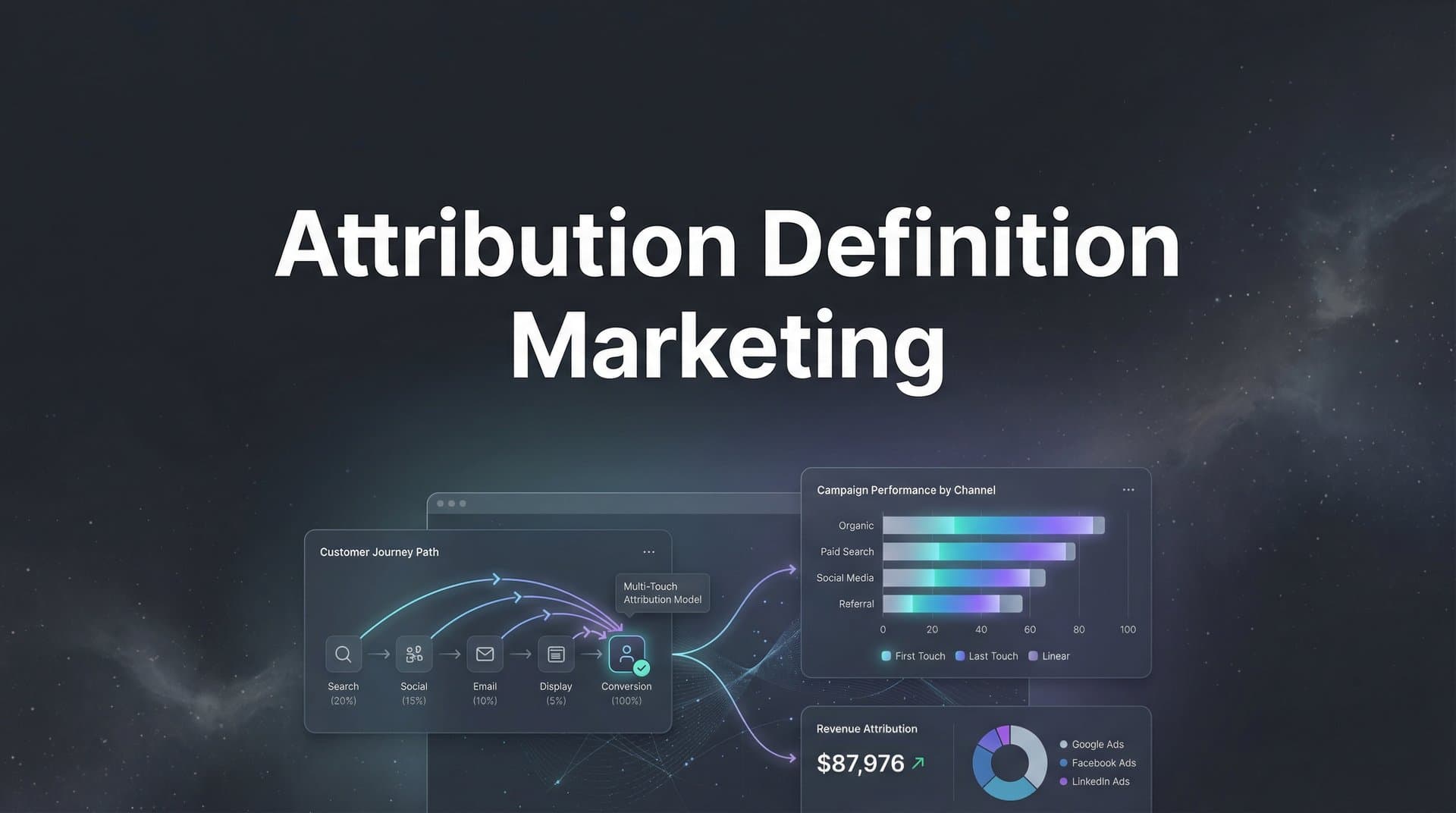
Consider a typical customer journey: Sarah sees your Facebook ad while scrolling during her lunch break. She doesn't click, but your brand registers in her mind. Two days later, she searches for a solution to her problem on Google, sees your search ad, and clicks through to your website. She browses but doesn't convert. The next morning, she receives a promotional email from your sequence, clicks the link, and finally makes a purchase.
Basic analytics would show you three separate interactions across three different channels. Attribution connects these dots into a single journey and helps you understand how each touchpoint contributed to Sarah's decision to buy. Did the Facebook ad deserve credit for initial awareness? Should the Google ad get recognition for capturing her active search intent? Does the email deserve all the credit for being the final touchpoint before conversion?
Without attribution, most marketers default to giving all credit to the last interaction—in Sarah's case, the email. But that approach systematically undervalues the awareness and consideration-building work that earlier touchpoints accomplished. It's like only crediting the player who scores the goal while ignoring the assists that made it possible.
Why Attribution Has Become Essential for Marketing Success
The marketing landscape has fundamentally changed. A decade ago, many businesses relied on one or two primary channels. Today, customers interact with brands across a dozen platforms before making a purchase decision. Without attribution, navigating this complexity becomes impossible.
The most immediate impact of attribution shows up in budget optimization. When you understand which channels and campaigns actually drive conversions, you can shift spending away from underperformers and double down on what works. This isn't minor optimization—companies often discover they're wasting 30-40% of their budget on channels that look productive in isolation but contribute minimally to actual revenue.
Consider the common scenario where your Google Ads show a strong return on ad spend in platform reporting, but when you implement proper attribution, you discover that most of those "conversions" were people who had already decided to buy after seeing your content marketing or social ads. Google captured the final click, but didn't create the demand. Without attribution, you might keep increasing your Google Ads budget while underinvesting in the channels that actually introduce customers to your brand. Implementing channel attribution in digital marketing helps you understand these dynamics clearly.
Attribution also transforms how you communicate marketing's value to leadership and stakeholders. Instead of reporting vanity metrics like impressions or clicks, you can connect marketing activities directly to revenue. When the CFO questions your budget request, you're not defending "engagement" or "brand awareness"—you're showing exactly how marketing dollars translate into customer acquisition and revenue growth.
The multi-channel reality makes this even more critical. Modern customers don't follow linear paths to purchase. They might discover you on Instagram, research you on Google, read reviews on third-party sites, visit your website multiple times, and finally convert after receiving a promotional offer. Each touchpoint plays a role in building trust and moving them toward a decision. Attribution ensures you're measuring and optimizing this entire journey, not just fragments of it.
The ROI Visibility Gap
Many marketing teams operate with a fundamental visibility problem. They can see activity—ad clicks, website visits, email opens—but struggle to connect that activity to outcomes. Attribution closes this gap by creating a clear line of sight from marketing investment to business results. The right marketing attribution platforms make this revenue tracking seamless.
This visibility becomes especially valuable when scaling. As you increase ad spend, attribution helps you identify which channels maintain efficiency at higher budgets and which ones experience diminishing returns. Without this insight, scaling often means proportionally scaling waste along with productive spending.
Understanding the Major Attribution Models
Attribution models are frameworks for distributing credit across the touchpoints in a customer journey. Choosing the right model shapes how you interpret performance data and where you allocate budget. Let's break down the major approaches and when each one makes sense. For a deeper dive into how these frameworks work, explore our guide on attribution model definition in marketing.
First-Click Attribution: This model gives 100% of the credit to the first touchpoint that introduced a customer to your brand. If someone discovers you through a blog post, then later clicks a paid ad before converting, the blog post gets all the credit. First-click attribution helps you understand which channels are most effective at generating initial awareness and bringing new prospects into your ecosystem. The downside? It completely ignores the nurturing and conversion work that happens after that initial interaction.
Last-Click Attribution: The opposite approach—all credit goes to the final touchpoint before conversion. This is the default model in most ad platforms because it makes their performance look good. If someone converts after clicking your Google Ad, Google gets 100% credit, regardless of the Facebook ads, content marketing, and email sequences that built interest over the preceding weeks. Last-click attribution is simple and easy to implement, but it systematically undervalues top-of-funnel activities and overvalues bottom-funnel channels.
Linear Attribution: This multi-touch model distributes credit equally across all touchpoints in the customer journey. If someone interacted with five different marketing activities before converting, each one receives 20% of the credit. Linear attribution recognizes that multiple touchpoints contribute to conversions, but it makes the questionable assumption that every interaction matters equally. The email someone opened but didn't click probably didn't influence their decision as much as the product demo they attended.
Time-Decay Attribution: This model gives more credit to touchpoints that happened closer to the conversion event. The logic is that recent interactions have a stronger influence on purchase decisions than older ones. If someone saw your ad a month ago but converted after clicking a retargeting ad yesterday, the retargeting ad receives significantly more credit. Time-decay works well for businesses with shorter sales cycles where recency matters, but it can undervalue important early-stage touchpoints that initiated the buying journey.
Position-Based Attribution: Also called U-shaped attribution, this model gives 40% of the credit to the first touchpoint, 40% to the last touchpoint, and distributes the remaining 20% among interactions in between. The reasoning is that the first and last touches are most critical—one introduces the customer to your brand, the other closes the deal. Position-based attribution provides a middle ground that acknowledges both awareness and conversion activities while still recognizing mid-funnel touchpoints.
Data-Driven Attribution: Rather than following predetermined rules, data-driven attribution uses machine learning to analyze your actual conversion patterns and assign credit based on which touchpoints statistically correlate with higher conversion rates. This approach requires significant data volume to work effectively, but it provides the most accurate picture of how different touchpoints actually influence outcomes in your specific business. Modern AI-powered marketing attribution tools use advanced algorithms to identify patterns humans might miss—like discovering that customers who engage with both your blog content and paid ads convert at 3x the rate of those who only see ads.
Choosing the Right Model for Your Business
There's no universally correct attribution model. The right choice depends on your sales cycle length, marketing mix, and business objectives. E-commerce businesses with short consideration periods might find last-click attribution reasonably accurate—customers often decide quickly and convert soon after discovery. B2B companies with 3-6 month sales cycles need multi-touch or data-driven models to capture the extended nurturing process. Our comprehensive guide on what is a marketing attribution model can help you evaluate your options.
The goal isn't perfect measurement—that's impossible given privacy limitations and cross-device complexity. The goal is directionally accurate insights that improve decision-making over time. Even an imperfect attribution model that consistently applies the same logic provides more value than no attribution at all.
Navigating Modern Attribution Challenges
Attribution has never been simple, but the past few years have introduced new complications that make accurate tracking significantly harder. Understanding these challenges helps you build more resilient measurement systems. For a detailed breakdown of what marketers face today, read about attribution challenges in marketing analytics.
The biggest challenge is cross-device tracking. Your customer might discover your brand on their phone during a commute, research your product on their work laptop, and finally convert on their home tablet. Traditional cookie-based tracking treats these as three separate users, completely fragmenting the customer journey. Without connecting these interactions, your attribution data shows three incomplete journeys instead of one cohesive path to purchase.
Privacy changes have intensified this challenge. Apple's App Tracking Transparency framework requires iOS apps to ask permission before tracking users across other apps and websites. Many users decline, creating blind spots in your attribution data. You might run Facebook ads that drive significant iOS traffic to your website, but if users haven't opted in to tracking, Facebook can't confirm conversions, and your attribution system can't connect their ad clicks to eventual purchases.
Browser cookie restrictions compound the problem. Safari's Intelligent Tracking Prevention and Firefox's Enhanced Tracking Protection automatically block many third-party cookies used for cross-site tracking. Chrome is phasing out third-party cookies entirely. These changes mean browser-based pixels and tags—the traditional foundation of digital attribution—are becoming less reliable.
The result is an attribution gap. Your actual marketing performance remains constant, but your ability to measure it deteriorates. This creates a dangerous situation where effective channels appear to underperform simply because you can't track their full impact.
Server-Side Tracking as a Solution
Server-side tracking has emerged as the most effective response to these privacy-driven limitations. Instead of relying on browser-based pixels that can be blocked, server-side tracking sends conversion data directly from your server to ad platforms and analytics tools. When someone converts on your website, your server immediately communicates that conversion to Facebook, Google, and other platforms—no browser cookies required.
This approach maintains attribution accuracy even when browser-level tracking fails. It also provides better data quality because server-side events are less susceptible to ad blockers, browser restrictions, and connection issues that can prevent client-side pixels from firing. For marketers running significant ad spend across multiple platforms, server-side tracking has shifted from nice-to-have to essential infrastructure.
Beyond technical implementation, attribution challenges also include organizational issues. Different teams often use different tools with incompatible tracking methodologies. Your paid ads team measures performance in Facebook Ads Manager, your email team uses their ESP's analytics, and your content team tracks engagement in Google Analytics. Each tool uses its own attribution logic, making it nearly impossible to compare channel performance accurately or understand how channels work together. Understanding how marketing attribution software differs from traditional analytics helps clarify why unified measurement matters.
Solving this requires unified tracking infrastructure that captures data consistently across all channels and applies the same attribution model to every touchpoint. This is where modern attribution platforms create value—they aggregate data from all your marketing channels, normalize it, and apply consistent measurement logic so you're actually comparing apples to apples.
Building Your Attribution System: A Practical Approach
Implementing effective attribution doesn't require a complete overhaul of your marketing stack. Follow this practical framework to build attribution capabilities that actually improve decision-making.
Step 1: Connect Your Data Sources
Start by integrating all the platforms where marketing happens and conversions occur. This includes your ad platforms (Facebook, Google, LinkedIn, TikTok), your website analytics, your CRM, your email marketing tool, and any other channels you use to reach customers. The goal is creating a unified view where every customer interaction is captured in one place, regardless of which platform it happened on. Reviewing the best software for tracking marketing attribution can help you identify the right tools for your needs.
This integration work is foundational. Without complete data collection, your attribution insights will have blind spots that lead to incorrect conclusions. If you're not tracking email marketing interactions, you might conclude that paid ads are driving all your conversions when in reality, email nurturing is doing significant work that remains invisible in your data.
Step 2: Select Your Attribution Model
Choose an attribution model that matches your business reality. If you have a short sales cycle where customers typically convert within days of discovery, last-click or time-decay models might work well. If you run a complex B2B business with long consideration periods and multiple stakeholders, multi-touch marketing attribution provides more accurate insights.
Don't overthink this decision. Start with a reasonable model and refine based on what you learn. Many businesses begin with position-based attribution because it balances simplicity with multi-touch recognition, then evolve toward data-driven approaches as they accumulate more conversion data.
Step 3: Turn Insights Into Action
Attribution only creates value when it changes your decisions. Review your attribution data regularly—weekly for high-velocity businesses, monthly for longer sales cycles—and use it to guide budget allocation. If attribution shows that your content marketing consistently contributes to conversions but receives only 10% of your marketing budget, that's a signal to shift investment.
Look for patterns beyond just channel-level performance. Attribution data often reveals that certain combinations of touchpoints produce significantly higher conversion rates. You might discover that customers who engage with both your paid ads and organic content convert at 3x the rate of those who only see ads. This insight suggests a strategy of using paid ads to drive traffic to high-quality content rather than directly to product pages.
Use attribution insights to optimize creative and messaging, not just budget allocation. If your attribution data shows that certain ad campaigns consistently appear early in high-value customer journeys, those campaigns are effectively doing awareness work even if they don't generate many last-click conversions. This understanding should influence how you evaluate and optimize those campaigns—focusing on reach and engagement rather than immediate conversion metrics.
Making Attribution Work for Your Business
Marketing attribution is fundamentally about connecting your marketing activities to business outcomes. It transforms marketing from a cost center that "does campaigns" into a revenue driver with clear ROI visibility. The core concept is straightforward: identify which touchpoints contribute to conversions and assign appropriate credit so you can make smarter decisions about where to invest.
The right attribution approach depends entirely on your business model and customer journey complexity. E-commerce brands with impulse purchases might find simple last-click attribution sufficient. B2B companies with six-month sales cycles need sophisticated multi-touch models that capture extended nurturing processes. The key is choosing an approach that matches your reality rather than implementing attribution for its own sake.
Start by auditing your current tracking setup. Do you actually know which marketing activities drive conversions, or are you relying on platform-reported metrics that each use different attribution logic? Can you trace a customer's complete journey from first interaction to final purchase, or do you only see disconnected fragments? If you're making budget decisions without clear attribution data, you're essentially guessing—and probably leaving significant performance on the table.
The marketing landscape will continue evolving. Privacy regulations will tighten, tracking will become more challenging, and customer journeys will grow more complex. But the fundamental need for attribution only intensifies as these changes unfold. Marketers who invest in robust attribution infrastructure now will have a significant competitive advantage over those who continue flying blind.
Ready to elevate your marketing game with precision and confidence? Discover how Cometly's AI-driven recommendations can transform your ad strategy—Get your free demo today and start capturing every touchpoint to maximize your conversions.