You're spending real money on paid search, LinkedIn campaigns, content syndication, and demand gen programs. Deals are closing. Pipeline is growing. But when your CFO asks which channels are actually driving revenue, you hesitate. Your Google Ads dashboard says one thing, your Meta reports say another, and your CRM shows something else entirely. Sound familiar?
This is the attribution problem that haunts nearly every B2B SaaS marketing team. And it is not a small inconvenience. When you cannot confidently connect ad spend to closed deals, every budget decision becomes a educated guess at best and a costly mistake at worst.
Attribution for B2B SaaS companies is the practice of identifying which marketing touchpoints, channels, and campaigns actually influenced a deal from first awareness to closed-won revenue. Done well, it transforms how you allocate budget, prioritize channels, and scale what works. Done poorly, or ignored entirely, it leads to scaling the wrong things while underinvesting in what actually moves the needle.
The challenge is that B2B SaaS attribution is genuinely more complex than attribution in ecommerce or B2C contexts. Long sales cycles, multiple decision-makers, CRM handoffs, and a fragmented mix of online and offline touchpoints create blind spots that standard tracking tools simply cannot handle. This guide is designed to help marketing and growth leaders understand the full picture: the models, the mechanics, the common mistakes, and the practical steps to build an attribution system that connects your ad spend to real revenue.
Why B2B SaaS Attribution Is a Different Beast Entirely
Think about how an ecommerce purchase works. Someone sees an ad, clicks it, browses a product page, adds to cart, and checks out. The entire journey might take twenty minutes. Attribution is relatively straightforward because the conversion happens in the same session or within a short window.
Now think about a typical B2B SaaS deal. A developer at a target company sees a LinkedIn thought leadership post and visits your blog. Two weeks later, a marketing manager at the same company clicks a paid search ad and downloads a case study. A month after that, the VP of Marketing requests a demo after seeing a retargeting ad. The sales team follows up over several calls, sends a proposal, and closes the deal three months after that first blog visit. How many touchpoints were involved? Which channels deserve credit?
This is the reality of B2B SaaS buying behavior. Decisions involve multiple stakeholders across different roles, including champions who advocate internally, economic buyers who approve the budget, and technical evaluators who assess fit. Each person may interact with your marketing independently, across different devices and channels, without any of those interactions being connected in your tracking system.
Single-touch attribution models were not designed for this complexity. First-touch attribution gives all credit to that initial LinkedIn post, ignoring everything that followed. Last-touch attribution credits the final retargeting ad before the demo request, completely ignoring the months of nurture that built intent. Both models tell a partial story and lead to partial decisions.
The consequence of relying on these simplified models is real and measurable in its damage. Teams scale channels that look impressive in last-click reports but contribute little to actual pipeline. Meanwhile, high-impact awareness and nurture channels that influence multiple deals receive no credit and get cut during budget reviews. Over time, this misallocation compounds, and growth stalls in ways that are difficult to diagnose because the data never told the true story.
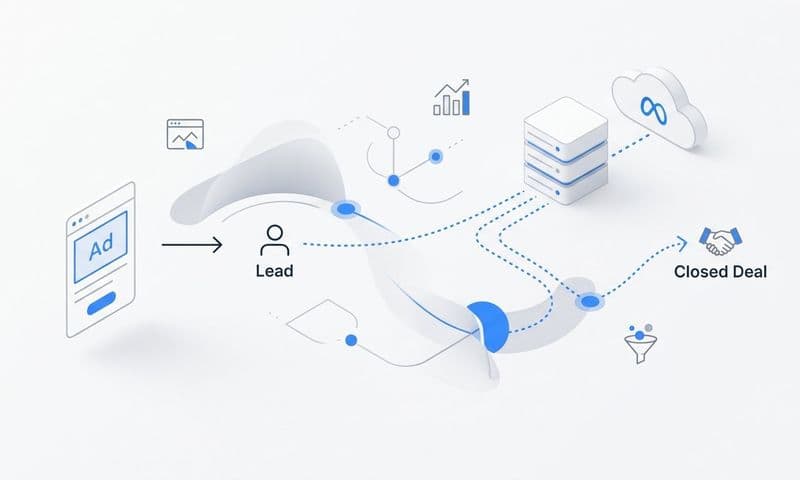
B2B attribution also has to bridge two worlds that rarely talk to each other: ad platforms and CRMs. A lead enters your CRM when they fill out a demo form, but the marketing touchpoints that drove them there live in your ad accounts and analytics tools. Once that lead is handed to sales, most marketing teams lose visibility. They never know if that lead became an opportunity, how long it sat in pipeline, or whether it closed. Without closing that loop, you are only doing half the SaaS revenue attribution work.
The Attribution Models Every B2B SaaS Marketer Should Know
Before you can build a smarter attribution system, you need to understand the models available and what each one is actually measuring. No model is universally correct. The right choice depends on what question you are trying to answer.
First-Touch Attribution: All credit goes to the first interaction a prospect had with your brand. This model is useful for understanding which channels are best at generating initial awareness and bringing new prospects into your funnel. Its weakness is that it ignores everything that happened after that first touch, making it a poor choice for evaluating channels that excel at nurture or conversion.
Last-Touch Attribution: All credit goes to the final touchpoint before a conversion event. This is the default for many ad platforms and analytics tools. It tends to over-credit branded search, direct traffic, and retargeting because those channels often appear last in the journey, even when they played a minor role in building intent.
Linear Attribution: Credit is distributed equally across all touchpoints in the journey. This is a more honest representation of multi-touch journeys but treats every interaction as equally important, which rarely reflects reality. A blog visit and a product demo request are not equivalent touchpoints.
Time Decay Attribution: More credit is given to touchpoints that occurred closer to the conversion event. This makes intuitive sense for shorter sales cycles but can undervalue early-stage awareness efforts that planted the seed for a deal that closed months later.
Position-Based Models (U-Shaped and W-Shaped): These models assign heavier credit to specific milestone touchpoints. U-shaped attribution splits the majority of credit between the first touch and the lead creation event, with the remainder distributed across middle touches. W-shaped adds a third milestone, typically the opportunity creation event, making it well suited to B2B SaaS companies with clearly defined funnel stages. Full-path models extend this further to include the closed-won event.
Data-Driven Attribution: Rather than applying fixed rules, data-driven models analyze your actual conversion data to determine how much credit each touchpoint deserves based on observed patterns. This is increasingly considered the gold standard for companies with sufficient conversion volume because it reflects how your specific buyers actually behave rather than a theoretical framework. The limitation is that it requires enough data to be statistically meaningful, which can be a barrier for earlier-stage companies.
The natural question is: which model should you use? The honest answer is that it depends on what decision you are trying to make. If you want to understand what drives initial awareness, first-touch gives you that lens. If you want to evaluate what closes deals, last-touch or time decay is more relevant. For a comprehensive view of pipeline influence, W-shaped or full-path models are typically the most informative for B2B SaaS companies. Many mature teams run multiple attribution models simultaneously and compare the results to surface discrepancies that reveal where the real value is being created.
Mapping the Full B2B Customer Journey for Accurate Attribution
Attribution models are only as good as the data feeding them. If your tracking has gaps, your attribution will have gaps. And in B2B SaaS, there are plenty of places where touchpoints go unrecorded.
The full customer journey for a B2B SaaS deal typically includes: a first ad click or organic visit, subsequent content interactions, a conversion event like a demo request or trial signup, CRM entry, sales follow-up touchpoints, pipeline stage progression, and eventually a closed-won or closed-lost outcome. Each of these stages needs to be captured and connected for attribution to work accurately.
The first layer of tracking is UTM parameters. Every paid link, email campaign, and owned channel link should carry UTM tags that identify the source, medium, campaign, and content. This ensures that when a prospect lands on your site, you know exactly where they came from. UTM data should be captured at the lead level and stored in your CRM so it travels with the contact through the entire sales cycle.
The second layer is server-side tracking. Traditional browser-based pixels have become increasingly unreliable due to iOS privacy updates, ad blockers, and cookie restrictions. When a pixel fires in a browser, there is a meaningful chance it gets blocked before the conversion signal reaches the ad platform. Server-side tracking moves this event capture to your server, where it is not subject to browser-level restrictions. This means more conversion events are recorded accurately, giving both your attribution platform and the ad platforms themselves a cleaner signal to work with.
Conversion API integrations, such as Meta's CAPI or Google's Enhanced Conversions, extend this server-side approach directly to the ad platforms. Instead of relying on a browser pixel to report a conversion, your server sends the event data directly to Meta or Google. This is particularly important for B2B SaaS companies where key conversion events, like a demo booking or a trial activation, may happen in a CRM or scheduling tool rather than on a standard webpage.
The third and most critical layer for B2B SaaS is CRM integration. This is where the loop gets closed. When your attribution platform connects to your CRM, it can pull deal stage data, opportunity values, and closed-won outcomes and match them back to the original marketing touchpoints. A lead that entered your CRM from a LinkedIn campaign, moved through three pipeline stages over two months, and closed at a specific contract value can now be traced back to its marketing origin. This transforms attribution from lead tracking into B2B revenue attribution software, which is a fundamentally different and more valuable capability.
Pipeline and Revenue Attribution: Connecting Ad Spend to Closed Deals
Here is a distinction that separates mature attribution programs from basic ones: lead attribution tells you where someone came from, while revenue attribution tells you which channels and campaigns influenced deals that actually closed. For budget decisions, only the latter truly matters.
Many B2B SaaS marketing teams optimize for cost per lead or cost per MQL. These are useful metrics, but they can be deeply misleading. A channel that generates a high volume of low-quality leads at a low cost per lead looks great in a lead-based report. A channel that generates fewer leads but sources deals that close at higher rates and larger contract values looks worse. Lead attribution rewards the first channel and punishes the second, which is the opposite of what you want.
Revenue attribution inverts this. Instead of measuring success at the lead level, you measure it at the deal level. Which campaigns sourced opportunities that entered pipeline? Which channels influenced deals at any point in the journey? Which specific ads can be connected to closed-won revenue?
To make this work operationally, you need your CRM deal stages synced with your marketing touchpoint data. When a deal moves to "Opportunity Created," that event should be attributed back to the marketing touchpoints that preceded it. When a deal reaches "Closed Won," the revenue value of that deal should flow back through the attribution model and be assigned to the contributing channels and campaigns.
The metrics that matter at this level include cost per pipeline opportunity by channel, which tells you how efficiently each channel is generating qualified pipeline rather than just leads. Pipeline influenced by channel shows you which channels touched accounts that ended up in pipeline, even if they were not the originating source. Revenue attributed per campaign gives you a direct line from ad spend to closed revenue. And the distinction between marketing-sourced revenue, where marketing was the first touch, and marketing-influenced revenue, where marketing touched the account at any point, helps you understand both the generating and supporting roles your programs play.
This level of visibility changes how you have budget conversations. Instead of defending your LinkedIn spend based on impressions or even leads, you can show exactly how much pipeline and revenue that channel influenced over the last quarter. That is a fundamentally different and more persuasive conversation.
Common Attribution Mistakes That Distort Your Marketing Data
Even teams that invest in attribution tooling often make mistakes that undermine the accuracy of their data. These are the most common ones worth actively guarding against.
Trusting Platform-Reported Conversions at Face Value: Every ad platform, whether Meta, Google, or LinkedIn, reports conversions using its own attribution methodology. Meta might use a seven-day click and one-day view window by default. Google uses its own data-driven model. LinkedIn uses its own window. When you add up conversions across all three platforms, you will almost certainly see more total conversions than actually occurred, because the same conversion is being claimed by multiple platforms simultaneously. This is self-reporting bias, and it is built into how ad platforms work. An independent, neutral attribution layer that deduplicates conversions across platforms is essential for getting an accurate picture of what is actually happening.
Ignoring the Multi-Stakeholder Reality: In B2B buying, the person who fills out the demo form is often not the only person who influenced the decision. If your tracking only captures the final form submitter, you miss the researchers, internal advocates, and technical evaluators who consumed your content and built internal consensus before anyone reached out. Account-based attribution, which tracks touchpoints across all contacts associated with a given company, provides a more accurate picture of how your marketing influenced the buying committee as a whole.
Leaving Offline and Sales-Assisted Touchpoints Untracked: Many B2B SaaS deals involve significant sales-assisted touchpoints: SDR outreach, discovery calls, product demos, and proposal reviews. If these are not captured in your attribution data, deals that involved heavy sales involvement appear to have no marketing influence. The upstream marketing touchpoints that generated the initial interest get lost, and sales gets credited for deals that marketing actually sourced. Capturing these offline conversion moments, typically through CRM activity logging and proper lead source tracking, is essential for an accurate attribution picture.
Failing to Define Conversion Events Clearly: Attribution is only as precise as the conversion events you define. If your system treats every form submission as equivalent, you are mixing trial signups, contact form submissions, content downloads, and demo requests into the same bucket. Each of these events represents a different level of intent and should be tracked and attributed separately to give you meaningful signal about what is actually driving pipeline. Understanding attribution window performance is equally important for ensuring each event is measured within the right timeframe.
Building an Attribution Stack That Scales With Your SaaS Business
Understanding attribution models and avoiding common mistakes is important groundwork, but the real question is: how do you actually build a system that delivers reliable attribution data at scale?
A scalable attribution stack for B2B SaaS typically has four core components. First, a dedicated attribution platform that sits above your individual ad channels and provides a neutral, unified view of performance. Second, server-side event tracking that captures conversion signals reliably, independent of browser limitations. Third, CRM integration that connects marketing touchpoints to pipeline stages and closed-won revenue. Fourth, a single reporting layer that aggregates data from all ad channels, your website, and your CRM into one place where you can analyze performance, compare models, and make decisions.
This is exactly the architecture that Cometly is built around. Cometly connects your ad platforms, CRM, and website to track the entire customer journey in real time, from the first ad click through every subsequent touchpoint to closed-won revenue. It captures every touchpoint, including CRM events, and feeds that enriched data to an AI layer that identifies which ads and campaigns are actually driving results. Rather than toggling between your Meta dashboard, Google Ads account, LinkedIn reports, and CRM, you get a single source of truth for marketing performance.
One of the most operationally valuable features of this approach is the ability to feed enriched conversion data back to the ad platforms themselves. When Meta and Google receive high-quality, server-side conversion signals that include downstream CRM events, their algorithms can optimize toward the outcomes you actually care about, like pipeline opportunities and closed deals, rather than just form fills. This creates a feedback loop where better attribution data leads to better algorithmic targeting, which leads to better multi-channel campaign performance.
The operational workflow looks like this: you set up tracking and define your key conversion events, from first touch through pipeline stages to closed-won. You connect your ad platforms and CRM. You analyze attribution reports across multiple models to understand which channels are generating awareness, which are driving pipeline, and which are influencing deals that close. You make budget decisions based on pipeline and revenue attribution rather than lead volume. And you feed that enriched conversion data back to your ad platforms to improve targeting and optimization over time.
As your business scales, this system scales with it. More conversion volume means more reliable data-driven attribution. More CRM data means richer pipeline and revenue attribution. And a unified reporting layer means your growth team always has a clear, accurate answer to the question that matters most: what is actually driving revenue? For a deeper look at how growth teams approach this, exploring how SaaS growth teams attribute revenue to marketing efforts can surface additional strategies worth adopting.
Putting It All Together: From Guesswork to Growth
Attribution for B2B SaaS companies is not a nice-to-have analytics project. It is the foundation of intelligent growth. When you know which channels, campaigns, and touchpoints actually drive pipeline and revenue, every budget decision becomes sharper, every conversation with leadership becomes more credible, and every dollar of ad spend works harder.
The journey starts with understanding why B2B attribution is uniquely complex and choosing models that reflect the reality of your sales cycle. It continues with capturing the full customer journey through server-side tracking, UTM parameters, and CRM integration. It matures when you connect ad spend directly to pipeline value and closed-won revenue, moving beyond lead metrics to the measurements that actually drive business outcomes.
The teams that get this right do not just have better data. They have a compounding advantage. Better attribution leads to smarter budget allocation, which leads to more efficient growth, which leads to more conversion data, which leads to even better attribution. It is a flywheel that starts with getting the fundamentals right.
If you are ready to move from fragmented platform reports to a single, accurate view of what is driving your revenue, Cometly is built specifically for this. It connects your ad platforms, CRM, and website to give your team the complete attribution picture that B2B SaaS growth requires. Get your free demo today and start capturing every touchpoint to see exactly what is driving your pipeline and revenue.