You're running campaigns on Meta, Google, TikTok, and LinkedIn. Leads are coming in. Sales are happening. But when your CMO asks which platform is actually driving revenue, you freeze. Was it the Facebook ad they clicked last week? The Google search they did yesterday? The email they opened this morning? Without a clear answer, you're flying blind—potentially pouring budget into channels that look good on paper while starving the ones quietly driving your best customers.
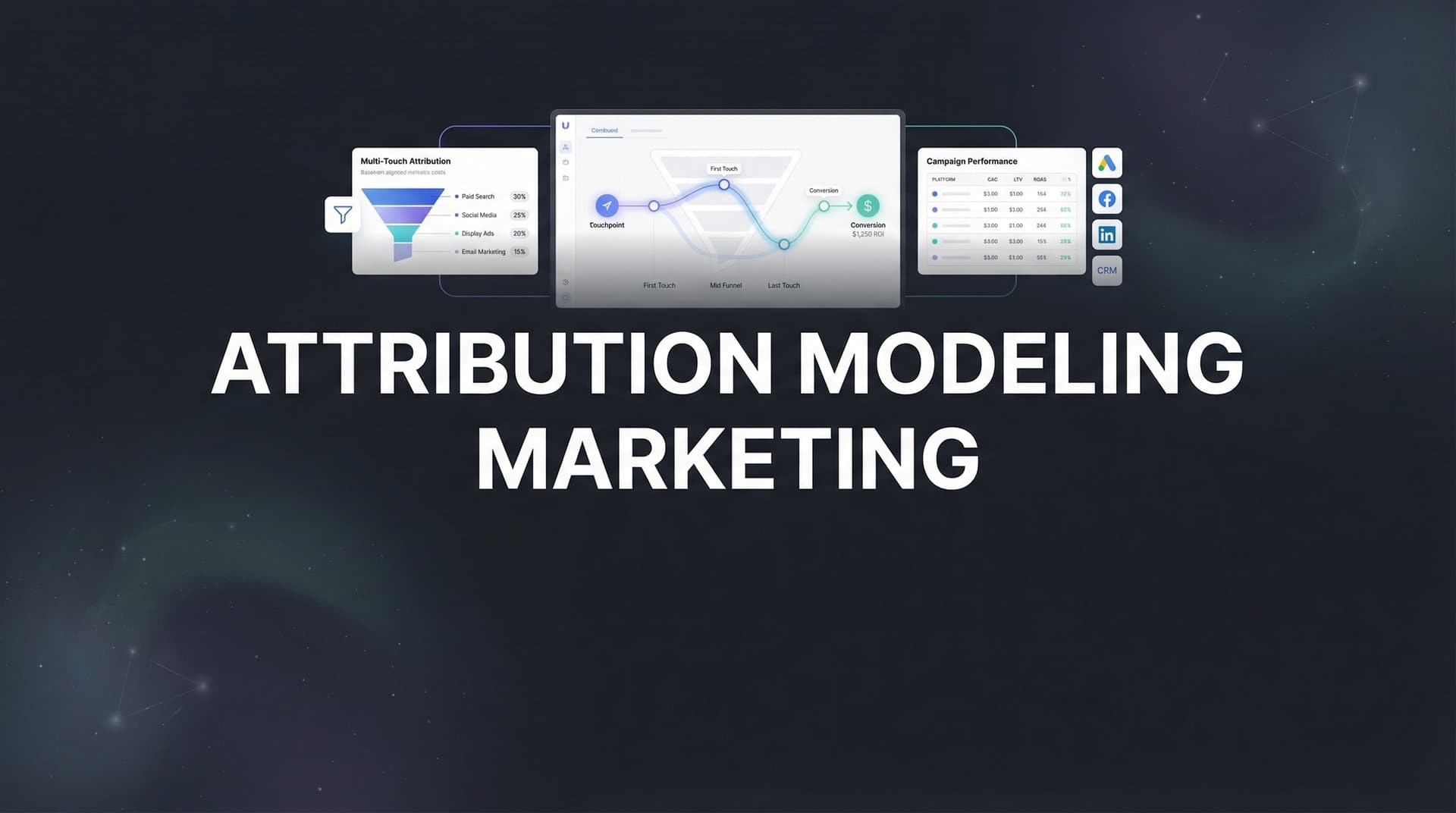
This is the puzzle attribution modeling solves. It's the framework that assigns credit to each marketing touchpoint in your customer's journey, revealing which interactions genuinely contribute to conversions. Think of it as the difference between guessing which ingredients made your recipe successful versus having the exact measurements that produced results.
The stakes couldn't be higher. Marketers without proper attribution make budget decisions based on incomplete stories. They see a last-click conversion from a Google ad and assume Google deserves all the credit, missing the Facebook campaign that introduced the customer three weeks earlier or the email sequence that nurtured them through consideration. The result? Misallocated budgets, underperforming campaigns, and a constant nagging doubt about whether you're investing in the right places.
By the end of this guide, you'll understand how different attribution models work, when each approach makes sense for your business, and how to implement attribution that actually reveals your marketing ROI. No more guesswork. Just data-informed decisions that help you scale what's working and cut what isn't.
The Foundation: How Attribution Assigns Credit Across Your Customer Journey
Attribution modeling is the methodology for determining which marketing touchpoints receive credit for conversions. It's not just tracking—it's interpretation. Your analytics platform sees the data points. Your attribution model decides what they mean.
Here's why this matters more than ever: your customers don't follow linear paths anymore. They see your Instagram ad on mobile during their morning commute. They Google your brand name on desktop at work. They click a retargeting ad on their tablet that evening. They receive an email two days later. Finally, they search your brand again and convert. That's five touchpoints across three devices over multiple days. Which one "caused" the conversion?
The answer fundamentally changes based on your attribution model. A last-click model gives 100% credit to that final branded search. A first-click model credits the Instagram ad entirely. A multi-touch model distributes credit across all five interactions. Same customer journey. Completely different conclusions about what's working.
This isn't academic. Your attribution model directly determines where you invest your budget. If your model over-credits bottom-funnel activities like branded search, you'll keep pouring money into channels that capture existing demand while underfunding the top-funnel campaigns that create awareness in the first place. You'll optimize for efficiency while slowly depleting your pipeline.
The modern customer journey typically involves seven to thirteen touchpoints before conversion. They're researching across devices. They're influenced by channels that don't even show up in your analytics—podcast mentions, word-of-mouth, offline ads. They're taking weeks or months to decide, not hours. Understanding marketing channel attribution modeling becomes essential for navigating this complexity.
Attribution modeling acknowledges this complexity. It creates a framework for assigning value across these interactions, giving you a more complete picture of what's actually driving results. The model you choose becomes your lens for understanding marketing performance—and like any lens, it reveals some details while obscuring others.
Single-Touch vs. Multi-Touch: Choosing Your Attribution Framework
Let's break down your options, starting with the simplest approaches and building to the most sophisticated.
First-Click Attribution: This model gives 100% credit to the first touchpoint in the customer journey. If someone discovers you through a Facebook ad, then interacts with five other touchpoints before converting, Facebook gets all the credit. This model answers the question: "What's creating awareness and starting customer relationships?" It's valuable for understanding your top-of-funnel performance and which channels bring new audiences into your ecosystem.
The limitation? It completely ignores everything that happened after that initial interaction. The nurture emails, retargeting campaigns, and consideration-stage content that actually convinced them to buy receive zero recognition. If you optimize purely on first-click data, you'll underfund the middle and bottom of your funnel.
Last-Click Attribution: The opposite approach—100% credit goes to the final touchpoint before conversion. This is what most platforms default to, and it's why your Google Ads dashboard loves showing you conversions from branded search terms. Someone searched your company name and converted? Google takes the credit, even though they were already looking for you specifically because of your other marketing efforts.
Last-click makes sense in specific scenarios. If you run a purely direct-response business with short sales cycles and single-session purchases, the last interaction might genuinely be the most important. But for most businesses with considered purchases, last-click systematically under-credits awareness and consideration-stage marketing.
Linear Attribution: Now we're entering multi-touch territory. Linear attribution distributes credit equally across all touchpoints. If there were five interactions in the journey, each gets 20% credit. This approach acknowledges that multiple channels contributed, treating each interaction as equally valuable.
The advantage? It's simple to understand and implement. The disadvantage? It's probably not accurate. In reality, some touchpoints matter more than others. The Facebook ad that introduced your brand likely had more impact than the fourth retargeting impression. Linear attribution doesn't account for these differences.
Time-Decay Attribution: This model weights recent interactions more heavily than older ones. A touchpoint from yesterday gets more credit than one from three weeks ago. The logic makes sense for many businesses—interactions closer to conversion often have more influence on the final decision.
Time-decay works well for products with clear consideration periods and decision-making processes. It recognizes that while early awareness matters, the content and campaigns that addressed final objections probably pushed the customer over the finish line.
Position-Based (U-Shaped) Attribution: Typically assigns 40% credit to the first interaction, 40% to the last interaction, and distributes the remaining 20% across middle touchpoints. This model says that introducing the customer and closing the deal are most important, while middle interactions play a supporting role.
Position-based attribution works when you have distinct awareness and conversion moments with a nurture period in between. It's popular because it balances the insights of first-click and last-click while acknowledging the middle of the funnel exists.
Data-Driven Attribution: This is where machine learning enters the picture. Instead of using predetermined rules, data-driven models analyze your actual conversion patterns to determine which touchpoints statistically correlate with higher conversion rates. If your data shows that customers who engage with video content convert at 3x the rate of those who don't, video touchpoints receive proportionally more credit.
The catch? You need significant conversion volume for the algorithms to identify meaningful patterns. If you're generating fewer than a few hundred conversions monthly, you don't have enough data for reliable machine learning models.
So which model should you use? Start with your customer journey complexity. If you're running simple, single-channel campaigns with short sales cycles, single-touch models might suffice. But if you're running integrated campaigns across multiple platforms with consideration periods measured in weeks or months, multi-touch marketing attribution becomes essential for understanding what's actually working.
Building the Foundation: Data Requirements for Accurate Attribution
Attribution models are only as good as the data feeding them. You can implement the most sophisticated multi-touch model available, but if your tracking infrastructure has gaps, you're building insights on quicksand.
Let's start with the basics: UTM parameters. These are the tags you add to your campaign URLs that tell analytics platforms where traffic came from. Every external link you share—social posts, email campaigns, paid ads, partner content—should have UTM parameters specifying the source, medium, campaign name, and ideally the specific content and term.
Without consistent UTM tagging, your attribution system sees traffic arriving with no context. That Facebook campaign you spent $10,000 on? If the links weren't tagged, it shows up as direct traffic or referral traffic. Your attribution model can't credit what it can't see. Proper attribution marketing tracking starts with getting these fundamentals right.
Next layer: pixel and conversion tracking implementation. Your website needs tracking pixels from your ad platforms (Meta Pixel, Google Ads tag, LinkedIn Insight Tag) properly installed and firing on the right pages. These pixels do more than track conversions—they capture the customer journey data that makes attribution possible.
But here's where it gets complicated. iOS 14.5 and subsequent updates introduced App Tracking Transparency, which requires apps to ask permission before tracking users across other companies' apps and websites. Many users decline. Browser privacy features and cookie deprecation add another layer of tracking limitations. The result? Significant blind spots in your attribution data if you're relying solely on browser-based tracking.
This is why server-side tracking has become critical. Instead of relying on browser cookies and pixels that users can block, server-side tracking sends conversion data directly from your server to ad platforms. It's more reliable, more privacy-compliant, and captures conversions that client-side tracking misses.
CRM integration represents the next level of attribution sophistication. When you connect your CRM to your attribution platform, you can track beyond the initial conversion to actual revenue. You see which marketing touchpoints led to customers who spent $500 versus $50,000. This marketing revenue attribution reveals your true marketing ROI, not just conversion volume.
Cross-device identification is another crucial piece. When someone clicks your ad on mobile but converts on desktop three days later, you need technology that recognizes this as the same person. Without cross-device tracking, you see two separate journeys that never connected—and your attribution model can't credit the mobile ad for the desktop conversion.
The harsh reality: incomplete data doesn't just reduce accuracy—it actively misleads. When your tracking infrastructure has gaps, your attribution model fills those gaps with assumptions. It might assume all untagged traffic is direct. It might miss mobile-to-desktop conversions entirely. It might fail to capture conversions from users who blocked tracking.
These aren't minor issues. They systematically bias your attribution toward certain channels while undercounting others. Mobile campaigns get under-credited because cross-device conversions aren't tracked. Top-of-funnel awareness campaigns get ignored because they happened in contexts where tracking was blocked. Bottom-funnel branded search gets over-credited because it's easy to track.
Before you worry about which attribution model to use, audit your data foundation. Are all your campaigns properly tagged? Are your tracking pixels firing correctly? Do you have server-side tracking in place? Can you track cross-device journeys? Are you connecting marketing data to revenue data through CRM integration?
Fix the foundation first. Then your attribution model can actually reveal meaningful insights instead of sophisticated interpretations of incomplete data.
From Setup to Insights: Implementing Attribution That Drives Decisions
Let's walk through what implementation actually looks like, from connecting your data sources to making your first budget reallocation based on attribution insights.
Start by connecting your ad platforms to your attribution system. This means integrating Meta Ads, Google Ads, LinkedIn Ads, TikTok Ads—whatever platforms you're running. Each integration pulls in your campaign data, ad spend, and the touchpoints users had with your ads. Most modern attribution platforms handle this through API connections that update automatically.
Next, map your conversion events. What actions count as conversions in your business? For e-commerce, it might be purchases. For SaaS, it could be trial signups, demo requests, or paid subscriptions. For lead generation, it's form submissions or phone calls. Define these events clearly and ensure they're tracked consistently across all your systems.
This is where many implementations stumble. You might track "purchases" in Google Analytics, "transactions" in your e-commerce platform, and "closed-won deals" in your CRM—but if these events aren't mapped to the same underlying action, your attribution system sees them as separate conversions. You end up double-counting or missing conversions entirely.
Set your attribution windows next. This is the timeframe during which touchpoints can receive credit for a conversion. A 30-day click window means if someone clicked your ad and converted within 30 days, that click is eligible for credit. Your attribution windows should align with your typical sales cycle. Selling enterprise software with 90-day sales cycles? You need longer attribution windows than someone selling impulse-buy consumer products.
Now you're ready to start reading attribution reports. But here's what trips up many marketers: attribution reports don't tell you what to do. They show you different perspectives on the same reality. Your job is interpreting what those perspectives reveal.
Compare your last-click report to your first-click report. If a channel looks great in last-click but terrible in first-click, it's probably capturing existing demand rather than creating new demand. That's not bad—you need bottom-funnel conversion—but you shouldn't scale it expecting it to generate awareness.
Look for channels that show up strongly in first-click but weakly in last-click. These are your awareness drivers. They're introducing customers who eventually convert through other channels. If you cut these channels because they don't show direct conversions, you're cutting the top of your funnel. You'll see the impact weeks or months later when your pipeline dries up.
Examine your multi-touch attribution data for patterns. Which touchpoint combinations correlate with higher conversion rates? Maybe customers who see both video content and retargeting ads convert at 2x the rate of those who only see one. That's an insight you can act on—create more video content and ensure video viewers enter your retargeting audiences.
Now translate these insights into budget decisions. If your attribution data shows that podcast advertising drives high-value customers who take longer to convert but have 3x higher lifetime value, maybe it deserves more budget even though it looks inefficient in last-click reports. If your data reveals that LinkedIn is primarily assisting conversions that close through Google search, you might keep LinkedIn spend steady while scaling Google to capture the demand LinkedIn is creating.
Watch out for common pitfalls. Double-counting happens when the same conversion gets credited in multiple systems. If both your analytics platform and your ad platform count the same purchase, your attribution model might credit it twice. Missing touchpoints occur when customers interact with your marketing in ways your tracking doesn't capture—offline ads, podcast mentions, word-of-mouth. Attribution window mismatches create confusion when different platforms use different windows, making cross-platform comparison misleading. Understanding these common attribution challenges in marketing analytics helps you avoid costly mistakes.
The most dangerous pitfall? Over-rotating on attribution data without considering context. Attribution models show correlation, not causation. Just because a touchpoint appears in many conversion paths doesn't mean it caused those conversions. Maybe it's just highly visible to people who were already likely to convert. Use attribution insights as inputs to decision-making, not as automatic answers.
Turning Attribution Into Optimization: Making Your Campaigns Smarter
Attribution data becomes valuable when it changes what you do. Here's how to use your insights to optimize campaigns, creative, audiences, and channel mix.
Start with creative testing. Your attribution data reveals which ad creative appears most frequently in high-value conversion paths. If video ads consistently show up in the journeys of customers who spend 2x more than average, that's a signal to create more video content and test different video formats. If carousel ads drive awareness but single-image ads close conversions better, you can build a strategy that uses each format for its strength.
We compare the leading options in our WooCommerce image ad tool roundup.
Attribution insights also inform audience targeting. When you see which audience segments convert through which channels, you can refine your targeting strategy. Maybe your attribution data shows that lookalike audiences convert best when they encounter your brand through content marketing first, then see retargeting ads. That's actionable—adjust your lookalike campaigns to focus on content amplification rather than direct conversion messaging.
Channel mix optimization becomes data-driven instead of guesswork. If your multi-touch attribution reveals that customers who interact with three or more channels convert at significantly higher rates than single-channel customers, you have evidence to support integrated campaigns across multiple platforms. You can justify budget for channels that don't show strong last-click performance because you see their contribution to multi-touch journeys. The right marketing channel attribution software makes this analysis straightforward.
Here's where attribution creates a powerful feedback loop: sending conversion data back to ad platforms. When you feed your attribution insights back to Meta, Google, and other platforms, you're improving their optimization algorithms. Their systems learn which users are most likely to convert based on your actual conversion patterns, not just their last-click data.
This is particularly powerful for server-side conversion tracking. When you send server-side events that include revenue data, purchase values, and customer lifetime value predictions, ad platforms can optimize for high-value conversions instead of just conversion volume. The algorithms learn to find customers similar to your best customers, not just your most recent customers.
Comparing attribution models side-by-side reveals different truths about your marketing performance. Run the same time period through last-click, first-click, and position-based models. The differences tell you a story. Channels that perform dramatically better in first-click than last-click are awareness drivers. Channels that excel in last-click but disappear in first-click are demand capture mechanisms. Channels that show strong performance across multiple models are genuinely driving results throughout the funnel.
Use these comparisons to set appropriate goals for each channel. Don't expect your brand awareness campaigns to show strong last-click performance. Don't expect your branded search campaigns to show strong first-click performance. Each channel has a role. Attribution helps you understand what that role actually is so you can optimize for the right outcomes.
The optimization cycle looks like this: implement attribution, gather data, identify patterns, form hypotheses about what's working, test those hypotheses with budget reallocations or campaign changes, measure the results, refine your understanding. It's continuous improvement driven by increasingly sophisticated insights about what actually drives conversions.
The Evolution: Advanced Attribution Strategies and What's Next
Attribution modeling is powerful, but it's not the complete picture. Let's explore what comes next.
Incrementality testing complements attribution by answering a different question. Attribution asks "which touchpoints were present in the conversion path?" Incrementality asks "which marketing activities actually caused conversions that wouldn't have happened otherwise?" You run incrementality tests by creating holdout groups who don't see certain campaigns, then comparing their conversion rates to exposed groups. The difference reveals true incremental impact.
Why does this matter? Attribution can show that branded search appears in 80% of conversion paths, making it look incredibly valuable. But incrementality testing might reveal that people who see your branded search ads convert at almost the same rate as people who don't—because they were already searching for your brand. Attribution identifies correlation. Incrementality identifies causation.
The ideal approach combines both. Use attribution modeling to understand the customer journey and identify which touchpoints appear most valuable. Use incrementality testing to validate whether those touchpoints are actually driving incremental conversions or just correlating with conversions that would have happened anyway. Understanding the differences between attribution modeling vs marketing mix modeling helps you choose the right methodology for different questions.
AI and machine learning are rapidly evolving attribution capabilities. Beyond basic data-driven models, advanced systems now analyze patterns across millions of customer journeys to identify non-obvious insights. They detect that customers who engage with specific content combinations convert at higher rates. They recognize that certain touchpoint sequences predict high lifetime value. They identify optimal channel mixes for different customer segments. Exploring content marketing attribution modeling with machine learning reveals how these technologies work together.
These AI systems can also predict future behavior. Based on a customer's current journey touchpoints, they estimate conversion probability and potential value. This enables proactive optimization—identifying high-potential customers early in their journey and adjusting marketing intensity accordingly.
The privacy-first future is reshaping attribution fundamentally. As third-party cookies disappear and tracking becomes more restricted, attribution increasingly relies on first-party data, server-side tracking, and privacy-preserving technologies. The marketers who build strong first-party data foundations now will have significant advantages as privacy regulations tighten. Staying current with the latest trends in marketing attribution technology helps you prepare for these changes.
This shift actually makes attribution more valuable, not less. When you can't track every detail of every journey, the attribution modeling you can do with consented, first-party data becomes more critical for understanding performance. The bar for data quality rises—you need better implementation, cleaner data, and more sophisticated analysis to extract insights from less granular information.
Looking ahead, attribution is moving toward unified measurement frameworks that combine multiple methodologies. Instead of choosing between attribution modeling, marketing mix modeling, and incrementality testing, advanced platforms integrate all three approaches. Each methodology reveals different insights, and together they create a more complete understanding of marketing effectiveness than any single approach can provide.
Your Path Forward: Building Attribution That Drives Growth
Attribution modeling isn't a reporting exercise you set up once and forget. It's the foundation for confident, data-driven marketing decisions that compound over time. Every budget reallocation based on attribution insights makes your marketing more efficient. Every optimization informed by customer journey data improves your results. The competitive advantage builds gradually, then suddenly becomes insurmountable.
The right attribution approach for your business depends on three factors: your customer journey complexity, your data infrastructure, and your decision-making needs. If you're running simple campaigns with short sales cycles, start with straightforward models and focus on getting your data foundation right. If you're managing complex, multi-channel campaigns with long consideration periods, invest in sophisticated multi-touch attribution and the infrastructure to support it.
What matters most isn't which model you choose—it's that you're making decisions based on data instead of assumptions. Marketers who understand which channels actually drive revenue, which touchpoints matter most in the customer journey, and how their marketing investments connect to business outcomes operate with a level of confidence that gut-feel marketers can't match.
The landscape is evolving rapidly. Privacy regulations are tightening. Tracking is becoming more complex. But the fundamental need—understanding what's working in your marketing—isn't going away. It's becoming more important as acquisition costs rise and competition intensifies. The marketers who master attribution now are building capabilities that will serve them for years.
Start where you are. Audit your current tracking infrastructure. Implement proper UTM tagging. Connect your data sources. Choose an attribution model that matches your business complexity. Read the reports. Form hypotheses. Test them. Refine your understanding. The insights compound quickly once you start paying attention.
Ready to elevate your marketing game with precision and confidence? Discover how Cometly's AI-driven recommendations can transform your ad strategy—Get your free demo today and start capturing every touchpoint to maximize your conversions.