Knowing which marketing channels actually drive revenue has never been more complicated. Customer journeys now span dozens of touchpoints across paid social, search, email, and even offline channels before a single conversion happens. Without the right attribution modeling software, you're essentially flying blind, scaling budgets based on incomplete data and guessing which campaigns deserve credit.
The good news: a new generation of attribution tools has emerged to solve exactly this problem. Whether you're running cross-platform paid ads, managing a Shopify store, or nurturing complex B2B buying cycles, there's a solution built for your specific needs.
To build this list, we evaluated tools on multi-touch attribution capabilities, platform integrations, data accuracy methods (especially server-side and first-party tracking), ease of use, and pricing transparency. Here are the top attribution modeling software options for marketers in 2026.
1. Cometly
Best for: Marketers and agencies running cross-platform paid ad campaigns who need AI-powered attribution and optimization in one place.
Cometly is an AI-powered marketing attribution platform that tracks the full customer journey across ad platforms, CRM data, and your website, with server-side tracking and conversion sync built in.
 9 Best Attribution Modeling Software for Marketers in 2026
Where This Tool Shines
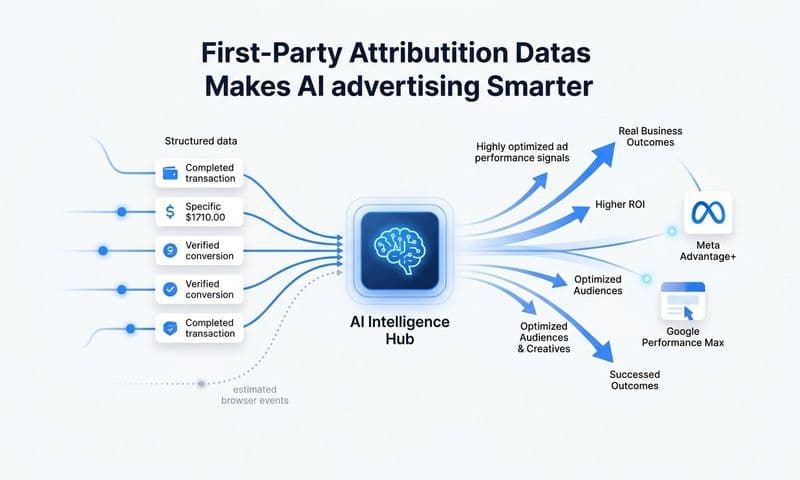
Cometly stands out because it doesn't just report on what happened. It actively helps you improve campaign performance by feeding enriched, conversion-ready events back to Meta, Google, and other ad platforms. This closes the loop between your attribution data and the algorithms that drive your ad spend, giving those platforms better signals to optimize toward real revenue events rather than surface-level clicks.
The AI layer adds another dimension. Instead of staring at dashboards and drawing your own conclusions, Cometly's AI Ads Manager surfaces optimization recommendations and the AI Chat feature lets you ask questions about your data in plain language. For busy marketing teams managing multiple channels, that kind of analytical leverage is genuinely useful.
Key Features
AI-Powered Multi-Touch Attribution: Tracks and attributes every marketing touchpoint across all channels to give a complete picture of the customer journey.
Server-Side Tracking: Collects data beyond browser and cookie limitations, improving accuracy in a privacy-first world where iOS changes and ad blockers routinely distort client-side data.
Conversion Sync: Sends enriched conversion events back to Meta, Google, and other ad platforms to improve targeting and algorithmic optimization.
AI Ads Manager: Delivers actionable recommendations on which ads and campaigns to scale, pause, or adjust based on attribution data.
AI Chat: Lets you query your marketing data using natural language, making analysis accessible without needing to dig through complex reports manually.
Best For
Cometly is an excellent fit for digital marketers, performance marketing teams, and agencies managing paid campaigns across multiple platforms who want attribution that goes beyond reporting. If you're serious about feeding better data back to ad algorithms and making AI-driven optimization decisions, it's a strong choice.
Pricing
Custom pricing based on your needs. You can request a demo at cometly.com/demo to get a tailored walkthrough and pricing details.
2. Triple Whale
Best for: Shopify ecommerce brands that want centralized attribution and creative analytics across paid social channels.
Triple Whale is an ecommerce analytics and attribution platform built primarily for Shopify brands, offering a first-party pixel, multi-touch attribution, and a unified ad performance dashboard.
 7 Best Funnel.io Alternatives for Marketing Data Analytics in 2026
Where This Tool Shines
Triple Whale has built a loyal following among Shopify-native brands because everything is designed around ecommerce workflows. The first-party pixel handles server-side data collection, which means you're not relying solely on Meta or Google's often-unreliable reported data. You get a cleaner, more accurate view of what's actually driving purchases.
The creative analytics feature is particularly useful for teams running a high volume of ad creatives. You can see exactly which images, videos, and copy combinations are driving the most revenue, making it easier to brief your creative team on what to produce next.
Key Features
First-Party Pixel: Server-side tracking that captures accurate purchase and conversion data independent of platform-reported numbers.
Deep Shopify Integration: Native connection to Shopify order data, customer records, and product performance for closed-loop attribution.
Creative Analytics: Breaks down ad performance by individual creative asset across platforms so you know which content actually converts.
Unified Dashboard: Consolidates performance data from Meta, Google, TikTok, and other channels into a single view.
Best For
Shopify-based direct-to-consumer brands spending meaningfully on paid social who want accurate attribution without heavy technical setup. Less suited for B2B or businesses without an ecommerce component.
Pricing
Starts around $100/month and scales based on ad spend volume and feature tier. Accessible entry point for growing ecommerce brands.
3. Northbeam
Best for: Mid-market ecommerce brands that want machine learning-driven attribution and media mix modeling without a data science team.
Northbeam is a machine learning-powered attribution and media mix modeling platform designed to give ecommerce brands data-science-level insights at a practical scale.
 9 Best Attribution Tools for Paid Advertising in 2026
Where This Tool Shines
What separates Northbeam from simpler attribution tools is its use of machine learning to model attribution rather than relying solely on rule-based approaches. This matters because rule-based models like last-click or even linear attribution make assumptions about customer behavior that often don't reflect reality. Northbeam's ML models adapt to your actual data patterns.
The media mix modeling layer helps with budget allocation decisions beyond just individual channel attribution. If you're trying to understand whether to shift spend from paid search to paid social at a macro level, this kind of modeling gives you a framework to work with.
Key Features
ML-Based Multi-Touch Attribution: Uses machine learning models rather than rigid rules to assign credit across touchpoints more accurately.
Media Mix Modeling: Provides budget allocation insights across channels to inform strategic spend decisions.
Cross-Channel Creative Analytics: Evaluates creative performance across platforms to identify top-performing ad assets.
Customizable Attribution Windows: Lets you adjust lookback windows and attribution models to match your actual sales cycle.
Best For
Mid-market ecommerce brands with meaningful ad spend who want more sophisticated attribution modeling than standard tools provide, without needing to hire a dedicated data science team.
Pricing
Custom pricing; typically positioned for mid-market brands and above. Best to contact their team directly for a quote based on your data volume and needs.
4. Rockerbox
Best for: Brands running omnichannel marketing that includes offline channels like TV, direct mail, and podcast advertising alongside digital.
Rockerbox is an omnichannel attribution platform that unifies measurement across both digital and offline marketing channels in a single reporting environment.
 9 Best Marketing Attribution Platforms for Startups in 2026
Where This Tool Shines
Most attribution tools are built for digital-only marketers. Rockerbox fills a genuine gap for brands that invest in offline channels and need to understand how those efforts contribute to conversions alongside their digital spend. If you're running TV spots, direct mail campaigns, or podcast sponsorships, this is one of the few platforms that can bring all of that into a unified attribution view.
The ability to compare offline and digital channel performance side by side helps marketing teams make more informed budget decisions, especially when justifying spend on channels that don't have a direct last-click path to conversion.
Key Features
Unified Digital and Offline Attribution: Measures TV, direct mail, podcast, and other offline channels alongside digital in one platform.
Multi-Touch Attribution with Customizable Models: Lets you apply and compare different attribution models to understand channel contribution from multiple angles.
Marketing Spend Optimization: Surfaces recommendations for reallocating budget based on channel performance data.
Offline Data Source Integrations: Connects with TV, podcast, and direct mail data providers to pull in impression and spend data automatically.
Best For
Growth-stage and enterprise brands with diversified marketing mixes that include both digital and offline channels. Particularly valuable for brands where TV or direct mail plays a significant role in customer acquisition.
Pricing
Custom pricing based on the number of channels tracked and overall data volume. Contact Rockerbox directly for a tailored quote.
5. HubSpot Marketing Hub (Attribution Reporting)
Best for: HubSpot users who want native closed-loop attribution tied directly to CRM contacts, deals, and pipeline revenue.
HubSpot Marketing Hub includes built-in multi-touch attribution reporting that connects marketing touchpoints to real revenue outcomes through its native CRM integration.
 9 Best Attribution Software for B2B SaaS in 2026
Where This Tool Shines
The biggest advantage HubSpot's attribution reporting offers is that it lives inside the same system as your CRM. There's no data syncing, no integration maintenance, and no reconciling numbers between separate platforms. Every touchpoint is automatically tied to a contact record, deal, and revenue figure, giving you genuinely closed-loop attribution without additional tooling.
For teams already using HubSpot for sales and marketing, this is often the most practical starting point for attribution. You can compare multiple attribution models side by side, from first touch to U-shaped to time decay, and see how each model changes your understanding of channel contribution.
Key Features
Native CRM Integration: Attribution data ties directly to contact records, deal stages, and closed revenue without requiring external integrations.
Multiple Attribution Models: Supports first touch, last touch, linear, U-shaped, time decay, and full-path models for flexible analysis.
Revenue Attribution by Campaign: Shows which campaigns and content pieces contribute to pipeline and closed revenue.
Content and Channel Reporting: Breaks down performance by landing pages, emails, ads, and organic channels within the same interface.
Best For
Marketing teams already on HubSpot's platform who want attribution without adding another tool to their stack. Especially useful for inbound-focused teams where content and email play a major role in the customer journey.
Pricing
Attribution reporting is available in Marketing Hub Professional at $800/month and Enterprise plans. Not available on Starter tiers.
6. Ruler Analytics
Best for: Lead-generation businesses that need to track phone calls, form submissions, and live chat back to their original marketing source.
Ruler Analytics is a closed-loop marketing attribution platform built specifically for businesses where leads come in through calls, forms, and chat rather than direct ecommerce transactions.
 8 Best Attribution Tools with Onboarding Support in 2026
Where This Tool Shines
Most attribution platforms are optimized for ecommerce conversion tracking. Ruler Analytics solves a different problem: how do you attribute revenue when the conversion is a phone call or a form fill, and the actual deal closes weeks later in your CRM? Ruler connects those dots by tracking the original marketing source for every lead and then syncing revenue data back from your CRM once deals close.
The call tracking capability with dynamic number insertion is particularly valuable for businesses running paid search campaigns where phone calls are a primary conversion action. You can see exactly which keywords and ads are generating calls that turn into revenue.
Key Features
Call Tracking with Dynamic Number Insertion: Assigns unique tracking numbers to visitors based on their source so every call can be attributed to the right campaign.
Form and Chat Tracking: Captures form submissions and live chat conversations and ties them back to their originating marketing touchpoint.
CRM Revenue Sync: Pulls closed deal values from your CRM back into attribution reporting so you can calculate true ROI by channel.
Ad Platform Integrations: Syncs attribution data with Google Ads, Google Analytics, and major CRMs for a connected reporting environment.
Best For
Service businesses, agencies, and B2B companies where leads come through calls, forms, or chat and the sales cycle extends beyond the initial conversion event. Not ideal for pure ecommerce.
Pricing
Starts around $200/month and scales with tracking volume and number of data sources. A reasonable investment for lead-gen focused teams.
7. Hyros
Best for: High-spend advertisers with complex funnels and long sales cycles who need deep funnel tracking and extended attribution windows.
Hyros is an AI-powered ad tracking and attribution platform built for advertisers running significant budgets across complex, multi-step funnels.
 7 Best Northbeam Alternatives for Small Business in 2026
Where This Tool Shines
Hyros is designed for scenarios where the standard 7-day or 28-day attribution windows used by ad platforms simply don't capture the full customer journey. For businesses with longer consideration cycles, webinar funnels, or high-ticket sales processes, Hyros extends tracking windows and follows customers through each stage of the funnel to give a more complete picture of which ads actually drive revenue.
The AI-based attribution engine attempts to go beyond simple rule-based models by analyzing patterns in your specific customer data. For advertisers spending heavily and needing precision in their attribution, this level of sophistication can meaningfully improve optimization decisions.
Key Features
AI-Based Ad Attribution: Uses AI to attribute conversions with extended lookback windows that match complex sales cycles.
Deep Funnel Tracking: Follows customer interactions through multi-step funnel processes, webinars, and long consideration periods.
Print Tracking: Extends attribution to direct mail and offline campaigns for marketers using offline touchpoints.
Ad Platform Data Sync: Sends conversion data back to ad platforms to improve algorithmic optimization.
Best For
High-spend advertisers in industries with longer sales cycles or complex funnel structures who need attribution that matches their actual customer journey rather than standard platform windows.
Pricing
Custom pricing; generally positioned at higher price points suited for advertisers with significant ad budgets. Contact Hyros directly for a quote.
8. Dreamdata
Best for: B2B companies that need account-based attribution across multi-stakeholder buying committees and long sales cycles.
Dreamdata is a B2B revenue attribution platform that maps the entire buying journey across multiple contacts within an account, connecting marketing and sales data for true account-based measurement.
Where This Tool Shines
B2B attribution is fundamentally different from B2C. Deals often involve multiple stakeholders, each interacting with your marketing in different ways over months. Dreamdata is built around this reality. Instead of tracking individual contacts in isolation, it maps touchpoints at the account level, giving you a complete view of how marketing influenced a deal across the entire buying committee.
The integration depth with CRMs, marketing automation tools, and ad platforms means you can connect pipeline data with campaign data and understand which content, channels, and campaigns are actually moving accounts through the funnel toward closed revenue.
Key Features
Account-Based Multi-Touch Attribution: Attributes revenue at the account level, crediting touchpoints across all contacts involved in a deal.
B2B Customer Journey Mapping: Visualizes the full buying journey across multiple stakeholders and extended time periods.
CRM and Ad Platform Integrations: Connects with Salesforce, HubSpot, LinkedIn Ads, Google Ads, and other core B2B tools.
Content Attribution: Measures the contribution of organic and paid content touchpoints to pipeline and revenue.
Best For
B2B marketing and revenue operations teams who need to justify marketing spend with pipeline and revenue data, especially in account-based go-to-market environments with long sales cycles.
Pricing
A free tier is available for getting started. Paid plans begin around $999/month, making it a serious investment suited for teams with meaningful pipeline to measure.
9. Wicked Reports
Best for: Subscription businesses and marketers focused on long-term customer lifetime value rather than single-conversion attribution.
Wicked Reports is a first-party data attribution platform that helps subscription and recurring revenue businesses understand which marketing channels acquire the most valuable customers over time.
Where This Tool Shines
Most attribution tools optimize for the initial conversion. Wicked Reports takes a longer view by tying acquisition channels to customer lifetime value and cohort performance. This matters enormously for subscription businesses where the true value of a customer isn't visible at the moment of first purchase. A channel that looks expensive on a cost-per-acquisition basis might be acquiring customers who retain far longer and generate significantly more revenue over time.
The focus on privacy-compliant, first-party data collection also makes it well-suited for a tracking environment where third-party cookies are increasingly unreliable. By building attribution on first-party data, Wicked Reports maintains accuracy even as browser and platform restrictions tighten.
Key Features
First-Party Data Tracking: Builds attribution on privacy-compliant, first-party data collection rather than relying on third-party cookies.
LTV-Based Cohort Attribution: Segments customers by acquisition cohort and tracks their long-term revenue contribution back to the originating marketing channel.
Subscription and Recurring Revenue Tracking: Natively handles subscription billing patterns, renewals, and churn in its attribution models.
Ad Platform and Email Integrations: Connects with major ad platforms and email marketing tools to pull in spend and engagement data for full ROI analysis.
Best For
Subscription businesses, SaaS companies, and membership-based brands where customer lifetime value is the primary metric for evaluating marketing channel performance.
Pricing
Starts around $250/month and scales with features and data volume. Reasonable for subscription businesses where LTV insights can meaningfully shift budget allocation decisions.
Which Attribution Tool Is Right for You
The best attribution modeling software depends entirely on your business model, channel mix, and what you're actually trying to measure. Here's a quick guide to matching the right tool to your situation.
If you're running cross-platform paid ad campaigns and want AI-powered attribution that actively improves your ad performance by feeding better data back to platform algorithms, Cometly is the strongest choice. It's built for performance marketers who want attribution that does more than report, it optimizes.
For Shopify ecommerce brands focused heavily on paid social, Triple Whale offers the deepest native integration and creative analytics purpose-built for that environment. Northbeam is worth considering if you want more sophisticated ML-based modeling at the mid-market level.
B2B teams with complex, multi-stakeholder buying cycles will find Dreamdata built specifically for their reality. It handles account-based attribution in a way that generic tools simply can't replicate. For lead-generation businesses where calls and form fills drive revenue, Ruler Analytics closes the loop between marketing source and CRM deal value better than most alternatives.
If your marketing mix includes TV, direct mail, or podcast advertising alongside digital, Rockerbox is one of the few platforms that can bring all of that together in one attribution view. And for subscription businesses focused on long-term customer value, Wicked Reports provides the LTV-based cohort analysis that short-window attribution tools miss entirely.
The most important step is matching the tool to your actual conversion paths. A platform built for ecommerce won't serve a B2B SaaS company well, and vice versa. Evaluate each option against your specific channels, your sales cycle length, and the metrics that actually matter to your business.
Ready to see what accurate, AI-driven attribution looks like in practice? Get your free demo of Cometly and start capturing every touchpoint across your customer journey to make smarter, more confident decisions about where to scale your ad spend.