If you run marketing for a B2B SaaS company, you have probably noticed something unsettling over the past few years: the numbers in your ad dashboards are telling a different story than the numbers in your CRM. Campaigns that look profitable in Google Ads or Meta somehow do not show up clearly in your pipeline. Conversions get attributed to the wrong channels. Budget decisions get made on data that feels increasingly unreliable.
This is not a coincidence. The infrastructure that ad platforms relied on to track user behavior across the web is quietly collapsing. Browser privacy restrictions are tightening, third-party cookies are fading out, and ad blockers are more widely used than ever. The result is a growing blind spot between your ad spend and your actual revenue.
For B2B SaaS companies, this blind spot is especially dangerous. Your sales cycles are long. Your buyers touch multiple channels before they ever book a demo. And by the time a deal closes, the original ad click that started the journey has often been lost entirely. You are left making budget decisions based on incomplete, fragmented data.
First-party data tracking is the answer to this problem. At its core, it means collecting behavioral, conversion, and customer data directly from your own properties and systems: your website, your CRM, your payment infrastructure, and your backend servers. Instead of relying on ad platforms to track your customers for you, you own the data and control the connection from ad click to closed deal.
This guide will walk you through why first-party data tracking matters specifically for B2B SaaS, what it actually involves under the hood, how to implement it step by step, and how it transforms your ability to make confident marketing decisions. Let us get into it.
Why Third-Party Data Is Failing B2B SaaS Marketers
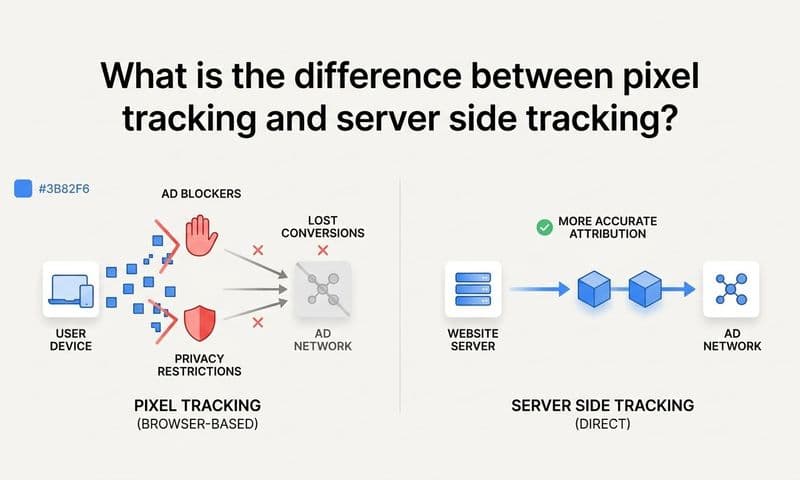
Third-party tracking was built on a simple idea: a pixel or cookie placed on your website by an ad platform could follow users around the web and report back what they did after seeing or clicking your ad. For years, this worked well enough. But several forces have converged to make that model increasingly unreliable.
Apple introduced App Tracking Transparency with iOS 14.5 in 2021, requiring apps to ask users for permission before tracking them across other apps and websites. The opt-in rates were low, and the impact on Meta's ability to track conversions was immediate and significant. Around the same time, Safari had already been running Intelligent Tracking Prevention (ITP) for years, which aggressively limits how long third-party cookies persist. Firefox followed with Enhanced Tracking Protection. Google has been evolving its Privacy Sandbox initiative in Chrome, moving away from traditional third-party cookie support entirely.
Add widespread ad blocker adoption to the mix, and you have an environment where browser-based tracking is losing data at almost every step of the funnel. Ad platforms are doing their best to fill the gaps with modeled data and machine learning estimates, but estimates are not the same as real conversion signals.
Now consider why B2B SaaS is hit harder by this than most other business models. A consumer buying a pair of shoes might convert within a single session. A B2B software buyer is on a completely different timeline. Sales cycles of 30 to 90 days or longer are common. Multiple stakeholders are involved: the end user who first finds your product, the manager who evaluates it, and the finance team or executive who signs off. Each of those people might interact with your brand across different devices, different browsers, and different channels before a deal closes.
Every privacy restriction, every blocked cookie, every session that cannot be connected to a prior touchpoint is another gap in your attribution data. And in B2B, those gaps compound. A prospect who clicked a LinkedIn ad three weeks ago, visited your pricing page from an organic search last week, and finally booked a demo through a direct visit today might show up in your ad platform as an unattributed conversion, or worse, as a direct conversion that gives no credit to the campaigns that actually drove the decision. Understanding tracking users without third-party cookies is essential for solving this problem.
The real-world consequences are significant. Your ROAS figures in ad dashboards become distorted: some campaigns look more profitable than they are, others look underperforming when they are actually driving real pipeline. Budget gets shifted toward channels that appear to work based on last-touch attribution, while channels that genuinely influence buying decisions get defunded. Over time, you are not optimizing your marketing. You are optimizing your reporting.
The only way to fix this is to stop depending on ad platforms to track your customers for you, and start building that capability yourself.
First-Party Data Tracking Explained in Plain Terms
First-party data tracking is the practice of collecting behavioral, conversion, and customer data directly from your own systems rather than relying on third-party cookies or ad platform pixels alone. The data comes from properties you own and control: your website, your app, your CRM, your payment processor, and your backend servers. For a deeper dive into the fundamentals, see our guide on what first-party data tracking is and why it matters.
Think of it this way. When a visitor lands on your site from a Google ad, a third-party tracking approach depends on Google's pixel in the browser to register that click and follow what happens next. A first-party approach captures that click ID on your own server the moment the visitor arrives, stores it in your own database, and links every subsequent action that visitor takes back to that original source. The difference is ownership and reliability.
For B2B SaaS specifically, there are several categories of first-party data that matter most.
Website interaction data: Page visits, scroll depth, content downloads, demo request form fills, free trial sign-ups, and pricing page views. These are behavioral signals that tell you what a prospect is interested in and how close they are to converting.
CRM events: Lead creation, marketing qualified lead (MQL) status, sales qualified lead (SQL) status, opportunity creation, pipeline stage progression, and closed-won or closed-lost outcomes. This is where the real revenue signal lives, and it almost never gets connected back to marketing attribution without deliberate effort.
Product and payment events: Free trial activations, feature usage milestones, subscription starts, plan upgrades, and churn events. For product-led growth SaaS companies, these events are critical signals for understanding which marketing channels bring in users who actually convert to paid and stay.
Ad click identifiers captured server-side: The GCLID from Google, the FBCLID from Meta, and equivalent parameters from other platforms. Capturing these on your server rather than relying on the browser to store them means they persist even when cookies are blocked or expire before a conversion happens.
The contrast with third-party tracking becomes clear when you look at what happens across a long B2B sales cycle. A third-party pixel might capture the initial click but lose the thread when the prospect returns two weeks later on a different browser. A first-party system, properly built, can stitch those sessions together because you are working with your own data, your own identifiers, and your own connection between the ad click and the eventual closed deal.
Ownership is the key word here. You are not at the mercy of what a browser decides to block, what a platform decides to model, or what an iOS update decides to restrict. The data lives in your systems, and you control how it is collected, stored, and used.
The Building Blocks of a First-Party Tracking Stack
Understanding what first-party data is matters less than understanding how to actually collect it reliably. There are three core infrastructure components that make a first-party tracking stack work: server-side tracking, CRM integration, and conversion APIs. Together, they create a closed loop from ad click to revenue.
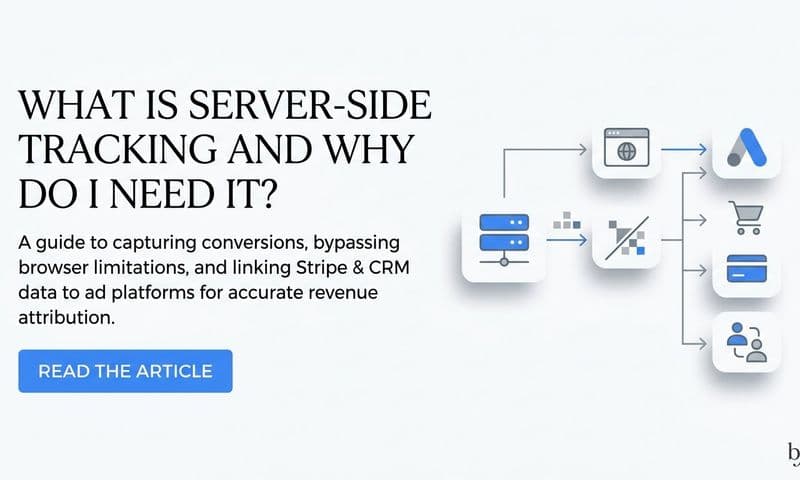
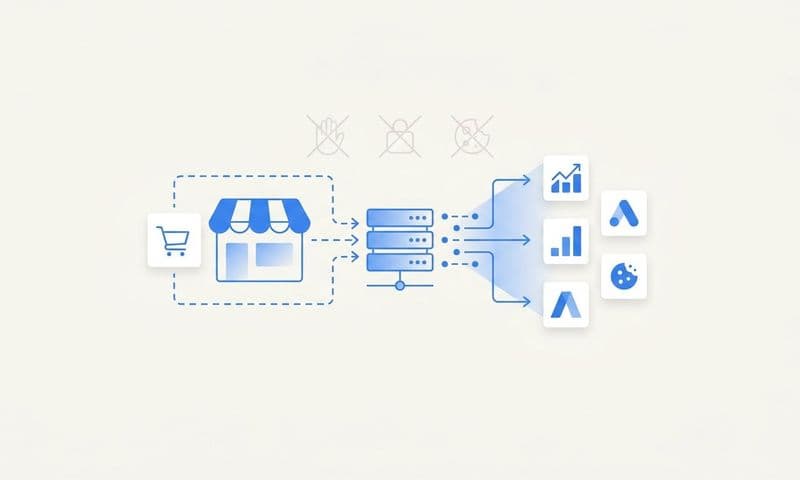
Server-side tracking is the foundation. Instead of relying on JavaScript running in the visitor's browser to fire tracking events, server-side tracking sends event data from your own web server or a dedicated tracking server. This bypasses browser-level restrictions entirely. Ad blockers cannot block a request that never leaves your server. ITP cannot expire a cookie that is stored server-side. The data gets captured regardless of what the visitor's browser is doing. Learn more about why server-side tracking is more accurate for marketing attribution.
When a user clicks your Google ad and lands on your site, a server-side setup captures the GCLID from the URL immediately, stores it server-side alongside a first-party identifier (often a cookie you set yourself), and begins logging every subsequent event that user triggers on your site. This creates a reliable, persistent record that does not depend on browser cooperation.
CRM integration is what transforms marketing data into revenue data. Most B2B SaaS companies have their lead and deal data sitting in a CRM like Salesforce or HubSpot, completely disconnected from their marketing attribution. Bridging that gap means passing the original marketing source and click identifiers into the CRM when a lead is created, and then sending events back to your attribution system when that lead progresses through the funnel.
When a prospect who originally clicked a LinkedIn ad eventually becomes a closed-won deal three months later, your attribution system should know about it. That connection only exists if you have built the integration between your CRM and your tracking for B2B marketing campaigns deliberately.
Conversion APIs are how you close the loop with ad platforms. Meta's Conversions API (CAPI) and Google's Enhanced Conversions allow you to send first-party conversion events directly from your server to the ad platform, bypassing the browser entirely. Instead of relying on a pixel to fire when a user submits a form, your server sends the verified conversion event with the original click ID attached. The ad platform receives a clean, accurate signal that it can use to optimize targeting and bidding.
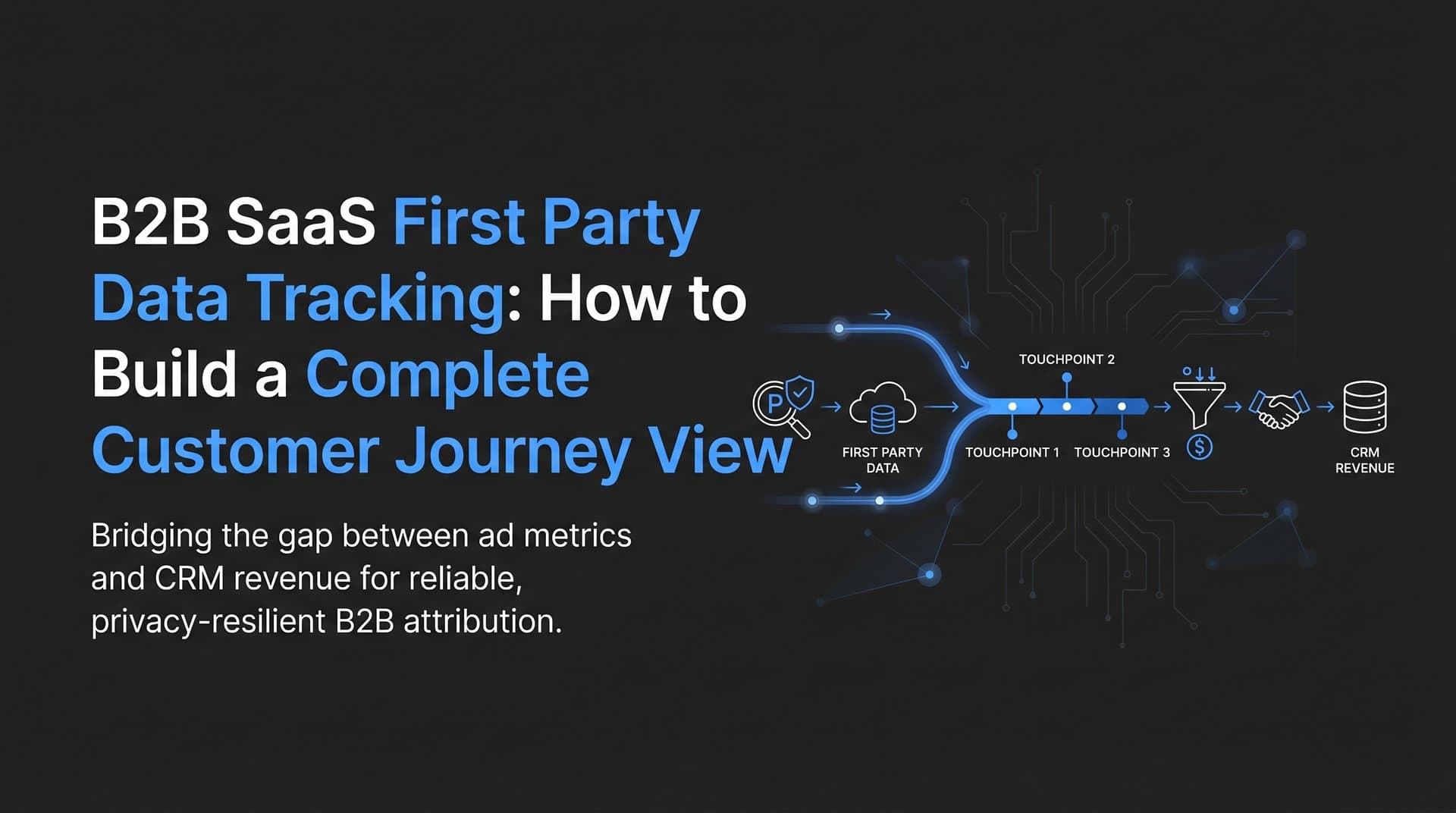
Here is how all three pieces connect in practice. A prospect clicks a Google ad. Your server captures the GCLID and sets a first-party cookie. The prospect fills out a demo request form. Your server fires a lead event to Google via the Enhanced Conversions API with the GCLID attached. The prospect becomes an SQL in your CRM. Your CRM integration fires an SQL event back to your attribution system. Six weeks later, the deal closes. Your attribution system records a closed-won event tied back to the original Google click, and you can see the full journey from first touch to revenue.
Identity resolution is the final piece that makes this work in B2B contexts. Many prospects will visit your site multiple times before converting, often across different devices or sessions. When they finally fill out a form or book a demo, you have a known identity (email address, company) that you can use to stitch together their prior anonymous visits. A well-built first-party stack handles this matching so that you get a complete picture of the journey, not just the last session before conversion.
How First-Party Data Transforms Attribution and Budget Decisions
Once you have a first-party tracking stack in place, the way you think about attribution changes fundamentally. Instead of looking at last-touch conversions in your ad platform dashboards, you can see the actual sequence of touchpoints that led to a closed deal and assign credit in a way that reflects how your buyers actually make decisions.
Consider a realistic B2B SaaS buying journey. A prospect first encounters your brand through a Google search ad and reads a blog post. Two weeks later, they click a LinkedIn ad promoting a webinar and attend it. A week after that, they visit your pricing page directly. Then they book a demo. A last-touch attribution model gives all the credit to the direct visit before the demo request. A first-touch model gives all the credit to the Google search ad. Neither tells you the whole story.
With first-party multi-touch attribution, you can see every step in that sequence and apply a credit model that matches your actual sales cycle. Whether you use linear attribution, time-decay, or a custom model that weights demo requests more heavily, you are working from real data about real touchpoints rather than a single-channel snapshot. Exploring revenue attribution for B2B SaaS companies can help you understand which models work best for longer sales cycles.
The impact on ad platform performance is equally important. When you feed accurate, first-party conversion data back to Meta and Google through their conversion APIs, their machine learning algorithms receive better signals for optimization. Instead of optimizing toward browser-fired pixel events that may be incomplete or delayed, the platforms are working with verified, server-side conversion data tied to the original click IDs. Over time, this improves the quality of targeting and bidding decisions the platforms make on your behalf.
Budget allocation is where this all comes together for marketing leaders. When you can connect ad spend to pipeline and closed revenue rather than just lead counts, the conversation changes. You stop asking which channel generated the most leads and start asking which channels generated the most revenue. Those are often very different answers.
A channel that drives a high volume of free trial sign-ups but low conversion to paid might look great on a lead count basis and terrible on a revenue basis. A channel that drives fewer but more qualified demo requests might look underwhelming in your ad dashboard but exceptional when you trace those leads through to closed deals in your CRM. Understanding how to track SaaS trial to paid conversions is critical for seeing that distinction and allocating budget accordingly.
This is the shift from vanity metrics to revenue metrics. And it is only possible when your tracking infrastructure connects the entire funnel, not just the top of it.
Implementing First-Party Tracking for Your B2B SaaS: A Step-by-Step Approach
Building a first-party tracking stack does not have to happen all at once. A phased approach lets you make progress quickly while building toward a complete system. Here is how to think about it.
Step 1: Audit your current tracking setup. Before you build anything new, understand what you have. Map your current tracking from ad click to revenue and identify where data is being lost. Common gaps include: UTM parameters that are not being stored in your CRM, form submissions that fire only a browser pixel with no server-side backup, CRM pipeline stages that are never connected back to marketing source, and payment events that live in a separate system with no attribution data attached. This audit will tell you where to focus first. If you are unsure whether your current numbers are reliable, our article on why attribution data doesn't match explains the most common causes.
Step 2: Implement server-side tracking. Set up a server-side tagging environment (Google Tag Manager Server-Side is a common starting point) or work with a platform that handles this for you. The goal is to capture ad click identifiers (GCLID, FBCLID, and others) at the server level the moment a visitor arrives, and to fire key conversion events from your server rather than relying solely on browser-based tags. This is the most technically involved step, but it is the foundation everything else depends on.
Step 3: Connect your CRM and payment systems. Work with your CRM administrator to ensure that marketing source data and original click identifiers are being passed into lead and contact records at creation. Then set up event triggers for key pipeline milestones: MQL, SQL, opportunity created, closed-won. These events should flow back to your attribution system so that revenue outcomes are connected to the marketing touchpoints that drove them.
Step 4: Set up conversion syncing to your ad platforms. Configure Meta's Conversions API and Google's Enhanced Conversions to receive server-side event data from your tracking infrastructure. Start with your most important conversion events (demo requests, trial sign-ups, and ideally closed-won deals if your sales cycle is short enough) and ensure each event includes the original click ID so the platform can match it back to the correct ad interaction.
Step 5: Configure multi-touch attribution models. Choose attribution models that reflect your actual sales cycle. For most B2B SaaS companies, a linear or time-decay model is more accurate than first-touch or last-touch alone. If your sales cycle is particularly long or complex, consider a custom model that weights certain touchpoints (like demo bookings or pricing page visits) more heavily. The goal is a model that helps you make better budget decisions, not one that flatters any particular channel.
A few common pitfalls to avoid as you build this out. First, resist the urge to track everything. Define a clear hierarchy of conversion events (from least to most valuable) and focus your attribution on the ones that actually correlate with revenue. Second, maintain consistent UTM tracking and attribution conventions across all campaigns and channels. Inconsistent tagging is one of the most common causes of attribution data falling apart. Third, validate your data before making major budget decisions. Cross-reference your attribution platform numbers with your CRM pipeline data to make sure they are telling a consistent story. Discrepancies are worth investigating before you act on them.
Building a Data-Confident Marketing Engine
The shift from third-party to first-party data tracking is not just a technical upgrade. It is a fundamental change in how you relate to your marketing data. Instead of hoping that ad platform dashboards are giving you an accurate picture, you are building your own source of truth that connects every touchpoint from the first ad click to the closed deal.
When that infrastructure is in place, the clarity it provides changes how your team operates. Budget conversations move from gut feel and platform-reported ROAS to actual pipeline contribution and revenue influence. Campaign optimization decisions are made on verified conversion signals rather than modeled estimates. And when a channel is working or not working, you know it because your data says so, not because an ad platform's reporting suggests it.
This is especially powerful for B2B SaaS companies navigating long, complex buying journeys. Every touchpoint that gets captured and connected is another data point that helps you understand how your buyers make decisions and which marketing investments are genuinely moving them forward.
Cometly is built specifically to solve this challenge. It connects your ad platforms, CRM, and website to track the full customer journey in real time, with server-side tracking that captures events reliably regardless of browser restrictions. Its multi-touch attribution gives you a complete view of how every channel contributes to pipeline and revenue, while AI-powered recommendations help you identify which campaigns and ads are actually driving results across every channel. And with conversion sync, Cometly feeds enriched, verified conversion data back to Meta, Google, and other platforms, giving their algorithms better signals to optimize targeting and bidding on your behalf.
If you are ready to stop guessing and start making marketing decisions backed by real revenue data, the next step is seeing how this works in practice for your own campaigns. Get your free demo today and discover how Cometly can help you capture every touchpoint, connect every conversion, and scale your B2B SaaS marketing with confidence.