
Startups run lean. Every dollar spent on ads, content, or campaigns needs to prove its worth before you double down. But without the right marketing analytics software, you are flying blind, guessing which channels drive pipeline and which ones drain budget.
The problem is that most analytics tools are built for enterprise teams with dedicated data engineers. Startups need something faster to set up, easier to interpret, and directly tied to revenue outcomes.
This list covers the best marketing analytics platforms built for or well-suited to startup teams. Whether you are a solo growth marketer or a scaling B2B SaaS team, each tool here solves a specific piece of the analytics puzzle. We evaluated each platform on ease of setup, depth of attribution data, integration ecosystem, pricing transparency, and how well it connects marketing activity to actual revenue. Let's get into it.
1. Cometly
Best for: B2B SaaS startups that need to connect ad spend directly to pipeline and closed revenue.
Cometly is a marketing attribution and analytics platform built specifically for B2B SaaS companies that need to track the full customer journey from first ad click to closed-won deal.
 9 Best Attribution Platforms for Agencies in 2026
Where This Tool Shines
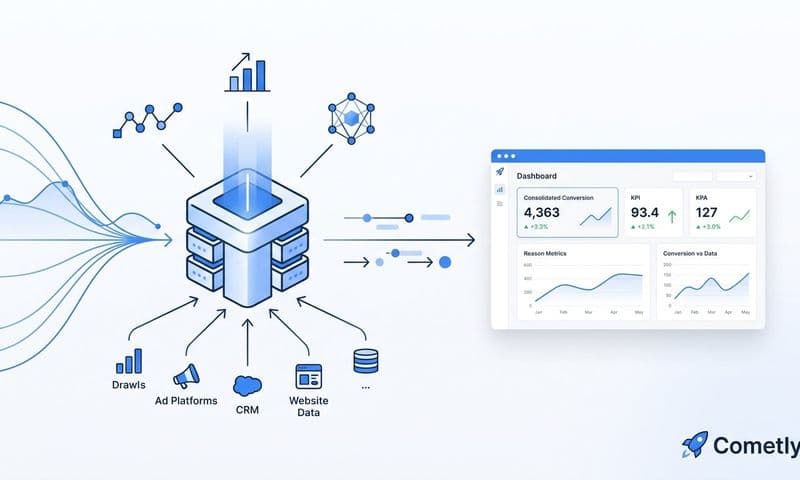
Most analytics tools tell you what happened on your website. Cometly tells you what drove revenue. It connects your ad platforms, CRM, and Stripe data so you can see exactly which campaigns generated pipeline, not just clicks or form fills.
For B2B SaaS startups with longer sales cycles, this distinction is critical. A lead from LinkedIn might take 60 days to close. Cometly tracks that entire journey and credits the right touchpoints, giving growth teams and CMOs a single source of truth they can actually present to leadership.
Key Features
Multi-Touch Attribution: Tracks every paid channel touchpoint across the customer journey and distributes credit accurately using multiple attribution models.
Server-Side Tracking and Conversion API: Sends first-party conversion data directly to Meta and Google, improving signal quality in a post-cookie environment.
AI Ads Manager: Identifies high-performing campaigns and recommends scaling decisions based on actual revenue data, not just surface-level metrics like CTR or CPC.
Pipeline and Revenue Attribution: Connects Stripe revenue data with ad platform data so you can calculate true ROI down to the campaign and ad level.
Customer Journey Analytics: Visualizes the full path a customer took before converting, with 70+ native integrations to pull data from across your stack.
Best For
B2B SaaS startups running paid acquisition on Meta, Google, or LinkedIn who need to justify ad spend with real revenue data. Particularly valuable for growth teams reporting to investors or leadership who want to see pipeline impact, not just traffic metrics.
Pricing
Paid plans available. Contact Cometly directly for current startup and growth tier pricing to find the right fit for your stage.
2. Google Analytics 4
Best for: Startups that need free, reliable web behavior tracking as a foundation layer.
Google Analytics 4 is Google's free web analytics platform that tracks user behavior, traffic sources, and conversion events using an event-based data model.
 11 Best Marketing Analytics Tools to Track and Optimize Campaign Performance in 2026
Where This Tool Shines
GA4 is the default starting point for almost every startup. It is free, deeply integrated with Google Ads, and provides solid visibility into how users find and interact with your website. The event-based model gives you more flexibility than the old session-based approach, making it easier to track custom actions that matter to your business.
The BigQuery export is a standout feature for growing teams. Once you are ready to do more advanced analysis, you can pipe raw GA4 data into a warehouse and build custom reports without paying for an enterprise plan.
Key Features
Free Web Analytics: No data volume limits for standard use, making it accessible for startups at any stage.
Google Ads Integration: Native connection to Google Ads for campaign-level performance tracking and audience remarketing.
Event-Based Tracking: Customizable conversion events that go beyond simple pageviews to track meaningful user actions.
Exploration Reports: Funnel analysis and audience segmentation tools built into the interface without needing additional software.
BigQuery Export: Raw data export for teams that want to build advanced analytics pipelines or combine GA4 data with other sources.
Best For
Every startup should have GA4 as a baseline. It is especially useful for content-driven or SEO-focused startups tracking organic traffic and on-site behavior. Note that it does not natively connect to CRM data, so it is not a complete attribution solution for B2B SaaS teams on its own.
Pricing
Free for standard use. Google Analytics 360 is an enterprise-tier paid upgrade with additional features and SLAs.
3. HubSpot Marketing Hub
Best for: Inbound-focused startups that want CRM-connected marketing analytics in one platform.
HubSpot Marketing Hub is an all-in-one inbound marketing platform combining email, landing pages, social tools, and CRM-native analytics in a single suite.
 9 Best Campaign Attribution Tracking Solutions for B2B SaaS in 2026
Where This Tool Shines
HubSpot's biggest advantage is that your marketing data and CRM data live in the same system. You can see which campaigns influenced contacts in your pipeline, track deal progression tied to specific marketing activities, and report on revenue impact without stitching together multiple tools.
For early-stage startups, the free CRM tier makes it accessible. As you grow, the Marketing Hub layers attribution reporting, email automation, and ad management on top of that same contact database, which keeps your data consistent across the entire funnel.
Key Features
CRM-Native Analytics: Contact-level tracking that connects marketing activity directly to deals and pipeline stages.
Multi-Touch Attribution Reporting: Available on paid plans, showing how different touchpoints contribute to revenue across the customer journey.
Unified Dashboard: Email, ads, and landing page performance visible in one place without switching between tools.
Traffic and Conversion Analytics: Tracks source-level traffic tied to actual deal pipeline, not just website sessions.
Free CRM Tier: Gives early-stage startups a no-cost entry point with core contact management and basic analytics.
Best For
Startups with an inbound content or email marketing motion who want their marketing analytics and CRM in the same platform. Attribution reporting granularity is more limited compared to dedicated attribution tools, so high-spend paid acquisition teams may want to supplement it.
Pricing
Free CRM tier available. Marketing Hub Starter begins around $20 per month. Professional and Enterprise tiers scale significantly higher as your contact list and feature needs grow.
4. Mixpanel
Best for: Product-led startups that need deep funnel and retention analytics inside their app.
Mixpanel is a product analytics platform that tracks user behavior inside web and mobile applications, enabling startups to analyze funnels, retention, and feature adoption.
 9 Best Marketing Analytics Software for Startups in 2026
Where This Tool Shines
Mixpanel is the go-to tool when you need to understand what users do inside your product. Where GA4 tracks website sessions, Mixpanel tracks in-app events with precision: which features users click, where they drop off in an onboarding flow, and which cohorts retain month over month.
The funnel analysis is particularly strong. You can build multi-step funnels, segment by user properties, and identify exactly where and why users are not completing key actions. For PLG startups optimizing activation and retention, this level of insight is hard to replicate elsewhere.
Key Features
Event-Based Behavioral Tracking: Captures granular user actions across web and mobile apps for deep product analytics.
Funnel Analysis: Identifies where users drop off across any defined sequence of steps, with segmentation by user attributes.
Retention and Cohort Reports: Measures how different user groups engage with your product over time, critical for understanding churn risk.
Real-Time Dashboards: Live data views for product and growth teams monitoring key activation and engagement metrics.
Free Plan: Available for startups under a monthly event threshold, making it accessible at early stages.
Best For
PLG startups and product teams that need to optimize in-app user journeys. Not designed for paid ad attribution or connecting marketing spend to revenue, so it works best alongside a dedicated attribution platform.
Pricing
Free plan available. Growth plan pricing scales based on monthly tracked users.
5. Segment
Best for: Startups that want a single data collection layer feeding all their analytics and marketing tools.
Segment is a customer data platform that collects user and event data from your website and app, then routes it to any analytics, marketing, or data warehouse tool in your stack.
 9 Best Conversion Tracking Alternatives to Pixels in 2026
Where This Tool Shines
Segment is less of an analytics tool and more of a data infrastructure layer. Instead of adding separate tracking code for every tool you use, Segment lets you instrument your data once and send it anywhere. This is a significant advantage for startups that are rapidly adding and swapping tools in their stack.
The identity resolution capability is particularly valuable for B2B SaaS companies. Segment stitches together anonymous website visits with identified user sessions, giving you a unified customer profile that persists across devices and sessions.
Key Features
Single Tracking Code: One implementation feeds data to 300+ downstream integrations, eliminating redundant tagging work.
Real-Time Event Streaming: Routes data to analytics tools, CRMs, and data warehouses as events happen.
Identity Resolution: Unifies customer profiles across devices and sessions for a complete view of each user's journey.
Data Governance: Schema management and validation tools that keep your event data clean and consistent across your stack.
Free Tier: Available for startups with lower event volumes, making it accessible during early instrumentation phases.
Best For
Technical startups that want a clean, scalable data foundation. Segment requires other tools to visualize and act on the data it collects, so it is best used as infrastructure alongside analytics platforms rather than as a standalone solution.
Pricing
Free tier available. Team plan starts around $120 per month. Business plan pricing is custom based on volume and features.
6. Triple Whale
Best for: E-commerce and DTC startups on Shopify that need blended ROAS visibility across paid channels.
Triple Whale is a marketing analytics and attribution platform designed for e-commerce and DTC brands, with a focus on aggregated ROAS reporting and deep Shopify integration.
 9 Best Marketing Analytics Software for Startups in 2026
Where This Tool Shines
Triple Whale solves a specific problem for DTC brands: getting accurate, consolidated ROAS data across Meta, Google, TikTok, and Pinterest in a single dashboard. After iOS privacy changes fragmented ad platform reporting, Triple Whale's first-party pixel became a popular solution for improving attribution accuracy without relying solely on platform-reported data.
The creative analytics feature stands out for performance marketing teams. You can see which ad creatives are driving the most revenue across channels, making it easier to prioritize creative production and budget allocation based on real performance data.
Key Features
Blended ROAS Dashboard: Aggregates performance data from Meta, Google, TikTok, and Pinterest into a single, comparable view.
First-Party Pixel: Improves attribution accuracy post-iOS changes by capturing conversion data independently of platform tracking.
Creative Analytics: Measures ad creative performance by channel to inform creative strategy and budget decisions.
Cohort-Based LTV Analysis: Tracks customer lifetime value by acquisition cohort to understand long-term revenue contribution.
Shopify Integration: Native connection to Shopify for real-time order and revenue data synced with ad performance.
Best For
E-commerce and DTC startups running paid social and search, particularly those on Shopify. Less suited for B2B SaaS companies with long sales cycles, subscription models, or CRM-dependent revenue tracking.
Pricing
Paid plans start based on monthly ad spend. Pricing tiers vary by store revenue, so costs scale with your business size.
7. Amplitude
Best for: Growth and product teams at PLG startups that need behavioral cohort analysis and experimentation.
Amplitude is a product analytics and digital optimization platform that helps startups understand user behavior, run experiments, and connect product engagement to business outcomes.
 9 Best Marketing Analytics Software for Startups in 2026
Where This Tool Shines
Amplitude goes deeper than most product analytics tools when it comes to behavioral segmentation. You can build cohorts based on specific sequences of actions, then compare how those cohorts convert, retain, and generate revenue over time. This makes it powerful for startups trying to find their ideal customer profile based on actual product behavior rather than demographic assumptions.
The experimentation layer on higher tiers adds another dimension. You can run A/B tests on product features and tie results directly to retention and revenue metrics, closing the loop between product changes and business outcomes.
Key Features
Behavioral Cohort Analysis: Segments users by specific actions and attributes to identify patterns in high-value user behavior.
Pathfinder and Funnel Analysis: Reveals the actual paths users take through your product and where conversion breaks down.
A/B Testing and Feature Flags: Available on higher tiers for running experiments and measuring their impact on key metrics.
Revenue and Retention Correlation: Connects product engagement signals to retention and revenue outcomes for informed prioritization.
Free Starter Plan: Available for early-stage startups to get started without upfront cost.
Best For
PLG and product-led startups with active user bases who need to understand behavioral drivers of retention and expansion revenue. Like Mixpanel, it is focused on in-product behavior rather than paid acquisition attribution.
Pricing
Free Starter plan available. Plus plan starts around $61 per month. Growth and Enterprise tiers are custom-quoted.
8. Supermetrics
Best for: Marketing teams that want to consolidate ad platform data into custom reports without a full BI stack.
Supermetrics is a data integration tool that pulls marketing performance data from ad platforms, social channels, and analytics tools into Google Sheets, Looker Studio, BigQuery, or other destinations.
Where This Tool Shines
Supermetrics is the fastest way to get all your paid channel data into one place without building a custom data pipeline. If your team lives in Google Sheets or Looker Studio, Supermetrics connects those familiar environments to your Meta, Google Ads, LinkedIn, and TikTok data automatically.
The automated refresh schedules mean your reports stay current without manual exports. For lean startup marketing teams that need to report on performance weekly or monthly, this eliminates a significant amount of repetitive data pulling work.
Key Features
100+ Data Source Connectors: Pulls from Meta, Google Ads, LinkedIn, TikTok, and many more into your preferred reporting destination.
Automated Refresh Schedules: Keeps reports current without manual intervention, saving time on recurring reporting tasks.
Pre-Built Report Templates: Ready-to-use templates for Looker Studio and Google Sheets to accelerate reporting setup.
Data Warehouse Destinations: Supports BigQuery and Snowflake for teams building more advanced data infrastructure.
No-Code Setup: Accessible for non-technical marketing teams without engineering support.
Best For
Marketing teams that need consolidated reporting across multiple ad platforms and are comfortable building their own reports in Sheets or Looker Studio. Note that Supermetrics is a data connector, not an attribution platform. It does not provide attribution modeling natively.
Pricing
Plans start around $29 per month for basic connectors. Pricing scales with the number of data sources and destinations you connect.
9. Heap
Best for: Startups that want retroactive product analytics without requiring upfront engineering instrumentation.
Heap is a digital insights platform that automatically captures all user interactions on your website or app without requiring manual event instrumentation upfront.
Where This Tool Shines
Heap's defining feature is auto-capture. Unlike Mixpanel or Amplitude, where you need to define and instrument events before you can track them, Heap records every click, form submission, and page view from the moment you install it. This means you can go back and analyze user behavior from months ago, even for events you never thought to track at the time.
For early-stage startups that do not have dedicated engineering resources for analytics instrumentation, this retroactive capability is a genuine advantage. You can answer product questions today using data that was already being collected, without waiting for a new tracking implementation to accumulate history.
Key Features
Auto-Capture: Automatically records all clicks, form submissions, and page views by default without manual event setup.
Retroactive Analysis: Lets you define and analyze events on historical data without re-tagging or re-instrumenting your product.
Session Replay and Heatmaps: Provides qualitative context alongside quantitative behavior data to understand the why behind user actions.
Funnel and Journey Analysis: Tracks user paths and conversion sequences with minimal engineering involvement.
Free Plan: Available for lower-traffic startups to get started without upfront cost.
Best For
Early-stage startups and small product teams that want product analytics insights quickly without a heavy instrumentation investment. Works best for teams focused on product experience optimization rather than paid acquisition attribution.
Pricing
Free plan available. Growth and Pro plans are custom-quoted based on session volume.
Which Tool Is Right for Your Startup?
The right marketing analytics stack depends on what stage you are at and what questions you most need to answer.
If you are a B2B SaaS startup running paid acquisition and need to connect ad spend to pipeline and revenue, Cometly is the clear starting point. No other tool on this list is purpose-built for the specific challenge of multi-touch attribution across a long B2B sales cycle, with native integrations to Stripe, your CRM, and major ad platforms. It is the tool that answers the question leadership actually cares about: which campaigns are generating revenue?
If you are building a product-led growth motion, pair a free GA4 setup with Mixpanel or Amplitude for in-app behavior analytics. Both have generous free tiers that work well for early-stage teams.
If you are an e-commerce or DTC startup on Shopify, Triple Whale gives you the blended ROAS visibility and creative analytics that generic tools cannot provide.
If you need a clean data foundation before committing to specific analytics tools, Segment is worth the investment early. It makes it significantly easier to add, swap, or upgrade tools later without re-instrumenting your entire product.
For teams that need consolidated reporting across ad platforms without building a custom pipeline, Supermetrics is a practical and affordable solution that works with tools you already use.
Most startups end up using two or three of these tools together rather than relying on a single platform. The key is knowing which layer each tool covers and making sure your stack has a clear answer for the question that matters most: which marketing activity is actually driving revenue.
Ready to get precise about what is driving your pipeline? Get your free demo of Cometly and see how AI-driven attribution can connect every touchpoint to the revenue outcomes your team needs to scale with confidence.