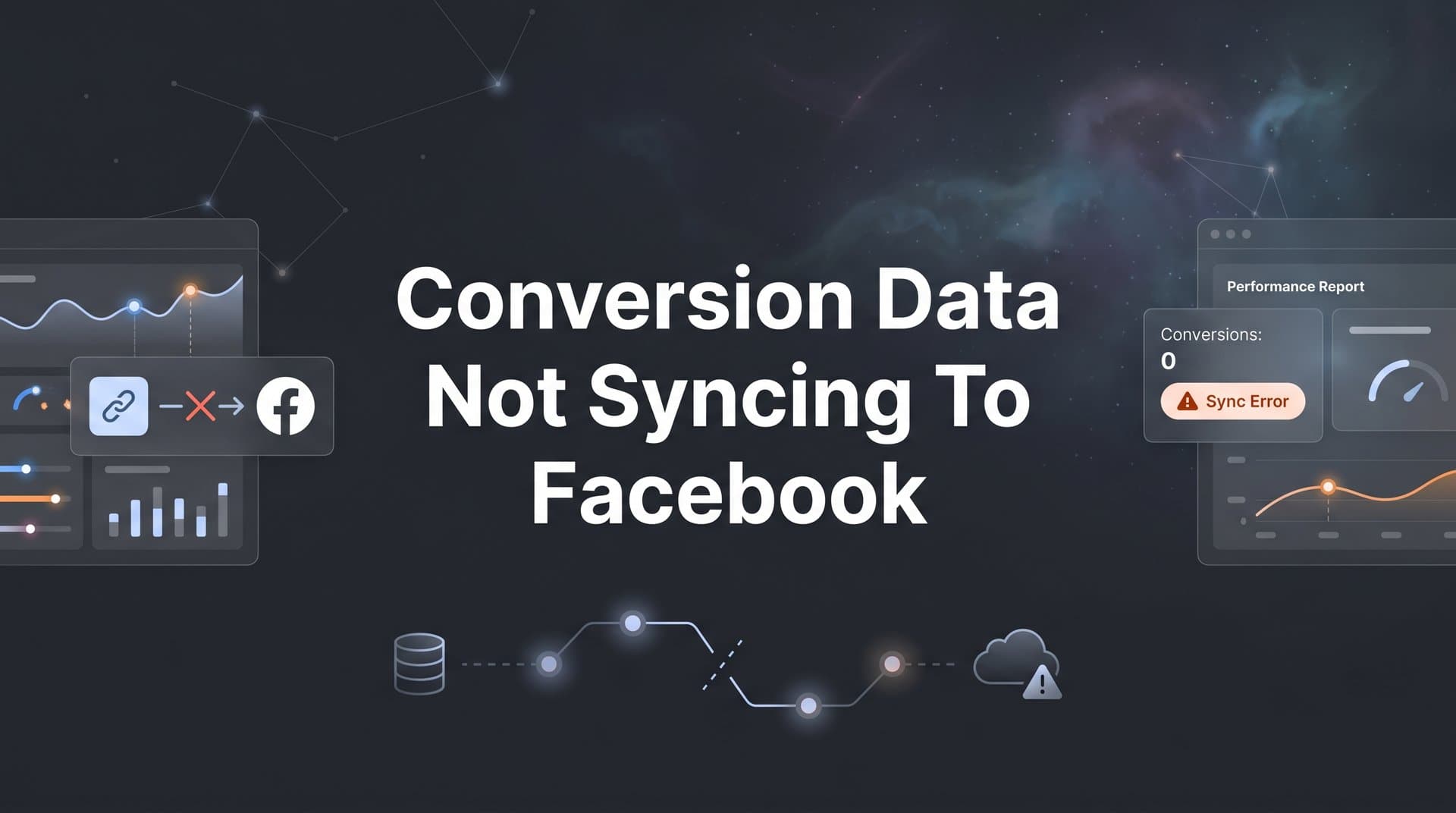
When your conversion data stops syncing to Facebook, the consequences ripple across your entire paid advertising strategy. Facebook's ad algorithm relies on conversion signals to optimize delivery, find lookalike audiences, and lower your cost per acquisition. Without accurate conversion data flowing back to the platform, you are essentially flying blind, and Facebook's machine learning has nothing meaningful to learn from. The result is wasted ad spend, poor targeting, and campaign performance that steadily declines.
This problem has become increasingly common since iOS privacy updates and browser-level tracking restrictions started limiting pixel-based tracking. Many marketers notice discrepancies between their CRM or analytics data and what Facebook Ads Manager reports, often discovering that conversions are being lost somewhere in the pipeline.
The good news is that most syncing issues stem from a handful of identifiable causes, and each one has a clear fix. In this guide, you will walk through a systematic troubleshooting process to diagnose exactly why your conversion data is not reaching Facebook and how to restore that critical data flow. Whether the issue lives in your pixel setup, your Events Manager configuration, your server-side connection, or the way your attribution tool communicates with Facebook's Conversions API, you will have a clear path to resolution by the end.
Let's get your data flowing again so Facebook's algorithm can do what it does best: optimize toward real revenue.
Step 1: Verify Your Facebook Pixel Is Firing Correctly on Every Conversion Page
The first place to look when conversion data is not syncing to Facebook is the pixel itself. A pixel that is not firing, firing on the wrong pages, or firing incorrectly will silently drop conversions without any obvious error message in Ads Manager.
Start by installing the Facebook Pixel Helper Chrome extension if you have not already. It is a free diagnostic tool from Meta that inspects any webpage and shows you whether the pixel is loaded, which events are firing, and whether those events contain errors. Visit each of your key conversion pages, including thank you pages, checkout confirmations, and lead form submission pages, and check what Pixel Helper reports.
Pixel not found: The pixel base code is missing from that specific page. This often happens with manually installed pixels when a developer updates the site template and the snippet gets removed.
Duplicate pixels firing: Two or more pixel IDs are firing on the same page. This inflates your event counts and can cause Facebook to process conflicting data signals.
Event fires but shows errors: The event name may be misspelled, parameters may be missing, or the event may be firing on page load instead of on the actual conversion action.
Pixel blocked: Cookie consent banners, ad blockers, or browser privacy settings can prevent the pixel from loading entirely. If a significant portion of your audience uses these tools, you could be losing a substantial share of conversion signals at the browser level.
After reviewing Pixel Helper, head to Events Manager in your Meta Business Suite and navigate to the Test Events tab. Enter your conversion page URL and trigger a test conversion. You should see the event appear in the Test Events panel within seconds. This confirms the pixel is not only installed but is successfully communicating with Facebook's servers.
How do you know this step is complete? You should see green checkmarks in Pixel Helper on every conversion page, and matching events should appear in Test Events in real time with no parameter errors flagged. If events are missing or showing warnings, resolve those before moving to the next step.
One important note: if your pixel is working but you are still seeing data discrepancies, the issue is likely further down the pipeline. Pixel-only tracking has real limitations in today's privacy-first environment, and understanding Facebook pixel tracking challenges is exactly why the steps that follow matter so much.
Step 2: Audit Your Events Manager for Configuration Errors and Mismatched Events
Even when your pixel fires correctly, Events Manager configuration errors can silently corrupt your conversion data. This step is about going deeper into how Facebook is interpreting the signals it receives.
Navigate to Events Manager and open the Diagnostics tab. This is where Facebook surfaces active warnings and errors it has detected across your pixel and server events. Common flags include missing required parameters, deduplication issues, and inactive events that have not received data in a while. Work through each flagged item systematically, as these are often the direct cause of conversion data not syncing properly.
Next, check your event names carefully. This is a surprisingly common source of data loss. If your ad set is optimizing for the standard event called Purchase but your website fires a custom event called CompletePayment or OrderConfirmed, Facebook does not automatically recognize these as equivalent. The algorithm cannot optimize toward an event it is not receiving, and your Facebook conversion tracking will suffer as a result.
Review your event parameters as well. For purchase events, Facebook expects value, currency, and ideally content_id to be populated. For lead events, you want at minimum the event to fire consistently. Missing parameters do not always prevent events from registering, but they reduce the quality of the data Facebook receives and can cause the platform to deprioritize those signals when optimizing your campaigns.
One critical setting that many advertisers overlook is domain verification. After iOS 14.5 introduced App Tracking Transparency, Meta made domain verification a requirement for proper event tracking. Go to Business Settings, then Brand Safety, then Domains and confirm your domain is verified. If it is not, you may be losing iOS conversion data entirely, and your Aggregated Event Measurement configuration will not function as intended.
How do you know this step is done correctly? Your Diagnostics tab should show no active errors or warnings, your event names should match exactly what your ad sets are optimizing for, and your domain should show a verified status. If you find mismatched event names, update either your website tracking code or your ad set optimization settings so they align.
Step 3: Check Your Conversions API Connection for Server-Side Gaps
Browser-side pixel tracking alone is no longer a reliable foundation for Facebook advertising. Ad blockers, cookie restrictions, Safari's Intelligent Tracking Prevention, and iOS App Tracking Transparency all chip away at the pixel's ability to capture conversions. Facebook's own guidance strongly recommends using the Conversions API (CAPI) as a server-side complement to the pixel to fill these gaps.
Here is how to check whether your CAPI is actually working. Go to Events Manager and look at the event breakdown for your conversion events. Each event should show data arriving via both Browser and Server channels. If you only see browser-side data, your Conversions API is either not connected or not sending events successfully. Our detailed Conversion API implementation tutorial walks through the full setup process if you need to start from scratch.
Expired access tokens: CAPI connections use access tokens that can expire or be revoked, especially after password changes or security reviews. If your CAPI was working before and suddenly stopped, check the token first.
Incorrect dataset IDs: Your CAPI integration needs to reference the correct dataset (formerly called pixel ID) to send data to the right place. A mismatch here means events go nowhere.
Missing user matching parameters: CAPI events need hashed user data to be useful. At minimum, you should be sending hashed email addresses, IP addresses, and user agent strings. Without these, Facebook cannot match server events to real people who clicked your ads, which significantly reduces the value of that data.
Server misconfiguration: If you are self-hosting your CAPI integration, server errors, firewall rules, or incorrect endpoint URLs can silently drop events before they ever reach Facebook.
To test your CAPI setup properly, use the Test Events tool in Events Manager. Generate a test event code, add it to your CAPI configuration, and trigger a test conversion. You should see a server event appear in the Test Events panel alongside the browser event. This confirms both channels are working and that deduplication will be possible, which leads directly into the next step.
If you are using a platform like Cometly that includes server-side tracking built in, many of these CAPI issues are handled for you automatically. Cometly's server-side tracking bypasses browser-level restrictions and sends enriched conversion data directly to Facebook's API, which is one of the most effective ways to recover lost conversion signals in a post-iOS 14.5 world.
Step 4: Resolve Event Deduplication Problems That Cause Missing or Double-Counted Data
Running both the pixel and the Conversions API is the right approach, but it introduces a new challenge: deduplication. When both your browser pixel and your server send a conversion event for the same action, Facebook needs a way to recognize they represent the same conversion and count it only once. When deduplication fails, you end up with either inflated conversion counts or, more problematically, Facebook discarding events it incorrectly flags as duplicates.
The mechanism Facebook uses for deduplication is the event_id parameter. Every conversion event fired by your pixel and every corresponding event sent via CAPI should include the same unique event_id for that specific conversion. When Facebook receives two events with the same event_id and event name within a 48-hour window, it deduplicates them and counts only one. Without a consistent event_id, Facebook has no reliable way to match them, and data integrity breaks down.
Check your implementation to confirm that both your pixel events and your CAPI events are generating and passing the same event_id. This is typically a unique string generated at the time of the conversion, such as an order ID combined with a timestamp. Having a well-defined marketing event data schema helps ensure consistency across both channels.
Next, review your Event Match Quality scores in Events Manager. This score reflects how well Facebook can match your server-sent events to actual people who interacted with your ads. Low match quality scores mean Facebook is receiving events but cannot confidently connect them to ad clicks, which leads to those conversions being dropped or underreported.
To improve event match quality, pass as many hashed user data parameters as possible through both your pixel and CAPI. The most impactful are:
Email address (hashed): The single most valuable matching parameter. Even a hashed email dramatically improves Facebook's ability to connect an event to a user profile.
Phone number (hashed): A strong secondary signal, especially for users who may not be logged into Facebook on the browser where the conversion happened.
fbclid: The Facebook Click ID appended to URLs when users click your ads. Capturing and passing this parameter creates a direct link between the conversion and the specific ad click.
external_id: A consistent unique identifier from your own system, such as a CRM contact ID, that helps Facebook build a more complete picture of the customer.
Aim for an event match quality score of at least 6 out of 10. Scores below that suggest you are missing key matching parameters and losing conversions in the reporting pipeline.
Step 5: Investigate Third-Party Integration and CRM Pipeline Breaks
If your pixel is firing, your CAPI is connected, and deduplication looks correct, but you are still seeing conversion data not syncing to Facebook, the break may not be in Facebook's tools at all. It may be in the pipeline between your CRM, marketing automation platform, or attribution tool and Facebook's API.
Many businesses send conversion data to Facebook through a third-party integration rather than directly through the pixel or a custom CAPI setup. This is common when using CRMs that track offline conversions, marketing automation tools that fire events based on pipeline stages, or attribution platforms that centralize data and push it back to ad platforms.
Start by checking the connection status of your integration. Most platforms have a settings area where you can see whether the Facebook connection is active or showing an error. Look for:
Revoked permissions: If someone changed a Facebook Business account password or adjusted Business Manager permissions, the OAuth connection between your tool and Facebook may have been revoked. Re-authenticating typically resolves this.
Expired OAuth tokens: Similar to access tokens in CAPI, OAuth tokens used by third-party integrations can expire. Many platforms will alert you when this happens, but not all do proactively.
Rate limiting: Facebook's API has rate limits. If your integration is sending a high volume of events in a short window, some may be dropped. Check your integration's error logs for rate limit responses from Facebook's API.
Field mapping errors: Your CRM's conversion event may not be mapped to the correct Facebook standard event. For example, if a "Deal Closed" stage in your CRM is mapped to a custom Facebook event instead of the standard Purchase event, Facebook may not recognize it for optimization purposes.
For teams using Cometly, the Conversion Sync feature is designed specifically to address this type of pipeline break. Cometly connects your ad platforms, CRM, and website into a single data flow, then sends enriched, conversion-ready events back to Facebook. To verify it is working correctly, check that the sync is active in your Cometly dashboard, that the correct Facebook ad accounts are connected, and that your conversion events are mapped to the right Facebook event types.
The best way to verify any third-party pipeline is to compare conversion counts in your CRM or Facebook attribution tracking tool against what Facebook Events Manager shows for the same time period and the same date range. If your CRM recorded 50 purchases yesterday but Events Manager only shows 20 server events, you have a pipeline break that needs investigation. A significant discrepancy between those two numbers is almost always a sign that events are failing to transmit, being dropped by the API, or are misconfigured in the field mapping.
Step 6: Validate Aggregated Event Measurement Settings for iOS Traffic
Even with a perfect pixel, a working CAPI, clean deduplication, and a functioning third-party integration, you can still experience missing conversion data from iOS users if your Aggregated Event Measurement (AEM) settings are not configured correctly.
Apple's App Tracking Transparency framework limits Facebook to receiving a maximum of 8 prioritized conversion events per domain from iOS 14.5 and later users. This is a hard limit set by Meta's implementation of Apple's privacy requirements. If your most important conversion event is not in that top 8, or is ranked too low in the priority list, Facebook may not receive or report that data from iOS users at all. Understanding the full scope of pixel tracking problems on iOS helps you appreciate why this configuration is so critical.
Navigate to Events Manager, then Aggregated Event Measurement, then Configure Web Events. Here you will see the list of events you have configured for your domain, ranked by priority. Your most critical conversion event, typically Purchase or Lead, should be ranked number one. Lower-priority events like ViewContent or AddToCart should sit further down the list.
A few important things to check in this section:
Domain verification: AEM only works for verified domains. If your domain is not verified, this entire configuration is inactive. Revisit the domain verification step from Step 2 if needed.
Correct domain vs. subdomain: Make sure you have configured events for the exact domain where conversions occur. If your checkout lives on a subdomain like shop.yourdomain.com but you have only verified and configured yourdomain.com, there may be a mismatch.
72-hour delay after changes: If you recently updated your event priority ranking, there is typically a 72-hour window before those changes take effect. During this period, data may appear incomplete or missing. Do not panic and make additional changes during this window, as that resets the clock.
Once your AEM configuration is correct and your domain is verified, iOS conversion data should begin flowing more reliably. Keep in mind that iOS users who have opted out of tracking will still not send individual-level data, but properly configured AEM ensures Facebook receives the aggregated signals it needs to optimize your Facebook conversions for that audience segment.
Putting It All Together: Your Conversion Sync Troubleshooting Checklist
You now have a complete, systematic approach to diagnosing and fixing conversion data not syncing to Facebook. Before you close out this guide, here is a quick-reference checklist to confirm you have covered every layer of the problem.
Pixel firing check: Pixel Helper shows green checkmarks on all conversion pages, and Test Events confirms real-time event registration with no parameter errors.
Events Manager diagnostics: Diagnostics tab shows no active errors, event names match your ad set optimization settings exactly, and your domain is verified in Business Settings.
CAPI connection: Events Manager shows data arriving via both Browser and Server channels, and Test Events confirms server events are registering with proper user matching parameters.
Deduplication: Both pixel and CAPI events share the same event_id for each conversion, and your Event Match Quality score is at a healthy level with hashed user data being passed through both channels.
Third-party pipeline: Your CRM or attribution platform connection is active, OAuth tokens are valid, field mappings are correct, and conversion counts in your tool align reasonably with what Events Manager reports.
Aggregated Event Measurement: Your top conversion event is ranked first in AEM, your domain is verified, and you have accounted for the 72-hour delay after any configuration changes.
For ongoing monitoring, make it a habit to review Events Manager diagnostics weekly, check your Event Match Quality scores regularly, and use an attribution platform to cross-reference conversion data across channels. Catching a pipeline break early means far less data loss and faster recovery.
This is exactly where Cometly adds ongoing value. Rather than manually checking each of these layers, Cometly provides server-side tracking that captures conversions browsers miss, enriches that data with CRM signals, and feeds it back to Facebook through a reliable pipeline. The result is a more complete picture of what is actually driving revenue, and a Facebook algorithm that has better data to optimize your campaigns with.
Ready to stop losing conversion data and start feeding Facebook's algorithm the signals it needs to perform? Get your free demo and see how Cometly's Conversion Sync and server-side tracking can ensure your conversion data always reaches Facebook accurately, so every dollar you spend works harder.