

You check your ad dashboard and see conversions. You check your analytics platform and see different numbers. You look at your CRM and find leads that don't match either system. Somewhere between the click and the conversion, the data just vanishes.
This isn't a tracking error on your end. It's the new reality of digital advertising.
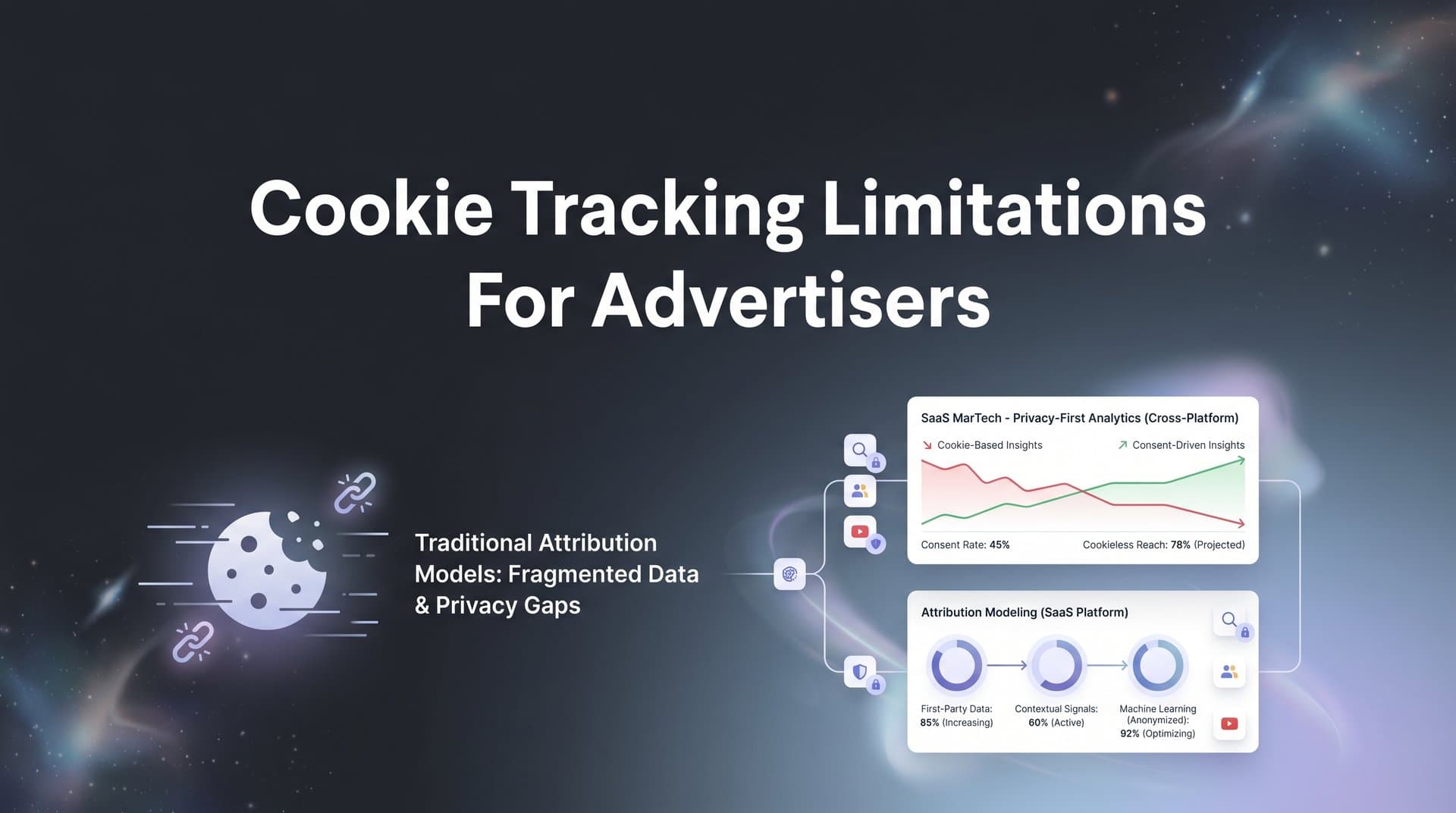
Cookie tracking limitations have fundamentally changed how advertisers measure campaign performance. What used to be straightforward attribution has become a puzzle with missing pieces. Retargeting audiences that once numbered in the tens of thousands now barely reach a few hundred. Conversions that clearly came from paid ads show up as "direct" traffic. Ad platform algorithms optimize based on incomplete data, making decisions with one hand tied behind their back.
The shift happened gradually, then all at once. Browser companies decided user privacy mattered more than advertiser convenience. They weren't wrong, but the change left marketers scrambling to understand what still works and what's permanently broken.
Here's what actually changed, why it matters for your campaigns, and what you can do about it.
How Cookie Tracking Actually Broke Down
For years, third-party cookies were the invisible infrastructure of digital advertising. When someone visited your website, a small piece of code dropped a cookie in their browser. When they visited another site, that same cookie identified them. Ad platforms used this cross-site tracking to build detailed profiles, target ads, and measure conversions across the entire web.
Then browsers started blocking it.
Safari fired the first shot in 2017 with Intelligent Tracking Prevention. The feature limited how long third-party cookies could persist in the browser. What started as a seven-day limit eventually became 24 hours for some tracking cookies. Firefox followed with Enhanced Tracking Protection. By 2020, both browsers were blocking third-party cookies by default.
Google Chrome, which holds the majority of browser market share, announced plans to phase out third-party cookies entirely. The timeline has shifted multiple times, but the direction is clear: third-party cookies are going away.
The technical difference matters here. First-party cookies come from the domain you're actually visiting. When you log into a website and it remembers you, that's a first-party cookie. Third-party cookies come from domains you're not visiting directly. When an ad network tracks you across multiple websites, that's a third-party cookie.
Browsers decided to block the third-party variety while allowing first-party cookies to continue working. This distinction seems simple, but it demolished the foundation of cross-site advertising measurement.
Ad platforms relied on third-party cookies to connect the dots. A user clicks your Facebook ad, browses your site, leaves without converting, sees your retargeting ad on another site, returns a week later, and purchases. Third-party cookies made that entire journey trackable. Now, those connections break at multiple points. Understanding pixel tracking cookie limitations helps explain why traditional measurement methods fail.
The timeline of restrictions accelerated faster than most advertisers realized. Safari's ITP updates rolled out incrementally, each version tightening restrictions further. Firefox's Enhanced Tracking Protection became the default setting for all users. Chrome's Privacy Sandbox initiative, while delayed, represents the final major browser committing to cookie deprecation.
What we're experiencing now isn't a temporary disruption. It's the permanent state of digital advertising measurement.
What This Actually Does to Your Campaigns
The impact shows up in three distinct ways, each creating its own set of problems for advertisers trying to scale profitably.
First, attribution gaps turn paid traffic invisible. You run a campaign, drive clicks to your site, and generate conversions. But when you check your analytics, those conversions appear as "direct" traffic or "unknown" source. The conversion happened, but the connection to your ad spend disappeared.
This isn't a small percentage. Many advertisers report 20-40% of their conversions showing incorrect attribution. That's not a rounding error. That's a fundamental inability to understand what's working.
The problem compounds when users take time to convert. Someone clicks your ad on Monday, thinks about it, returns directly to your site on Friday and purchases. With third-party cookies blocked or expired, that Friday conversion has no connection to Monday's ad click. Your ad platform never learns that the campaign drove a conversion. Your analytics platform credits direct traffic. Your reporting shows the campaign underperforming when it actually worked.
Second, retargeting audiences collapse. Building a retargeting pool used to be straightforward: drop a pixel on your site, collect visitors, show them ads across the web. Now, browsers block or limit those pixels, preventing users from being added to your audience.
Advertisers who once retargeted thousands of site visitors now reach hundreds. The audience pool shrinks to a fraction of actual traffic. Campaigns that relied on retargeting for conversions suddenly show dramatic performance drops, not because the strategy stopped working, but because the audience disappeared. The iOS tracking limitations for advertisers compound these challenges even further on mobile devices.
Lookalike audiences suffer similarly. Ad platforms build lookalikes by analyzing your existing customer data and finding similar users. When cookie restrictions prevent accurate customer identification, the lookalike model trains on incomplete data. The resulting audiences become less precise, less targeted, and less likely to convert.
Third, ad platform algorithms optimize blindly. Machine learning needs complete data to make smart decisions. When Facebook, Google, or any other platform only sees a portion of your conversions, their algorithms optimize toward incomplete information.
Think about what this means practically. Your campaign drives 100 conversions, but cookie limitations mean the ad platform only sees 60 of them. The algorithm looks at which ads drove those 60 conversions and optimizes accordingly. But what if the other 40 conversions came from different ad variations? The platform has no way to know. It makes optimization decisions based on partial data, potentially scaling the wrong ads while pausing the ones that actually drive more revenue.
This creates a compounding problem. Poor data leads to poor optimization. Poor optimization leads to worse performance. Worse performance leads to reduced budget. The entire campaign suffers because the measurement foundation crumbled.
Why Quick Fixes Don't Actually Fix Anything
When cookie tracking broke, marketers rushed to find workarounds. Most of these solutions create as many problems as they solve.
Browser fingerprinting attempts to identify users without cookies by collecting browser characteristics: screen resolution, installed fonts, timezone, language settings, and dozens of other data points. Combine enough characteristics and you can create a unique "fingerprint" that identifies a specific browser.
The problem? Browsers actively fight fingerprinting. Safari and Firefox specifically block many fingerprinting techniques. The methods that still work are often unreliable, creating false matches or failing to identify returning users. More importantly, fingerprinting exists in a legal gray area. Privacy regulations like GDPR weren't written with fingerprinting in mind, but the spirit of requiring user consent applies.
Probabilistic matching takes a different approach, using statistical models to guess which user is which based on available data. If someone with similar characteristics visits your site at similar times from a similar location, probabilistic matching might conclude it's the same person.
Might.
The accuracy issues are obvious. Probabilistic matching introduces error rates that make reliable attribution impossible. You can't optimize campaigns based on guesses about who converted. The data becomes directional at best, misleading at worst.
Consent management platforms offered another path: ask users for permission to track them. In theory, users who consent can still be tracked with cookies. In practice, consent rates are abysmal. Studies show single-digit consent rates for advertising cookies in many regions. Even when users consent, they often revoke permission later or clear cookies manually. Many advertisers are now exploring cookieless tracking for advertisers as a more reliable alternative.
Building an attribution strategy on data from 5% of your traffic doesn't work. You're measuring a tiny, potentially unrepresentative sample and extrapolating to your entire audience. The insights become unreliable, the optimization becomes questionable, and the competitive advantage disappears.
Relying solely on platform-native tracking creates a different problem: siloed data. Facebook's tracking tells you what Facebook sees. Google's tracking tells you what Google sees. Neither platform shows you the complete customer journey across all touchpoints.
A user might click your Facebook ad, research on Google, return via email, and convert after seeing a retargeting ad. Platform-native tracking only shows each platform's slice of that journey. Facebook claims credit for the conversion. Google claims credit for the conversion. Your email platform claims credit for the conversion. You're left trying to reconcile conflicting attribution data with no single source of truth.
Server-Side Tracking Changes the Game
While browsers block client-side tracking, server-side tracking operates in a completely different environment. The distinction matters more than most advertisers realize.
Client-side tracking happens in the user's browser. A pixel fires, JavaScript executes, and the browser sends data to the ad platform. Every step depends on the browser cooperating. When browsers block third-party cookies or limit tracking scripts, client-side tracking breaks.
Server-side tracking happens on your server, completely independent of browser restrictions. When a user converts, your server sends that conversion data directly to the ad platform. No cookies required. No browser involvement. No opportunity for privacy features to block the data flow. The server-side tracking benefits for advertisers extend far beyond just bypassing browser limitations.
The technical implementation involves setting up a server that sits between your website and ad platforms. When conversion events occur, your website sends data to your server. Your server processes that data and forwards it to Facebook, Google, or any other platform you're using. From the ad platform's perspective, they receive accurate conversion data. From the browser's perspective, no third-party tracking occurred.
This approach solves multiple problems simultaneously. Attribution gaps close because your server captures every conversion and explicitly connects it to the traffic source. The data doesn't depend on cookies surviving browser restrictions or users clearing their cache. Retargeting audiences grow because you can identify users through first-party data on your server, then sync that information to ad platforms.
More importantly, ad platform algorithms receive complete conversion data. When your server tells Facebook about every purchase, not just the ones that happened to fire a pixel successfully, Facebook's machine learning optimizes based on reality. The algorithm sees which ads actually drive revenue and scales accordingly.
Server-side tracking also enables something crucial: connecting your entire marketing ecosystem. Your ad platforms, CRM system, email marketing tool, and website can all send data to a central server. That server becomes the single source of truth, tracking the complete customer journey across every touchpoint.
Someone fills out a lead form from a Google ad. Your CRM records them as a lead. They receive nurture emails. They eventually purchase. A robust conversion tracking API for advertisers connects all these events, attributing the final conversion back to the original Google ad while also crediting the email sequence that closed the deal.
This comprehensive view was always possible with third-party cookies, but cookie limitations made it unreliable. Server-side tracking makes it reliable again, providing the foundation for accurate attribution regardless of browser privacy features.
Building Attribution That Actually Works
Server-side tracking provides the infrastructure, but effective attribution requires strategic implementation of first-party data collection and intelligent analysis.
First-party data collection starts with capturing information directly from your own properties. When users visit your website, fill out forms, make purchases, or interact with your content, you collect that data with their consent. This data lives in your systems, under your control, unaffected by browser restrictions. Implementing first-party data tracking for ads creates a foundation that survives any browser update.
The key is capturing meaningful identifiers that persist across sessions. Email addresses work when users provide them. Phone numbers serve similar purposes. Even hashed versions of these identifiers allow you to track users across touchpoints while maintaining privacy.
When someone clicks your ad, lands on your site, and provides an email address, you've created a first-party connection. That email becomes the identifier linking their ad click to future purchases, even if they return days later through a different channel. Your server can track this journey using first-party data, then report conversions back to ad platforms with proper attribution.
Multi-touch attribution models take this further by crediting multiple touchpoints along the customer journey. Linear attribution gives equal credit to every touchpoint. Time-decay attribution gives more credit to recent interactions. Position-based attribution emphasizes first and last touches while still crediting middle interactions.
The model you choose matters less than implementing any multi-touch model at all. Single-touch attribution, whether first-click or last-click, ignores the reality that modern customer journeys involve multiple interactions. Someone might discover you through a Facebook ad, research through Google, sign up via email, and convert after a retargeting campaign. Every touchpoint contributed to the conversion.
Multi-touch attribution shows you this complete picture. You see which channels work together, which touchpoints assist conversions versus driving them directly, and where your budget creates the most impact across the entire funnel. Effective attribution tracking for multiple campaigns reveals these cross-channel insights.
Feeding enriched conversion data back to ad platforms completes the loop. When you capture conversions on your server with complete attribution data, you can send that information to Facebook, Google, and other platforms. This process, often called conversion API or server-side events, tells ad platforms exactly what happened.
The enrichment matters. Instead of just reporting "a conversion occurred," you can send revenue amounts, product categories, customer lifetime value predictions, and other contextual data. Ad platforms use this enriched information to optimize more effectively. Facebook's algorithm learns to find users likely to generate high-value conversions, not just any conversion. Google's smart bidding adjusts based on actual revenue, not just conversion counts.
This creates a competitive advantage. While competitors struggle with incomplete data from cookie-limited tracking, you feed ad platforms complete, enriched conversion data. Their algorithms optimize toward partial information. Your algorithms optimize toward complete information. The performance gap compounds over time.
Your Next Steps Start Here
Understanding cookie tracking limitations is one thing. Fixing them requires specific action.
Start by auditing your current tracking setup. Check what percentage of conversions show unknown or direct attribution. Review your retargeting audience sizes compared to actual site traffic. Look at whether your ad platforms report different conversion numbers than your analytics platform. These gaps reveal where cookie limitations are costing you visibility.
Implement server-side tracking before trying to optimize around incomplete data. Client-side tracking alone won't provide the data quality you need. The investment in server-side infrastructure pays for itself through better attribution and improved ad performance.
Prioritize first-party data collection across every customer touchpoint. Forms, account creation, email signups, and purchase processes all provide opportunities to collect identifiers that work regardless of cookie restrictions. The more first-party data you collect, the more complete your attribution becomes.
Connect your marketing tools into a unified system. Your ad platforms, CRM, email marketing, and analytics should all feed into a central attribution platform that tracks the complete customer journey. Siloed data creates blind spots. Connected data creates clarity. Using conversion tracking for multiple ad platforms ensures nothing falls through the cracks.
Use AI-powered analysis to identify what actually drives conversions. When you have complete data from server-side tracking and first-party sources, AI can find patterns humans miss. Which ad combinations drive the highest lifetime value? Which touchpoint sequences convert most efficiently? Which channels assist conversions versus driving them directly?
The answers become clear when your data is complete and your analysis is sophisticated.
The Path Forward Is Clear
Cookie tracking limitations aren't going away. Browser privacy features will continue tightening. Regulations will keep expanding. The advertisers who win in this environment are the ones who adapt their measurement infrastructure to work with these changes, not against them.
Server-side tracking provides the foundation. First-party data collection creates the fuel. Multi-touch attribution delivers the insights. Enriched conversion data feeds ad platforms the information they need to optimize effectively. Together, these strategies rebuild what cookie deprecation broke.
The competitive advantage goes to advertisers who implement these solutions now, while competitors still struggle with incomplete data and misattributed conversions. Better data quality leads to better optimization. Better optimization leads to better performance. Better performance leads to more efficient scaling.
This isn't about finding workarounds or hoping browsers reverse course. It's about building an attribution foundation that captures every touchpoint, connects them to actual revenue, and feeds that intelligence back into your campaigns.
Ready to elevate your marketing game with precision and confidence? Discover how Cometly's AI-driven recommendations can transform your ad strategy. Get your free demo today and start capturing every touchpoint to maximize your conversions.


