When your CRM and ad platforms operate in silos, you lose visibility into which campaigns are actually generating pipeline and revenue. A lead might click a Facebook ad, visit your site three times, and convert weeks later through a Google search. Without CRM integration for ad attribution, that entire journey stays invisible.
The result: budget decisions based on incomplete data, undervalued channels, and ad spend that leaks into campaigns that look good on the surface but never close deals. Here are the top tools for connecting your CRM data to ad attribution in 2026, evaluated on attribution depth, CRM connectivity, ease of setup, and how well each feeds data back to ad platforms to sharpen algorithmic targeting.
1. Cometly
Best for: Marketers who need AI-powered attribution connecting ad spend directly to CRM revenue
Cometly is an AI-powered marketing attribution platform that connects your CRM events, ad platforms, and website behavior to show exactly which ads are driving revenue.
 9 Best Marketing Attribution Platforms to Compare in 2026
Where This Tool Shines
Cometly stands out because it does not just collect data, it acts on it. The platform captures every touchpoint from first ad click through to CRM deal closure and presents it in a unified customer journey view. This gives marketers a clear line of sight between ad spend and actual revenue, not just lead volume.
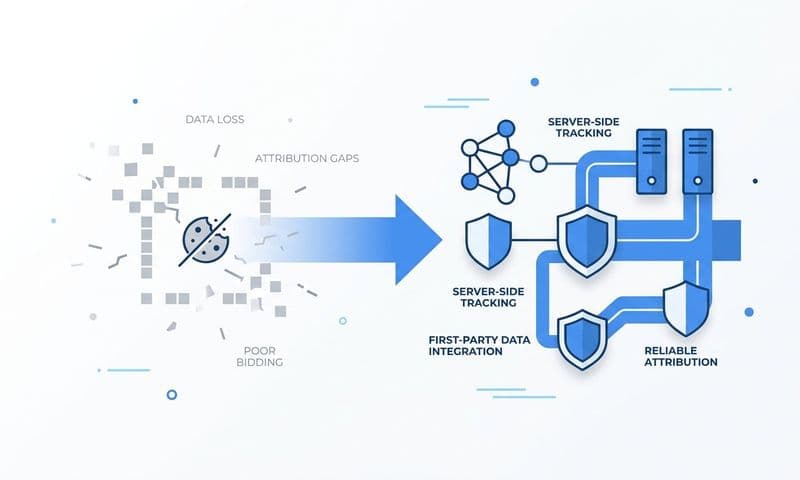
What makes Cometly particularly valuable in 2026 is its approach to the tracking reliability problem. Server-side tracking captures conversions that browser-level pixels miss due to iOS restrictions and cookie deprecation. Conversion Sync then sends enriched conversion data back to Meta, Google, and TikTok, giving those algorithms better signals to optimize targeting and delivery.
Key Features
Multi-Touch Attribution: Tracks every paid channel touchpoint and assigns credit across the full customer journey rather than defaulting to first or last click.
Server-Side Tracking: Captures conversion events at the server level, bypassing browser-level restrictions that cause standard pixels to underreport results.
Conversion Sync: Feeds enriched CRM and conversion data back to Meta, Google, and TikTok algorithms to improve targeting, bidding, and overall ad ROI.
AI Ads Manager: Surfaces optimization recommendations based on actual attribution data, so you know where to scale and where to pull back.
AI Chat: Lets you query your campaign and attribution data in plain language, making it easy to pull insights without digging through dashboards.
Best For
Cometly is a strong fit for performance marketing teams and agencies running paid campaigns across multiple channels who want to connect ad spend to CRM revenue. It works well for both B2B teams tracking long sales cycles and DTC or lead gen teams optimizing for conversion quality over volume.
Pricing
Pricing details are available at cometly.com. The platform offers plans suited to growing marketing teams and agencies.
2. HubSpot
Best for: Teams already using HubSpot CRM who want native attribution without adding another tool
HubSpot is an all-in-one CRM and marketing platform with multi-touch attribution reporting built directly into contact and deal records.
 9 Best CRM Integrations for Ad Attribution in 2026
Where This Tool Shines
HubSpot's biggest advantage for attribution is that it lives inside your CRM. There is no separate integration to maintain or data pipeline to manage. Attribution reports connect directly to the contacts and deals your sales team is already working, which makes it easy to show marketing's influence on closed revenue.
For teams that are already invested in the HubSpot ecosystem, this is a genuinely compelling option. The native ad integrations with Google Ads, Facebook Ads, and LinkedIn Ads mean you can pull campaign performance data alongside CRM outcomes without leaving the platform.
Key Features
Native Attribution Models: Includes first-touch, last-touch, linear, time-decay, and U-shaped models, all configurable within the platform.
CRM-Connected Reporting: Attribution data ties directly to HubSpot contact and deal records for closed-loop revenue visibility.
Ad Platform Integrations: Native connections to Google Ads, Facebook Ads, and LinkedIn Ads for campaign-level attribution.
Revenue Attribution Reports: Links marketing activity to closed deals so you can demonstrate ROI to leadership without manual data pulls.
No Additional Tool Required: For HubSpot CRM users, attribution is available within the existing platform, reducing stack complexity.
Best For
HubSpot attribution is best suited for SMB and mid-market teams already running HubSpot CRM who want a straightforward way to connect marketing activity to pipeline. Teams needing deep cross-channel attribution or server-side tracking may find the built-in models limiting compared to dedicated platforms.
Pricing
Attribution reporting is available on Marketing Hub Professional and Enterprise tiers. Current pricing is listed at hubspot.com.
3. Salesforce Marketing Cloud
Best for: Enterprise teams running large-scale campaigns on the Salesforce CRM ecosystem
Salesforce Marketing Cloud is an enterprise marketing platform with Einstein AI attribution deeply integrated with Salesforce CRM objects including Leads, Contacts, and Opportunities.
 9 Best CRM Integrations for Ad Attribution in 2026
Where This Tool Shines
For organizations already running Salesforce as their CRM, Marketing Cloud offers the deepest possible integration between ad attribution and CRM data. Einstein AI connects campaign activity to Opportunity stages and closed revenue, giving enterprise marketing teams a genuinely closed-loop view of how ad spend influences pipeline at every stage.
The platform handles the complexity that comes with large ad budgets and sophisticated sales processes. Custom attribution model configuration, support for enterprise-scale workflows, and direct integration with Salesforce Sales Cloud make it a natural fit for teams where the CRM is the system of record for everything.
Key Features
Einstein AI Attribution: AI-powered attribution insights connected directly to Salesforce CRM objects for revenue-level analysis.
Closed-Loop Revenue Attribution: Tracks the journey from ad click through Lead, Contact, and Opportunity stages to closed deal.
Salesforce Sales Cloud Integration: Full pipeline visibility across marketing and sales within a single platform ecosystem.
Custom Attribution Models: Enterprise teams can configure attribution logic to match their specific sales cycle and channel mix.
Enterprise Workflow Support: Built to handle large ad budgets, complex approval workflows, and multi-region marketing operations.
Best For
Salesforce Marketing Cloud is built for enterprise marketing teams with large budgets, dedicated Salesforce admins, and complex sales cycles. The implementation complexity and cost make it less practical for smaller teams, but for organizations already deep in the Salesforce ecosystem, it is the natural choice.
Pricing
Enterprise pricing is available on request at salesforce.com.
4. Triple Whale
Best for: DTC and ecommerce brands wanting first-party attribution independent of ad platform reporting
Triple Whale is an attribution and analytics platform built for DTC and ecommerce brands, combining a first-party pixel with Shopify and CRM data for blended attribution.
 9 Best CRM Integrations for Ad Attribution in 2026
Where This Tool Shines
Triple Whale was built specifically for the challenges that DTC brands face: ad platform pixels that overclaim credit, Shopify revenue data that does not always match what platforms report, and the need to understand which creative is actually driving purchases. The first-party pixel collects data independently, giving brands a view of attribution that is not filtered through each platform's self-interest.
The blended attribution approach is particularly useful. Rather than forcing you to choose between platform-reported data and Triple Whale's own model, it shows both side by side, letting you make informed decisions about where the truth likely sits.
Key Features
First-Party Pixel: Collects conversion data independently of ad platform pixels, reducing reliance on platform self-reporting.
Blended Attribution: Combines platform-reported data with Triple Whale's attribution model for a more complete picture.
Shopify Integration: Native connection to Shopify for revenue-level attribution tied directly to actual order data.
Customer Lifetime Value Analysis: Connects acquisition channel data to LTV metrics so you can optimize for long-term value, not just initial conversion.
Creative Analytics: Identifies top-performing ad assets across channels, helping creative teams understand what is actually driving results.
Best For
Triple Whale is purpose-built for DTC ecommerce brands running paid social and search campaigns. It is especially strong for Shopify-based businesses. B2B teams or brands without an ecommerce component will find it less relevant.
Pricing
Pricing is tiered based on store revenue. Current rates are available at triplewhale.com.
5. Northbeam
Best for: Performance marketers who need ML-based attribution independent of ad platform pixels
Northbeam is a machine learning attribution platform that models customer journeys using first-party signals, giving performance marketers a channel view that does not rely on ad platform self-reporting.
 9 Best Marketing Attribution Platforms Compared by Pricing in 2026
Where This Tool Shines
Northbeam takes a fundamentally different approach to attribution by using machine learning to model the customer journey rather than relying on deterministic pixel matching. This matters because pixel-based attribution has become increasingly unreliable as browsers restrict tracking and ad platforms apply their own attribution windows.
The platform also combines multi-touch attribution with media mix modeling, which gives marketers both granular channel-level insights and a higher-level view of how budget allocation affects overall performance. That combination is rare and valuable for teams managing significant ad spend across many channels.
Key Features
ML-Based Attribution Modeling: Uses machine learning and first-party data signals to model customer journeys rather than relying on pixel tracking alone.
Channel-Level Attribution: Provides attribution that is independent of each ad platform's own reported data, reducing overcounting.
Media Mix Modeling: Combines multi-touch attribution with MMM for both granular and macro-level budget insights.
Real-Time Spend Pacing: Surfaces budget recommendations and pacing alerts to help teams avoid overspending or underspending against targets.
Multi-Channel Support: Built for complex paid media programs running across paid social, search, display, and other channels simultaneously.
Best For
Northbeam is best suited for performance marketing teams and agencies managing large, multi-channel paid media programs where platform self-reported data is consistently inconsistent. It is enterprise-oriented in both capability and pricing.
Pricing
Pricing is available at northbeam.io. The platform is generally oriented toward enterprise and high-growth brands.
6. Rockerbox
Best for: Brands with complex channel mixes including offline, digital, and CRM data in one attribution layer
Rockerbox is a marketing attribution platform that centralizes paid, organic, offline, and CRM data into a single attribution layer for brands running diverse channel mixes.
 9 Best CRM Integrations for Ad Attribution in 2026
Where This Tool Shines
Most attribution tools are built around digital channels. Rockerbox goes further by incorporating offline channels like direct mail and TV alongside digital paid media, organic, and CRM data. For brands that run omnichannel campaigns, this unified view is genuinely hard to replicate with tools that only handle digital.
The deduplication capability is another standout. When multiple channels claim credit for the same conversion, Rockerbox applies deduplication logic across all sources, giving you a cleaner picture of what actually drove the result rather than inflated aggregate numbers.
Key Features
Unified Data Layer: Connects digital, offline, and CRM attribution into a single view for omnichannel brands.
Multiple Attribution Models: Supports standard models alongside custom model building to fit specific business needs.
Offline Channel Support: Includes direct mail, TV, and other non-digital channels alongside paid digital attribution.
Deduplicated Conversion Reporting: Removes cross-channel double-counting to give accurate conversion totals across all sources.
Ad Platform and CRM Integrations: Connects to major ad platforms and CRM tools to centralize data without manual exports.
Best For
Rockerbox is a strong choice for mid-market and enterprise brands running campaigns across both digital and offline channels who need a single attribution source of truth. Pure digital-only advertisers may find simpler tools more cost-effective.
Pricing
Pricing is available at rockerbox.com.
7. Ruler Analytics
Best for: B2B lead generation teams tracking visitor journeys from first ad click to CRM deal closure
Ruler Analytics is a B2B-focused attribution platform that tracks the full visitor journey from first ad click through to CRM deal closure, mapping marketing touchpoints to actual revenue.
Where This Tool Shines
Ruler Analytics was built specifically for the B2B attribution problem: a visitor clicks an ad, fills out a form weeks later, enters a sales cycle that lasts months, and eventually closes as a deal in the CRM. Most attribution tools break down somewhere in that chain. Ruler Analytics tracks the entire sequence and maps it back to the originating marketing touchpoints.
The closed-loop connection to Salesforce and HubSpot is particularly well-executed. Revenue data from CRM deal records flows back into Ruler's attribution reports, so marketers can see which campaigns and channels are generating actual revenue, not just lead volume or form fills.
Key Features
Full Visitor Journey Tracking: Captures every touchpoint from first ad click through to CRM deal close across long B2B sales cycles.
Closed-Loop Attribution: Connects marketing spend to CRM revenue data so you can tie ad investment to actual closed deals.
Native CRM Integrations: Direct integrations with Salesforce and HubSpot for seamless data flow between attribution and CRM records.
Multiple Attribution Models: Includes data-driven attribution options alongside standard models for more nuanced analysis.
B2B Sales Cycle Design: Built around longer sales cycles where multiple touches over weeks or months influence a single deal.
Best For
Ruler Analytics is an excellent fit for B2B marketing teams running paid campaigns with long sales cycles who need to connect ad spend to CRM revenue. It is particularly strong for teams using Salesforce or HubSpot as their primary CRM.
Pricing
Tiered plans are available at ruleranalytics.com.
8. Dreamdata
Best for: B2B teams running account-based marketing with multiple stakeholders in each buying group
Dreamdata is a B2B revenue attribution platform built for account-based marketing, mapping touchpoints across multiple stakeholders within a buying group throughout long sales cycles.
Where This Tool Shines
B2B deals rarely involve a single buyer. A typical enterprise purchase touches a champion, an economic buyer, a technical evaluator, and an executive sponsor, each of whom may interact with your ads and content at different times. Dreamdata's account-level attribution maps all of those touchpoints together at the account level rather than treating each contact in isolation.
This approach gives B2B marketers a much more accurate picture of which campaigns are influencing deals across the full buying committee. Combined with integrations across CRM, ad platforms, and product analytics, Dreamdata connects a wide range of signals into a single revenue attribution view.
Key Features
Account-Level Attribution: Maps touchpoints across multiple contacts within a single buying account rather than attributing at the individual contact level only.
Broad Integration Coverage: Connects with Salesforce, HubSpot, major ad platforms, and product analytics tools for comprehensive data coverage.
B2B-Specific Attribution Models: Attribution models designed for complex, multi-stakeholder sales cycles rather than adapted from B2C models.
Revenue Analytics: Connects pipeline stages to marketing activity so teams can see which channels are influencing deals at each stage.
Self-Serve Reporting: Pre-built B2B revenue reports make it accessible to marketing teams without heavy analyst support.
Best For
Dreamdata is purpose-built for B2B marketing teams running account-based programs with complex, multi-stakeholder buying processes. It is especially useful for teams where a single deal involves multiple contacts across a long sales cycle.
Pricing
Pricing is available at dreamdata.io.
9. Segment (Twilio)
Best for: Engineering-supported marketing teams building a custom first-party attribution stack
Segment is a customer data platform that acts as the connective layer between your CRM, website events, and ad destinations, enabling server-side data routing and first-party data ownership.
Where This Tool Shines
Segment is not a traditional attribution tool. It is the infrastructure layer that makes sophisticated attribution architectures possible. By collecting events from your website, app, and CRM and routing them to any connected destination, Segment gives engineering-supported marketing teams the ability to build a custom attribution stack on top of clean, first-party data.
The server-side tracking capability is particularly relevant in 2026 as browser-level restrictions continue to limit pixel accuracy. Segment can route conversion events server-side to ad platforms, ensuring that the data reaching Meta, Google, and other platforms is accurate and complete rather than filtered through browser restrictions.
Key Features
Universal Data Collection: Collects CRM events, website behavior, and app data in a single pipeline and routes them to any connected destination.
Server-Side Event Tracking: Sends conversion events server-side for first-party data accuracy that bypasses browser-level restrictions.
Audience Builder: Creates CRM-based audiences for ad targeting and suppression across connected ad platforms.
400+ Destination Connections: Connects to Google Ads, Meta, major CRMs, analytics platforms, and hundreds of other tools in a single integration layer.
Custom Attribution Architecture: Flexible, developer-friendly setup that supports fully custom attribution logic for teams with specific requirements.
Best For
Segment is best suited for technical marketing teams or organizations with engineering resources who want to own their data infrastructure. It requires more setup than purpose-built attribution tools but offers unmatched flexibility for teams building custom stacks.
Pricing
A free tier is available. Paid plans scale with monthly tracked users. Full pricing details are at segment.com.
Choosing the Right Tool for Your Stack
The right CRM integration for ad attribution depends entirely on your business model, technical resources, and what you actually need to measure. Here is a quick guide to cut through the decision.
If you are a performance marketer or agency running multi-channel paid campaigns: Cometly is the strongest all-around choice. It combines server-side tracking, multi-touch attribution, CRM connectivity, and Conversion Sync in one platform, and the AI-powered recommendations give you something actionable, not just data to stare at.
If you are already using HubSpot or Salesforce: Start with the native attribution features in those platforms before adding another tool. HubSpot's built-in attribution works well for most SMB and mid-market teams. Salesforce Marketing Cloud is the right move for enterprise teams with complex workflows and dedicated admins.
If you run a DTC ecommerce brand on Shopify: Triple Whale was built for exactly your use case. Its first-party pixel and blended attribution model address the core challenges DTC brands face with platform self-reporting.
If you are in B2B with long sales cycles and account-based marketing: Ruler Analytics and Dreamdata are both purpose-built for this problem. Ruler is stronger for connecting individual visitor journeys to CRM deals. Dreamdata is the better choice when multiple stakeholders within a single account are involved in the buying decision.
If you need to build a custom data infrastructure: Segment gives you the foundation to route first-party data wherever it needs to go, but plan for technical investment upfront.
Whichever direction you go, the goal is the same: connect your ad spend to actual revenue outcomes so every budget decision is grounded in real data. If you want to see how AI-powered attribution can close that loop across all your paid channels, Get your free demo of Cometly and start capturing every touchpoint from first click to closed deal.