

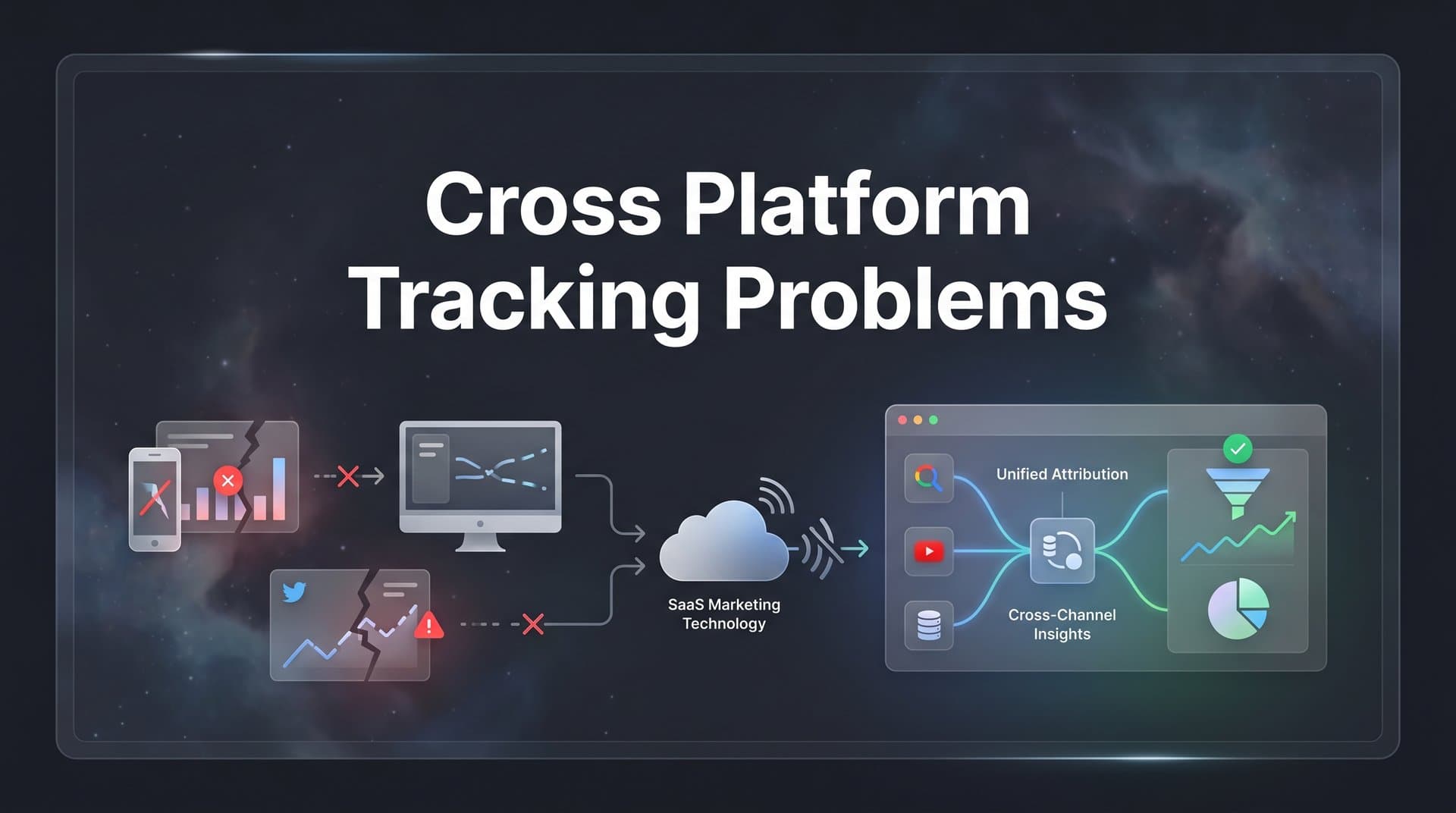
You're staring at three different dashboards, and none of them agree. Google Ads says you drove 47 conversions this week. Meta claims 52. Your CRM shows 38 actual sales. Each platform insists it deserves credit, and you're left wondering which numbers to trust when it's time to decide where to allocate next month's budget.
This isn't a minor reporting glitch. It's the reality of cross platform tracking problems that plague nearly every marketer running campaigns across multiple channels. The customer journey that once seemed straightforward has fractured into dozens of touchpoints spanning devices, browsers, and weeks of consideration. And the tools we've relied on to measure performance? They're struggling to keep up.
The stakes are higher than ever. When your tracking data doesn't add up, every budget decision becomes a gamble. You might be pouring money into channels that look successful but actually contribute little to revenue. Or worse, you could be starving your best-performing campaigns because the data makes them appear mediocre.
The Data Fragmentation Dilemma
Here's the fundamental problem: each advertising platform operates in its own universe with proprietary tracking methods that don't communicate with each other. Meta has its pixel. Google has its tag. TikTok, LinkedIn, Twitter—they all deploy their own tracking scripts that capture data in isolation.
When a potential customer clicks your Meta ad on their phone during lunch, researches your product on their work laptop that afternoon, and finally converts on their tablet three days later, you're looking at a journey that spans three devices, two browsers, and multiple sessions. Each platform sees only fragments of this story.
Meta's pixel fires when someone clicks your ad, drops a cookie in their browser, and waits to see if they convert within the attribution window. But when that person switches devices, the cookie doesn't follow. The conversion happens in a completely different environment that Meta can't track back to the original ad click. From Meta's perspective, this conversion never happened.
Meanwhile, Google Ads might have shown a search ad to that same person on their laptop. When they eventually convert on their tablet after seeing your retargeting ad, Google claims credit because someone from that household searched your brand name. The fact that Meta's ad three days earlier sparked the initial interest? Google's tracking has no way to know that.
This creates the infamous scenario where platform-reported conversions exceed actual sales by margins that make your data completely unreliable. You might see 150 conversions reported across all platforms when you actually closed 80 deals. Which 80 were real? Which platforms drove them? The fragmented tracking systems can't tell you. Understanding multiple ad platforms tracking problems is essential to solving this challenge.
The customer journey has become exponentially more complex, but our tracking infrastructure hasn't evolved to match. We're trying to measure a multi-dimensional journey with tools designed for a simpler, single-device world.
Privacy Changes That Broke Traditional Tracking
If data fragmentation created cracks in the foundation, recent privacy changes shattered it completely. The shift began in April 2021 when Apple released iOS 14.5 with App Tracking Transparency. Suddenly, iPhone and iPad users had to explicitly opt in to being tracked across apps and websites. Most didn't.
The impact was immediate and devastating for pixel-based attribution. Meta, which had relied heavily on tracking users across the iOS ecosystem, lost visibility into huge portions of the customer journey. The Facebook pixel that once captured detailed browsing behavior now hits a wall when users opt out of tracking. Conversion events that used to fire reliably simply don't register.
This wasn't just a Meta problem. Any platform relying on client-side tracking—where a JavaScript pixel fires in the user's browser—faced the same limitations. The data gaps became massive. Marketers running iOS-targeted campaigns found themselves flying blind, unable to see which ads drove results and which burned budget. These cross device conversion tracking problems continue to plague marketers today.
Browser cookie restrictions compounded the challenge. Safari had already implemented Intelligent Tracking Prevention, limiting how long cookies could persist and blocking many third-party cookies entirely. Firefox followed with Enhanced Tracking Protection. Google Chrome, which still allows third-party cookies, has announced plans to phase them out, though the timeline keeps shifting as the industry struggles to find alternatives.
Here's what this means in practice: a potential customer clicks your ad, browses your site, and leaves. Your retargeting pixel drops a cookie to show them ads later. But if they're using Safari, that cookie expires after seven days. If they're on iOS and opted out of tracking, the cookie might not work at all. Your carefully planned retargeting sequence never reaches them, and you have no data showing why the campaign underperformed.
Consent requirements under GDPR and similar privacy regulations created another layer of complexity. Users must actively consent to tracking cookies, and many don't. Even when they do, the consent might only apply to certain types of cookies, creating partial data sets that make attribution nearly impossible.
The result is a tracking landscape full of holes. You're not seeing the complete customer journey anymore. You're seeing fragments, and those fragments are getting smaller as privacy protections expand. Traditional pixel-based tracking that worked reliably for years now captures maybe 60-70% of actual activity, and that percentage continues to decline.
Attribution Model Conflicts Between Platforms
Even when tracking works, platforms disagree about who deserves credit. This isn't a technical glitch. It's a fundamental conflict in how different platforms define and measure conversions.
Meta defaults to a 7-day click and 1-day view attribution window. This means if someone clicks your ad and converts within seven days, Meta claims that conversion. If they simply view your ad and convert within 24 hours without clicking, Meta still counts it. Google Ads uses different default windows and offers various attribution models that can be customized. TikTok has its own rules. LinkedIn has different standards.
Picture this scenario: Someone sees your Meta ad on Monday but doesn't click. On Tuesday, they search your brand name on Google and click your search ad. On Wednesday, they see a retargeting ad from Meta and click through. On Thursday, they convert. Who gets credit?
Meta claims the conversion twice—once for the view-through from Monday's ad (if you're within the 1-day view window, which you're not), and definitely for the click on Wednesday. Google Ads claims it because the user clicked their search ad before converting. If you're running a last-click attribution model, the retargeting ad gets full credit. If you're using first-click, the search ad wins. Linear attribution would split credit across all touchpoints. Implementing cross platform attribution tracking helps resolve these conflicts.
This is why you see conversion totals that don't match reality. Each platform is measuring the same events through different lenses, applying different rules, and claiming credit based on its own logic. They're all technically correct according to their own attribution models, but they can't all be right about which channel actually drove the conversion.
The problem intensifies when you consider view-through conversions. These are conversions that happen after someone sees your ad but doesn't click it. Meta might show someone your ad in their feed. They scroll past without clicking. Two hours later, they search your brand name, visit your site, and buy. Should Meta get credit for that conversion because their ad created awareness? Or should the search campaign get credit because it captured intent?
Different attribution models answer this question differently, and there's no universal standard. What you end up with is multiple sources of truth that contradict each other, making it impossible to confidently answer the most important question in marketing: which channels actually drive revenue?
The Real Cost of Inaccurate Cross Platform Data
These tracking problems aren't just annoying reporting discrepancies. They directly damage your marketing performance and waste your budget.
When you can't identify which channels truly drive revenue, you misallocate budget. You might be scaling Meta campaigns that show strong conversion numbers in the platform, not realizing that most of those conversions would have happened anyway through branded search. Meanwhile, your top-of-funnel YouTube campaigns that actually introduce new customers to your brand show weak direct attribution, so you cut their budget. You've just starved your growth engine while doubling down on bottom-funnel tactics that depend on awareness you're no longer building.
This happens constantly because platform-native reporting makes every channel look better than it actually performs. Each platform wants to prove its value, so attribution windows and models are configured to maximize reported conversions. The platforms aren't lying—they're just measuring from their own perspective, which naturally favors their own contribution. The chaos of duplicated conversion tracking across platforms makes accurate budget decisions nearly impossible.
The scaling problem gets worse as you grow. When you're spending $5,000 per month, misattribution might waste a few hundred dollars. When you're spending $100,000 per month, suddenly you're burning tens of thousands on campaigns that don't actually drive incremental revenue. The marketers who scale fastest are often those who scale their mistakes fastest.
There's another insidious cost that many marketers miss: feeding bad data back to ad platform algorithms. Modern ad platforms rely heavily on machine learning to optimize delivery. Facebook's algorithm learns which users are most likely to convert based on the conversion data you send back. Google's Smart Bidding adjusts bids in real time based on conversion probability.
But what happens when the conversion data you're feeding these algorithms is incomplete or inaccurate? The machine learning models train on flawed information. They optimize for patterns that don't actually predict real revenue. Your campaigns might show improving efficiency metrics in the platform while your actual return on ad spend stagnates or declines.
This creates a compounding effect. Bad tracking leads to bad data. Bad data leads to poor algorithmic optimization. Poor optimization leads to worse campaign performance. Worse performance leads to more aggressive budget cuts or misguided scaling decisions. The tracking problem becomes a performance problem that cascades through your entire marketing operation.
Building a Unified Tracking Foundation
The solution to cross platform tracking problems isn't trying to make traditional pixel-based tracking work better. It's fundamentally changing how you collect and connect marketing data.
Server-side tracking forms the backbone of accurate cross platform measurement. Instead of relying on JavaScript pixels that fire in users' browsers—where they can be blocked by privacy settings, ad blockers, and cookie restrictions—server-side tracking sends event data directly from your server to ad platforms and analytics tools. The user's browser never enters the equation.
Here's how this changes everything: When someone converts on your website, your server captures that event with all relevant details—user identifier, conversion value, product purchased, attribution data. This information gets sent server-to-server to Meta, Google, and other platforms. Because the data transmission happens between servers, it bypasses all the browser-level restrictions that break traditional tracking. Following a comprehensive cross platform tracking setup guide ensures you implement this correctly.
Server-side tracking maintains accuracy regardless of iOS settings, browser cookie policies, or ad blockers. The data flows reliably because it's not dependent on client-side scripts that users can disable. This immediately solves the data loss problem that's plagued marketers since iOS 14.5.
But server-side tracking alone isn't enough. You need to connect ad platforms, website events, and CRM data into a single source of truth. This is where unified attribution platforms come in. Instead of looking at fragmented reports from each channel, you need a system that captures every touchpoint across the entire customer journey and connects them to actual revenue outcomes.
This means tracking customer journey across platforms—when someone clicks a Meta ad, visits your website, fills out a form, receives follow-up emails, clicks a Google search ad, returns to your site, and finally converts. Every touchpoint gets logged with timestamps, channel information, and user identifiers. When that conversion happens, you can trace it back through the complete journey and understand which channels actually contributed to the outcome.
First-party data becomes your competitive advantage in this new tracking landscape. Data you collect directly from your owned properties—your website, your app, your CRM—remains accurate and reliable regardless of privacy restrictions. Browser settings and iOS permissions can block third-party tracking, but they don't prevent you from collecting data on your own platforms. A robust first party data tracking platform is essential for modern marketing success.
The key is connecting this first-party data to your ad platforms in a way that maintains accuracy while respecting privacy. When someone converts, you know their email address, purchase history, and lifetime value from your CRM. You can send this enriched conversion data back to ad platforms through server-side connections, giving their algorithms better information to optimize delivery.
This approach—combining server-side tracking, unified attribution, and first-party data—creates a foundation that actually works in the current privacy landscape. You're not fighting against browser restrictions or trying to patch together fragmented data. You're building a tracking infrastructure designed for how marketing actually works today.
Putting It All Together: From Fragmented Data to Clear Insights
The shift from platform-reported metrics to unified attribution fundamentally changes how you make marketing decisions. Instead of asking "What does Meta say drove conversions?" you ask "What actually drove revenue according to our complete data?"
This clarity enables confident scaling decisions. When you can see that a specific Meta campaign consistently appears in the customer journey three to five days before conversions, you understand its true value even if Meta's native reporting doesn't give it full credit. When you notice that users who see both YouTube ads and search ads convert at twice the rate of those who see only one channel, you can strategically increase budget to both channels simultaneously.
Accurate tracking also reveals which campaigns truly underperform versus which ones simply get misattributed. That LinkedIn campaign that shows weak conversion numbers in the platform might actually introduce high-value leads who convert through other channels days later. Your unified data shows the real story, preventing you from cutting campaigns that actually drive growth. Implementing accurate cross platform conversion tracking makes this level of insight possible.
The benefits compound over time. Better data leads to smarter budget allocation. Smarter allocation leads to improved performance. Improved performance generates more revenue that you can reinvest in scaling. The marketers who solve their cross platform tracking problems first gain a massive advantage over competitors still making decisions based on fragmented, inaccurate data.
If you're ready to move beyond the guesswork and conflicting reports, start by auditing your current tracking setup. Identify where data gaps exist. Map out the complete customer journey across all touchpoints. Then build toward a unified attribution system that connects everything to actual revenue outcomes.
Your Path to Tracking Clarity
Cross platform tracking problems aren't going away. Privacy restrictions will continue tightening. Customer journeys will keep getting more complex. Traditional tracking methods will become even less reliable.
But these challenges are solvable. The solution isn't better pixels or more sophisticated workarounds for cookie restrictions. It's a fundamental shift to server-side tracking, unified attribution, and first-party data that gives you accurate visibility into the complete customer journey.
When you can see which channels actually drive revenue, budget allocation stops being guesswork. Scaling decisions become confident moves backed by reliable data. Your ad platform algorithms receive enriched conversion data that helps them optimize delivery. The compounding benefits transform your entire marketing operation.
The marketers winning in this new landscape aren't those with the biggest budgets. They're those with the clearest data. They understand which touchpoints matter, which channels drive incremental revenue, and how to feed their ad platforms the accurate signals needed for algorithmic optimization.
Ready to elevate your marketing game with precision and confidence? Discover how Cometly's AI-driven recommendations can transform your ad strategy—Get your free demo today and start capturing every touchpoint to maximize your conversions.


