

Every B2B SaaS marketer has faced the same frustrating moment: a deal closes, and three different channels are claiming credit for it. Your LinkedIn campaign says it drove the conversion. Google Ads says the same. And somewhere in your CRM, there's a form submission that tells a completely different story. The question isn't just which channel gets the trophy. The question is which data you can actually trust to make your next budget decision.
This is the core problem that deterministic attribution is designed to solve. Instead of inferring which touchpoints probably influenced a conversion, deterministic attribution creates a verified, identity-based link between a specific ad interaction and a downstream conversion event. No guessing. No statistical modeling. A confirmed connection built on real identity signals.
For B2B SaaS teams managing long sales cycles, multiple stakeholders, and significant ad budgets, the difference between guessing and knowing is the difference between scaling the right campaigns and wasting money on the wrong ones. By the end of this article, you'll understand exactly how the deterministic attribution method works, how it compares to probabilistic approaches, where it breaks down, and how to implement it across your marketing stack to connect every ad dollar to actual revenue.
The Core Mechanics of Deterministic Attribution
At its foundation, the deterministic attribution method works by anchoring every conversion to a confirmed identity signal rather than an inferred one. Think of it like a paper trail: instead of assuming someone walked through your door based on footprints near the entrance, you checked their ID at the door and have a signed record of their visit.
The identity signals that power deterministic attribution typically include logged-in user IDs, hashed email addresses, CRM-matched records, and persistent identifiers passed through server-side event tracking. When a user clicks an ad and later converts, the system can confirm it was the same person by matching these signals across touchpoints. The result is a direct, verifiable link rather than a probabilistic estimate.
This is fundamentally different from methods that rely on behavioral inference. Probabilistic attribution might notice that a user visited your pricing page twice from the same city, used a similar device, and then converted, and assign partial credit based on that pattern. Deterministic attribution skips the pattern-matching entirely because it already knows who the user is.
The data sources that make this possible fall into a few key categories:
First-party login data: When users are authenticated on your platform or website, their session carries a persistent identifier that can be matched to ad interactions regardless of device or browser.
Form submissions: When a prospect fills out a demo request or contact form, the submitted email or phone number becomes an identity anchor that can be matched against your CRM and ad platform customer lists.
CRM records: Your CRM is the single most valuable source of deterministic identity data. Every contact, lead, and opportunity carries attributes that can be used to resolve identity across your marketing stack.
Server-side event tracking: Rather than relying on browser-based pixels that can be blocked or degraded by privacy changes, server-side tracking passes identity-matched events directly from your backend to ad platforms, preserving signal quality at the source.
The precision of deterministic attribution makes it the preferred standard for teams that need to make confident budget decisions. When your attribution data is built on confirmed identity signals, you can trust that the channel getting credit actually earned it.
Deterministic vs. Probabilistic Attribution: Knowing the Difference
To appreciate why deterministic attribution matters, it helps to understand what it's being compared against. Probabilistic attribution uses signals like IP addresses, device fingerprints, browser characteristics, and behavioral patterns to make educated guesses about which touchpoints influenced a conversion. It's a sophisticated form of inference, and in many contexts, it's genuinely useful.
Imagine a user who clicks a LinkedIn ad on their work laptop but never logs in to your site. They later convert from a different device, using a different browser. There's no persistent identifier connecting those two sessions. Probabilistic attribution would look at shared signals, similar IP ranges, matching device attributes, overlapping behavioral patterns, and assign a probability score to the connection. It's not certain, but it's better than nothing.
The practical distinction comes down to confidence. Deterministic attribution delivers high confidence in credit assignment because it's grounded in verified identity. Probabilistic attribution delivers a best estimate, which can be valuable but introduces noise into your performance data.
For B2B SaaS specifically, this distinction carries significant weight. Consider the typical B2B buying journey: a deal might involve six to ten touchpoints spread across weeks or months, with multiple stakeholders from the same company each interacting with your content independently. If your attribution system is making probabilistic guesses about which of those interactions belong to the same account, errors compound quickly. A single misattribution in a long sales cycle can skew your understanding of which channels are actually driving pipeline.
Deterministic attribution handles this scenario with much greater accuracy because it ties each touchpoint to a confirmed identity, whether that's a hashed email, a user ID, or a CRM-matched record. Even when different stakeholders from the same account are interacting with your campaigns, you can map each interaction to the right deal.
That said, the two approaches are not mutually exclusive. The practical tradeoff is this: deterministic attribution requires a robust first-party data infrastructure and consistent identity resolution across your stack. Probabilistic attribution can fill gaps where that identity data simply doesn't exist, particularly in upper-funnel awareness campaigns where users haven't yet provided any identifying information.
Many mature attribution strategies use both in combination. Deterministic signals anchor the high-confidence touchpoints, typically mid-funnel and below, while probabilistic modeling fills in the gaps at the top of the funnel. The goal is to maximize the proportion of your attribution that's deterministic, using probabilistic methods only where necessary.
Why B2B SaaS Teams Rely on Deterministic Data to Track the Full Customer Journey
B2B SaaS buying journeys are not linear. A prospect might discover your product through a paid search ad, read three blog posts over two weeks, attend a webinar, get a personalized LinkedIn retargeting ad, and then finally request a demo after receiving an email from a sales rep. That's a six-touchpoint journey spanning multiple channels and potentially multiple months.
The challenge is that each of those interactions might happen on a different device, in a different browser session, or through a different channel entirely. Without a deterministic identity layer connecting those touchpoints, your attribution system can't reliably credit the right channels or understand how they worked together to drive the conversion.
This is where server-side tracking and Conversion APIs become essential infrastructure. Browser-based pixels have become increasingly unreliable as a result of ad blockers, iOS privacy changes, and the gradual deprecation of third-party cookies. When a pixel fires in a browser that's blocking tracking scripts, that touchpoint disappears from your attribution data entirely. Server-side tracking bypasses this problem by sending identity-matched conversion events directly from your server or CRM to ad platforms, using first-party data that isn't subject to browser-level restrictions.
Meta's Conversion API and Google's Enhanced Conversions are two of the most widely adopted server-side solutions. When configured correctly, they allow you to pass hashed email addresses, phone numbers, and other first-party identifiers alongside conversion events, enabling ad platforms to match those events to real users in their systems with much higher accuracy than a browser pixel alone would achieve.
The other critical piece for B2B SaaS teams is connecting attribution all the way to revenue, not just stopping at lead generation. Many marketing teams measure success by the number of demo requests or trial signups their campaigns generate. But in B2B SaaS, a lead is not a revenue event. A closed-won deal is.
When you connect deterministic attribution to your CRM pipeline data, you gain the ability to trace every ad interaction through the entire funnel: from first click to MQL, from MQL to opportunity, from opportunity to closed-won revenue. This gives growth teams a clear picture of which channels and campaigns are generating not just leads but actual revenue, and at what cost per acquisition.
This level of visibility fundamentally changes how marketing budgets get allocated. Instead of optimizing for cost per lead, teams can optimize for cost per closed deal, which is the metric that actually matters to the business.
Common Challenges That Undermine Deterministic Attribution Accuracy
The deterministic attribution method is only as reliable as the identity data that powers it. When that data has gaps or inconsistencies, the accuracy of your attribution breaks down in predictable ways. Understanding these failure points is the first step to preventing them.
Cross-device identity gaps: This is one of the most common sources of attribution errors. A user clicks a LinkedIn ad on their mobile phone during their commute but converts on their desktop later that evening while logged out of your site. Without a login event or a persistent identifier connecting those two sessions, the identity chain is broken. The ad click and the conversion appear as separate, unconnected events. To address this, teams need either a login-based identity resolution system that recognizes the same user across devices or a unified identity graph that can probabilistically bridge the gap when deterministic signals aren't available.
Incomplete CRM data and inconsistent UTM tagging: The quality of your deterministic attribution is directly tied to the hygiene of your first-party data. If your CRM records are missing email addresses, have duplicate contacts, or lack consistent source tracking, your attribution system can't reliably match ad interactions to downstream conversions. Similarly, if UTM parameters are applied inconsistently across campaigns, or if links are shared without UTMs at all, you lose the thread that connects an ad click to a session and ultimately to a conversion. Establishing consistent UTM conventions and enforcing CRM data standards are not glamorous tasks, but they are foundational to accurate attribution.
Event deduplication: This is a technical challenge that's easy to overlook but can significantly distort your performance data. When teams implement both a client-side pixel and a server-side Conversion API, the same conversion event can be fired twice: once by the pixel in the browser and once by the server-side integration. Without deduplication logic in place, your attribution platform and ad platforms will count that as two separate conversions, inflating your reported performance and misrepresenting the true cost per acquisition.
Proper deduplication requires assigning a unique event ID to each conversion and passing that ID through both the pixel and the server-side event. Ad platforms like Meta and Google use this event ID to identify and discard duplicate events, ensuring each conversion is counted exactly once. This step is critical but often skipped during initial implementation, leading to data quality issues that can be difficult to diagnose after the fact.
How to Implement Deterministic Attribution Across Your Marketing Stack
Implementing the deterministic attribution method effectively is less about choosing the right tool and more about building the right data infrastructure. The tool is only as good as the identity signals flowing through it. Here's how to approach implementation in a way that sets you up for reliable, high-confidence attribution.
Build a first-party data foundation: Start by ensuring that your website, CRM, and ad platforms share a consistent user identifier. This might be a hashed email address, a user ID generated at sign-up, or a matched customer list synced from your CRM to your ad platforms. The goal is to have a single identity anchor that can be used to resolve the same user across different touchpoints, devices, and sessions. Without this foundation, deterministic attribution is impossible regardless of which attribution platform you use.
Implement server-side tracking and Conversion APIs: Once your identity infrastructure is in place, configure server-side event tracking to send enriched, identity-matched conversion events directly from your server to ad platforms. This typically means setting up Meta CAPI and Google Enhanced Conversions, passing hashed email addresses and other first-party identifiers alongside each conversion event. This improves match rates, preserves signal quality in privacy-constrained environments, and gives ad platform machine learning models better data to optimize against.
Ensure consistent UTM parameter coverage: Every paid ad, email campaign, and owned media link should carry UTM parameters that follow a consistent naming convention. This is what allows your attribution platform to connect a session back to a specific campaign, ad set, and creative. Gaps in UTM coverage create blind spots in your attribution data that no amount of server-side tracking can fix.
Map the full customer journey to revenue: Configure your attribution platform to capture touchpoints across the entire funnel, from first ad click through to closed-won revenue. This means integrating your CRM so that pipeline stages and deal outcomes are visible alongside your ad performance data. When you can see which campaigns are generating pipeline and which are generating closed deals, you can make budget decisions based on actual business outcomes rather than proxy metrics.
Implement event deduplication from day one: Before you go live with any server-side tracking, establish your deduplication logic. Assign unique event IDs to every conversion event and pass them through both your pixel and your server-side integration. Test your setup in a staging environment to confirm that duplicate events are being correctly identified and discarded before they reach your attribution data.
Turning Deterministic Attribution Into Smarter Ad Decisions
Accurate attribution data is only valuable if it changes how you make decisions. Once your deterministic attribution infrastructure is in place, the real work begins: using that data to optimize your campaigns, allocate budget more effectively, and feed better signals back into the ad platforms themselves.
One of the most immediate benefits is the ability to compare channel performance with confidence. When your touchpoint data is grounded in confirmed identity signals rather than statistical estimates, you can apply different attribution models, such as linear, first-touch, last-touch, or data-driven, and trust that the underlying data is accurate. You're not arguing about whether the model is right; you're having a much more productive conversation about which model best reflects how your customers actually make decisions.
This is where AI-powered attribution tools add significant value. Rather than manually analyzing performance across channels and campaigns, AI can process your deterministic touchpoint data at scale and surface which campaigns and creatives are consistently driving high-value conversions. It can identify patterns that aren't visible in aggregate reporting, such as a specific ad creative that performs well for enterprise accounts but poorly for SMB, or a channel that generates a high volume of leads but a low rate of closed deals. These insights allow teams to scale what's working and cut what isn't with much greater precision than traditional reporting allows.
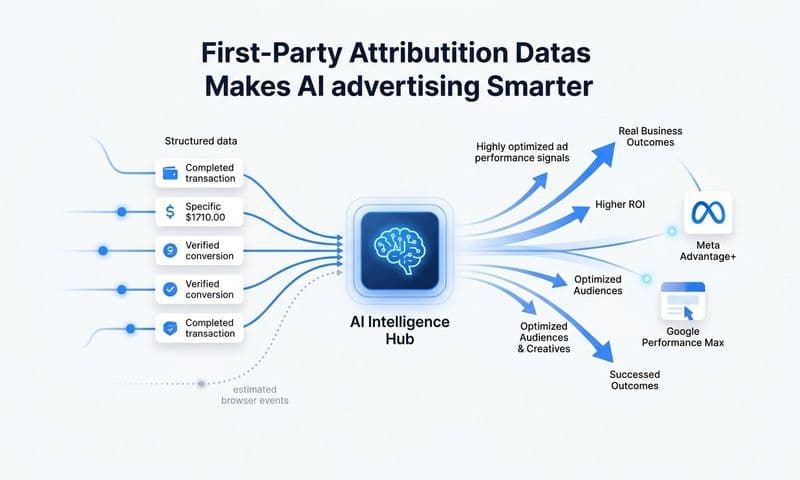
There's also a compounding benefit to feeding deterministic conversion signals back into ad platforms. When you send enriched, identity-matched conversion events through Meta CAPI or Google Enhanced Conversions, you're giving those platforms' machine learning models better data to optimize against. Better data means better targeting, better bidding, and better ad delivery over time. Teams that invest in this feedback loop often find that their ad platform performance improves progressively as the models learn from higher-quality signals.
The practical outcome is a virtuous cycle: deterministic attribution gives you accurate data, accurate data drives smarter decisions, smarter decisions improve campaign performance, and better campaigns generate more high-quality conversion signals to feed back into the system. This is the compounding advantage that separates teams with mature attribution infrastructure from those still relying on last-click or platform-reported data.
Building on a Foundation That Actually Works
The deterministic attribution method isn't a new concept, but it's become more important than ever as privacy changes erode the signal quality that marketers once took for granted. The teams that will win in this environment are the ones that invest in first-party data infrastructure, server-side tracking, and identity resolution now, before the gaps in their data become too large to bridge.
The core distinction is worth repeating: deterministic attribution is built on confirmed identity signals. Probabilistic attribution is built on statistical inference. Both have a role to play, but for B2B SaaS teams making significant budget decisions based on attribution data, the higher the proportion of your attribution that's deterministic, the more confident you can be in the decisions that data informs.
This is exactly what Cometly is built to deliver. Cometly connects your ad platforms, CRM, and website to capture every deterministic touchpoint across the full customer journey, from first ad click to closed-won revenue. With server-side tracking, Conversion API integration, and native CRM connectivity, Cometly gives your team a single source of truth for marketing performance. Its AI-powered recommendations surface which campaigns and channels are actually driving revenue, so you can scale with confidence rather than guessing.
If you're ready to move beyond last-click reporting and build attribution you can actually trust, Get your free demo today and see how Cometly makes deterministic attribution actionable across your entire marketing stack.