Your client just asked the question every agency dreads: "Which of our marketing channels is actually driving revenue?" You pull up the dashboard, see clicks and impressions across six different platforms, and realize you're about to deliver an answer built on educated guesses rather than hard data. The client nods politely, but you both know the truth—without clear attribution, you're asking them to trust your instincts with their marketing budget.
This isn't sustainable. As clients become more sophisticated about marketing measurement, agencies face a fundamental choice: prove concrete ROI or become replaceable vendors. Attribution measurement bridges the gap between marketing activity and business outcomes, transforming vague correlations into defensible cause-and-effect relationships.
This guide walks through everything agencies need to know about implementing attribution measurement systems that actually work—from choosing the right tracking infrastructure to translating data into client-ready insights that justify every dollar spent.
Why Agencies Can't Afford to Guess at Attribution Anymore
The agency-client relationship has fundamentally shifted. Five years ago, clients accepted reports showing increased traffic, higher engagement rates, and growing follower counts as evidence of marketing success. Today, those same clients want to see a direct line from ad spend to revenue. This isn't unreasonable—it's the natural evolution of marketing as a business discipline.
The conversation has moved from "How many people saw our ads?" to "Which specific campaigns generated customers who actually bought something?" This shift puts agencies in a difficult position. Without proper attribution systems, you're stuck reporting metrics that sound impressive but don't answer the fundamental question: did this marketing investment make money?
The stakes get higher when you consider the competitive landscape. When a prospective client interviews three agencies, the one that can demonstrate clear attribution capabilities immediately stands apart. Being able to say "We'll show you exactly which touchpoints contributed to each conversion" is dramatically more compelling than "We'll optimize your campaigns based on platform metrics."
Technical changes have made this challenge more urgent. Apple's iOS App Tracking Transparency framework and the ongoing deprecation of third-party cookies have disrupted the tracking methods agencies relied on for years. Browser-based pixels that once captured clean conversion data now miss significant portions of the customer journey. Platform-reported metrics often overcount conversions because they can't see the full picture across channels. Understanding these attribution challenges in digital marketing is essential for agencies navigating this landscape.
This creates a credibility problem. When Facebook claims 50 conversions, Google Ads reports 45, and your CRM shows 30 actual customers, which number do you present to the client? Without independent attribution measurement, you're forced to either pick one platform's self-reported data or admit you don't really know what's working.
The agencies thriving in this environment have made attribution measurement a core competency rather than a nice-to-have feature. They've invested in tracking infrastructure that captures complete customer journeys across every touchpoint. When they present campaign results, they're not relying on platform dashboards—they're showing unified data that connects specific marketing touches to actual revenue events.
This capability becomes your competitive moat. Clients don't leave agencies who can definitively prove ROI. They leave agencies who can't answer basic questions about what's working and what's wasting budget.
The Building Blocks of Agency Attribution Systems
Building reliable attribution starts with capturing complete customer journey data. This means connecting every system where customer interactions happen: ad platforms, your client's website, their CRM, email marketing tools, and any other touchpoints where prospects engage with the brand. Each disconnected system creates blind spots in your attribution model.
The foundation is first-party data collection. Unlike third-party cookies that browsers increasingly block, first-party data comes directly from your client's owned properties. When someone clicks an ad, visits the website, fills out a form, and eventually makes a purchase, you need to track all of those events under a single customer identifier. This creates the continuous thread that attribution models need to assign credit appropriately.
Here's where implementation gets technical. Traditional browser-based tracking relies on JavaScript pixels that fire when someone visits a page. These pixels worked well for years, but they're increasingly unreliable. Browser privacy features block them, ad blockers eliminate them entirely, and iOS restrictions prevent them from functioning properly on mobile devices.
Server-side tracking offers a more robust alternative. Instead of relying on browser-based pixels that may or may not fire, server-side tracking sends event data directly from your servers to tracking platforms. When someone converts, your server communicates that conversion event regardless of browser settings or privacy features. This approach captures significantly more complete data, especially for mobile traffic where browser-based tracking has become particularly problematic.
The distinction matters because incomplete data produces unreliable attribution. If your tracking system only captures 60% of conversions, your attribution model will systematically undervalue the channels driving that missing 40%. You'll make budget decisions based on partial information, potentially cutting spend from channels that are actually performing well but aren't being properly measured.
Creating unified customer journey maps requires connecting these data sources into a single view. When someone clicks a Facebook ad, visits the website, leaves without converting, returns three days later through a Google search, and finally converts after receiving an email, your attribution system needs to recognize all of those touchpoints as part of one customer's journey. Implementing multi-channel attribution in digital marketing makes this comprehensive tracking possible.
This is harder than it sounds. Each platform uses different identifiers. Facebook has its click ID, Google uses GCLID, your email platform has its own tracking parameters. Your attribution system needs to reconcile all of these into a single customer record. This typically involves matching on multiple identifiers: email addresses, phone numbers, device IDs, and custom parameters you append to campaign URLs.
For agencies managing multiple clients, this infrastructure needs to scale. You can't build custom tracking implementations for each client—you need standardized processes that work across different business types and technology stacks. The setup should be repeatable: connect the client's ad accounts, implement tracking on their website, integrate with their CRM, and start collecting unified journey data within days, not months.
The payoff for getting this right is dramatic. Once you have complete customer journey data flowing into a centralized system, you can answer questions that were previously impossible: How many touchpoints does the average customer need before converting? Which channel combinations work best together? What's the typical time lag between first touch and conversion? These insights transform how you manage campaigns.
Attribution Models Explained: Choosing the Right Lens for Client Data
Attribution models are the rules that determine how credit for conversions gets distributed across touchpoints. The model you choose fundamentally shapes how you interpret performance data and make optimization decisions. There's no universally "correct" model—different approaches reveal different insights about what's driving results.
Single-touch attribution models assign all credit to one touchpoint in the customer journey. Last-click attribution gives 100% credit to the final touchpoint before conversion—typically a branded search or direct visit. First-click attribution does the opposite, crediting the initial touchpoint that introduced the customer to the brand. These models are simple to understand and implement, which explains their continued popularity despite obvious limitations.
Last-click attribution makes sense for clients with very short sales cycles where customers typically convert immediately after discovering the brand. If you're running campaigns for a flash sale or limited-time offer, the final touchpoint often is the most important because there's no extended consideration period. The model also works when you specifically want to understand which channels close deals, even if other channels contributed to awareness earlier.
First-click attribution helps answer different questions: Which channels are best at introducing new customers to our brand? Where should we invest to expand our reach? For agencies managing top-of-funnel campaigns, first-click data reveals which channels are effective at generating awareness and initial interest, even if other touchpoints are needed to close the sale.
The problem with single-touch models is that they ignore the reality of modern customer journeys. Someone might discover your client through a Facebook ad, research the product by clicking a display retargeting ad, return through an organic search, and finally convert after receiving an email. Giving all credit to the email dramatically undervalues the earlier touchpoints that made that conversion possible.
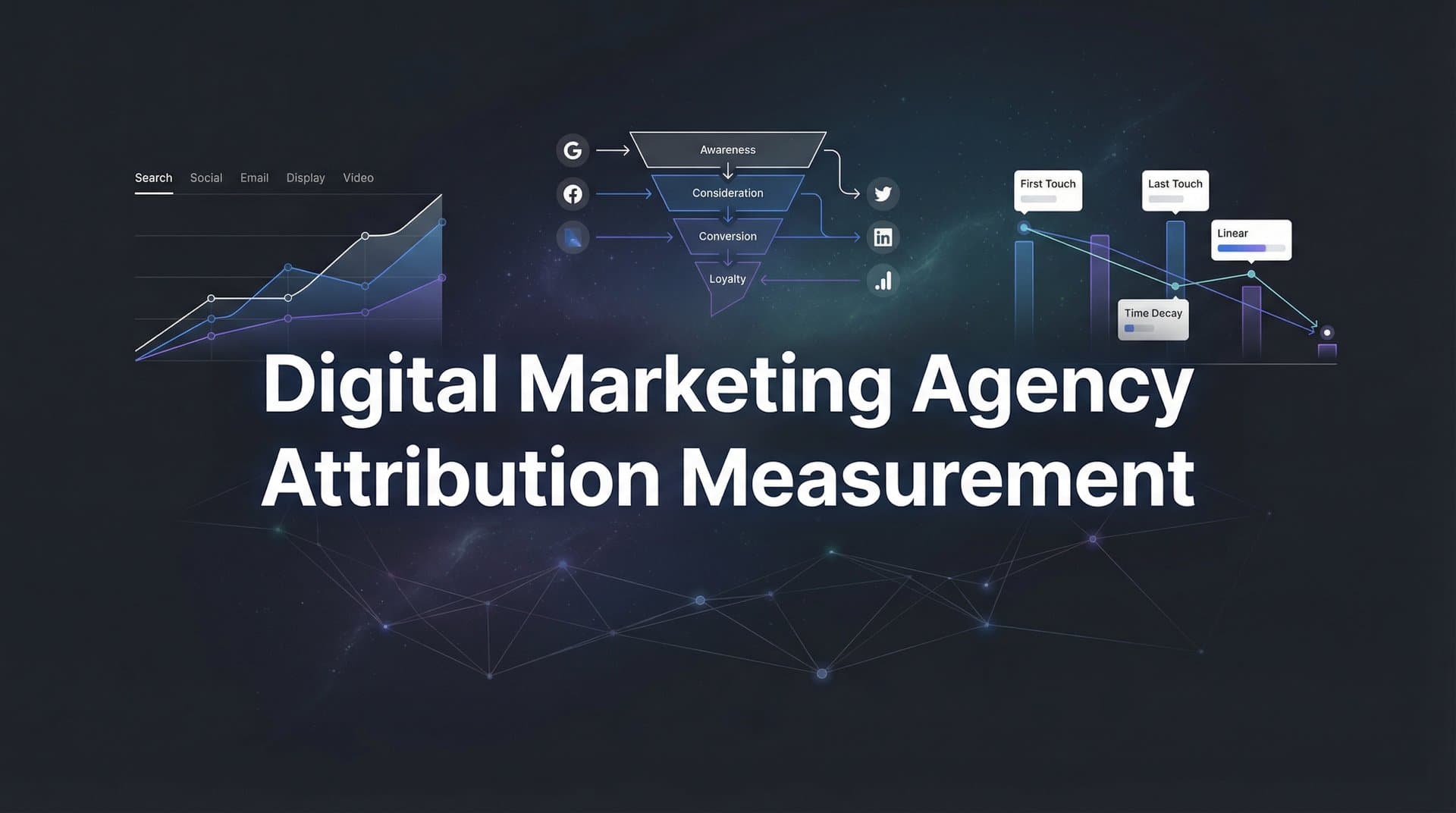
Multi-touch attribution models distribute credit across multiple touchpoints based on various rules. Linear attribution gives equal credit to every touchpoint in the journey. Time-decay attribution assigns more credit to touchpoints closer to conversion. Position-based (U-shaped) attribution emphasizes the first and last touchpoints while giving some credit to middle interactions. Each approach offers a different perspective on channel performance. Understanding what is attribution model in digital marketing helps agencies select the right approach for each client.
Linear attribution works well when you genuinely believe every touchpoint contributes equally to conversions. This might be true for complex B2B sales where multiple educational touchpoints are necessary to move prospects through a long consideration process. The model prevents you from over-optimizing toward channels that happen to be last in the sequence while undervaluing channels that play crucial supporting roles.
Time-decay attribution reflects the intuition that recent interactions matter more than distant ones. If someone clicked an ad six months ago but only converted after seeing a retargeting campaign last week, the recent campaign probably deserves more credit. This model works well for clients with defined sales cycles where you can observe that conversion likelihood increases as prospects engage with recent touchpoints.
Position-based attribution acknowledges that first and last touchpoints often play special roles. The first touchpoint introduces the customer to the brand—a critical function. The last touchpoint closes the sale. Middle touchpoints matter but perhaps less than these bookends. Many agencies find this model produces intuitive results that align with how marketing teams think about funnel stages.
Matching attribution models to client business types requires understanding their sales cycle. E-commerce clients with impulse purchases might find last-click attribution sufficient. B2B clients with six-month sales cycles need multi-touch models to understand how early-stage content and awareness campaigns contribute to eventual conversions. High-consideration consumer products like furniture or appliances typically need attribution modeling in digital marketing because customers research extensively before buying.
The most sophisticated approach is using multiple attribution models simultaneously. Rather than picking one "true" model, analyze performance through different lenses. Compare how channels perform under last-click versus linear versus time-decay attribution. Channels that perform well across multiple models are genuinely strong performers. Channels that only look good under one specific model might be less reliable than they appear.
From Raw Data to Client-Ready Insights
Attribution data becomes valuable when you translate it into decisions. A dashboard showing that Facebook gets 23% attribution credit and Google gets 31% is interesting, but it doesn't tell you what to do next. The goal is converting raw attribution percentages into actionable recommendations that improve campaign performance.
Start by identifying over-performing and under-performing channels relative to budget allocation. If Google Ads receives 40% of the budget but only generates 25% of attributed conversions, that's a signal. Either the channel isn't performing efficiently, or you're measuring it incorrectly. Dig deeper to understand whether the issue is creative, targeting, bidding strategy, or measurement gaps.
Attribution data reveals optimization opportunities within channels, not just across them. You might discover that Facebook campaigns perform dramatically better when they're part of a sequence that includes display retargeting. This insight suggests increasing the retargeting budget isn't just about improving retargeting performance—it's about making your entire Facebook strategy more effective by ensuring prospects see multiple touchpoints.
Building client-ready reports requires connecting marketing spend directly to revenue outcomes. Clients don't care about attribution percentages in isolation—they care about return on ad spend. Your reports should show: "We spent $50,000 on paid search this month. Based on multi-touch attribution, those campaigns contributed to $175,000 in revenue, delivering a 3.5x return." This framing makes attribution data immediately relevant to business decisions. A comprehensive digital marketing attribution report transforms raw numbers into strategic insights.
The most effective reports tell a story rather than just presenting data. Walk through the customer journey: "Most customers first discover us through paid social, research our products through organic search, and convert after seeing a retargeting ad. Based on this pattern, we're recommending increasing the retargeting budget by 20% because it's the final touchpoint that closes sales, but it's currently underfunded relative to its impact."
Use attribution insights to recommend specific budget reallocation across channels. Don't just say "Facebook is performing well"—quantify it: "Attribution data shows Facebook campaigns are delivering conversions at $45 CPA while our target is $60. We recommend reallocating $10,000 from display advertising (currently at $78 CPA) to Facebook to improve overall efficiency while maintaining total conversion volume."
Attribution data also reveals timing patterns that inform strategy. You might discover that customers typically convert 12 days after first touchpoint, with an average of 4.3 interactions during that window. This insight shapes everything from retargeting frequency caps to budget pacing throughout the month. If conversions cluster around specific days of the week or times of month, adjust campaign scheduling accordingly.
The goal is making attribution measurement feel like a strategic advantage rather than a technical reporting requirement. When you present attribution insights that lead directly to performance improvements, clients understand the value. They're not just paying for campaign management—they're paying for the intelligence that makes campaign management more effective.
Feeding Better Data Back to Ad Platforms
Attribution measurement isn't just about understanding what happened—it's about using that understanding to improve future performance. One of the most powerful applications is sending enriched conversion data back to ad platforms, which helps their machine learning algorithms optimize more effectively.
Ad platforms like Meta and Google rely on conversion data to train their targeting and bidding algorithms. When you tell Facebook that a conversion happened, its algorithm learns which types of users are most likely to convert and adjusts targeting accordingly. The quality of conversion data you send directly impacts how well the platform can optimize.
The problem with standard pixel-based tracking is that it only captures conversions that happen immediately in the browser session. If someone clicks an ad, leaves your site, and converts three days later through a different channel, the ad platform never receives that conversion signal. Its algorithm thinks the ad didn't work, when in reality it played a crucial role in starting the customer journey. This is one of the core issues addressed by channel attribution in digital marketing revenue tracking.
Server-side conversion tracking solves this by sending conversion events directly to ad platforms regardless of browser limitations. When attribution measurement identifies that a Facebook ad contributed to a conversion—even if the actual purchase happened days later through a different channel—you can send that conversion signal back to Facebook. This gives the platform a more complete picture of which ads are actually driving results.
The feedback loop between accurate attribution and improved targeting creates compound benefits. Better conversion data leads to better algorithm optimization, which produces better campaign performance, which generates more conversion data, which further improves optimization. Agencies that implement this feedback loop see sustained performance improvements over time as ad platform algorithms learn from increasingly accurate signals.
This approach is particularly valuable for campaigns with longer sales cycles. B2B campaigns might have weeks or months between initial ad click and final conversion. Standard pixel tracking would never connect those dots, leaving ad platform algorithms blind to which campaigns are actually working. Server-side conversion sync ensures platforms receive conversion signals for every attributed touchpoint, dramatically improving their ability to optimize toward quality prospects. Agencies specializing in B2B marketing attribution understand this challenge intimately.
Enriched conversion data also enables more sophisticated optimization strategies. Instead of just sending "conversion happened" signals, you can send conversion value data. This allows ad platforms to optimize for high-value customers rather than just conversion volume. If your attribution system shows that customers acquired through certain campaigns have 3x higher lifetime value, feeding that information back to the platform helps it find more similar high-value prospects.
Scaling winning campaigns becomes dramatically easier when you have verified performance data. Instead of gradually increasing budgets while hoping performance holds, you can scale aggressively when attribution data confirms a campaign is genuinely driving profitable conversions. The confidence that comes from accurate measurement enables faster, bolder optimization decisions.
Putting Attribution Measurement Into Practice
Implementing attribution measurement doesn't require rebuilding your entire agency infrastructure. Start by evaluating what you need from an attribution solution: Does it connect to all the ad platforms you manage? Can it integrate with your clients' CRM systems? Does it support server-side tracking to capture complete conversion data? Will it scale across multiple clients without requiring custom implementations each time?
The best attribution platforms handle the technical complexity behind the scenes. You shouldn't need to write custom code or maintain complex integrations. Look for solutions that offer pre-built connectors to major ad platforms, CRM systems, and analytics tools. The faster you can get a new client fully tracked, the sooner you can start delivering attribution insights. Reviewing the top digital marketing attribution software tools helps agencies identify the right solution for their needs.
Building attribution into your standard client onboarding process transforms it from a special project into a core service offering. When you pitch new clients, lead with your attribution capabilities: "We don't just run campaigns—we show you exactly which marketing activities drive revenue, and we use that data to continuously optimize your results." This positions attribution as a fundamental differentiator rather than a technical detail.
The onboarding sequence should be standardized: connect ad accounts, implement tracking on the website, integrate with the CRM, establish baseline attribution reporting, and schedule regular review sessions to discuss insights. This process should take days, not weeks. The faster you can demonstrate attribution value, the stronger the client relationship becomes.
Start with the attribution model that best matches each client's business type and sales cycle. Don't overcomplicate it initially—pick one primary model and use it consistently for the first few months. As you and the client become comfortable with attribution reporting, you can introduce additional models to provide different perspectives on performance.
Regular attribution reviews should become part of your client communication rhythm. Monthly strategy calls should include attribution insights: which channels are over-performing or under-performing, what budget reallocations you're recommending, and how attribution data is informing creative and targeting decisions. Leveraging data analytics for digital marketing keeps attribution top-of-mind and reinforces its value in driving results.
For agencies ready to upgrade their measurement capabilities, the next step is exploring purpose-built attribution platforms designed specifically for marketing agencies. These platforms handle the technical complexity of multi-client tracking, provide white-label reporting capabilities, and offer the server-side tracking infrastructure needed for accurate attribution in the post-cookie era.
Building Your Attribution Advantage
Attribution measurement transforms agency-client relationships from hope-based to evidence-based. Instead of presenting campaign results and hoping the client believes they're working, you're showing definitive proof of what's driving revenue. This shift changes the entire dynamic of the relationship.
Clients don't question agencies who can demonstrate clear ROI. They don't demand budget cuts when you can prove every channel is pulling its weight. They don't leave for competitors when you're the only agency showing them exactly where their marketing dollars are going and what returns they're generating. Attribution measurement turns you from a replaceable vendor into an indispensable partner.
The competitive advantage compounds over time. As you accumulate attribution data across campaigns, you build institutional knowledge about what works for different client types, industries, and campaign objectives. This intelligence makes you more effective with each new client, creating a virtuous cycle where better measurement leads to better results, which attracts better clients, which generates more data to improve your measurement further.
The agencies that will dominate the next decade are the ones investing in attribution capabilities now. As privacy regulations continue tightening and tracking becomes more complex, the gap between agencies with sophisticated attribution systems and those relying on platform-reported metrics will only widen. The time to build this capability is before it becomes a basic client expectation rather than a competitive differentiator.
Ready to elevate your marketing game with precision and confidence? Discover how Cometly's AI-driven recommendations can transform your ad strategy—Get your free demo today and start capturing every touchpoint to maximize your conversions.