You're spending thousands on Facebook ads. Your Ads Manager dashboard shows clicks, impressions, and conversions. But here's the uncomfortable truth: those numbers might be telling you a story that has very little to do with what's actually happening in your business.
Most marketers treat Facebook ads data like a scoreboard—check the numbers, celebrate the wins, panic at the losses. But Facebook generates an overwhelming amount of information across dozens of metrics, and the vast majority of advertisers only scratch the surface of what's available. They optimize for clicks when they should be optimizing for revenue. They celebrate low cost-per-click when their actual customer acquisition costs are bleeding them dry.
The real challenge isn't accessing Facebook ads data. It's understanding which data actually matters, how to connect those metrics to genuine business outcomes like revenue and customer lifetime value, and how to make decisions that scale campaigns profitably rather than just efficiently. This guide will walk you through exactly how to move beyond vanity metrics and build a data foundation that drives real growth.
The Anatomy of Facebook Ads Data: What Gets Tracked and Why It Matters
Facebook tracks everything that happens with your ads, but not all data points carry equal weight. Understanding how Facebook organizes this information is the first step toward making sense of your campaign performance.
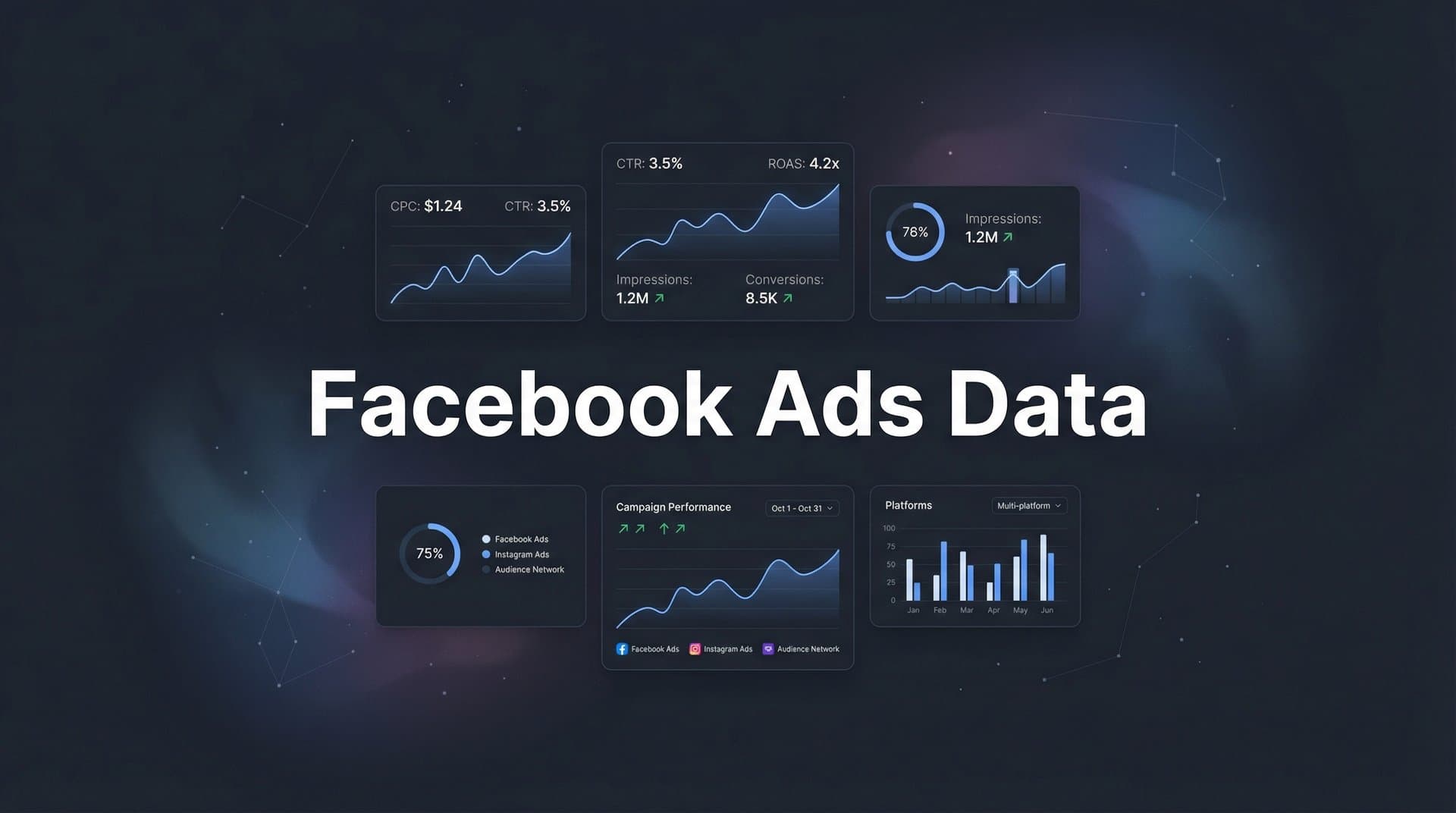
Facebook ads data falls into three distinct categories. Delivery metrics include impressions, reach, and frequency—these tell you how many people saw your ads and how often. Engagement metrics cover clicks, click-through rate, video views, and post interactions—these measure how people respond to your creative. Conversion metrics track purchases, leads, add-to-carts, and return on ad spend—these connect your ads to actual business outcomes.
Here's where it gets interesting: Facebook's Ads Manager organizes all this data at three hierarchical levels, and each level reveals different optimization opportunities.
At the campaign level, you see overall performance across your entire advertising effort. This is where you evaluate whether your core strategy is working—are you spending profitably? Is your overall ROAS trending in the right direction? Campaign-level data helps you make big-picture decisions about budget allocation and strategic direction.
The ad set level shows performance by audience, placement, and budget. This is where you discover which customer segments respond best to your offers, whether mobile or desktop placements perform better, and how different bidding strategies affect your results. Ad set data tells you where to double down and where to pull back.
At the ad level, you see which specific creative elements drive results. One headline might outperform another by 40%. A video might generate twice the conversions of a static image. This granular data guides your creative production and helps you understand what messaging resonates with your audience.
But here's the critical distinction that trips up most marketers: platform-reported data and actual business results are not the same thing. Facebook tells you it drove 100 conversions. Your Shopify dashboard shows 75 orders. Your CRM records 60 new customers. Which number is correct? Understanding Facebook ads reporting discrepancies is essential for accurate analysis.
This discrepancy exists because Facebook can only track what it can see within its own ecosystem. When customers interact with multiple touchpoints across different platforms, use ad blockers, or complete purchases days after clicking an ad, Facebook's view of the customer journey becomes incomplete. Understanding this limitation is essential for interpreting your data accurately and building a more complete attribution system.
Why Your Facebook Ads Data Might Be Lying to You
Let's address the elephant in the room: Facebook ads data has become significantly less reliable over the past few years, and it's not Facebook's fault.
The iOS 14.5 update fundamentally changed how tracking works on Apple devices. When Apple introduced App Tracking Transparency, users gained the ability to opt out of cross-app tracking. Many did. Browser restrictions from Safari and Firefox have similarly limited cookie-based tracking. The result? A substantial portion of conversions that Facebook ads actually drive never get reported back to Facebook.
This creates a frustrating situation for marketers. You launch a campaign, Facebook reports modest results, but your bank account tells a different story. Or worse—Facebook shows strong conversion numbers, but your actual revenue doesn't match up. Both scenarios happen regularly, and both stem from incomplete tracking. These Facebook ads attribution issues affect virtually every advertiser on the platform.
Attribution windows add another layer of complexity. Facebook defaults to a 7-day click and 1-day view attribution window, meaning it only claims credit for conversions that happen within seven days of someone clicking your ad, or within one day of someone viewing it. But what if your sales cycle is longer? What if customers typically research for two weeks before buying?
In these cases, Facebook systematically underreports its impact. The ad might have been the crucial touchpoint that started the customer journey, but because the purchase happened outside the attribution window, Facebook doesn't count it. Your campaigns appear less effective than they actually are, and you might cut budgets on ads that are genuinely driving results.
The opposite problem also occurs. For businesses with very short sales cycles or impulse purchases, Facebook's attribution might overstate performance by claiming credit for conversions that would have happened anyway. A customer who was already planning to buy might have seen your ad coincidentally right before purchasing—Facebook counts it as a conversion, but the ad didn't actually influence the decision.
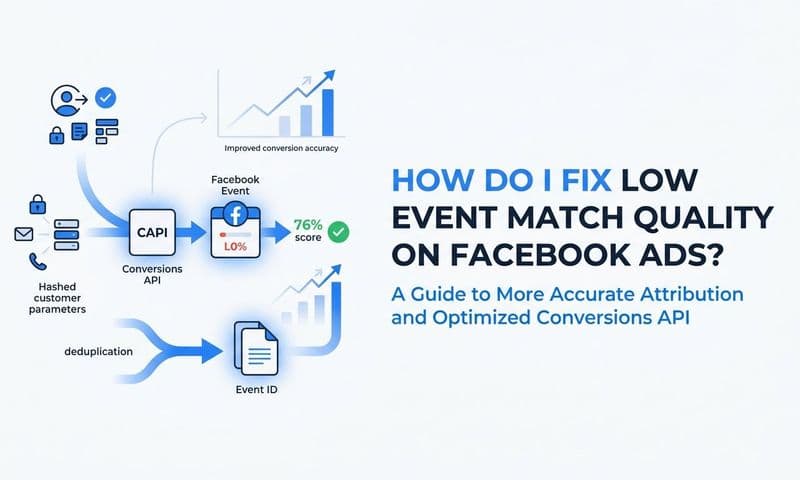
Server-side tracking has emerged as the solution to many of these challenges. Instead of relying solely on browser-based pixels that can be blocked or restricted, server-side tracking sends conversion data directly from your server to Facebook's servers. Learning how to improve Facebook ads tracking through server-side implementation captures events that traditional pixel tracking misses, giving Facebook a more complete picture of campaign performance and providing you with more accurate data for decision-making.
Building a Complete Picture: Connecting Facebook Data to Your Full Customer Journey
Here's a scenario that plays out thousands of times every day: Someone sees your Facebook ad, clicks through to your website, but doesn't buy. Three days later, they search for your brand on Google, click your paid search ad, visit your site again, and still don't convert. A week later, they receive your email newsletter, click through, and finally make a purchase.
Facebook claims credit for the conversion because of the initial click. Google Ads claims credit because of the last click before purchase. Your email platform claims credit because the purchase happened after an email click. Who's right?
They all are—and none of them are. This is why Facebook ads data alone only shows part of the story. Customers interact with multiple touchpoints before converting, and understanding the full journey requires connecting data from all your marketing channels, not just Facebook. A thorough Facebook ads vs Google ads tracking comparison reveals how differently each platform attributes conversions.
The real power comes from integrating your CRM data with your ad platform data. Your CRM knows which customers actually generated revenue, what they purchased, and what they're worth over time. When you connect this business data back to your advertising data, you can see which campaigns drive actual customers, not just clicks or even conversions.
This integration reveals patterns that individual platforms can't show you. You might discover that Facebook ads don't directly drive many last-click conversions, but customers who interact with your Facebook ads have 3x higher lifetime value than those who don't. Or you might find that certain Facebook campaigns consistently attract one-time buyers while others bring in customers who make repeat purchases.
Multi-touch attribution models help distribute credit across the entire customer journey rather than giving all credit to a single touchpoint. A linear model gives equal credit to every interaction. A time-decay model gives more credit to touchpoints closer to the conversion. A position-based model emphasizes both the first and last touchpoints. Understanding Facebook ads attribution models is crucial for accurate performance measurement.
Which model is best? It depends on your business. Companies with longer sales cycles often benefit from models that recognize early touchpoints, since those initial interactions play a crucial role in starting the customer journey. Businesses with shorter cycles might find last-click attribution more aligned with their reality.
The key insight is this: when you connect Facebook ads data to your complete customer journey, you stop optimizing for what Facebook thinks is working and start optimizing for what actually drives business results. That shift in perspective changes everything about how you allocate budgets, evaluate creative, and scale campaigns.
Key Facebook Ads Data Metrics That Actually Predict Profitability
Most Facebook Ads Manager dashboards are cluttered with dozens of metrics. Impressions, reach, frequency, clicks, CTR, CPC, CPM, engagement rate, video watch time—the list goes on. But here's the truth: most of these metrics are noise. Only a handful actually predict whether your campaigns will be profitable.
Cost per acquisition is the first metric that matters. CPA tells you exactly how much you're paying to acquire a customer or lead. If you're spending $50 to acquire a customer who generates $200 in revenue, you have a profitable campaign. If you're spending $150 to acquire that same customer, you're losing money on every conversion.
Return on ad spend takes this concept further by showing you the revenue generated for every dollar spent. A 3x ROAS means you're generating $3 in revenue for every $1 in ad spend. But ROAS alone doesn't tell you if a campaign is profitable—you need to factor in your product costs, fulfillment expenses, and overhead. A 3x ROAS might be highly profitable for a digital product with 90% margins, but unprofitable for a physical product with 40% margins. Mastering Facebook ads ROI calculation requires understanding these nuances.
The relationship between customer acquisition cost and customer lifetime value determines whether you can scale sustainably. If your CAC is $100 and your average customer lifetime value is $300, you have room to grow. You can afford to spend more to acquire customers because you know they'll generate value over time. But if your CAC is $100 and your LTV is $120, you're operating on razor-thin margins with no room for error.
Calculating LTV requires looking beyond the initial purchase. How many customers make repeat purchases? What's the average order value on those repeat purchases? How long do customers typically stay active? These questions require integrating your CRM data with your advertising data to understand the full value of customers acquired through different campaigns.
Frequency deserves special attention because it signals when campaigns need refreshing. Frequency measures how many times the average person sees your ad. Low frequency means you're reaching new people. High frequency means you're showing the same ad to the same people repeatedly.
As frequency increases beyond 3-4 impressions, performance typically declines. Click-through rates drop. Cost per result increases. This is ad fatigue—your audience has seen your ad so many times they've stopped responding to it. When you notice frequency climbing above 5 with declining performance metrics, it's time to refresh your creative, expand your audience, or both.
These metrics—CPA, ROAS, CAC-to-LTV ratio, and frequency—form the core of profitable Facebook advertising. Everything else is supporting data that helps you understand why these key metrics are moving in certain directions, but these four numbers tell you whether your campaigns are actually working.
Turning Raw Data Into Actionable Optimization Decisions
Having access to Facebook ads data means nothing if you don't know what to do with it. The real skill isn't collecting data—it's transforming that data into decisions that improve performance.
Start with a systematic framework for analyzing your campaigns. First, identify your winning audiences by comparing performance metrics across different ad sets. Which demographics, interests, or behaviors generate the lowest CPA and highest ROAS? These are your core audiences that deserve increased budget allocation.
Next, look for creative patterns. When you analyze your top-performing ads, what do they have in common? Maybe video ads consistently outperform static images. Maybe ads featuring customer testimonials drive more conversions than product-focused ads. Maybe certain color schemes or headline formulas generate better results.
Document these patterns. They're not just interesting observations—they're insights that should guide your creative production process. If video ads with customer testimonials consistently win, produce more of them. If benefit-focused headlines outperform feature-focused headlines, adjust your copywriting approach. Understanding Facebook video ads size specifications ensures your creative displays optimally across placements.
Placement performance reveals where your ads actually work. Facebook offers placements across Facebook Feed, Instagram Feed, Stories, Reels, Audience Network, and more. Many advertisers use automatic placements and never examine which ones actually drive results. When you dig into placement-level data, you might discover that 80% of your conversions come from 20% of your placements.
Budget allocation decisions should flow directly from this analysis. The most common mistake marketers make is spreading budgets evenly across campaigns based on gut feeling or arbitrary percentages. Data-driven budget allocation means continuously shifting spend toward what's working and cutting what isn't. Implementing proper Facebook ads optimization strategies transforms raw data into profitable scaling decisions.
This doesn't mean killing underperforming campaigns immediately. New campaigns need time to gather data and optimize. But once you have statistical significance—typically a few hundred clicks or a few dozen conversions—you can make confident decisions about where to allocate resources.
Here's where the feedback loop becomes powerful: when you feed better conversion data back to Facebook, you improve the platform's optimization algorithms for future campaigns. Facebook's machine learning system uses conversion data to identify patterns in user behavior and find more people likely to convert. The more accurate and complete your conversion data, the better Facebook becomes at finding high-value customers. Learning how to sync conversion data to Facebook ads creates this powerful optimization loop.
This is why server-side tracking and proper conversion event setup matter so much. You're not just getting better reporting—you're training Facebook's algorithms with higher-quality data, which improves targeting and reduces your cost per acquisition over time.
The optimization cycle never stops. Analyze performance, identify patterns, make decisions, implement changes, measure results, and repeat. Marketers who treat this as an ongoing process rather than a one-time setup consistently outperform those who set campaigns and forget them.
Putting It All Together
Facebook ads data is only as valuable as your ability to connect it to real business outcomes. You can have perfect tracking, comprehensive dashboards, and detailed reports, but if those numbers don't tie back to revenue, customer lifetime value, and profitability, you're just collecting information without gaining insight.
The marketers who win aren't those with the most data—they're those who can see the complete customer journey and act on accurate insights. They understand that Facebook's reported conversions are just one piece of the puzzle. They know how to integrate CRM data, account for attribution complexity, and focus on metrics that actually predict profitability.
They recognize when their data might be incomplete due to tracking limitations, and they implement solutions like server-side tracking to capture the full picture. They use multi-touch attribution to understand how different channels work together rather than competing for credit. They continuously optimize based on patterns in their data rather than hunches or industry best practices.
Most importantly, they understand that the quality of their data directly impacts the performance of their campaigns. Better data leads to better optimization decisions, which leads to lower acquisition costs and higher return on ad spend. It's a virtuous cycle that compounds over time.
If you're still relying solely on Facebook's Ads Manager to understand campaign performance, you're missing critical insights that could transform your results. Attribution platforms bridge the gap between platform-reported metrics and actual revenue, giving you the complete view you need to scale confidently.
Ready to elevate your marketing game with precision and confidence? Discover how Cometly's AI-driven recommendations can transform your ad strategy—Get your free demo today and start capturing every touchpoint to maximize your conversions.