You're spending thousands on Google Ads every month. Your conversion numbers look solid in the dashboard. But when you dig deeper, something feels off. Which campaigns are actually driving sales? Which keywords deserve more budget? And why does it seem like your best-performing ads change every time you check?
This confusion isn't because you're bad at marketing. It's because Google Ads attribution—the system that decides which ads get credit for your conversions—operates like a black box for most advertisers. You see the results, but the logic behind them remains murky.
Understanding how Google Ads tracks and credits conversions changes everything. It transforms your dashboard from a confusing mess of numbers into a strategic roadmap. You'll know which campaigns to scale, which to pause, and where your budget actually generates revenue. This guide breaks down exactly how Google Ads attribution works, its limitations, and how to use it to make smarter advertising decisions.
The Mechanics Behind Google Ads Conversion Credit
Every time someone clicks your Google Ad, something invisible but powerful happens. Google attaches a unique identifier called a GCLID (Google Click Identifier) to the URL. Think of it as a digital fingerprint that follows that user through their journey on your website.
When that person completes a conversion action—whether it's a purchase, form submission, or phone call—Google matches the GCLID back to the original ad click. This connection is what allows Google to tell you which campaign, ad group, keyword, and even specific ad creative drove that conversion.
But here's where it gets more complex. Google doesn't just track clicks. It also monitors view-through conversions—when someone sees your ad but doesn't click, then converts within a specific timeframe. The default window for view-through conversions is just one day, while click-through conversions get a 30-day window. You can adjust these, but most advertisers stick with the defaults without realizing how much these settings shape their attribution data.
The conversion window matters more than most marketers realize. If your typical sales cycle is 45 days but your conversion window is set to 30 days, you're missing conversions that your ads actually influenced. Your data shows lower performance than reality, and you might cut budget from campaigns that are actually working.
Google relies heavily on cookies to maintain this tracking connection. When someone clicks your ad, Google drops a cookie in their browser. This cookie stores the GCLID and other tracking information. As long as that cookie persists and the user returns to your site within the conversion window, Google can connect the dots.
This is where the default last-click attribution model creates problems. Imagine a customer who clicks your branded search ad on Monday, your competitor comparison ad on Wednesday, and your product-specific ad on Friday before purchasing. Last-click attribution gives 100% of the credit to that Friday ad, completely ignoring the two previous interactions that moved the customer closer to buying.
Your branded search campaign looks like a superstar because it captures people ready to buy. Meanwhile, your awareness and consideration campaigns appear to underperform, even though they're doing the heavy lifting of moving prospects through your funnel. You end up over-investing in bottom-funnel campaigns and starving the top of your funnel, wondering why your overall conversion volume plateaus.
Breaking Down Google's Attribution Models
Google offers several attribution models, each telling a different story about your campaign performance. The model you choose fundamentally changes which campaigns get credit and, consequently, where you allocate budget.
Data-driven attribution is now Google's default model for most accounts. It uses machine learning to analyze thousands of conversion paths in your account, identifying patterns in how users interact with your ads before converting. If users who see Ad A followed by Ad B convert at higher rates than those who only see Ad B, data-driven attribution gives Ad A more credit.
The beauty of data-driven attribution is that it's personalized to your specific business. It doesn't apply generic rules—it learns from your actual customer behavior. However, it requires a minimum threshold of data to function properly. If your account doesn't generate enough conversions, Google falls back to last-click attribution, and you might not even realize it.
Rules-based models take a simpler approach. Last-click gives all credit to the final touchpoint before conversion. It's straightforward and easy to understand, but it systematically undervalues every campaign except the one that closes the deal. If you're running brand awareness or consideration campaigns, last-click attribution makes them look ineffective even when they're essential to your conversion funnel.
First-click attribution flips the script, giving all credit to the initial touchpoint. This model helps you understand which campaigns are best at introducing new prospects to your business. If you're heavily focused on customer acquisition and want to reward campaigns that start relationships, first-click provides that perspective. But it completely ignores the nurturing work that happens between first touch and conversion.
Linear attribution takes a democratic approach, distributing credit equally across all touchpoints in the conversion path. If someone clicks five different ads before converting, each ad gets 20% of the credit. This model ensures that every interaction gets recognized, but it doesn't account for the reality that some touchpoints matter more than others in the decision-making process.
Time decay attribution recognizes that touchpoints closer to conversion typically have more influence. It assigns progressively more credit to interactions that happen nearer to the conversion moment. This model works well if you have a defined nurturing sequence where later-stage content is genuinely more influential in driving decisions.
Position-based attribution, also called the U-shaped model, typically assigns 40% of credit to the first touchpoint, 40% to the last touchpoint, and splits the remaining 20% among middle interactions. This model acknowledges that both introducing a prospect and closing the deal matter most, while still recognizing the journey in between.
To change your attribution model, navigate to Tools & Settings in your Google Ads account, then click Measurement, followed by Conversions. Select the conversion action you want to modify, click Edit Settings, and scroll to Attribution Model. You'll see all available models with brief descriptions. Choose the one that best matches your marketing strategy and sales cycle.
Here's the strategic question most advertisers miss: which model should you actually use? The answer depends on your sales cycle complexity and marketing goals. If you have a short, simple sales cycle where people convert quickly after their first interaction, last-click or data-driven attribution works fine. If you're running a complex, multi-stage funnel with long consideration periods, position-based or time decay attribution gives you a more accurate picture of what's working.
Common Attribution Blind Spots That Skew Your Data
Even with perfect attribution model selection, Google Ads attribution has fundamental limitations that create blind spots in your data. Understanding these gaps is essential for making informed decisions about your advertising strategy.
Cross-device tracking is one of the biggest challenges. A prospect might click your ad on their phone during their morning commute, research your product on their work computer during lunch, and finally convert on their tablet at home that evening. Google can only connect these dots if the user is signed into their Google account across all three devices. For anonymous users or those who aren't signed in, each device looks like a different person.
This fragmentation makes your conversion paths look shorter and simpler than they actually are. You might see a direct conversion from a single ad click, when in reality that person had multiple interactions across different devices. Your attribution data undervalues campaigns that generate initial awareness on mobile because the final conversion happens on a different device.
iOS privacy changes have dramatically impacted tracking accuracy. When Apple introduced App Tracking Transparency, users gained the ability to opt out of cross-app tracking. Many did. This means that when someone clicks your Google Ad in a mobile app, then later converts on your website, that connection often gets lost. Google can't track the full journey, so those conversions appear as direct traffic or get misattributed to other sources.
Browser cookie restrictions compound the problem. Safari and Firefox block third-party cookies by default. Chrome is phasing them out. As cookies disappear, Google's ability to track users across sessions diminishes. Someone might click your ad on Monday, but if they clear their cookies or use a privacy-focused browser, Google can't connect their Tuesday conversion back to that original click. These are just some of the Google Ads conversion tracking problems that marketers face daily.
The most critical blind spot is that Google Ads attribution only sees Google Ads interactions. It has no visibility into the rest of your marketing ecosystem. If someone discovers your brand through an Instagram post, signs up for your email list, receives three nurture emails, searches for your brand on Google, and clicks your ad before converting, Google Ads attributes 100% of that conversion to the ad click. It completely misses the Instagram post, the emails, and the organic brand search that happened before the paid click.
This creates a distorted view of your marketing performance. Your Google Ads campaigns look more effective than they are because they're getting credit for conversions that other channels helped generate. Meanwhile, your email marketing and social media efforts appear less valuable because their contributions happen outside Google's visibility.
Long sales cycles create another attribution challenge. If your typical B2B sales cycle is six months but your conversion window is set to 90 days, you're missing conversions that your ads influenced. The prospect who clicked your ad in January but didn't convert until July won't show up in your attribution reports. Your campaigns look less effective than they actually are, and you might cut budget from initiatives that are working but operating on longer timelines than your tracking can capture.
Reading Your Attribution Reports Like a Pro
Google Ads provides powerful attribution reports, but most advertisers never look beyond the basic campaign performance dashboard. These deeper reports reveal which campaigns are secretly driving your success and which ones are getting undeserved credit.
To access attribution reports, click Tools & Settings in your Google Ads interface, then navigate to Measurement and select Attribution. You'll find several report types that each tell a different part of your conversion story.
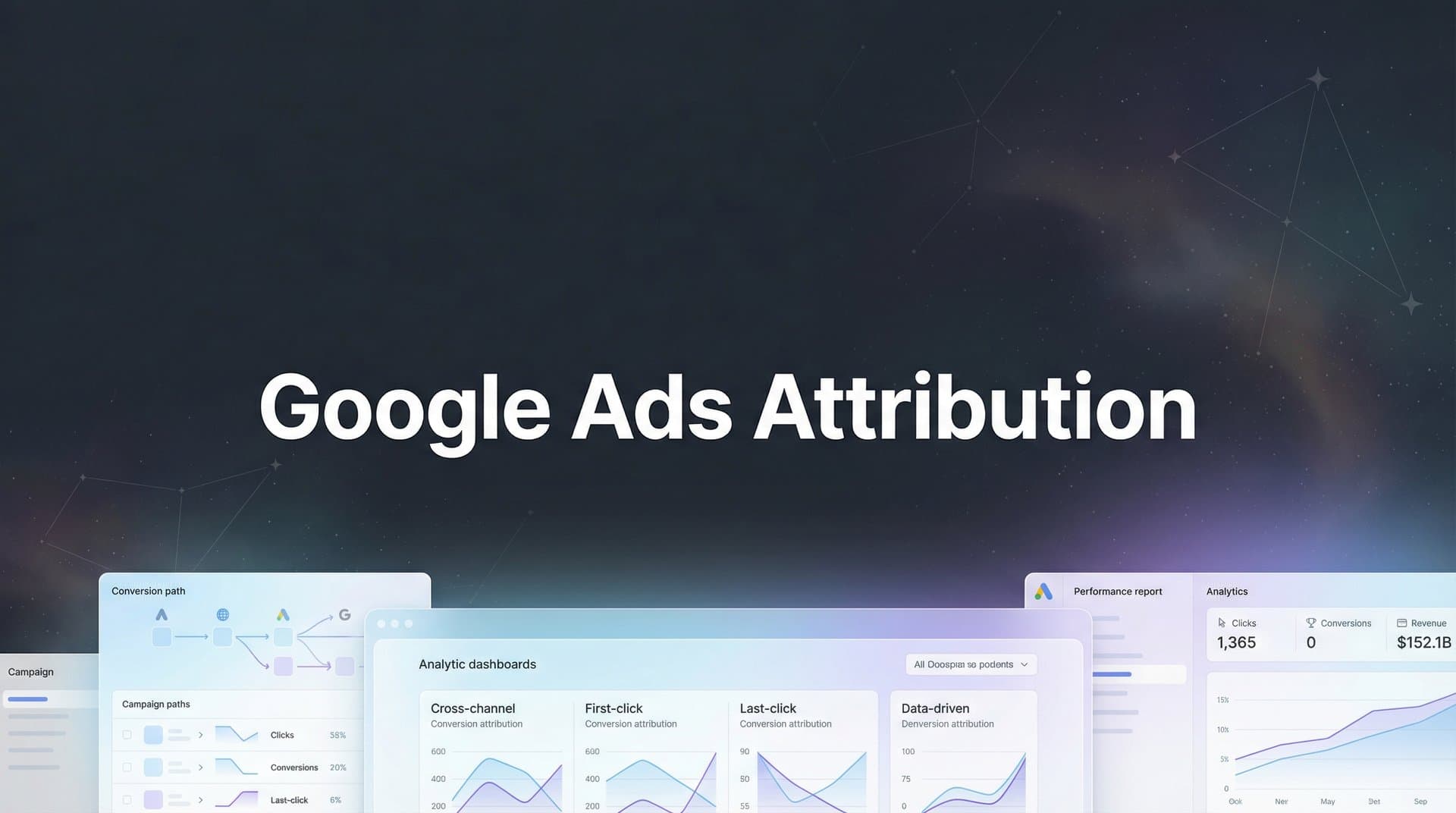
The assisted conversions report is where you discover your unsung heroes. This report shows campaigns that contributed to conversions but didn't get the final click. You'll see metrics like "Assisted Conversions" (how many conversions this campaign helped with) and "Assist/Last Click Ratio." A high ratio means the campaign is excellent at starting or nurturing customer relationships, even if it rarely closes the deal.
Many advertisers make the mistake of cutting budget from campaigns with low last-click conversions without checking assisted conversions first. You might pause a top-of-funnel awareness campaign because it "isn't converting," only to watch your overall conversion volume drop two weeks later as your pipeline dries up. The assisted conversions report prevents this mistake by showing you which campaigns are essential to your funnel even when they don't get final credit.
The top conversion paths report reveals the actual sequences users take before converting. You might discover that your most common path is: branded search → competitor comparison ad → product-specific ad → conversion. This insight tells you that all three campaign types are essential. Cut any one of them, and you break the chain that leads to conversions.
Look for patterns in your conversion paths. If you notice that conversions involving multiple touchpoints have higher average order values, that's a signal that your multi-touch campaigns are attracting more valuable customers. This justifies maintaining budget across your full funnel rather than concentrating everything on bottom-funnel campaigns.
The time lag report shows how long it typically takes from first ad click to conversion. If most conversions happen within 7 days, your sales cycle is short and your conversion window settings are probably fine. If you see significant conversion volume happening at 20+ days, you might need to extend your conversion window to capture the full impact of your campaigns.
Time lag data also informs your optimization timeline. If your typical conversion takes 14 days, you can't accurately evaluate a new campaign after just 3 days. You need to wait long enough for the full conversion cycle to play out. Many advertisers pause campaigns too early because they don't account for their natural time lag.
The model comparison tool lets you see how different attribution models would credit your campaigns. Select two models and compare them side by side. You'll often discover that campaigns performing poorly under last-click attribution look much stronger under data-driven or position-based models. This comparison helps you understand which campaigns are being undervalued by your current model.
When analyzing these reports, look for campaigns with high assisted conversion ratios but low last-click conversions. These are your pipeline builders—the campaigns that introduce prospects and move them through your funnel. They deserve budget protection even if they don't show strong performance in your main campaign dashboard. Without them, your bottom-funnel campaigns have no one to convert.
Connecting Google Ads Data to Your Full Marketing Picture
Google Ads attribution tells you what happens within Google Ads. But your customers don't live in a single platform. They interact with your brand across email, social media, organic search, direct visits, and multiple ad platforms before converting. Relying solely on Google Ads attribution means you're making budget decisions based on incomplete information.
Platform-native attribution creates data silos. Google Ads shows one version of performance. Meta Ads Manager shows another. LinkedIn Campaign Manager shows a third. Each platform claims credit for the same conversions using different attribution models and tracking mechanisms. When you add up the conversions each platform reports, you often get 150% or more of your actual conversion total. Everyone's taking credit, but no one's telling the full truth. Understanding the Facebook Ads vs Google Ads tracking comparison reveals just how different these platforms measure success.
This fragmentation makes strategic decisions nearly impossible. Should you shift budget from Google to Meta? You can't answer that question when each platform is measuring success differently. You need a unified view that shows how all your marketing channels work together to drive conversions.
The real power comes from connecting your ad data with CRM and revenue outcomes. A conversion in Google Ads might be a form submission, but what happens after that? Do those leads actually close? What's the revenue value? How long does it take to close? Google Ads can't answer these questions because its tracking stops at the conversion event.
When you connect ad clicks to closed revenue, your optimization strategy transforms. You might discover that leads from one campaign close at twice the rate and generate 3x the revenue compared to another campaign, even though both show similar conversion rates in Google Ads. This insight allows you to reallocate budget based on actual revenue impact rather than surface-level conversion metrics.
Multi-touch attribution platforms solve this problem by tracking the complete customer journey across all channels. They capture every touchpoint—from the first social media ad to the last Google search—and connect them to final revenue outcomes. This comprehensive view reveals which marketing channels and campaigns truly drive growth. Exploring marketing attribution platforms for revenue tracking can help you understand the full scope of these solutions.
Server-side tracking has become essential for accurate attribution. As browser-based tracking degrades due to privacy restrictions, server-side tracking maintains accuracy by sending conversion data directly from your server to your analytics platforms. This approach bypasses browser limitations and provides more reliable data about your campaign performance.
Cometly captures every touchpoint across your entire marketing stack, from ad clicks to CRM events. This complete view allows our AI to analyze the full customer journey and identify which campaigns actually drive revenue. You're not guessing based on incomplete platform data—you're making decisions based on comprehensive attribution that connects ad spend directly to revenue outcomes.
The shift from platform-native attribution to unified attribution isn't just about better data. It's about making confident budget decisions. When you know which campaigns drive revenue across your entire funnel and all your marketing channels, you can scale aggressively without fear. You're not hoping your budget changes work—you're executing based on clear evidence of what drives growth.
Building an Attribution Strategy That Actually Works
Understanding attribution theory is one thing. Implementing a strategy that improves your actual marketing performance is another. Start by auditing your current setup to identify gaps between what you're tracking and what you need to know.
Check your conversion tracking first. Log into Google Ads and review your conversion actions. Are you tracking all the events that matter to your business? Many advertisers only track final purchases or form submissions, missing valuable micro-conversions like email signups, product page views, or content downloads. These micro-conversions help you understand user behavior earlier in the funnel. Our guide on Google Ads conversion tracking covers the essential setup steps.
Verify your conversion windows match your sales cycle. If you're in B2B with a 90-day sales cycle but your conversion window is 30 days, you're missing two-thirds of your conversions. Extend your windows to capture the full impact of your campaigns. Just remember that longer windows mean you need more patience when evaluating new campaigns.
Review your attribution model selection. If you're still using last-click attribution by default, you're systematically undervaluing your top and middle-funnel campaigns. Switch to data-driven attribution if your account has sufficient conversion volume. If not, consider position-based or time decay models that recognize the full customer journey.
Match your attribution model to your marketing strategy. If you're heavily focused on customer acquisition and want to reward campaigns that start relationships, first-click or position-based attribution makes sense. If you're optimizing for efficiency and want to reward campaigns that close deals, last-click or time decay works better. There's no universally correct model—only the model that aligns with your goals.
Use attribution insights to reallocate budget intelligently. Look at your assisted conversion reports and identify campaigns with high assist ratios but low last-click conversions. These campaigns are building your pipeline. Protect their budget even if they don't show strong performance in basic reports. Then identify campaigns with low assist ratios and low last-click conversions—these are candidates for budget cuts.
Test incrementally rather than making massive changes. Attribution insights should inform gradual optimization, not radical overhauls. Shift 10-15% of budget from underperforming campaigns to those showing strong assisted conversion metrics. Monitor the impact on overall conversion volume over a full sales cycle before making additional changes. For deeper guidance on improving performance, explore our Google Ads optimization strategies.
Document your attribution strategy so your entire team understands how you're measuring success. When everyone knows which metrics matter and why, you avoid the confusion that comes from different team members optimizing toward different goals. Your paid search specialist, social media manager, and email marketer should all understand how their channels contribute to the full customer journey.
Moving Forward With Confidence
Google Ads attribution provides valuable insights into how your campaigns perform, but it's only part of the picture. The platform shows you what happens within its own ecosystem while missing the broader context of your customer's journey across all marketing touchpoints.
The most successful advertisers recognize these limitations and build attribution strategies that go beyond platform-native data. They connect their ad platforms to their CRM systems, track the complete customer journey from first touch to closed revenue, and make budget decisions based on comprehensive performance data rather than fragmented platform reports. Many are discovering that an alternative to Google Analytics attribution provides the unified view they need.
This shift from single-platform attribution to unified attribution isn't just about better reporting. It's about making confident decisions that drive real business growth. When you know which campaigns truly drive revenue across your entire marketing funnel, you can scale aggressively without fear. You're not hoping your budget allocation works—you're executing based on clear evidence.
The gap between what Google Ads shows you and what's actually driving your revenue is where opportunity lives. Closing that gap means connecting your advertising data with your business outcomes, tracking every touchpoint that influences conversions, and using AI-driven insights to identify which campaigns deserve more investment.
Ready to elevate your marketing game with precision and confidence? Discover how Cometly's AI-driven recommendations can transform your ad strategy—Get your free demo today and start capturing every touchpoint to maximize your conversions.