

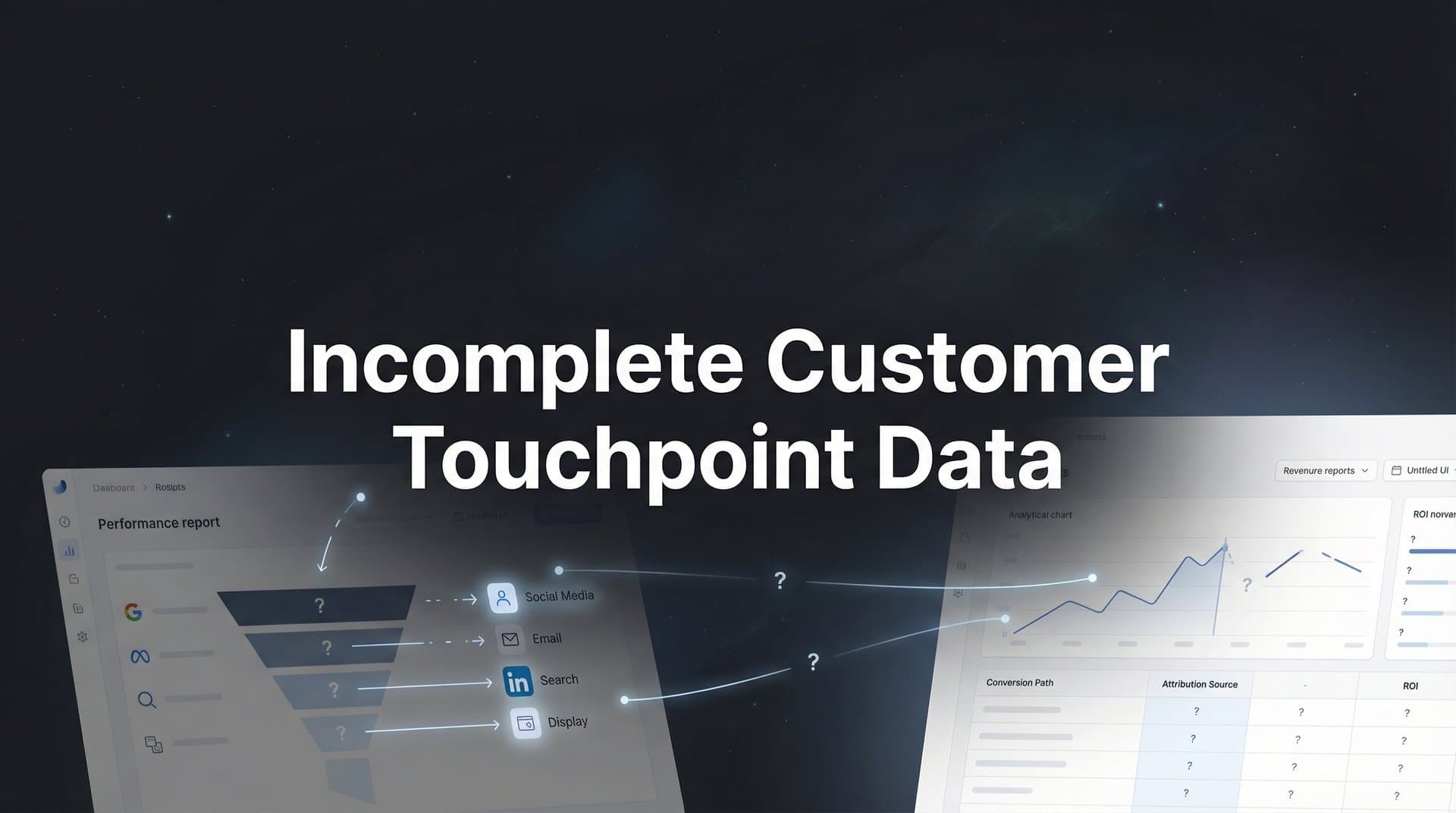
Your marketing dashboard shows 500 conversions from your latest campaign. Google Ads claims 200 of them. Meta Ads Manager says 180. Your CRM records 150 deals closed. And your analytics platform reports that 120 came from "direct" traffic with no identifiable source.
Something doesn't add up.
This isn't a data glitch or a reporting error. You're looking at the real-world impact of incomplete customer touchpoint data, a problem that affects nearly every marketing team running multi-channel campaigns. When your tracking systems can't capture the full journey from first impression to final purchase, you're making budget decisions based on fragments of the story. You're optimizing campaigns with one eye closed. And you're leaving money on the table because you can't identify which marketing efforts actually drive revenue.
The Hidden Gaps in Your Customer Journey Data
Incomplete customer touchpoint data means you're missing critical interactions that happen between a prospect's first exposure to your brand and their eventual conversion. It's not that these touchpoints don't exist. They're happening every day. Your tracking systems simply can't see them.
Think of it like watching a movie with random scenes deleted. You see the opening, catch a few moments in the middle, and witness the ending. But without the full narrative, you can't understand why characters made certain decisions or how the plot actually developed. That's exactly what happens when your attribution data has gaps.
The symptoms show up in ways that many marketers have learned to accept as normal. You see conversions attributed to "direct" traffic that spike after running awareness campaigns, but you can't prove the connection. Your reporting shows discrepancies between what ad platforms claim and what actually shows up in your sales data. Different tools give you different numbers for the same campaign, and reconciling them becomes a monthly headache.
Here's what makes this particularly frustrating: partial data looks complete until you dig deeper. Your dashboard shows numbers. Your platforms report conversions. Everything appears to be working. But you're only seeing the touchpoints your systems can track, not the full journey your customers actually take.
Complete journey visibility means capturing every meaningful interaction: the initial Facebook ad view, the Google search three days later, the email click, the retargeting ad on Instagram, the YouTube video watch, and the final direct visit to your site. When any of these pieces go missing, your attribution becomes a guessing game rather than a strategic tool. Understanding customer journey touchpoints is essential to building this complete picture.
The difference between partial data and complete visibility isn't just about having more numbers in your reports. It's about understanding causation versus correlation. With incomplete data, you might see that conversions increased after launching a new campaign, but you can't definitively say whether that campaign drove the results or simply happened to run during a period when other factors were at play.
Why Your Tracking Misses Critical Interactions
The tracking infrastructure that worked reliably for years has fundamentally broken down. This isn't about poor implementation or technical mistakes. The digital ecosystem itself has changed in ways that make traditional tracking methods increasingly ineffective.
iOS privacy updates, particularly App Tracking Transparency introduced in iOS 14.5, gave users the power to block tracking across apps and websites. When someone opts out, your tracking pixels can't follow their journey across different platforms. You might see them click an ad, but what happens next becomes invisible. Studies show that over 60% of iOS users choose to opt out of tracking, creating massive blind spots in your attribution data. Many marketers are losing attribution data due to privacy updates at an alarming rate.
Browser restrictions have compounded the problem. Safari's Intelligent Tracking Prevention and Firefox's Enhanced Tracking Protection actively block third-party cookies and limit the lifespan of first-party cookies. Even Chrome, which delayed its cookie deprecation plans, has implemented restrictions that affect how tracking works. When a prospect visits your site from multiple browsers or devices, traditional cookie-based tracking treats them as separate users, fragmenting what should be a unified journey.
Cross-device behavior has become the norm rather than the exception. A typical customer journey might start with a mobile ad view during a morning commute, continue with desktop research at work, include tablet browsing in the evening, and end with a mobile purchase. Each device switch represents a potential break in your tracking. Without a way to connect these interactions to the same person, you're left with disconnected data points that don't tell a coherent story.
The problem gets worse when you consider how siloed your data sources are. Your ad platforms operate independently, each tracking their own touchpoints without visibility into what happens on other channels. Meta sees the Facebook and Instagram interactions. Google sees search and YouTube. TikTok sees its own engagement. Your CRM tracks sales conversations and deal stages. Your website analytics captures on-site behavior.
These systems don't naturally talk to each other. They weren't designed to. Each one provides a piece of the puzzle, but assembling those pieces into a complete picture requires infrastructure that most marketing teams simply don't have. The result is that your attribution lives in separate silos, with each platform claiming credit based only on what it can see. This is why customer touchpoint visibility issues plague so many organizations.
Ad blockers add another layer of complexity. Millions of users actively block tracking scripts, analytics tools, and advertising pixels. To them, your carefully implemented tracking infrastructure is completely invisible. They interact with your brand, convert into customers, and generate revenue, but your systems record them as ghosts in the machine.
The Real Cost of Missing Touchpoint Data
Incomplete attribution data doesn't just create reporting headaches. It directly impacts your bottom line through misallocated budgets and missed optimization opportunities.
Consider what happens when you rely on last-click attribution with incomplete data. Your reporting shows that Google search drives 40% of conversions, so you increase your search budget. But what you can't see is that most of those searchers were first introduced to your brand through Facebook ads, nurtured through email campaigns, and influenced by LinkedIn content. By over-investing in the final touchpoint, you're starving the awareness and consideration channels that actually create demand.
This misallocation compounds over time. Channels that generate awareness and influence early-stage consideration get deprioritized because they don't show direct conversions. Your budget shifts toward bottom-funnel tactics that capture existing demand rather than creating new demand. Eventually, you notice diminishing returns, but by then, you've already cut the marketing activities that were filling your pipeline.
The impact on ad platform optimization might be even more costly. Meta, Google, TikTok, and other platforms use machine learning algorithms to optimize your campaigns. These algorithms need accurate conversion data to learn which users are most likely to convert and how to find more like them. When your conversion tracking is incomplete, you're feeding these algorithms partial information. Proper attribution data for ad optimization is critical for campaign success.
Think about what this means in practice. Your Meta campaigns might be driving valuable conversions that your tracking can't capture due to iOS restrictions. Meta's algorithm sees these as non-converting users and adjusts its targeting away from similar audiences. Over time, the platform learns to target the wrong people because it's optimizing based on incomplete signals rather than actual results.
The inability to identify which campaigns actually influence revenue creates strategic blindness. You might pause campaigns that show poor click-through rates or high cost-per-click, not realizing they're playing a crucial role in the customer journey. You might double down on tactics that appear successful in isolation but actually just capture demand created by other channels.
This problem becomes particularly acute when you're trying to scale. Growth requires understanding which marketing activities create leverage and which ones simply maintain the status quo. Without complete touchpoint data, you can't distinguish between campaigns that generate new pipeline and campaigns that simply convert existing demand more efficiently. You end up scaling the wrong things and wondering why growth plateaus despite increased spending.
Signs Your Attribution Has Blind Spots
How do you know if incomplete touchpoint data is affecting your marketing decisions? The symptoms often hide in plain sight, disguised as normal reporting quirks or acceptable discrepancies.
Platform-reported conversions that don't match your actual sales data represent one of the clearest warning signs. When Google Ads claims 150 conversions but your CRM only shows 100 new deals from that period, something is missing. Either the platforms are over-reporting due to duplicate attribution, or your tracking isn't connecting ad interactions to final sales. Both scenarios indicate incomplete data. Learning about solving attribution data discrepancies can help you address these mismatches.
Unexplainably high direct traffic tells a similar story. Direct traffic should primarily represent people who deliberately type your URL into their browser or use a saved bookmark. If direct traffic accounts for 30% or more of your conversions, especially if your brand isn't a household name, you're likely looking at misattributed traffic. These are conversions that happened after touchpoints your systems couldn't track, so they get dumped into the "direct" bucket by default.
Watch for campaigns that show poor engagement metrics but correlate with revenue spikes. You might run a brand awareness campaign on YouTube that generates low click-through rates and no directly attributed conversions. Your instinct might be to cut it. But if you notice that organic search volume, direct traffic, and overall conversion rates increase during and immediately after the campaign runs, that YouTube spend is likely driving results that your attribution can't capture.
Inconsistent conversion windows across platforms create another red flag. If Meta reports conversions within a 7-day window but your actual sales cycle takes 21 days on average, you're missing the majority of conversions that Meta influenced. The platform shows poor performance not because the campaigns aren't working, but because your tracking can't connect early-stage touchpoints to eventual conversions that happen outside the attribution window. Addressing marketing analytics data gaps requires understanding these timing mismatches.
These symptoms compound when you're running multi-channel campaigns. The more platforms you use, the more opportunities for tracking gaps to emerge. Each additional channel introduces new potential breaks in the customer journey, new privacy restrictions to navigate, and new data silos to reconcile.
Building a Complete View of Every Customer Journey
Solving incomplete touchpoint data requires rethinking how you capture and connect customer interactions across every channel and device. Traditional tracking methods can't adapt to current privacy restrictions and cross-device behavior. You need infrastructure designed for the reality of modern digital marketing.
Server-side tracking represents the most significant advancement in attribution technology in recent years. Instead of relying on browser-based pixels that users can block and privacy features can restrict, server-side tracking sends data directly from your server to advertising platforms and analytics tools. When someone converts on your site, your server communicates that conversion to Meta, Google, and other platforms, regardless of whether their browser allowed client-side tracking.
This approach captures conversions that traditional pixels miss entirely. iOS users who opted out of tracking. People using ad blockers. Cross-device journeys where cookies don't persist. Server-side tracking sees all of it because it operates independently of browser restrictions. The data flows from your server, where you have complete control, rather than depending on what a user's device allows. Implementing first-party data tracking solutions is essential for this approach.
But capturing more touchpoints is only half the solution. You also need to connect all your data sources into a unified system that tracks the complete customer journey. This means integrating your ad platforms, CRM, email marketing tools, website analytics, and any other system that touches customer interactions.
When these systems connect properly, you can see how a prospect moves from initial ad exposure through multiple touchpoints across different channels before converting. You can track the Facebook ad view, the Google search, the email open, the webinar attendance, the sales call, and the final purchase as a single journey rather than disconnected events. This unified view reveals patterns and relationships that siloed data can never show. A robust customer touchpoint tracking system makes this possible.
Multi-touch attribution models become powerful once you have complete journey data. Instead of giving all credit to the first or last touchpoint, multi-touch models distribute credit across every interaction based on its influence on the final conversion. You can see which channels work together, which touchpoints are essential versus supplementary, and where your marketing creates the most leverage.
The key is ensuring your attribution system enriches the data it captures. Basic tracking might record that someone visited your site from a Facebook ad. Enriched tracking captures which specific ad they saw, what campaign it belonged to, which audience segment they were in, what actions they took on your site, whether they engaged with other marketing touchpoints, and how all of this connects to their eventual conversion or lack thereof.
This enriched data becomes particularly valuable when you feed it back to ad platforms. Meta and Google's algorithms optimize based on the conversion signals they receive. When you send them enriched data that includes conversions their native tracking missed, their algorithms can learn from a more complete picture of what drives results. They can identify patterns in converting users that partial data would never reveal.
Turning Complete Data Into Smarter Marketing Decisions
Complete touchpoint data transforms from a technical achievement into a strategic advantage when you use it to make better marketing decisions. The goal isn't just to have more accurate reports. It's about identifying what actually drives revenue and scaling those efforts with confidence.
Feeding enriched conversion data back to ad platforms improves their optimization in ways that compound over time. When Meta receives complete conversion signals instead of partial data, its algorithm can identify the true characteristics of your best customers. It learns which audiences, creative approaches, and targeting parameters actually lead to conversions, not just which ones appear to based on incomplete tracking.
This creates a virtuous cycle. Better data leads to better optimization. Better optimization leads to better results. Better results generate more conversion data to feed back into the system. Over time, your campaigns become increasingly effective as the algorithms learn from a complete picture rather than fragments. Understanding how data analytics can improve marketing strategy helps you maximize this advantage.
Identifying high-performing campaigns across all channels becomes straightforward when you have unified attribution data. You can compare the true impact of your Meta campaigns versus Google Ads versus LinkedIn versus email marketing. Not based on what each platform claims, but based on how they actually contribute to revenue when you account for the full customer journey.
This visibility reveals insights that siloed data hides. You might discover that your LinkedIn campaigns rarely drive direct conversions but consistently influence high-value deals. Or that certain Meta campaigns generate lower click-through rates but attract prospects who convert at much higher rates after engaging with your content. Or that email nurture sequences dramatically increase conversion rates for people who previously interacted with paid ads.
Budget decisions become strategic rather than reactive. Instead of shifting spend based on last-click attribution or platform-reported metrics, you can allocate budget based on true revenue influence. You can invest confidently in awareness campaigns because you can prove they fill your pipeline. You can maintain spending on channels that play supporting roles in the customer journey rather than cutting them because they don't show direct conversions. A comprehensive marketing data analytics platform enables this level of strategic decision-making.
The ability to make these decisions with confidence separates marketing teams that scale efficiently from those that plateau despite increased spending. When you know what actually drives revenue, you can double down on those activities without second-guessing yourself. You can test new channels and tactics knowing you'll be able to measure their true impact. You can defend your marketing budget because you have data that proves ROI rather than estimates based on incomplete attribution.
AI-powered recommendations take this a step further by analyzing your complete attribution data to identify optimization opportunities you might miss. These systems can spot patterns across thousands of campaigns and touchpoints, revealing which combinations of channels, audiences, and creative approaches drive the best results. They can suggest budget reallocation strategies based on what actually generates revenue rather than what appears to based on partial data.
Moving Forward with Complete Attribution
Incomplete customer touchpoint data isn't just a technical inconvenience. It's a strategic problem that affects every marketing decision you make. When you can't see the full customer journey, you can't optimize it. When your attribution has blind spots, your budget allocation becomes guesswork. When ad platforms receive partial conversion signals, their algorithms optimize toward the wrong outcomes.
The solution requires connecting all your marketing data sources into a unified system that captures every touchpoint across every channel and device. Server-side tracking ensures you capture conversions that browser-based pixels miss. Multi-touch attribution models reveal how different channels work together to drive results. Enriched conversion data fed back to ad platforms improves their optimization over time.
This isn't about having perfect data. That's impossible in an ecosystem with privacy restrictions, cross-device behavior, and multiple touchpoints. It's about having complete enough data to make confident strategic decisions. It's about seeing the full story rather than fragments. It's about understanding what actually drives revenue so you can scale those efforts intelligently.
The marketing teams that solve incomplete touchpoint data gain a significant competitive advantage. They allocate budgets based on reality rather than assumptions. They optimize campaigns with complete information rather than partial signals. They scale efficiently because they know what creates leverage and what just maintains the status quo.
Evaluate your current attribution setup honestly. Look for the symptoms: unexplained direct traffic, platform discrepancies, campaigns that correlate with revenue but don't show direct conversions. If you recognize these patterns, you're working with incomplete data. And that means you're leaving optimization opportunities on the table.
Ready to elevate your marketing game with precision and confidence? Discover how Cometly's AI-driven recommendations can transform your ad strategy. Get your free demo today and start capturing every touchpoint to maximize your conversions.


