Picture this: your marketing team is three months into a major paid media push, and the numbers just do not add up. Your Meta Ads dashboard says one thing, your analytics tool says another, and nobody can agree on which campaigns are actually driving revenue. You pull a cross-device report and realize entire customer journeys are invisible to your current setup. Someone suggests switching platforms, and the room goes quiet. The idea of migrating your entire analytics stack feels like performing surgery while the patient is running a marathon.
This tension is more common than you might think. As privacy changes have reshaped how data flows across the web, many analytics setups that worked well a few years ago are now producing unreliable, incomplete pictures of campaign performance. The tools have not kept up. But the fear of migration, specifically the fear of losing historical data, breaking integrations, or creating reporting blind spots, keeps teams stuck on platforms that are actively costing them money.
That is exactly the problem a marketing analytics migration service is designed to solve. Rather than treating a platform switch as a risky disruption, a structured migration service turns it into a controlled, validated transition that preserves your data, protects your ad platform integrations, and sets your team up with a stronger foundation than you had before. By the end of this article, you will understand what these services actually involve, how to recognize when you need one, and how to execute a migration that upgrades your analytics capabilities rather than just moving them sideways.
What a Marketing Analytics Migration Service Actually Encompasses
The term "migration service" gets used loosely, so it is worth being precise. A marketing analytics migration service is the end-to-end process of moving your entire tracking infrastructure from one analytics platform to another. That includes historical data, attribution models, conversion events, CRM integrations, ad platform connections, UTM structures, and reporting configurations. It is not just exporting a CSV and importing it somewhere new.
The distinction between a DIY migration and a structured migration service is significant. A DIY approach typically means manually rebuilding your tracking setup in the new platform, which often results in configuration errors, gaps in historical context, and broken integrations that nobody notices until a campaign starts underperforming. A structured migration service, by contrast, follows a deliberate process that includes data mapping, validation checkpoints, and a parallel tracking period where both the old and new systems run simultaneously so you can confirm data accuracy before fully cutting over.
Think of it like switching CRMs. The complexity is not just in moving records. It is in reconfiguring how data flows between systems, remapping fields so nothing gets lost in translation, and making sure every downstream process still works correctly after the switch. Analytics migration carries the same level of operational weight, which is why understanding a comprehensive marketing analytics solution before you begin is so important.
The core components of a well-executed migration service typically include:
Data Audit: A thorough inventory of every tracking pixel, conversion event, UTM parameter convention, CRM connection, and ad platform integration currently in place. You cannot migrate what you have not cataloged.
Platform Mapping: Translating your current data architecture into the new platform's structure. This means matching event names, attribution windows, and data models so that post-migration reports remain comparable to historical benchmarks.
Integration Reconfiguration: Reconnecting your ad platforms, CRM, and website tracking in the new environment. This step is where most DIY migrations break down, because integrations often have dependencies that are not obvious until something stops working.
Historical Data Transfer: Moving as much historical event-level data as possible into the new platform so your team is not starting from zero. Aggregated summaries are not sufficient here. Raw event data gives you the flexibility to reanalyze and reattribute as your understanding of the customer journey evolves.
Testing and Validation: Running both platforms in parallel and comparing outputs to identify discrepancies before the old platform is decommissioned. This phase is non-negotiable for maintaining reporting confidence.
Post-Migration Monitoring: Watching the new platform closely in the weeks after cutover to catch any edge cases or misconfigured events that did not surface during parallel tracking.
Signs Your Analytics Stack Has Outgrown Its Current Home
Not every analytics frustration warrants a full migration. But there are specific warning signs that indicate your current setup is not just inconvenient but actively unreliable. Recognizing these signals early can save significant ad spend.
The most common trigger is growing data discrepancies between your ad platforms and your analytics tool. When Meta Ads reports significantly more conversions than your analytics dashboard, and you cannot explain the gap, that is not a rounding error. It is a signal that your tracking infrastructure has holes. These gaps tend to widen over time as privacy settings, browser behavior, and tracking prevention tools affect more of your audience. Understanding the fundamentals of marketing analytics data can help you identify exactly where those holes exist.
A second warning sign is the inability to track cross-device or cross-platform journeys accurately. Modern customers interact with brands across multiple devices and channels before converting. If your analytics tool can only see a fraction of those touchpoints, your attribution data is going to systematically mislead you about which channels are actually driving revenue.
Third, if your current setup relies heavily on third-party cookies, the clock is already running. Apple's App Tracking Transparency changes, introduced with iOS 14.5, significantly reduced the visibility of mobile ad conversions for platforms relying on browser-based tracking. And while Google has adjusted its timeline for Chrome's third-party cookie deprecation, the direction of travel is clear. Platforms without server-side tracking capabilities are increasingly vulnerable to these privacy-driven changes.
The cost of staying on an outdated platform is not just technical frustration. It is wasted ad spend. When your attribution data is inaccurate, you are making budget allocation decisions based on a distorted picture. Channels that appear to be underperforming might actually be driving significant assisted conversions that your tool cannot see. Channels that look like top performers might be getting credit for conversions they did not actually influence. Both errors lead to misallocated spend.
Finally, if your current platform lacks server-side tracking and multi-touch attribution, it is not just behind on features. It is structurally limited in its ability to give you an accurate view of modern marketing performance. These are not nice-to-have capabilities anymore. They are the baseline for reliable attribution in a privacy-first environment.
Anatomy of a Successful Migration: Phase by Phase
A well-executed marketing analytics migration follows a phased approach that treats each stage as a checkpoint rather than a checkbox. Here is how it breaks down in practice.
Phase 1: The Data and Integration Audit
Before touching anything in the new platform, you need a complete inventory of what you have. That means cataloging every tracking pixel currently deployed on your site, every conversion event being fired and where it is being sent, your UTM structure and naming conventions, every CRM connection and what data it is passing, and every ad platform integration along with its attribution window settings.
This audit is tedious, but skipping it is the single most common reason migrations go wrong. Teams often discover during this phase that they have duplicate pixels firing, conversion events that were set up years ago and never cleaned up, or integrations that nobody on the current team fully understands. Having a clear marketing event data schema in place before you begin ensures nothing gets lost in translation.
Phase 2: Platform Setup and Configuration
With a complete audit in hand, you can build out the new platform deliberately. This means configuring conversion events that match your existing definitions, setting up integrations with your ad platforms and CRM, establishing your UTM conventions, and selecting attribution models that align with how you currently measure performance.
The attribution model mapping piece deserves particular attention. If your current platform uses last-click attribution and your new platform defaults to data-driven or linear attribution, your post-migration reports will look dramatically different from your historical benchmarks, even if the underlying data is perfectly accurate. Document your current attribution settings carefully and replicate them in the new platform before adding more sophisticated models.
Phase 3: Parallel Tracking
This is the most important phase of any migration. Run both the old and new platforms simultaneously for a minimum of two to four weeks. During this window, compare outputs daily. Look for discrepancies in conversion counts, session data, channel attribution, and revenue figures. Investigate every material difference before proceeding.
Parallel tracking is your safety net. It is also your proof of concept. When you can show stakeholders that the new platform's data aligns closely with the old platform's data during a live period, you build the confidence needed to complete the cutover without resistance. Solid conversion tracking practices during this phase are what separate a smooth migration from a chaotic one.
The Final Cutover
Once parallel tracking validates data accuracy, you can decommission the old platform. This means redirecting all data flows to the new system, removing or disabling old tracking pixels, and closing out any integrations that were running in both environments. Immediately after cutover, run a post-migration validation: check that all conversion events are still firing, all ad platform integrations are syncing correctly, and all dashboards are pulling from the new data source. Do not wait a week to discover that a critical conversion event stopped firing on day one.
Migration Pitfalls That Can Derail Your Transition
Even well-planned migrations encounter problems. Knowing the most common failure points in advance lets you build safeguards before they become crises.
Data Loss During Transfer: The single biggest risk in any migration is losing event-level data during the transfer process. Relying solely on aggregated reports, like monthly conversion summaries or channel-level dashboards, is not sufficient. Aggregated data cannot be re-sliced or reattributed after the fact. Before decommissioning your old platform, export raw event-level data. This is non-negotiable. Even if you cannot immediately import all of it into the new platform, having it archived means you retain the ability to reference it or reprocess it later.
Broken Ad Platform Integrations: This is the pitfall with the most immediate business impact. When conversion events stop syncing to Meta, Google, or TikTok during a migration, those platforms lose the optimization signals their bidding algorithms depend on. Meta's Advantage+ campaigns, Google's Smart Bidding, and similar automated systems are only as good as the conversion data they receive. Even a brief interruption in that data flow can cause campaign performance to degrade noticeably as algorithms lose their calibration. Using reliable performance marketing tracking software helps protect these critical integrations during the transition.
Reporting Gaps and Stakeholder Confusion: Migrations create moments of uncertainty in reporting, and if stakeholders are not prepared for that, it erodes trust in the data and in the team managing the transition. The solution is proactive communication. Set clear expectations about the parallel tracking window, explain what discrepancies might appear and why, and maintain access to old platform dashboards for reference until the new platform's data has been validated over a meaningful time period. Designating a single migration lead who owns communication with leadership and clients prevents conflicting messages from creating unnecessary alarm.
Underestimating Configuration Complexity: Many teams budget time for moving data but underestimate the time required to reconfigure integrations, rebuild custom reports, and retrain the team on a new interface. Build buffer into your timeline. A migration that feels 90 percent complete but has broken integrations or missing dashboards is not ready for cutover.
What to Prioritize When Choosing Your Next Analytics Platform
A migration is an opportunity to upgrade, not just relocate. The platform you move to should be built for the realities of modern marketing, not the tracking environment of five years ago. Here is what to evaluate seriously.
Server-Side Tracking: This is the foundational capability that separates modern analytics platforms from legacy ones. Server-side tracking moves data collection from the browser to your server, which means it is not affected by ad blockers, browser privacy settings, or third-party cookie restrictions. As privacy-driven changes continue to reshape the web, server-side tracking is the infrastructure layer that keeps your data accurate regardless of what happens in Chrome, Safari, or iOS.
Native Ad Platform Integrations: Look for platforms that have direct, maintained integrations with Meta, Google Ads, TikTok, LinkedIn, and your CRM. These integrations should not just pull data in for reporting. They should push enriched conversion data back to the ad platforms, feeding their optimization algorithms with better signals. This bidirectional data flow is what allows platforms like Meta and Google to improve their targeting and reduce your cost per acquisition over time. Reviewing the top marketing attribution platforms can help you benchmark which solutions offer the strongest native integrations.
Multi-Touch Attribution: Last-click attribution was always a simplification. In a world where customers interact with your brand across five or six touchpoints before converting, it is a dangerous simplification. Look for platforms that offer multiple attribution models and let you compare them side by side. The ability to see how linear, time-decay, and data-driven models differently credit your channels gives you a much more honest view of what is actually driving revenue.
AI-Powered Analysis: The volume of data modern marketing generates is too large for manual analysis to keep up with. Platforms that use AI to surface optimization recommendations, flag underperforming campaigns, and identify high-value audience segments allow your team to act on insights faster than a manual reporting workflow ever could. Exploring the latest AI analytics software options gives you a sense of what is possible in this space.
Migration Simplicity: Finally, evaluate how straightforward the platform makes the migration itself. Does it have clear documentation for connecting your existing ad platforms and CRM? Does it offer parallel tracking support? Does it have a customer success process that helps you get configured correctly from the start? The best platform in the world is only valuable if you can actually get your data into it accurately.
Making the Switch Without Losing Momentum
The practical reality of a migration is that it competes with everything else your team is already doing. Here is a pre-migration checklist that keeps the process moving without letting it become a months-long project.
Start by documenting every current tracking event in detail, including the event name, the trigger, where it is sent, and what it represents in your funnel. Export all available historical data from your current platform before you begin configuring the new one. Notify stakeholders early, explain the timeline, and set expectations about the parallel tracking window. A well-structured campaign tracker template can help you organize this documentation efficiently.
Set a parallel tracking window of at least two to four weeks and treat it as a hard requirement, not a suggestion. Designate a migration lead who owns the process end to end, because migrations without a clear owner tend to stall at the 80 percent mark. And schedule a post-migration validation review for the week after cutover to catch anything that slipped through.
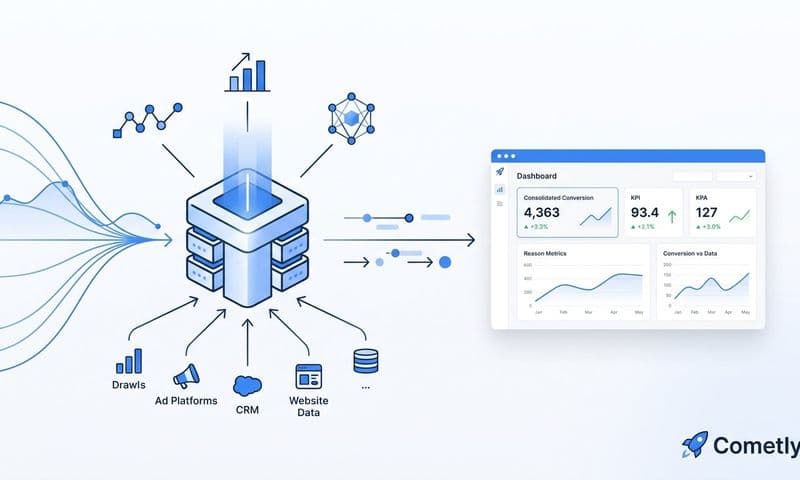
Platforms like Cometly are designed to simplify this process considerably. By connecting your ad platforms, CRM, and website tracking in one place, Cometly eliminates the fragmented integration work that makes migrations complex. Its server-side tracking ensures your conversion data remains accurate regardless of browser privacy settings, and its conversion sync features keep Meta, Google, and other ad platforms fed with the enriched data their algorithms need to optimize effectively. Learning how to use marketing analytics effectively in your new platform accelerates the value you get from the switch.
After migration, Cometly's AI-powered recommendations help teams quickly identify which campaigns and channels are driving real revenue, shortening the ramp-up period that typically follows a platform switch. Instead of spending weeks rebuilding your understanding of performance, you get clear, actionable insights from day one.
A well-executed migration is not a lateral move. It is an upgrade opportunity. When you capture every touchpoint, improve attribution accuracy, and start feeding better data to your ad platforms, the compounding effect on campaign performance is real. The goal is not just to be on a better platform. It is to be making better decisions because of it.
The Bottom Line on Analytics Migration
Switching analytics platforms will never feel completely risk-free. But the bigger risk is continuing to make budget decisions based on data you know is incomplete or unreliable. Every month you spend on a platform that cannot accurately track cross-device journeys, lacks server-side tracking, or produces growing discrepancies with your ad platforms is a month of misallocated spend and missed optimization opportunities.
The key takeaways are straightforward: audit your current setup thoroughly before touching anything, run parallel tracking until you have validated data accuracy, protect your ad platform integrations as a top priority throughout the transition, and choose a platform that is built for the realities of modern marketing rather than the tracking environment of five years ago.
Migration done right is not a disruption. It is a foundation upgrade. And with the right platform and process, you come out the other side with cleaner data, stronger attribution, and the confidence to scale your campaigns based on what is actually working.
Ready to elevate your marketing game with precision and confidence? Discover how Cometly's AI-driven recommendations can transform your ad strategy. Get your free demo today and start capturing every touchpoint to maximize your conversions.