

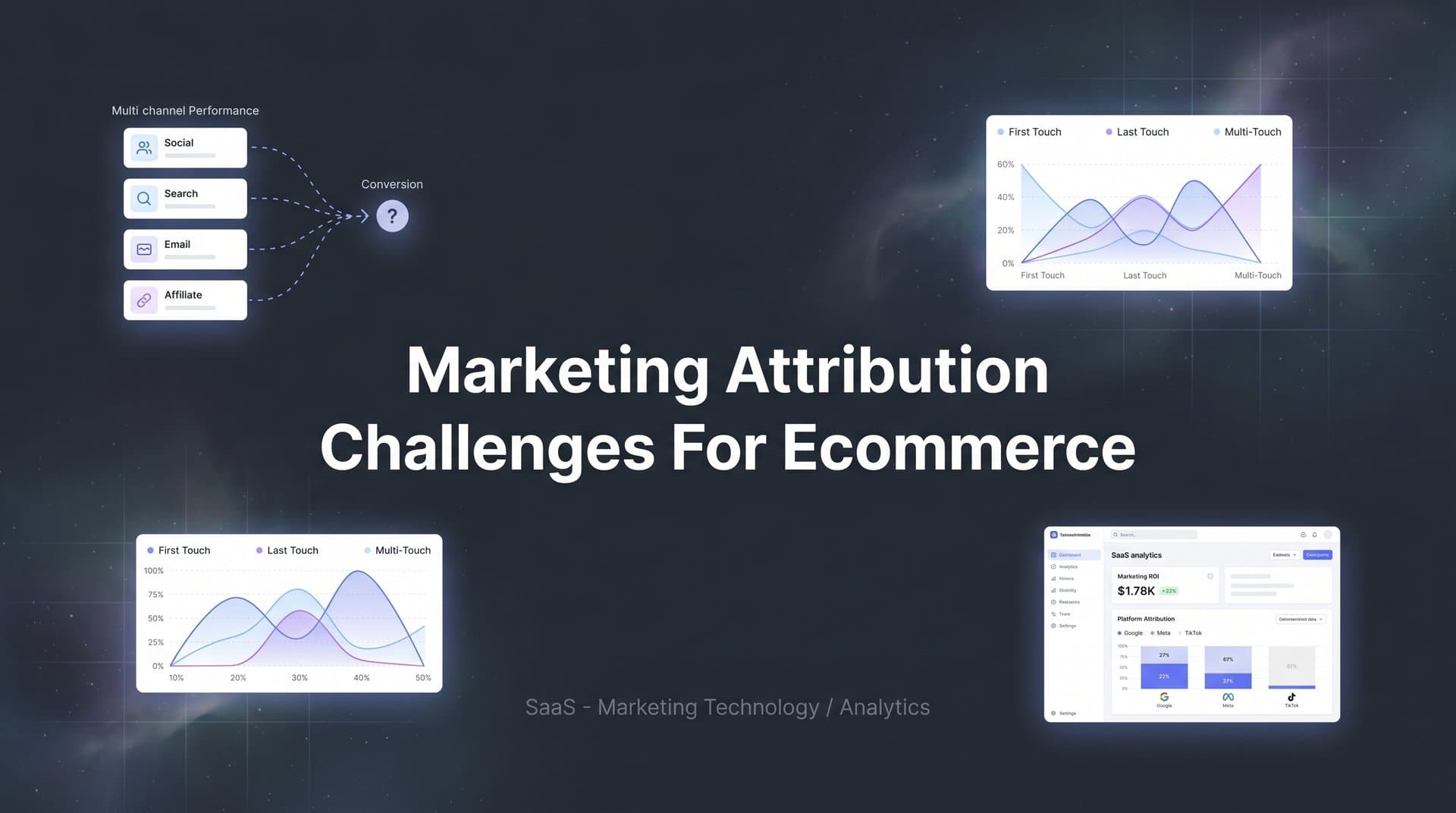
You launch a Facebook campaign, track conversions in Google Analytics, check sales in Shopify, and review email performance in Klaviyo. Each platform reports different numbers. Facebook claims 50 conversions. Google Analytics shows 35. Your actual Shopify orders? 42. Which one is right? None of them tell the complete story.
This is the daily reality for ecommerce marketers in 2026. Customers discover your brand on Instagram while browsing on their phone during lunch. They research reviews on their laptop that evening. Three days later, they click a retargeting ad on their tablet. Finally, they convert after opening a cart abandonment email on their phone the next morning.
Meanwhile, iOS privacy updates have eliminated visibility into a massive portion of mobile traffic. Third-party cookies are vanishing. Browser restrictions are tightening. The tracking methods that worked two years ago are now riddled with blind spots.
The cost of this confusion is staggering. You are scaling campaigns that might not actually drive revenue. Cutting budgets from channels that play crucial supporting roles. Making decisions based on incomplete, conflicting data.
But here is the reality: solving marketing attribution challenges for ecommerce is not about finding one magic solution. It requires a strategic, multi-layered approach that addresses each obstacle systematically. The brands that crack this code gain an unfair advantage. They know exactly which marketing efforts drive sales, which channels deserve more budget, and which tactics are wasting money.
This guide breaks down seven proven strategies to overcome the most common marketing attribution challenges for ecommerce. Each addresses a specific gap in your tracking and measurement capabilities. Together, they create a complete picture of your customer journey from first click to final purchase.
1. Implement Server-Side Tracking
The Challenge It Solves
Browser-based tracking is fundamentally broken for ecommerce. iOS users who have disabled tracking represent a black hole in your data. Ad blockers strip pixels before they can fire. Safari's Intelligent Tracking Prevention deletes cookies after just seven days. Even customers who would allow tracking often browse in private mode or across multiple browsers.
The result? Your pixel-based tracking might be missing 30-50% of actual conversions. You are making budget decisions based on half the picture, systematically undervaluing channels that drive iOS users or privacy-conscious customers.
The Strategy Explained
Server-side tracking fundamentally changes how conversion data reaches your analytics and ad platforms. Instead of relying on browser pixels that can be blocked or restricted, your server sends conversion events directly to platforms like Meta and Google.
When a customer completes a purchase, your ecommerce platform triggers a server-side event that includes all relevant conversion data: order value, products purchased, customer information, and the marketing source that drove the sale. This happens entirely independent of browser restrictions, cookies, or user privacy settings.
The data flows from your server to the platform APIs, bypassing all the obstacles that plague traditional tracking. You capture conversions from iOS users, ad blocker users, and privacy mode browsers with the same accuracy as fully trackable traffic. Understanding attribution tracking for ecommerce is essential to implementing this correctly.
Implementation Steps
1. Choose a server-side tracking solution that integrates with your ecommerce platform (Shopify, WooCommerce, BigCommerce, etc.) and supports the ad platforms you use.
2. Configure conversion events to fire from your server when key actions occur: purchases, add-to-carts, checkout initiations, and high-value page views.
3. Implement event matching to connect server-side events with the original ad clicks using parameters like email addresses, phone numbers, and click IDs that persist server-side.
4. Test thoroughly by completing test purchases and verifying that conversion events appear correctly in your ad platform reporting with accurate attribution to the source campaign.
5. Monitor data quality metrics in your ad platforms to ensure match rates remain high and conversion values align with your actual ecommerce revenue.
Pro Tips
Start with purchase events first since they represent your most valuable conversions. Once those are flowing accurately, layer in additional funnel events. Send as much customer data as possible in your server events to improve match rates, but ensure you are handling personal information in compliance with privacy regulations. The better your match rates, the more accurate your attribution becomes.
2. Unify Data Sources with Central Attribution
The Challenge It Solves
Every marketing platform wants to take credit for your conversions. Facebook attributes sales to Facebook ads. Google attributes the same sales to Google Ads. Your email platform claims the conversion happened because of the email. Each platform uses different attribution windows, different conversion definitions, and different tracking methods.
When you try to reconcile these reports, the numbers never add up. The sum of platform-reported conversions exceeds your actual sales by 2x or 3x. You waste hours every week trying to build spreadsheets that make sense of conflicting data, and you still cannot confidently answer which channels truly drive revenue.
The Strategy Explained
Central attribution platforms solve this by becoming the single source of truth for all your marketing data. Instead of each platform tracking conversions in isolation, a central system ingests data from every marketing channel, your CRM, and your ecommerce platform.
This creates a unified customer journey that shows every touchpoint a customer experienced before converting. When someone makes a purchase, the attribution platform can see they first clicked a Facebook ad, later searched and clicked a Google ad, then received an email, and finally converted. Instead of three platforms each claiming 100% credit, you see the actual sequence of events.
The platform applies consistent attribution logic across all channels, eliminating the conflicting reports. You can compare channel performance apples-to-apples because everything is measured using the same rules, the same conversion definitions, and the same time windows. A dedicated marketing attribution platform for ecommerce makes this process significantly easier.
Implementation Steps
1. Connect all your marketing platforms (Meta, Google Ads, TikTok, email, etc.) to your attribution platform using native integrations or API connections.
2. Integrate your ecommerce platform so actual purchase data flows into the attribution system, providing the ground truth for revenue and conversion counts.
3. Configure your attribution settings to match your business model: set appropriate conversion windows, choose which events count as conversions, and define how you want to handle return customers.
4. Allow 7-14 days for the system to collect sufficient data across the full customer journey before making major decisions based on the unified reports.
5. Compare the unified attribution data against individual platform reports to understand where the biggest discrepancies exist and which platforms were over-claiming credit.
Pro Tips
Focus on revenue-based metrics rather than just conversion counts. A channel might drive fewer conversions but higher average order values. Use the unified view to identify assist channels that rarely get last-click credit but play crucial roles earlier in the journey. These are often the first channels you would cut based on platform-reported data, but they are actually essential to your funnel.
3. Adopt Multi-Touch Attribution Models
The Challenge It Solves
Last-click attribution gives 100% credit to whatever the customer clicked immediately before purchasing. This systematically undervalues every other marketing touchpoint that influenced the decision. Your brand awareness campaigns that introduced customers to your product get zero credit. The comparison content that convinced them you are the best option gets ignored. The retargeting that kept you top-of-mind gets overlooked.
The result is a distorted view of marketing effectiveness. You over-invest in bottom-funnel tactics that capture demand and under-invest in top and middle-funnel activities that create demand. Your attribution model is literally telling you to stop doing the marketing that makes your bottom-funnel tactics work.
The Strategy Explained
Multi-touch attribution distributes credit across all the touchpoints in a customer journey based on their relative influence. Instead of the last click getting 100% credit, each interaction that contributed to the conversion receives a portion of the credit. Our comprehensive guide on multi-touch marketing attribution platforms explains this in greater detail.
Different models distribute credit differently. Linear attribution gives equal credit to every touchpoint. Time-decay gives more credit to recent interactions. Position-based (U-shaped) gives more credit to the first and last touches. Data-driven attribution uses machine learning to determine how much credit each touchpoint deserves based on actual conversion patterns.
This reveals the true value of channels that rarely get last-click credit but play essential roles. You might discover that customers who eventually convert almost always interact with your blog content first, even though the blog never gets last-click credit. Or that email nurture sequences dramatically increase conversion rates for people who previously clicked ads, even when the email is not the final click.
Implementation Steps
1. Start by analyzing your typical customer journey length and touchpoint count using your attribution platform's journey analysis tools to understand how complex your paths to purchase actually are.
2. Experiment with different attribution models (linear, time-decay, position-based) on the same data set to see how channel performance changes under different credit distribution rules.
3. Compare multi-touch results against your current last-click data to identify which channels are being systematically undervalued in your existing measurement approach.
4. Choose a primary attribution model that aligns with your business goals and customer journey complexity, but continue monitoring multiple models to gain different perspectives on performance.
5. Adjust budget allocation gradually based on multi-touch insights rather than making dramatic shifts immediately, giving you time to validate that the new attribution model accurately predicts revenue impact.
Pro Tips
No single attribution model is perfect for every situation. Use position-based attribution when you want to emphasize both demand creation and demand capture. Use time-decay when recent interactions matter more for your product category. Use data-driven attribution when you have sufficient conversion volume for the algorithm to identify meaningful patterns. The key is understanding what each model tells you and what it obscures.
4. Bridge Cross-Device Journeys
The Challenge It Solves
Your customer discovers your brand on Instagram while scrolling on their phone during their commute. They visit your site but do not buy. That evening, they research your product on their laptop, comparing options and reading reviews. Two days later, they see a retargeting ad on their tablet and finally decide to purchase. They complete checkout on their phone the next morning.
Traditional tracking sees this as four different anonymous users. Your attribution data shows four separate, incomplete journeys instead of one continuous path to purchase. You cannot see that the Instagram ad started a journey that took four devices and three days to complete. Your reporting suggests that mobile traffic does not convert, when in reality mobile is where most journeys begin.
The Strategy Explained
Identity resolution connects the dots across devices by recognizing when different sessions belong to the same person. It uses multiple signals to match anonymous browsing on one device with identified activity on another: email addresses when customers log in, phone numbers from checkout forms, device fingerprinting, and probabilistic matching based on behavior patterns.
When a customer finally identifies themselves by logging in or entering their email, the system can retroactively connect their previous anonymous sessions across devices. That Instagram view on mobile, the laptop research session, and the tablet retargeting click all get stitched together into a single customer journey. This is one of the most significant cross-platform marketing measurement challenges that brands face today.
This reveals the true role each device plays in your funnel. You discover that mobile drives discovery and initial interest, desktop drives detailed research and comparison, and purchases happen across all devices. Instead of seeing mobile as low-converting traffic you should deprioritize, you recognize it as the essential first step in most customer journeys.
Implementation Steps
1. Implement user authentication and account creation features that encourage customers to log in or identify themselves early in their journey, creating more opportunities to connect cross-device activity.
2. Use an attribution platform with identity resolution capabilities that can match anonymous sessions to known users when they eventually identify themselves through login, email entry, or purchase.
3. Configure your tracking to capture device type, browser, and operating system information for every session so you can analyze how different devices contribute to conversions.
4. Review cross-device journey reports to understand typical patterns: which devices start journeys, which devices complete purchases, and how much time typically passes between devices.
5. Adjust your device-specific strategies based on actual cross-device behavior rather than last-click device attribution that misses the full picture.
Pro Tips
Look for opportunities to encourage early identification without creating friction. Offering a discount for email signup or account creation gives you identity data while providing customer value. Pay special attention to high-value customer segments and analyze whether their cross-device behavior differs from average customers. Premium buyers might do more research across more devices before purchasing.
5. Feed Better Data to Ad Platforms
The Challenge It Solves
Ad platform algorithms optimize toward the conversion data they receive. When iOS restrictions and browser limitations create gaps in your pixel data, the algorithms are learning from incomplete information. Facebook's algorithm thinks certain audiences do not convert because it cannot see the iOS conversions. Google's smart bidding undervalues keywords that drive customers who convert on different devices or after the cookie expires.
The platforms are trying to optimize your campaigns, but they are working with fundamentally flawed data. They are making targeting and bidding decisions based on seeing only 60% of your actual conversions. The result is suboptimal performance: you are not reaching your best audiences, you are not bidding appropriately on your best keywords, and the algorithm cannot learn what truly drives results.
The Strategy Explained
Conversion sync (also called Conversions API or server-side conversion tracking) sends enriched, complete conversion data back to ad platforms. Instead of the platforms relying solely on browser pixels that miss iOS users and privacy-conscious browsers, you feed them server-side conversion events that capture every purchase.
This gives the algorithms a complete picture of what is actually converting. Facebook can now see that the iOS users who clicked your ads are converting at high rates, even though the pixel could not track them. Google discovers that certain keywords drive customers who convert days later after the cookie expires, but the conversions are real and valuable. Platforms designed for marketing attribution and revenue tracking excel at this synchronization.
With better data, the algorithms make better decisions. Automated bidding strategies become more effective because they are optimizing toward complete conversion data. Audience targeting improves because the platform can identify the true characteristics of your converters. Campaign performance increases because the machine learning is finally working with accurate information.
Implementation Steps
1. Implement server-side conversion tracking for your primary ad platforms (Meta Conversions API, Google Enhanced Conversions, TikTok Events API) to supplement pixel-based tracking.
2. Send enriched conversion events that include not just the conversion itself but valuable parameters like purchase value, product categories, customer lifetime value predictions, and customer type (new vs. returning).
3. Monitor event match quality scores in your ad platforms to ensure your server-side events are successfully matching back to ad clicks with high accuracy rates.
4. Compare campaign performance before and after implementing conversion sync, looking specifically at campaigns targeting iOS users or using automated bidding strategies that rely heavily on conversion data.
5. Gradually shift more budget to automated bidding and targeting strategies as your conversion data quality improves, allowing the algorithms to do more optimization work.
Pro Tips
Send conversion value data, not just conversion counts. Platforms can optimize for revenue, not just conversion volume, if you feed them order values. Include customer type in your conversion events so platforms can optimize differently for new customer acquisition versus repeat purchases. The more context you provide in your conversion data, the smarter the algorithmic optimization becomes.
6. Adjust Attribution Windows
The Challenge It Solves
Default attribution windows rarely match actual customer behavior. Facebook's default seven-day click window might be perfect for impulse purchases but completely wrong for considered purchases that take weeks of research. Google's default 30-day window might be too long for flash sales but too short for big-ticket items with three-month consideration cycles.
Using mismatched attribution windows creates two problems. Too-short windows miss conversions that happen after your lookback period expires, making channels appear less effective than they are. Too-long windows over-attribute conversions to channels that happened to be clicked weeks before purchase but had minimal actual influence.
The Strategy Explained
Attribution windows define how long after an ad interaction you will still count a conversion as being influenced by that ad. A seven-day click window means if someone clicks your ad and converts within seven days, the ad gets credit. If they convert on day eight, it does not.
The right attribution window matches your actual customer purchase cycle. If you sell low-cost impulse items, a shorter window accurately reflects that customers decide quickly. If you sell high-consideration products, a longer window captures the reality that customers research extensively before buying. Choosing the right attribution model for ecommerce marketing is critical to getting this right.
You can also use different windows for different attribution touches. Give first-touch interactions longer windows since awareness campaigns influence customers early in long consideration cycles. Use shorter windows for last-touch to focus credit on interactions that directly preceded purchase.
Implementation Steps
1. Analyze your time-to-conversion data to understand how long customers typically take between first interaction and purchase for different product categories and customer segments.
2. Segment your analysis by product price point, as higher-value items almost always have longer consideration cycles that require longer attribution windows.
3. Configure different attribution windows for different campaign objectives: longer windows for awareness and consideration campaigns, shorter windows for retargeting and bottom-funnel campaigns.
4. Test different window lengths on the same data set to see how channel performance changes, identifying channels that are particularly sensitive to window selection.
5. Review attribution window settings quarterly as your product mix, pricing, and customer behavior evolve over time.
Pro Tips
Look at the distribution of time-to-conversion, not just the average. If 80% of customers convert within seven days but 20% take up to 30 days, a seven-day window will miss a significant portion of conversions. Consider using view-through windows for brand awareness campaigns, as customers often see ads without clicking but are still influenced by the exposure.
7. Leverage AI-Powered Analysis
The Challenge It Solves
Human analysis has fundamental limitations when dealing with complex attribution data. You can analyze individual channels, but you cannot simultaneously process how dozens of channels interact across thousands of customer journeys. You might notice that a specific campaign performed well, but you cannot identify the subtle patterns that separate high-converting journeys from low-converting ones across your entire customer base.
The data contains insights that human analysis will never surface. Which specific sequence of touchpoints produces the highest conversion rates? Which combinations of channels create synergy where the whole is greater than the sum of the parts? Which audience segments follow completely different paths to purchase that require different marketing strategies?
The Strategy Explained
AI-powered attribution analysis processes your entire dataset simultaneously, identifying patterns and opportunities that would be impossible to spot manually. Machine learning algorithms analyze thousands of customer journeys to determine which touchpoint sequences correlate most strongly with conversions and high order values. A marketing attribution platform with AI capabilities can transform how you understand your data.
The AI can identify non-obvious insights like discovering that customers who interact with both blog content and comparison pages convert at 3x the rate of customers who only visit product pages. Or that a specific combination of Facebook ad creative and follow-up email timing produces dramatically better results than other sequences.
Beyond pattern recognition, AI provides actionable recommendations. Instead of just showing you what happened, it suggests what you should do: which campaigns to scale, which audiences to prioritize, which underperforming elements to cut, and which new combinations to test based on successful patterns in your data.
Implementation Steps
1. Ensure you have sufficient data volume for AI analysis to identify statistically significant patterns, typically requiring at least several hundred conversions per month across multiple channels.
2. Implement an attribution platform with AI-powered analysis capabilities that can process your complete customer journey data and surface actionable insights.
3. Review AI-generated recommendations regularly, starting with the highest-confidence suggestions that have clear supporting data and significant potential impact.
4. Test AI recommendations systematically by implementing suggested changes in controlled experiments where you can measure the actual impact on performance.
5. Feed results back into the system by tracking which recommendations you implemented and what results they produced, helping the AI improve its suggestions over time.
Pro Tips
Start by focusing on AI insights about your best-performing customer segments and journeys. Understanding what is already working exceptionally well often provides clearer opportunities than trying to fix underperforming areas. Use AI to identify assist channels that human analysis typically overlooks because they rarely get last-click credit but consistently appear in high-value customer journeys. These hidden contributors often represent your biggest optimization opportunities.
Moving Forward with Confidence
Solving marketing attribution challenges for ecommerce is not about implementing one silver bullet solution. It requires a strategic, layered approach that addresses each gap in your tracking and measurement capabilities.
Start with the foundation: server-side tracking ensures you are capturing accurate conversion data regardless of browser restrictions or privacy settings. This alone will reveal conversions you are currently missing and improve the data quality feeding your decisions.
Next, unify your data sources to eliminate the conflicting reports that make confident decision-making impossible. When all your marketing channels, your CRM, and your ecommerce platform speak the same language, you can finally see the complete picture.
Layer in multi-touch attribution to understand the true value of every channel, not just the last click. This reveals which marketing activities create demand versus which ones capture existing demand, allowing you to invest appropriately across your entire funnel.
As your attribution capabilities mature, add cross-device tracking to connect fragmented customer journeys. Feed enriched conversion data back to ad platforms so their algorithms can optimize effectively. Configure attribution windows that match your actual customer behavior. Leverage AI to identify patterns and opportunities that human analysis would never surface.
The brands that master these strategies gain a decisive competitive advantage. They know exactly which marketing efforts drive revenue. They can confidently scale what works and cut what does not. They make every marketing dollar count because they understand the complete customer journey from first impression to final purchase.
The difference between guessing and knowing is transformative. When you can see which channels truly drive your most valuable customers, which touchpoint sequences produce the highest conversion rates, and which marketing combinations create synergy, you stop wasting budget on activities that do not work and double down on the strategies that do.
Ready to elevate your marketing game with precision and confidence? Discover how Cometly's AI-driven recommendations can transform your ad strategy. Get your free demo today and start capturing every touchpoint to maximize your conversions.


