

You've spent the last three months running Facebook ads, nurturing an email list, hosting weekly webinars, and partnering with affiliates to promote your online course. When someone finally enrolls in your $997 program, you check your dashboard and see... conflicting data everywhere. Facebook claims credit for the conversion. Google Analytics says it came from organic search. Your email platform shows they clicked through from a campaign. And you're left wondering: what actually convinced them to buy?
This isn't just frustrating. It's expensive. Without knowing which marketing efforts truly drive enrollments, you're essentially flying blind, making budget decisions based on incomplete information and platform-reported metrics that often tell very different stories.
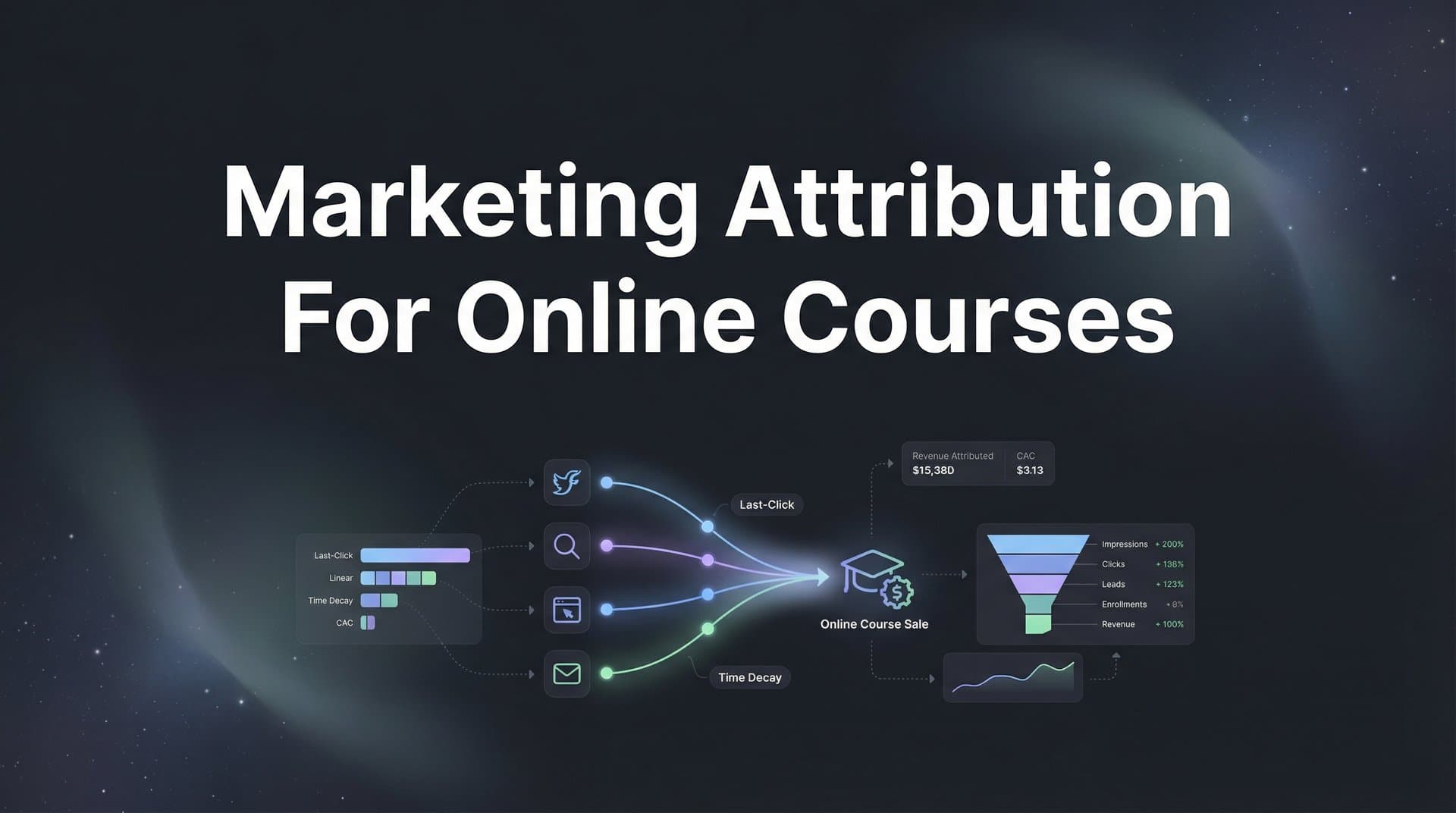
Marketing attribution solves this problem by connecting every touchpoint in your prospect's journey to their final enrollment decision. For online course creators, this visibility is especially critical because your buyers rarely convert on first contact. They discover you through an ad, download a lead magnet, consume your nurture emails, attend a webinar, visit your sales page multiple times, and then finally enroll weeks or even months later. Attribution shows you which combination of these touchpoints actually creates buyers, not just which one happened to be last before purchase.
The Hidden Complexity of Course Buyer Journeys
Online courses occupy a unique space in digital marketing. Unlike impulse purchases or low-ticket products, course enrollments typically follow extended consideration periods with multiple decision points along the way.
Think about how your ideal student actually finds and buys from you. They might first see your Instagram ad while scrolling during lunch. Three days later, they Google a problem your course solves and find your blog post. A week after that, they download your free PDF guide and enter your email sequence. Over the next two weeks, they open several of your emails, click through to case studies, and watch testimonial videos. Then they attend your live webinar, visit your sales page twice, and finally enroll after receiving a limited-time offer email.
That's nine distinct touchpoints across four different platforms before a single dollar changes hands. Now multiply this complexity across hundreds of students, each with their own unique path to enrollment, and you begin to see why simple last-click attribution fails course creators so dramatically.
The standard analytics most course creators rely on only shows them the final click before purchase. In the scenario above, that last-click model would give 100% credit to the email containing the limited-time offer, completely ignoring the Instagram ad that started the journey, the blog post that built initial trust, the lead magnet that captured the email, and the webinar that created the "aha moment" leading to enrollment. Understanding marketing analytics for online courses helps you move beyond these limitations.
This creates three critical blind spots. First, you undervalue top-of-funnel channels that introduce qualified prospects to your world. That Instagram ad campaign might look unprofitable if you only measure direct conversions, even though it's actually your most effective awareness channel. Second, you can't identify which middle-funnel content actually moves people closer to enrollment versus what just generates vanity metrics like opens and clicks. Third, you have no way to optimize your entire funnel as a system because you're only seeing isolated snapshots of individual touchpoints.
The cost of these attribution gaps compounds quickly. Many course creators waste thousands on channels that appear to perform well in platform dashboards but actually contribute little to final enrollments. Meanwhile, they underinvest in the awareness and nurture activities that create the conditions for conversion, simply because those touchpoints don't get credit in last-click models.
Connecting the Dots Across Your Entire Marketing Ecosystem
Marketing attribution for online courses works by tracking and connecting every interaction a prospect has with your brand, from their very first touchpoint through their enrollment and beyond.
The foundation is comprehensive event tracking. Instead of just monitoring purchases, effective attribution systems capture the full spectrum of prospect behavior: ad impressions and clicks, landing page visits, lead magnet downloads, email opens and link clicks, webinar registrations and attendance, sales page views, checkout page visits, and finally course enrollments. Each of these events gets timestamped and linked to the individual prospect who took that action.
This creates a complete journey map for every student. You can see exactly how Sarah discovered you through a YouTube ad, downloaded your content upgrade from a blog post three days later, attended your webinar the following week, visited your sales page twice over the next five days, and finally enrolled after clicking through from your sixth nurture email. Implementing proper marketing tracking for online courses makes this visibility possible.
But here's where it gets technically challenging: these interactions happen across completely different platforms that don't naturally talk to each other. Your Facebook ad platform has no idea what happens in your email sequences. Your course hosting platform doesn't know which ads someone clicked before arriving. Your CRM can't see which webinars someone attended unless you manually connect that data.
Effective attribution bridges these gaps by creating a unified tracking system that connects your ad platforms, website analytics, email marketing software, webinar tools, CRM, and course platform into one cohesive view. When someone clicks your Facebook ad, that click gets associated with their profile. When they later download your lead magnet and enter your email list, that action connects to the same profile. When they attend your webinar, enroll in your course, or take any other meaningful action, it all ties back to their complete journey history.
This is where server-side tracking becomes essential for course creators. Traditional browser-based tracking relies on pixels and cookies that fire when someone visits your website. This approach has become increasingly unreliable due to iOS privacy changes, browser cookie restrictions, and ad blockers. A significant portion of your actual traffic and conversions simply disappears from pixel-based tracking.
Server-side tracking solves this by capturing conversion data directly from your servers rather than relying on browser pixels. When someone enrolls in your course, your course platform or payment processor sends that conversion event directly to your attribution system and back to your ad platforms. This data doesn't get blocked by privacy settings or ad blockers because it never touches the user's browser. The result is dramatically more accurate conversion tracking, often revealing 20-30% more conversions than pixel-based methods alone.
For course creators, this accuracy matters enormously. If your pixel-based tracking only captures 70% of actual enrollments, your ad platforms are optimizing toward incomplete data, your attribution models are missing crucial touchpoints, and your budget allocation decisions are based on a fundamentally flawed understanding of what's working.
Choosing Your Attribution Model Based on Your Course Business Goals
Once you're tracking the complete customer journey, you need to decide how to assign credit for enrollments across the various touchpoints that contributed. Different attribution models distribute this credit differently, and the right choice depends on your specific business model and growth stage.
First-touch attribution gives 100% credit to whatever initially brought someone into your world. If a prospect first discovered you through a Facebook ad, that ad gets full credit for the eventual enrollment, regardless of the emails, webinars, and content they consumed afterward. This model helps you understand which channels are best at generating qualified awareness and filling the top of your funnel with potential students.
First-touch attribution works well when you're primarily focused on audience building and want to identify which channels introduce you to people who eventually become students. It's particularly useful for newer course creators who need to understand which awareness strategies bring in their ideal prospects. The limitation is that it completely ignores the nurture and conversion activities that actually convinced someone to enroll.
Last-touch attribution does the opposite, giving 100% credit to the final interaction before enrollment. If someone enrolled after clicking through from an email, that email gets full credit, even if they first discovered you months earlier through completely different channels. This model shows you which touchpoints are most effective at closing the sale and driving immediate conversions.
Last-touch attribution makes sense when you're optimizing for direct response and want to identify which specific calls-to-action, offers, or messages push prospects over the finish line. It's the default model in most analytics platforms because it's simple and aligns with how ad platforms report conversions. But for course businesses with longer sales cycles, it systematically undervalues the awareness and consideration-stage touchpoints that make those final conversions possible.
Multi-touch attribution distributes credit across all the touchpoints that contributed to an enrollment. Someone might have discovered you through a YouTube ad, downloaded a lead magnet from organic search, engaged with several nurture emails, and enrolled after attending a webinar. Our multi-touch marketing attribution platform guide explains how this approach recognizes that each of these interactions played a role and assigns partial credit to all of them.
For high-ticket courses and programs with extended consideration periods, multi-touch attribution provides the most accurate picture of what's actually driving enrollments. It shows you which combinations of touchpoints create buyers, not just which individual touchpoints happen to be first or last. This enables much smarter optimization because you can see the full funnel working together as a system.
The practical guidance comes down to your price point and sales cycle length. If you're selling a $47 course with a simple funnel where most people buy within days of discovering you, last-touch attribution probably gives you the actionable insights you need. If you're selling a $2,000 program where the average buyer journey spans 30-60 days and includes multiple touchpoints across several platforms, multi-touch attribution becomes essential for understanding what's actually working.
Many sophisticated course creators use multiple attribution models simultaneously, comparing them to gain different perspectives on their marketing performance. First-touch shows which channels build your audience. Last-touch shows what closes sales. Multi-touch reveals the complete picture of how everything works together.
We compare the leading options in our performance marketing software roundup.
Building Your Attribution Infrastructure Step by Step
Setting up comprehensive attribution tracking for your course business requires connecting several systems that probably don't communicate with each other by default. The good news is that you don't need to be technical to implement this. You just need to understand what needs to connect and why.
Start with your foundational tracking infrastructure. Your website needs proper analytics implementation that captures not just page views but specific events: lead magnet downloads, webinar registration form submissions, sales page visits, checkout page arrivals, and purchase completions. Each of these events should trigger tracking that associates the action with the individual visitor and captures the source of their traffic.
Next, connect your advertising platforms. Facebook Ads, Google Ads, YouTube, and any other paid channels need to send conversion data about enrollments and key funnel events back to their platforms. This serves two purposes: it improves their optimization algorithms by teaching them which audiences and creative actually drive enrollments, and it creates a complete record of ad performance in your attribution system. Reviewing best software for tracking marketing attribution can help you choose the right tools.
If you're still comparing platforms, our best performance marketing software guide ranks the leaders.
This is where server-side tracking integration becomes critical. Instead of relying solely on browser pixels that miss conversions due to privacy settings, you want your course platform or payment processor to send enrollment data directly to your ad platforms and attribution system. When someone completes a purchase on Teachable, Kajabi, Thinkific, or your custom platform, that conversion event should fire server-side to ensure it gets captured accurately.
Your email marketing platform needs integration too. Email opens and clicks are important touchpoints in course buyer journeys, and you need to see how email engagement correlates with eventual enrollments. The best attribution systems can show you which email sequences, campaigns, and individual messages contribute most to conversions versus which ones generate activity without driving revenue.
Don't forget your CRM if you use one. For course creators who nurture leads through a CRM before they enroll, tracking the progression through CRM stages and the activities that happen there provides crucial context for attribution. You might discover that prospects who engage with certain CRM sequences or reach specific lead scoring thresholds convert at much higher rates, even if the CRM touchpoints don't get credit in simpler attribution models.
Webinar platforms deserve special attention because webinars are often the highest-impact touchpoint in course funnels. You want to track not just registrations but actual attendance, engagement during the webinar, and how webinar participation correlates with enrollments. Many course creators find that webinar attendees convert at 10-20x the rate of non-attendees, making this a critical data point for attribution.
Beyond purchase events, identify the key milestone actions in your funnel that indicate buying intent. For most course businesses, these include: lead magnet downloads that bring people into your ecosystem, webinar registrations that signal serious interest, sales page visits that show active consideration, and checkout page arrivals that indicate purchase intent. Tracking these events gives you a much richer understanding of funnel progression than just monitoring final enrollments.
The final piece is feeding enriched conversion data back to your ad platforms. When someone enrolls in your course, you don't just want to send a basic "purchase" event to Facebook or Google. You want to send the actual revenue value, the course they purchased, and any other data that helps the platform's algorithm understand what a valuable conversion looks like. Understanding marketing attribution platforms revenue tracking capabilities ensures you capture this valuable data.
Turning Attribution Insights Into Enrollment Growth
Once you have accurate attribution data flowing, the real value comes from using those insights to make smarter marketing decisions that directly increase enrollments while reducing wasted spend.
Start by identifying your true top-performing channels. You might discover that the Facebook ads you thought were your best enrollment source are actually just good at last-touch conversions, while your YouTube channel that seemed unprofitable is actually introducing most of your highest-value students to your brand. Multi-touch attribution reveals these patterns that last-click data obscures.
This insight allows you to reallocate budget with confidence. Instead of cutting YouTube spend because it doesn't show direct conversions, you recognize its role in building qualified awareness and increase investment there. Instead of pouring more money into Facebook retargeting because it gets last-click credit, you optimize it as part of a larger funnel system where awareness channels feed prospects who retargeting converts. Effective performance marketing attribution makes this strategic budget allocation possible.
Look at each stage of your funnel through an attribution lens. Which awareness channels bring in leads that actually convert to enrollments versus leads that just inflate your list size? Which lead magnets attract serious prospects versus casual browsers? Which email sequences move people toward purchase versus which ones generate opens without driving action? Which webinar topics and formats create the most enrollments?
These questions become answerable with proper attribution. You might find that one specific lead magnet generates half as many downloads as another but produces three times as many eventual enrollments. That's actionable insight you can use to create more content like the high-converting magnet and promote it more heavily.
Attribution data also reveals optimization opportunities within channels. In your Facebook advertising, you can see which ad creative, audiences, and placements generate prospects who actually enroll versus which ones drive cheap clicks that never convert. This allows you to scale the profitable segments aggressively while cutting the vanity metrics that look good in the ads dashboard but don't drive revenue. Strong attribution reporting for marketing teams helps you communicate these insights across your organization.
For course creators running multiple programs or price points, attribution shows you which marketing approaches work for different offerings. Your $97 course might convert best from simple Facebook ad funnels with minimal touchpoints, while your $2,997 program requires content marketing, email nurture, and webinars to generate enrollments. Without attribution, you might try to use the same marketing strategy for both and wonder why one underperforms.
The confidence factor matters enormously for scaling. When you know with certainty that your YouTube ads generate prospects who enroll at a 5% rate after going through your nurture sequence, you can confidently increase YouTube spend even if the platform itself doesn't show direct conversions. When you can prove that webinar attendees convert at 15% while non-attendees convert at 0.8%, you can justify spending more to drive webinar registrations.
This data-driven approach to scaling transforms course marketing from educated guessing into a systematic growth engine. You're no longer wondering whether to invest more in content marketing or paid ads. You're looking at attribution data that shows exactly which combination of channels and touchpoints creates enrollments, and you're scaling what works while eliminating what doesn't.
Building a Data-Driven Course Business
Marketing attribution transforms online course marketing from a collection of disconnected tactics into an integrated system where every piece works together toward enrollment growth. Instead of managing Facebook ads in isolation from email marketing in isolation from content creation, you see how these elements combine to create the conditions for conversion.
The course creators who scale successfully aren't the ones with the best ads or the most engaging emails or the most compelling webinars. They're the ones who understand how all these pieces connect, which combinations drive enrollments, and where to invest their limited time and budget for maximum impact.
Without attribution, you're making critical business decisions based on incomplete information and platform-reported metrics that often conflict with each other. With attribution, you're making those same decisions based on a complete view of what actually drives revenue for your specific business.
The difference shows up in your bottom line. Proper attribution typically helps course creators reduce their cost per enrollment by 25-40% while simultaneously increasing total enrollment volume. This happens because you stop wasting money on channels and tactics that don't actually convert, and you double down on the combinations that do.
Ready to elevate your marketing game with precision and confidence? Discover how Cometly's AI-driven recommendations can transform your ad strategy. Get your free demo today and start capturing every touchpoint to maximize your conversions.



