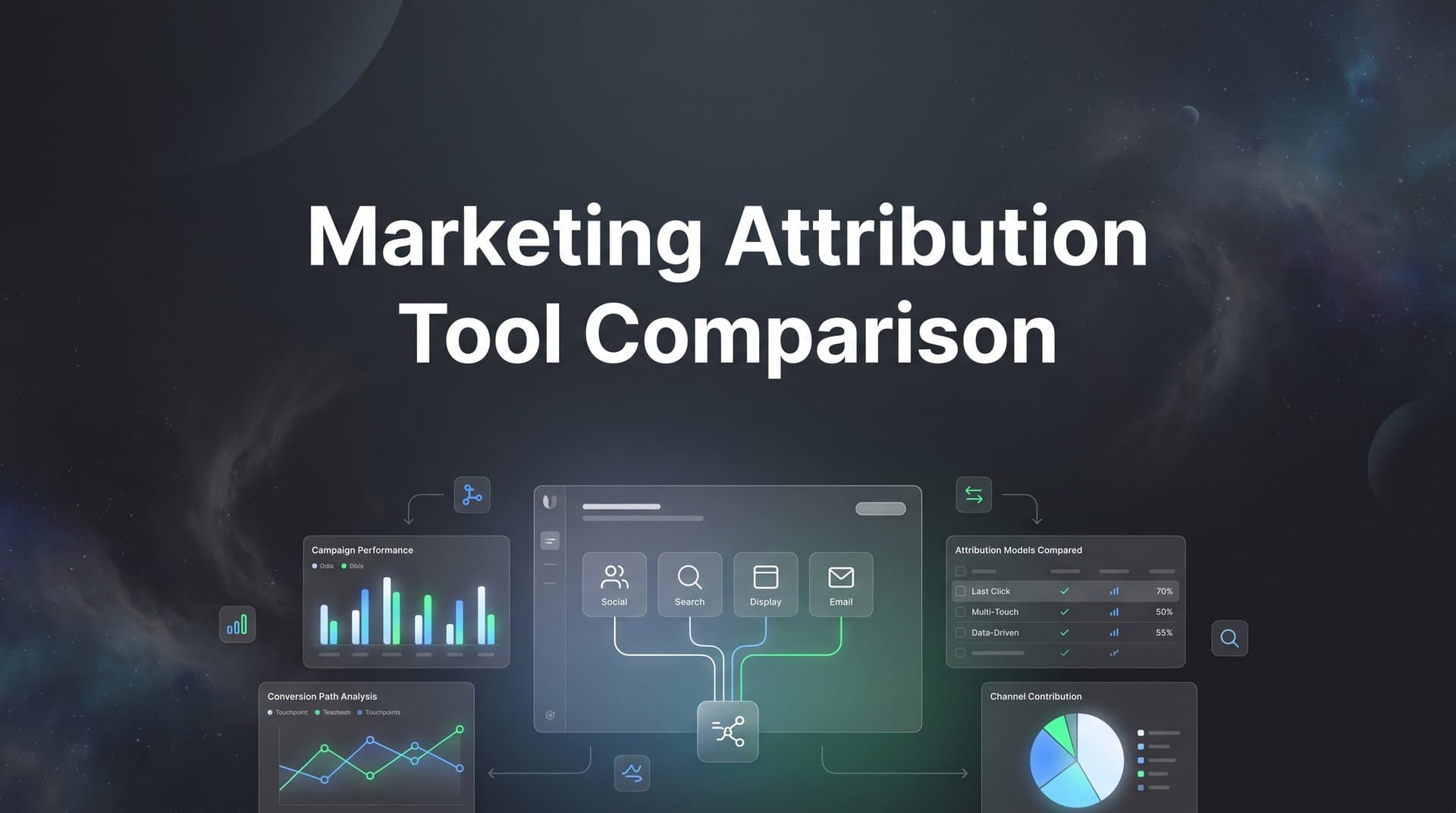
Tracking which ads and channels actually drive revenue has never been more complicated. Customers interact with your brand across multiple touchpoints, devices, and platforms before converting, and native ad platform reporting often gives you an incomplete or conflicting picture of what's really working.
Choosing the right attribution tool comes down to a few key factors: your tech stack, the channels you run, how granular you need your data, and your budget. To help you cut through the noise, we evaluated these tools based on multi-touch attribution capabilities, platform integrations, data accuracy, ease of setup, and pricing transparency.
Whether you're a DTC brand scaling paid social, a B2B team connecting marketing to pipeline, or an agency managing spend across a dozen channels, there's a tool on this list built for your situation. If you're also thinking about how attribution fits into your broader analytics strategy, it's worth reading up on marketing attribution models and multi-touch attribution before diving in.
1. Cometly
Best for: Teams running paid campaigns across multiple channels who need AI-powered attribution and optimization.
Cometly is an AI-powered marketing attribution platform that connects your ad platforms, CRM, and website to track the full customer journey and feed enriched conversion data back to ad algorithms.
 9 Best Marketing Attribution Tools Compared for 2026
Where This Tool Shines
Cometly addresses one of the biggest problems in modern paid advertising: the gap between what ad platforms report and what's actually driving revenue. By combining server-side tracking with multi-touch attribution, it captures conversion data that browser-based tracking frequently misses due to iOS privacy restrictions and ad blockers.
What sets Cometly apart is its Conversion Sync feature, which feeds enriched, verified conversion events back to Meta, Google, TikTok, and other ad platforms. This gives ad algorithms better data to work with, improving targeting and optimization over time. Pair that with AI-driven recommendations and natural-language reporting, and you get a platform that doesn't just show you data but helps you act on it.
Key Features
AI-Powered Multi-Touch Attribution: Tracks every paid channel touchpoint across the full customer journey, giving credit where it's actually due rather than defaulting to last click.
Server-Side Tracking: Captures conversion data accurately even when browser privacy restrictions, iOS changes, or ad blockers would otherwise create gaps.
Conversion Sync: Sends enriched conversion events back to Meta, Google, TikTok, and other platforms to improve algorithmic targeting and campaign performance.
AI Ads Manager: Delivers real-time budget optimization recommendations based on actual attribution data, so you're scaling what's working and cutting what isn't.
AI Chat: Lets you query your marketing data in plain language, making reporting faster and more accessible without needing to build custom dashboards.
Best For
Cometly is a strong fit for growth-focused marketing teams and agencies managing paid campaigns across multiple platforms. It's particularly valuable for businesses that want to close the loop between attribution data and ad platform optimization, rather than just reporting on results after the fact.
Pricing
Custom pricing based on ad spend. A demo is available on request via the Cometly website, which is the best way to get a quote tailored to your scale.
2. Triple Whale
Best for: DTC e-commerce brands on Shopify needing unified profit, creative, and attribution data.
Triple Whale is an e-commerce-focused analytics and attribution platform built around deep Shopify integration and creative performance tracking.
 7 Best Funnel.io Alternatives for Marketing Data Analytics in 2026
Where This Tool Shines
Triple Whale was built with DTC brands in mind, and it shows. The platform pulls together ad spend, revenue, cost of goods, and shipping data into a single dashboard so you can see true profitability alongside attribution, not just top-line ROAS. For brands managing multiple ad creatives across Meta and TikTok, the creative analytics layer is genuinely useful.
The customer journey visualization helps teams understand how customers move from awareness to purchase, while influencer and affiliate attribution brings non-paid channels into the picture. It's a well-rounded solution for brands where Shopify is the center of operations.
Key Features
Native Shopify Integration: Real-time profit and loss tracking that connects ad spend directly to revenue and margins without manual exports.
Creative Analytics: Measures ad creative performance across platforms to identify which visuals and copy are actually driving conversions.
Pixel and Server-Side Tracking: Combines both tracking methods to improve data accuracy across privacy-restricted environments.
Influencer and Affiliate Attribution: Tracks conversions from influencer campaigns and affiliate partners alongside paid channel data.
Customer Journey Visualization: Maps the path from first touch to purchase so you can see how channels work together.
Best For
DTC e-commerce brands running on Shopify, particularly those with active paid social campaigns and influencer programs. Less suited for B2B, lead gen, or businesses operating outside the Shopify ecosystem.
Pricing
Plans start around $100/month and scale based on revenue. Higher tiers unlock more advanced analytics and creative reporting features.
3. Northbeam
Best for: High-spend e-commerce brands that need multi-touch attribution combined with media mix modeling.
Northbeam is a machine-learning-powered attribution platform that blends multi-touch attribution with media mix modeling and incrementality testing.
 9 Best Analytics Platforms for Paid Ads in 2026
Where This Tool Shines
Northbeam is built for brands that have outgrown simple attribution and need a more sophisticated view of how their marketing budget is working. The combination of multi-touch attribution for channel-level insights and media mix modeling for top-level budget planning gives marketing leaders tools to make both tactical and strategic decisions from the same platform.
The incrementality testing feature is particularly valuable for brands running large-scale campaigns. Rather than just attributing conversions, it helps you measure the true lift that specific channels or campaigns are generating, which is a much harder question to answer.
Key Features
Multi-Touch Attribution: Customizable attribution windows that reflect your actual sales cycle rather than defaulting to platform-standard windows.
Media Mix Modeling: Top-level budget planning analysis that accounts for channel interactions and diminishing returns.
Incrementality Testing: Measures true lift from campaigns to separate actual impact from organic conversions that would have happened anyway.
Creative-Level Insights: Breaks down performance at the individual creative level to inform content decisions.
Cross-Channel Spend Optimization: Recommendations for reallocating budget based on modeled performance data.
Best For
E-commerce brands with significant ad spend who want to move beyond standard attribution and incorporate media mix modeling into their planning. Best suited for teams with dedicated analytics resources who can act on the insights.
Pricing
Custom pricing. Northbeam is generally positioned for brands with substantial ad budgets, so it's worth requesting a quote to evaluate fit.
4. Rockerbox
Best for: Brands running omnichannel campaigns that include offline channels like TV, direct mail, and podcasts.
Rockerbox is an omnichannel attribution platform that unifies digital and offline marketing measurement in a single view.
 9 Best Marketing Attribution Tools Compared for 2026
Where This Tool Shines
Most attribution tools are built around digital channels, which leaves brands running TV, direct mail, or podcast advertising with a significant blind spot. Rockerbox fills that gap by bringing offline and online attribution into the same platform, so you're not maintaining separate measurement systems for different channel types.
The deduplication logic is another strength. When multiple channels contribute to a conversion, Rockerbox works to ensure you're not double-counting results across platforms, which is a common problem when relying on native ad platform reporting alongside third-party tools.
Key Features
Omnichannel Attribution: Covers digital, TV, direct mail, and podcast channels in a unified measurement framework.
Multi-Touch Model Comparison: Lets you compare first-touch, last-touch, and multi-touch attribution models side by side.
Deduplicated Conversion Tracking: Reduces double-counting across platforms to give you a more accurate conversion count.
Marketing Spend Optimization Dashboard: Surfaces channel-level performance data to inform budget allocation decisions.
Platform Integrations: Connects with major ad platforms and analytics tools to centralize your data.
Best For
Mid-market and enterprise brands running a mix of digital and offline marketing channels who need a single source of truth across all their spend. Particularly valuable for brands investing in linear TV or direct mail alongside digital campaigns.
Pricing
Custom pricing based on channels and data volume. Contact Rockerbox directly for a quote.
5. Hyros
Best for: High-ticket businesses, info products, and coaching funnels with long sales cycles and phone-based conversions.
Hyros is an attribution platform designed for businesses where the path from ad click to closed sale spans days or weeks and often involves a phone call.
 7 Best Northbeam Alternatives for Small Business in 2026
Where This Tool Shines
Standard attribution tools are built around e-commerce-style conversions where someone clicks an ad and buys within a short window. Hyros is built for a different reality: high-ticket offers where a prospect might see an ad, sign up for a webinar, attend a call, and then purchase weeks later. The long attribution windows ensure that the original ad touchpoint still gets credit for that sale.
Call tracking attribution is a standout feature for businesses that close deals over the phone. Connecting a phone conversion back to the specific ad that started the journey is a capability that most general-purpose attribution tools don't handle well.
Key Features
Long Attribution Windows: Tracks conversions over extended periods to match high-ticket sales cycles where purchase decisions take time.
Call Tracking Attribution: Connects phone-based conversions back to the original ad touchpoints that initiated the customer journey.
AI-Driven Ad Optimization: Provides recommendations for improving ad performance based on attributed revenue data.
Ad Platform Data Feedback: Sends conversion data back to ad platforms to improve algorithmic targeting.
Funnel-Level Tracking: Reports on performance at each stage of the funnel, not just at the final conversion point.
Best For
High-ticket coaches, consultants, course creators, and info product businesses running paid traffic to webinars, VSLs, or application funnels. Less suited for standard e-commerce or B2B SaaS with product-led growth models.
Pricing
Plans start around $99/month and scale with ad spend and feature requirements. Review current pricing on the Hyros website as tiers can change.
6. Ruler Analytics
Best for: Lead generation businesses that need to connect marketing touchpoints to CRM revenue data.
Ruler Analytics is a revenue attribution platform that ties marketing activity to closed deals in your CRM, including conversions that happen via calls, forms, and live chat.
 8 Best Attribution Tools with Onboarding Support in 2026
Where This Tool Shines
For lead gen businesses, the attribution challenge is different from e-commerce. The conversion event isn't a purchase; it's a form fill, a call, or a chat message that eventually becomes a deal weeks later. Ruler Analytics is built specifically for this workflow, tracking the full journey from first marketing touchpoint through to closed revenue in your CRM.
The integration with Salesforce, HubSpot, and other CRMs means that revenue data flows back into the attribution model, so you're measuring actual business outcomes rather than just lead volume. This is a meaningful distinction for teams that care about lead quality, not just quantity.
Key Features
CRM Revenue Attribution: Connects marketing touchpoints directly to closed deal revenue, not just lead conversions.
Multi-Channel Conversion Tracking: Captures conversions from calls, forms, and live chat in a single attribution view.
Multi-Touch Attribution Models: Compare different attribution models side by side to understand how credit is distributed across touchpoints.
CRM Integrations: Native integrations with Salesforce, HubSpot, and other major CRM platforms.
Offline Conversion Tracking: Brings offline conversion events into the attribution model for a more complete picture.
Best For
B2C and B2B lead generation businesses, professional services firms, and agencies where the customer journey involves multiple touchpoints and a sales team closes deals. Particularly strong for teams already using Salesforce or HubSpot.
Pricing
Plans start around $200/month. Pricing scales based on tracked sessions and features required.
7. Dreamdata
Best for: B2B companies with complex, multi-stakeholder sales cycles that need account-level attribution.
Dreamdata is a B2B revenue attribution platform that maps account-level customer journeys and connects marketing activity to pipeline and closed revenue.
Where This Tool Shines
B2B attribution is fundamentally different from B2C. Multiple stakeholders from the same company interact with your marketing over months before a deal closes, and standard person-level attribution models miss this entirely. Dreamdata operates at the account level, stitching together all the touchpoints from everyone at a given company into a single journey view.
The content attribution capability is particularly useful for B2B teams investing in organic content, webinars, and gated assets. Understanding whether a blog post or a webinar influenced a deal that closed three months later is a question most tools can't answer, and Dreamdata addresses it directly.
Key Features
Account-Based Attribution: Tracks and attributes touchpoints at the account level rather than the individual level, reflecting how B2B buying actually works.
Full Customer Journey Mapping: Visualizes every interaction from first touch to closed deal at the account level.
Pipeline and Revenue Attribution: Connects marketing activity to pipeline creation and won revenue across all channels.
Content Attribution: Measures the influence of blog posts, webinars, and downloadable assets on deal outcomes.
CRM and Marketing Automation Integrations: Connects with Salesforce, HubSpot, and major marketing automation platforms.
Best For
B2B SaaS companies, professional services firms, and enterprise marketing teams running account-based marketing programs with long sales cycles. The free tier makes it accessible for smaller teams getting started with B2B attribution.
Pricing
A free tier is available for smaller teams. Paid plans start around $999/month, reflecting the enterprise-grade nature of the platform.
8. AppsFlyer
Best for: Mobile app businesses that need accurate install attribution, in-app event tracking, and fraud prevention.
AppsFlyer is a mobile attribution and marketing analytics platform that tracks app installs, in-app events, and deep links with built-in fraud detection.
Where This Tool Shines
Mobile attribution operates in a fundamentally different environment from web attribution. App store privacy frameworks, SKAdNetwork limitations, and the complexity of deep linking create challenges that general-purpose attribution tools aren't equipped to handle. AppsFlyer was built specifically for this environment and has become one of the most widely used platforms in the mobile marketing space.
The fraud prevention engine is a meaningful differentiator. Mobile ad fraud is a persistent problem, and having detection built into your attribution layer rather than as a separate tool simplifies operations and reduces wasted spend.
Key Features
Mobile Install and In-App Event Attribution: Tracks which campaigns and networks drive installs and downstream in-app actions like purchases and subscriptions.
Deep Linking: Enables seamless user experiences by routing users to specific in-app content from ads and other sources.
Fraud Prevention: Built-in detection identifies and blocks fraudulent installs and events before they skew your data.
SKAdNetwork and Privacy Sandbox Support: Handles Apple's SKAdNetwork framework and Google's Privacy Sandbox to maintain measurement in privacy-first environments.
Partner Integrations: Connects with thousands of ad networks, agencies, and analytics tools across the mobile ecosystem.
Best For
Mobile app developers, gaming companies, and any business where the primary customer experience lives inside a mobile app. Not designed for web-only businesses or traditional e-commerce without an app component.
Pricing
A free tier is available for apps with lower conversion volumes. Paid plans scale based on conversion volume and are available on request from AppsFlyer.
9. Google Analytics 4 (GA4)
Best for: Teams that need a free baseline attribution tool with native Google Ads integration.
Google Analytics 4 is Google's free analytics platform with built-in data-driven attribution modeling, cross-device tracking, and native integration with Google Ads and Search Console.
Where This Tool Shines
GA4's biggest advantage is its price point: free. For teams that are primarily running Google Ads and want attribution data without additional tool costs, the native integration between GA4 and Google Ads is genuinely seamless. The data-driven attribution model, which distributes credit across touchpoints based on actual conversion patterns, is a meaningful step up from simple last-click models.
The BigQuery export capability opens up advanced analysis for teams with data engineering resources. And the event-based tracking model, while requiring more setup than the old Universal Analytics, gives you flexibility to track almost any user action as a conversion event.
Key Features
Data-Driven Attribution: Distributes conversion credit across touchpoints using machine learning, available at no cost within the platform.
Cross-Device Tracking: Connects user behavior across devices and platforms using Google signals and user IDs.
Native Google Integrations: Direct connection to Google Ads and Search Console for unified reporting without additional setup.
Custom Event Tracking: Flexible event-based model lets you define and track virtually any user action as a conversion.
BigQuery Export: Raw data export to BigQuery enables advanced analysis and custom reporting for technical teams.
Best For
Businesses of all sizes that want a free attribution baseline, especially those heavily invested in Google Ads. It's a starting point rather than a complete solution for teams running complex multi-channel campaigns where non-Google channels need equal measurement depth.
Pricing
Free for standard use. GA4 360, the enterprise version with higher data limits and additional features, is available through Google's sales team with custom pricing.
Which Tool Is Right for Your Business?
The best attribution tool isn't the one with the most features. It's the one that fits your business model, channel mix, and the decisions you actually need to make.
Here's a quick breakdown of where each tool fits best:
Cometly: Best for paid media teams running campaigns across multiple platforms who want AI-powered attribution, server-side tracking accuracy, and conversion data fed back to ad algorithms for better optimization.
Triple Whale: Best for DTC e-commerce brands on Shopify who need unified profit, creative, and attribution data in one dashboard.
Northbeam: Best for high-spend e-commerce brands that want to combine multi-touch attribution with media mix modeling and incrementality testing.
Rockerbox: Best for brands running omnichannel campaigns that span digital and offline channels like TV, direct mail, and podcasts.
Hyros: Best for high-ticket businesses, coaches, and info product creators with long sales cycles and phone-based conversions.
Ruler Analytics: Best for lead generation businesses that need to connect marketing touchpoints to CRM revenue across calls, forms, and chat.
Dreamdata: Best for B2B companies with complex, multi-stakeholder sales cycles that require account-level attribution.
AppsFlyer: Best for mobile app businesses that need install attribution, in-app event tracking, and fraud prevention built in.
GA4: Best as a free baseline for teams primarily running Google Ads, or as a supplementary data source alongside a dedicated attribution tool.
If your team is running paid campaigns across Meta, Google, TikTok, and other platforms and you want attribution data that actually improves your ad performance rather than just reporting on it, Cometly is built for exactly that use case. The combination of server-side tracking, multi-touch attribution, and Conversion Sync creates a feedback loop where better data leads to better algorithmic targeting, which leads to better results.
Ready to see how it works for your campaigns? Get your free demo and start capturing every touchpoint to maximize your conversions.