Your campaigns are generating leads. The dashboard looks healthy. Cost per lead is down, volume is up, and the team is hitting targets. Then the quarterly business review happens, and someone in the room asks the question that changes everything: "Which of these campaigns actually drove revenue?"
Suddenly, the metrics that felt so solid start to look incomplete. Lead volume tells you how many people raised their hand. It does not tell you which hands were attached to people who eventually signed contracts.
This is the core tension B2B SaaS marketing teams live with every day. Lead attribution and pipeline attribution are not competing philosophies. They answer fundamentally different questions. And using the wrong one as your primary decision-making lens leads to misallocated budget, frustrated sales teams, and a marketing function that cannot credibly connect its work to revenue.
This guide is for marketing leaders who need to understand both models clearly, know when each one applies, and build an attribution strategy that serves both short-term campaign optimization and long-term revenue accountability. Let's start with what each model actually measures.
Two Attribution Models, Two Different Questions
Attribution, at its core, is about answering one question: which marketing touchpoints influenced this outcome? The answer changes dramatically depending on what you define as "the outcome."
Lead attribution defines the outcome as lead creation. A prospect clicks an ad, fills out a demo request form, or signs up for a trial. That event is the finish line. Lead attribution looks backward from that moment and assigns credit to the touchpoints that brought the prospect there. The metrics it produces are familiar: cost per lead, lead volume by channel, lead source distribution, and conversion rate from click to form fill.
These metrics are genuinely useful for understanding top-of-funnel performance. They tell you which channels are reaching your target audience, which messages are compelling enough to generate a response, and how efficiently your budget is generating hand-raisers. For campaign optimization at the awareness and consideration stages, lead attribution provides the feedback loop you need.
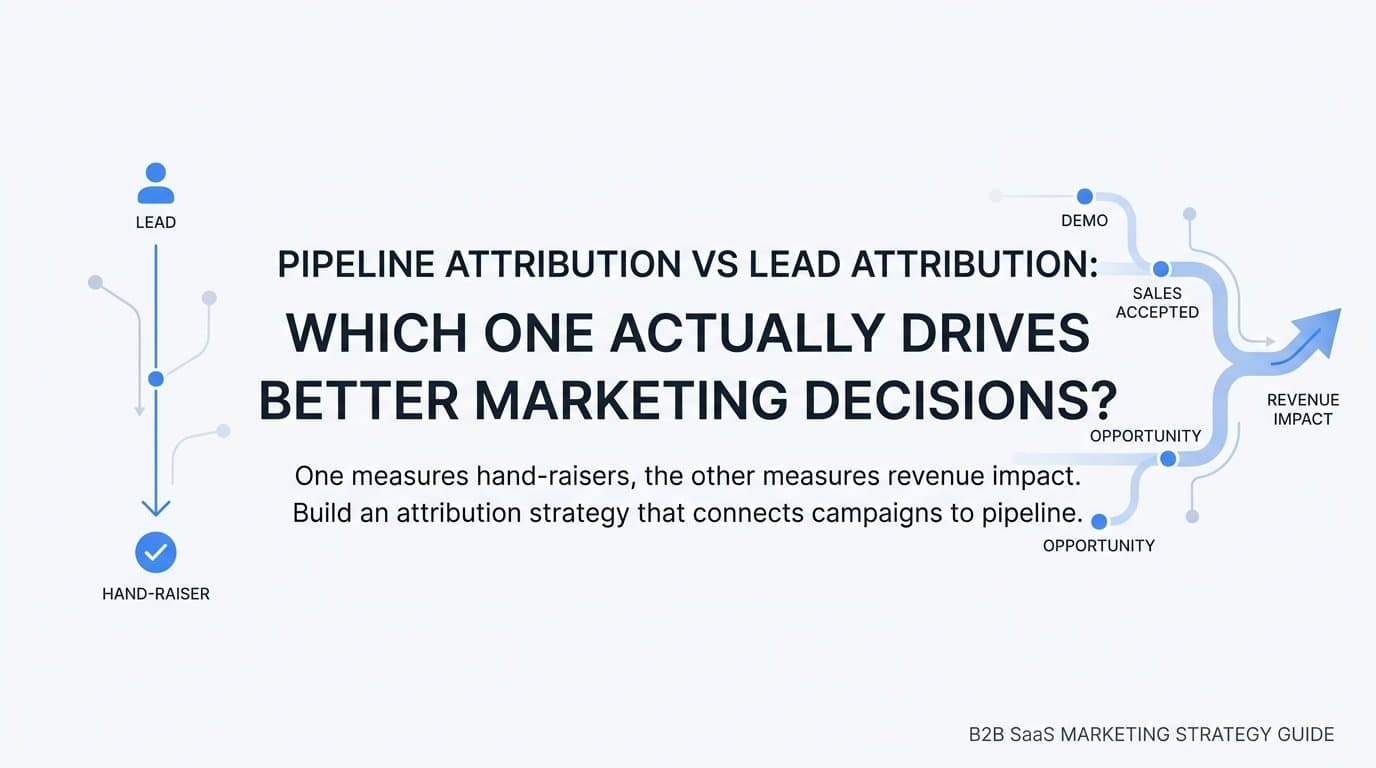
Pipeline attribution defines the outcome differently. Instead of stopping at lead creation, it extends measurement forward into your CRM. The conversion event is opportunity creation: the moment a lead becomes a qualified deal that enters the sales pipeline. Pipeline attribution connects specific campaigns, ads, and channels to the opportunities those interactions influenced, and it assigns credit based on the touchpoints that occurred before and during the deal's progression through stages.
The pipeline attribution question is not "which channels generated leads?" It is "which channels generated deals worth pursuing?" That distinction has significant consequences for how you allocate budget and how you evaluate channel performance.
Think of it this way. Lead attribution measures the top of a funnel. Pipeline attribution measures what flows through it. A channel can look excellent on lead attribution metrics while performing poorly on pipeline attribution if the leads it generates rarely qualify as real opportunities. Conversely, a channel with modest lead volume might punch far above its weight when you look at how many of those leads become pipeline.
The fundamental difference is the conversion event each model tracks. Lead attribution stops at form submission. Pipeline attribution follows the journey into the CRM and through deal stages, connecting marketing activity to revenue in progress rather than activity in isolation. Understanding this distinction is the first step toward building an attribution strategy that actually informs decisions at every level of the organization.
Why Lead Attribution Alone Misleads B2B Marketing Teams
Lead attribution is not wrong. It is incomplete. And in B2B SaaS, incomplete attribution does not just leave gaps in your understanding. It actively points you in the wrong direction.
The most common problem is volume optimization without quality validation. When lead volume is your primary success metric, you naturally direct budget toward channels that produce the most leads at the lowest cost. This makes sense on paper. In practice, it often means concentrating spend on sources that attract high-intent-looking but low-converting prospects. A channel that generates many leads at low cost might be filling your pipeline with people who will never buy, while a more expensive channel that generates fewer leads might be consistently producing your best customers.
Without pipeline attribution to validate which lead sources actually convert to opportunities, you have no way to know the difference. You are optimizing for a proxy metric and hoping it correlates with revenue. Sometimes it does. Often, it does not.
This creates a structural disconnect between marketing and sales that is one of the most persistent sources of tension in B2B organizations. Marketing reports success based on lead volume metrics. Sales reports frustration based on lead quality. Both teams are right from their own vantage point. Marketing delivered what it was measured on. Sales received leads that did not convert. Leadership sits between them without a shared truth to adjudicate the disagreement.
Pipeline attribution resolves this by giving both teams a common metric: pipeline generated and influenced by marketing activity. When marketing can show that specific campaigns drove qualified opportunities, and sales can see which lead sources produce their best deals, the conversation shifts from blame to collaboration.
There is also a timing problem with lead attribution that is specific to B2B SaaS. Sales cycles in this category often span weeks or months. A prospect might interact with paid ads, read three pieces of organic content, attend a webinar, engage with a sales sequence, and participate in multiple product demos before becoming a closed-won customer. Lead attribution captures the first portion of this journey, sometimes just the first touchpoint, and declares the measurement complete at the moment of form fill.
That means the touchpoints that actually influence the purchase decision, the content that addressed the prospect's specific objection, the retargeting ad that re-engaged them during evaluation, the case study that convinced the economic buyer, receive no credit in a lead attribution model. You end up with a picture of what started the journey, not what completed it. For a sales cycle that lasts months, that is a significant blind spot.
Optimizing purely for lead volume without validating pipeline quality also inflates customer acquisition cost in ways that are not immediately visible. Sales teams spend time working leads that will not convert, which increases the cost per closed deal even when cost per lead looks healthy. By the time this shows up in revenue metrics, significant budget has already been misallocated.
What Pipeline Attribution Reveals That Lead Attribution Cannot
Pipeline attribution does not replace lead attribution. It extends your visibility into the parts of the customer journey that actually determine whether marketing investment translates into revenue.
The most direct value is connecting specific campaigns, ads, and channels to deal value. Instead of knowing that a LinkedIn campaign generated 200 leads, pipeline attribution tells you that those 200 leads produced 18 qualified opportunities worth a specific amount of pipeline. You can compare that to a Google Ads campaign that generated 400 leads but produced only 12 opportunities with lower average deal value. The lead attribution story favors Google Ads. The pipeline attribution story might favor LinkedIn. Budget decisions made on lead attribution alone could systematically underinvest in your highest-revenue-generating channel.
Pipeline attribution also surfaces influence at later deal stages, not just entry points. In a multi-touch B2B sales cycle, some marketing touchpoints introduce the brand. Others educate the prospect during evaluation. Others re-engage a deal that has gone quiet. Lead attribution gives credit to introduction touchpoints. Pipeline attribution can assign credit across the entire journey, revealing which content, campaigns, and channels are doing the heavy lifting during consideration and evaluation rather than just at the top of the funnel.
This matters because the channels that nurture deals to close are often different from the channels that generate initial interest. Retargeting campaigns, email sequences, and bottom-of-funnel content rarely show up as lead sources, but they frequently appear in the touchpoint history of closed-won deals. Without pipeline attribution, these channels are invisible in your performance data and vulnerable to budget cuts.
Pipeline attribution also enables more accurate customer acquisition cost calculations. When you can connect marketing spend to the specific opportunities it influenced, you can calculate a true cost per pipeline dollar generated rather than a cost per lead. This gives finance and leadership a metric that actually maps to business outcomes, which makes marketing's budget requests more credible and easier to evaluate.
Budget forecasting improves as well. If you know that a specific channel historically generates a certain amount of pipeline per dollar spent, you can model what additional investment in that channel is likely to produce. Lead attribution cannot support this kind of forecasting because the relationship between lead volume and pipeline is not stable across channels. Pipeline attribution makes the relationship direct and measurable.
For B2B SaaS companies working toward full revenue attribution, where closed-won deal value is connected back to specific marketing touchpoints, pipeline attribution is the essential stepping stone. It establishes the data connections and measurement infrastructure that revenue attribution requires, and it begins shifting the organization's thinking from activity metrics to outcome metrics.
When to Use Each Model and How They Work Together
The goal is not to choose between lead attribution and pipeline attribution. The goal is to use each one where it provides the most useful signal.
Lead attribution is the right tool for optimizing top-of-funnel campaigns in real time. When you are testing a new ad creative, launching a campaign on a new channel, or trying to understand whether a particular audience segment is responding to your messaging, you need fast feedback. Pipeline attribution operates on a longer time horizon because deals take time to develop. If you are waiting for pipeline data to evaluate a campaign you launched two weeks ago, you will be too slow to make meaningful optimizations.
Lead attribution also makes sense for understanding reach and awareness efficiency. When the question is "how effectively are we reaching our target audience and generating initial interest?", lead volume, cost per lead, and lead source distribution are the right metrics. These are legitimate questions that deserve accurate answers, and lead attribution answers them well.
Pipeline attribution is the right tool for budget allocation decisions and quarterly planning. When you are deciding how to distribute budget across channels for the next quarter, you need to know which channels produce revenue-generating opportunities, not just leads. Pipeline attribution provides that signal. It is also the model you need for board-level conversations about marketing's contribution to revenue, because leadership is evaluating marketing on its impact on the business, not on its ability to generate form fills.
The strongest attribution strategy layers both models so they inform each other. Lead attribution identifies which campaigns are generating volume and which audiences are responding. Pipeline attribution validates which of those lead sources are actually producing qualified opportunities. Over time, you build a feedback loop: lead attribution data helps you optimize campaigns quickly, while pipeline attribution data validates which lead sources deserve continued investment and which should be reconsidered despite strong lead metrics.
For example, if lead attribution shows that a particular content syndication campaign is generating leads at low cost, but pipeline attribution shows that almost none of those leads become opportunities, that is a clear signal to redirect budget. Without both models running simultaneously, you might continue investing in that channel based on lead metrics alone, not realizing it is generating volume without value.
Think of lead attribution as your short-term optimization layer and pipeline attribution as your long-term validation layer. Neither is complete without the other. Together, they give you a picture of marketing performance that is both actionable in the moment and credible over time.
The Data Infrastructure Required to Run Both Models
Understanding the strategic value of pipeline attribution is straightforward. Building the infrastructure to run it accurately is where most teams encounter friction.
Accurate pipeline attribution requires connecting three data systems that are often managed separately: ad platform data, website tracking data, and CRM data. The connection has to be continuous and bidirectional. A touchpoint recorded in your ad platform when someone clicks an ad needs to be associated with the lead record created when that person fills out a form, and that association needs to carry forward to the opportunity record created when the lead qualifies as a deal. If any link in that chain breaks, pipeline attribution becomes impossible for that prospect's journey.
This is why so many B2B marketing teams struggle with pipeline attribution even when they understand its value. The data exists in separate systems with different identifiers, different timestamp formats, and different definitions of what constitutes a touchpoint. Bridging those systems requires deliberate integration work, not just connecting platforms at a surface level.
Multi-touch attribution models are essential for pipeline attribution because B2B deals are rarely influenced by a single touchpoint. A linear attribution model distributes credit equally across all touchpoints in a deal's history. A time-decay model gives more credit to touchpoints closer to conversion. A data-driven model uses historical patterns to assign credit based on which touchpoints are statistically associated with deals that close. Each approach has trade-offs, but all of them are more accurate than single-touch models for B2B sales cycles where multiple interactions over extended periods drive the outcome.
Server-side tracking and first-party data collection are not optional for teams that want reliable pipeline attribution. Browser-based tracking has become increasingly unreliable due to cookie restrictions, ad blockers, and privacy changes across major platforms. When client-side pixels miss events, the touchpoint history for a prospect becomes incomplete. If a touchpoint is not recorded, it cannot receive credit in any attribution model, which means your pipeline attribution data systematically undervalues channels whose traffic is more likely to use ad blockers or privacy-focused browsers.
Server-side tracking captures events at the server level rather than relying on the browser to fire a pixel, which means it is not affected by the same limitations. Conversion API integrations with platforms like Meta and Google allow you to send event data directly from your server to the ad platform, improving both the completeness of your attribution data and the quality of signals you send back to ad platform algorithms for optimization.
First-party data collection, meaning data you collect directly through your own properties rather than relying on third-party cookies, is the foundation that makes server-side tracking work. When you own the data and control how it is collected and stored, you are not dependent on third-party infrastructure that can change or disappear.
Building an Attribution Strategy That Scales
The most important first step is an honest audit of where your touchpoint data is currently lost. Map the journey from ad click to lead creation to opportunity stage and identify every point where the connection between those events is broken or unreliable. Common gaps include ad clicks that are not tied to form submissions because UTM parameters are stripped, lead records that do not carry source data forward to opportunity records in the CRM, and touchpoints that occur after lead creation but before opportunity creation that are not captured at all.
Closing those gaps is the prerequisite for running pipeline attribution accurately. You cannot build a reliable model on incomplete data, and the most sophisticated attribution platform will produce misleading results if the underlying touchpoint data has significant holes.
Aligning marketing and sales around shared attribution definitions is equally important and often underestimated. Both teams need to agree on what counts as a pipeline-attributed touchpoint, how credit is assigned across deal stages, and what the shared metrics are that both teams will be held accountable to. Without this alignment, pipeline attribution data becomes a source of disagreement rather than a shared truth. Marketing and sales will interpret the same data differently based on their own incentives, which defeats the purpose of having a unified attribution model.
The operational reality is that switching between lead attribution and pipeline attribution views should not require manual data reconciliation. If your team has to export data from your ad platform, match it to CRM exports in a spreadsheet, and manually calculate pipeline attributed to each channel, that process will not happen consistently. It will happen when someone has time, which means it will not inform real-time decisions.
A platform that unifies ad data, CRM events, and customer journey tracking in one place makes both models accessible without friction. Cometly connects your ad platforms, CRM, and website tracking so you can see which campaigns are generating leads and which of those leads are becoming pipeline, all from a single interface. It supports multi-touch attribution across the full customer journey, uses server-side tracking to capture touchpoints that browser-based pixels miss, and sends enriched conversion data back to ad platforms to improve their optimization algorithms.
The result is an attribution strategy that gives you fast feedback for campaign optimization through lead-level data and long-term validation through pipeline and revenue attribution, without requiring your team to manually bridge the gap between those two views.
The Bottom Line on Attribution Models
Neither lead attribution nor pipeline attribution is universally superior. They are tools that answer different questions, and the question you ask determines which tool you reach for.
Lead attribution answers: how efficiently are we generating interest? Pipeline attribution answers: which of that interest is actually becoming revenue? B2B SaaS marketing teams that rely exclusively on lead attribution optimize for a metric that does not always correlate with the business outcomes leadership cares about. Teams that try to run only on pipeline attribution lose the fast feedback loops they need to optimize campaigns in real time.
The practical path forward is to run both models, understand what each one is telling you, and use them together to make decisions that are both timely and strategically sound. That requires the right data infrastructure, alignment between marketing and sales on shared definitions, and a platform that makes switching between views effortless.
If you are ready to connect your ad spend directly to pipeline and revenue so you can run both attribution models from a single source of truth, Get your free demo and see how Cometly gives your team the complete picture from first ad click to closed-won deal.