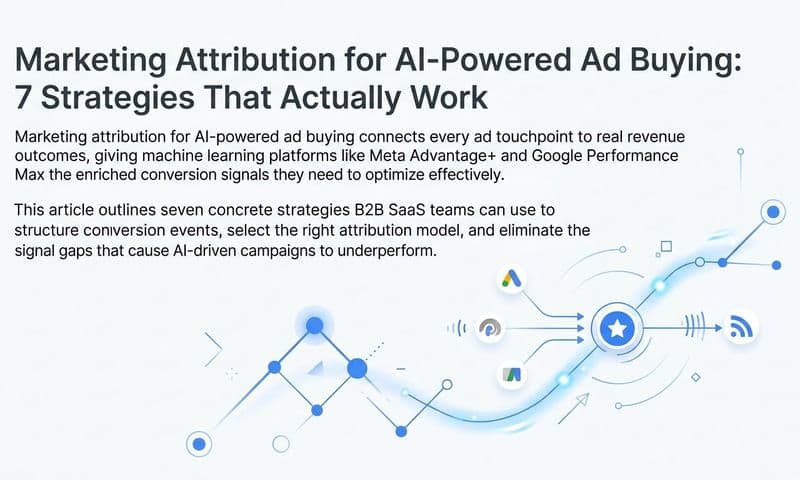

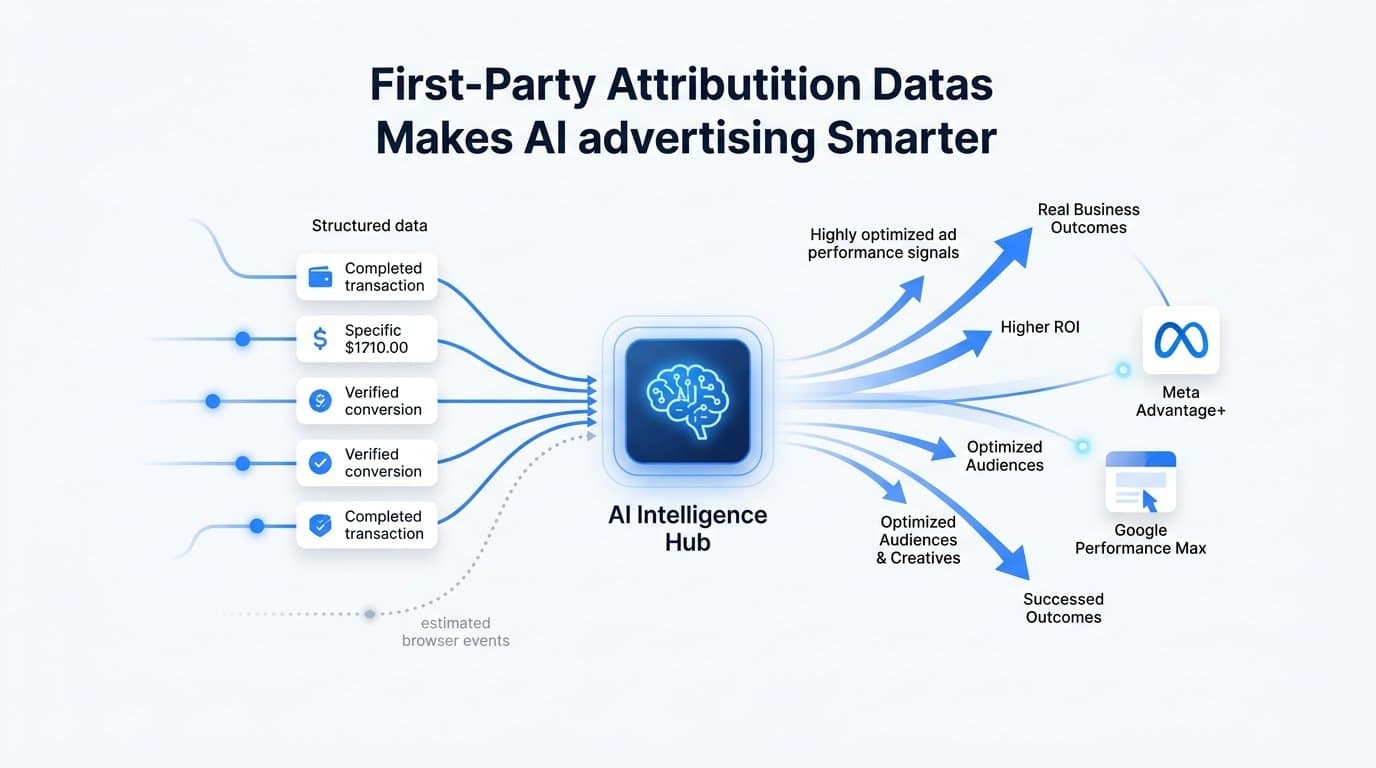
First party attribution data makes AI ads smarter by giving ad platform algorithms accurate, complete conversion signals that reflect real business outcomes rather than estimated or incomplete browser-based events. When AI systems like Meta Advantage+ or Google Performance Max receive richer, more reliable data about which clicks led to actual pipeline and revenue, they optimize toward audiences and creatives that drive genuine results.
This matters more now than it ever has. As browser-based tracking continues to erode due to privacy changes, ad blockers, and iOS restrictions, the gap between what pixels capture and what actually happens in your business keeps widening. Ad platform AI fills that gap with assumptions, and those assumptions cost you money.
Platforms like Cometly are built specifically to collect, enrich, and send first party conversion data back to Meta, Google, and other ad networks via server-side integrations, giving AI algorithms a cleaner signal than browser pixels alone can provide. Whether you are running paid search, paid social, or multi-channel campaigns, the quality of your conversion data is now the single biggest lever you control for improving AI-driven ad performance.
The strategies below break down the specific mechanisms behind that process and show exactly how B2B SaaS marketing teams can feed their ad AI better data starting today.
What Is First Party Attribution Data?
First party attribution data is conversion and customer information collected directly by your business, from your own website, CRM, payment processor, or product, and used to measure which marketing touchpoints led to a desired outcome. Unlike third party data sourced from external providers, first party data is collected with user consent through your own systems, making it both more accurate and more durable as privacy regulations tighten.
In the context of AI ad optimization, first party attribution data typically includes events like form submissions, demo bookings, trial signups, qualified pipeline entries, and closed-won revenue, all tied back to the specific ad clicks or impressions that preceded them.
Why Data Quality Is the Foundation of AI Ad Performance
Ad platform AI does not think. It pattern-matches. Meta Advantage+ and Google Smart Bidding identify which users, creatives, placements, and times of day correlate with your defined conversion events, then shift budget and bids toward more of the same.
If the conversion events you feed those systems are incomplete, delayed, or inaccurate, the patterns they learn are wrong. The AI optimizes confidently toward the wrong audience. You get more volume, lower quality, and a growing gap between what your dashboard shows and what your CRM records.
First party attribution data closes that gap by replacing estimated or partial signals with verified, business-level outcomes. That is the core mechanism behind everything that follows.
1. Send Server-Side Conversion Events Instead of Relying on Pixels
The Challenge It Solves
Browser pixels are fragile. Safari's Intelligent Tracking Prevention, Firefox Enhanced Tracking Protection, iOS privacy changes, and ad blockers all interfere with pixel-based event tracking. Meta and Google both publicly document this signal loss problem, and it directly degrades the conversion data their AI systems receive. If a significant portion of your conversions never register, your AI is optimizing on an incomplete dataset.
The Strategy Explained
Server-side tracking sends conversion events directly from your server to the ad platform's API, bypassing the browser entirely. Meta calls this the Conversions API (CAPI). Google calls it Enhanced Conversions. Because the event travels server-to-server, it is not affected by browser restrictions, ad blockers, or device-level privacy settings.
The result is a more complete conversion signal. Meta publicly states that higher Event Match Quality (EMQ) scores, which improve with better server-side data, correlate with stronger ad delivery performance. More complete data means the AI has more accurate patterns to learn from, which translates to better targeting and more efficient bidding.
Implementation Steps
1. Audit your current pixel setup to identify which conversion events are affected by signal loss. Compare browser-reported conversions against CRM or backend records to quantify the gap.
2. Implement a server-side Conversion API integration for Meta and Enhanced Conversions for Google. Tools like Cometly handle this natively, connecting your backend events directly to both platforms without requiring custom engineering for each integration.
3. Run both pixel and server-side tracking simultaneously during the transition, using event deduplication (covered in Strategy 4) to prevent double-counting.
Pro Tips
Do not remove your pixel when you add server-side tracking. Running both in parallel with proper deduplication gives you redundancy and maximizes match rates. Prioritize your highest-value conversion events first, such as demo bookings or trial starts, since those carry the most weight in AI bidding models.
2. Match Conversions to Real Revenue, Not Just Leads
The Challenge It Solves
Most B2B SaaS teams optimize their ad campaigns toward top-of-funnel events like form submissions or content downloads because those are easy to track in the browser. The problem is that ad platform AI then optimizes toward the audience most likely to fill out a form, not the audience most likely to become a paying customer. Lead quality suffers, and cost per acquisition climbs even as cost per lead looks fine.
The Strategy Explained
The fix is to pass downstream CRM events back to ad platforms as offline conversions. When a lead becomes a qualified opportunity, that event gets sent to Meta or Google. When a deal closes, that event gets sent too. The AI now has a signal that reflects actual revenue, not just activity.
Cometly's Stripe revenue integration is a practical example of this approach. By connecting your Stripe payment data to your ad attribution layer, you can send closed-won revenue events back to Meta and Google with the original click attribution intact. The AI learns which ad audiences and creatives actually generate paying customers, and adjusts accordingly.
Implementation Steps
1. Map your CRM pipeline stages to specific conversion events. Identify which stages represent meaningful business outcomes: marketing qualified lead, sales accepted opportunity, closed-won deal.
2. Connect your CRM or payment processor to your attribution platform. Cometly supports 70+ native integrations with ad platforms and CRMs, making this connection straightforward without custom development.
3. Upload or stream these downstream events to Meta and Google as offline conversions, with the original click or impression data preserved for accurate attribution.
Pro Tips
Assign revenue values to each conversion event where possible. When AI bidding systems receive value-based conversion signals, they can optimize for maximum revenue rather than maximum volume, which is a fundamentally different and more profitable objective for most B2B SaaS companies.
3. Enrich Conversion Events with First Party User Data
The Challenge It Solves
A conversion event that arrives at Meta or Google without user identifiers is difficult to match to a known profile. Low match rates mean the AI cannot accurately attribute the conversion to the right audience segment, which weakens lookalike targeting and reduces the precision of AI-driven audience expansion.
The Strategy Explained
Enriching your server-side conversion events with hashed first party identifiers, such as email address, phone number, or company domain, significantly improves match rates. Meta's EMQ score is directly influenced by how many identifiers you include with each event. Higher match quality means the platform can more accurately connect your conversions to its user graph, which improves both attribution accuracy and the quality of AI-generated lookalike audiences.
For B2B SaaS specifically, you can also append firmographic data like company size or job title to events where that information is available from your CRM. This gives the AI richer context about which types of companies and roles are converting, enabling more precise audience targeting.
Implementation Steps
1. Identify which first party data points you collect at conversion: email, name, phone, company, job title. Ensure these are stored in your CRM or backend with the associated conversion event.
2. Hash all personal identifiers using SHA-256 before sending them to ad platforms. Both Meta and Google require hashed data for privacy compliance, and most server-side integration tools handle this automatically.
3. Pass as many matching parameters as possible with each event. Meta's documentation indicates that including multiple identifiers improves match rates more than relying on a single identifier alone.
Pro Tips
Even partial data helps. If you only have an email address for some conversions and a full profile for others, send what you have. Partial enrichment still improves match rates compared to sending events with no user data at all.
4. Deduplicate Events to Prevent AI from Learning on Bad Data
The Challenge It Solves
When you run both browser pixels and server-side tracking simultaneously, the same conversion can be reported twice: once by the pixel and once by the server. Without deduplication, your reported conversion count is inflated. The AI treats those duplicate events as real signal and optimizes toward whatever audience produced them, which corrupts your bidding model and wastes budget.
The Strategy Explained
Meta and Google both document a deduplication mechanism based on unique event IDs. Every conversion event you fire, whether from the pixel or the server, should carry the same unique identifier for that specific conversion. When both the pixel and server-side event arrive with the same ID, the platform keeps one and discards the other.
This sounds simple but is frequently misconfigured. The event ID must be generated at the time of the conversion and passed consistently through both channels. If the IDs do not match, deduplication fails and you end up with inflated counts.
Implementation Steps
1. Generate a unique event ID for every conversion at the moment it occurs. This can be a UUID, an order ID, or any unique string tied to that specific transaction or action.
2. Pass the same event ID through your browser pixel's event parameters and your server-side API call for the same conversion event.
3. Verify deduplication is working by checking your Events Manager in Meta or your conversion diagnostics in Google Ads. Look for deduplication rate metrics that confirm events are being correctly matched and collapsed.
Pro Tips
Deduplication is not optional when running parallel tracking. Skipping it means your AI is learning on inflated data, which is often worse than having no server-side tracking at all. Treat deduplication setup as a prerequisite, not an afterthought.
5. Use Multi-Touch Attribution to Identify Which Touchpoints Actually Convert
The Challenge It Solves
Last-click attribution gives all conversion credit to the final touchpoint before a conversion. In a multi-channel B2B environment where a buyer might see a LinkedIn ad, click a Google search ad, read a retargeting ad, and then convert on a direct visit, last-click systematically undercredits the channels that initiated and nurtured the deal. Budget follows attribution, so last-click models consistently defund the top-of-funnel channels that actually drive pipeline.
The Strategy Explained
Multi-touch attribution distributes conversion credit across all the touchpoints that contributed to a deal. Models like linear, time-decay, and data-driven attribution each take a different approach to how that credit is distributed, but all of them give you a more accurate picture of which channels and creatives are doing real work in the customer journey.
Google publicly deprecated last-click as the default attribution model in Google Ads in favor of data-driven attribution, which uses machine learning to assign credit based on actual conversion path data. Cometly's multi-touch attribution modeling extends this thinking across all your channels simultaneously, giving you a unified view of which touchpoints drive revenue rather than just the last one before conversion.
Implementation Steps
1. Map your typical customer journey from first touch to closed deal. Identify which channels appear most frequently at each stage: awareness, consideration, and decision.
2. Implement a multi-touch attribution model in your analytics platform. Start with a time-decay or linear model if you are new to multi-touch, then move toward data-driven attribution as your conversion volume grows.
3. Use attribution insights to adjust budget allocation. Channels that consistently appear in winning conversion paths but receive low last-click credit are likely underinvested.
Pro Tips
Attribution model selection matters less than consistency. Pick a model, apply it uniformly, and use it to make relative budget decisions over time. The goal is directional accuracy, not perfect credit assignment.
6. Feed AI Consistent, Real-Time Conversion Signals
The Challenge It Solves
AI bidding systems like Google Smart Bidding and Meta's Advantage+ operate on continuous feedback loops. They adjust bids and targeting in near real time based on incoming conversion data. When conversions are batched and uploaded once a day or once a week, the AI is operating on stale information. Campaigns can overspend in the hours between uploads, and the learning phase takes longer to complete.
The Strategy Explained
Real-time server-side event firing keeps the AI's feedback loop tight. Every time a conversion happens on your server, the event is sent to the ad platform immediately. The algorithm receives fresh signal, updates its model, and adjusts bidding within minutes rather than hours or days.
This is especially important during campaign launches and after creative changes, when the AI is in its most active learning phase. Faster signal means faster learning, which means you exit the learning phase sooner and reach stable, optimized performance more quickly.
Implementation Steps
1. Audit your current conversion event pipeline for latency. Identify any points where events are queued, batched, or delayed before being sent to ad platforms.
2. Implement real-time event firing through your server-side integration. Most Conversion API setups can be configured to fire events immediately on conversion rather than on a schedule.
3. Monitor your campaign learning phase duration before and after implementing real-time signals. A shorter learning phase is a direct indicator that the AI is receiving better data.
Pro Tips
If you have downstream CRM events that cannot be sent in real time because they depend on human actions like a sales rep marking a deal closed, send your earliest reliable conversion event in real time and supplement with delayed CRM events using value-based conversion uploads. The combination gives AI both speed and accuracy.
7. Align Attribution Windows with Your B2B Sales Cycle
The Challenge It Solves
Default attribution windows on most ad platforms are set to 7 days for click-based conversions. For B2B SaaS companies with sales cycles that span weeks or months, this means the majority of closed deals are never attributed to the campaigns that generated them. The AI sees low conversion volume, assumes the campaign is underperforming, and reallocates budget away from campaigns that are actually working.
The Strategy Explained
Extending attribution windows and syncing offline CRM conversion events back to ad platforms allows the AI to correctly connect ad exposure to revenue, even when the deal closes long after the initial click. Both Meta and Google support offline conversion uploads with historical timestamps, so you can attribute a deal that closed 60 days after the first click back to the original campaign.
Cometly's pipeline and revenue attribution is designed specifically for this B2B SaaS use case. It tracks the full customer journey from first ad click through to closed-won revenue, preserving the original attribution data across a sales cycle of any length, and syncing those outcomes back to your ad platforms with the correct timestamps.
Implementation Steps
1. Analyze your actual sales cycle length using CRM data. Calculate the average and 90th percentile time from first touch to closed deal so you know what attribution window you actually need.
2. Extend your attribution windows in Meta and Google Ads settings to match your sales cycle. Both platforms allow custom attribution windows up to 90 days for clicks.
3. Set up offline conversion imports for downstream CRM events. When a deal closes, send the closed-won event to your ad platforms with the original click timestamp preserved so the AI attributes it to the correct campaign.
Pro Tips
Segment your attribution window analysis by channel. Paid search often has shorter cycles than paid social because search captures in-market intent. Applying a single window across all channels may undercount social-influenced deals while accurately counting search-driven ones.
Which Ad Platforms Benefit Most from First Party Data?
All major AI-driven ad platforms benefit from first party attribution data, but the impact is most pronounced on Meta and Google, where the AI bidding systems are most sophisticated and most dependent on conversion signal quality. Meta's Advantage+ campaigns and Google's Performance Max both use first party conversion data as the primary input for audience targeting, bid adjustments, and creative optimization.
LinkedIn, which is particularly relevant for B2B SaaS, also supports Insight Tag server-side events and Conversion API integrations, making first party data enrichment applicable across your full paid social stack.
What Is Event Match Quality and Why Does It Matter?
Event Match Quality (EMQ) is Meta's score for how well a conversion event can be matched to a user in its system. Higher EMQ scores mean the platform can more accurately attribute conversions and build better lookalike audiences. EMQ improves when you include more user identifiers with each event, such as email, phone number, and browser data, which is exactly what server-side enrichment enables. Google has an equivalent concept in its Enhanced Conversions diagnostics, where match rate directly influences attribution accuracy and Smart Bidding performance.
Putting It All Together: A First Party Data Action Plan
The strategies above work together as a system, not a checklist. Start by eliminating signal loss with server-side tracking, then enrich those signals with real revenue data from your CRM or Stripe, and clean them up with proper deduplication. Layer in multi-touch attribution to understand which touchpoints actually drive pipeline, and align your attribution windows with how long your deals actually take to close.
Each of these steps gives ad platform AI more accurate, complete data to work with. That directly translates to better audience targeting, smarter bid adjustments, and lower cost per acquisition over time. The compounding effect is significant: better data produces better AI decisions, which produce better results, which generate more data to learn from.
Cometly is built to execute this entire workflow for B2B SaaS companies. It connects your ad platforms, CRM, and payment data into a single attribution layer, sends enriched server-side events to Meta and Google, and gives your team real-time visibility into which campaigns drive revenue. The AI ads manager surfaces recommendations based on actual performance data, not vanity metrics, so you can scale what works with confidence.
If your AI ads are underperforming, the data feeding them is likely the root cause. Start there. Get your free demo today and see exactly which campaigns are driving pipeline and revenue for your business.