A prospect sees your Facebook ad while scrolling on a Tuesday evening. They click through, browse your pricing page, and then disappear. Two weeks later, they search your brand name on Google, land on a blog post, and leave again. Then one morning, they click a link in your nurture email and convert. So here's the question that keeps marketers up at night: which of those three touchpoints actually deserves credit for that sale?
This is exactly the problem that marketing attribution models were built to solve. And first touch attribution is one of the most straightforward answers to that question. It says the Facebook ad started everything, so the Facebook ad gets all the credit. Simple, clean, and easy to explain to a room full of stakeholders.
But like most things in marketing, the simplest answer is rarely the complete answer. First touch attribution is genuinely useful, but it also has real blind spots that can lead to poor budget decisions if you rely on it exclusively. This guide will walk you through how first touch attribution works, where it excels, where it struggles, and how to use it as part of a smarter, more complete attribution strategy. Whether you're new to attribution or looking to sharpen your approach, you'll come away with a clear picture of what this model can and cannot tell you.
The Basics: How First Touch Attribution Assigns Credit
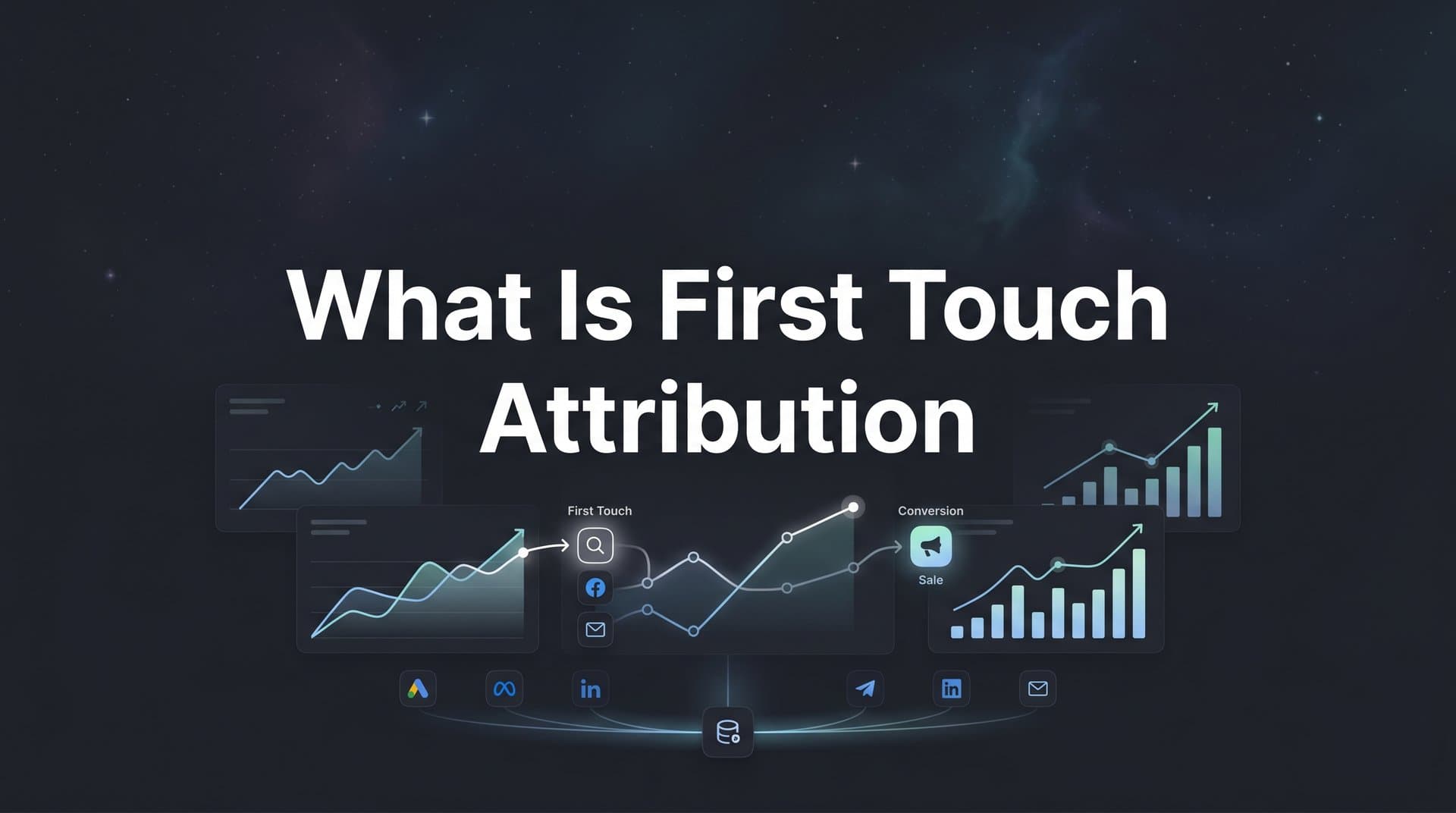
First touch attribution is a single-touch attribution model that gives 100% of the conversion credit to the very first interaction a customer has with your brand. That first interaction could be an ad click on Meta, an organic search visit, a LinkedIn post, a referral link from a partner site, or any other channel that introduced the prospect to your business for the first time.
No matter how many touchpoints follow, the first one owns the entire conversion in this model. Everything else in the journey is invisible from a credit standpoint.
To make this concrete, consider a customer journey that looks like this: a prospect clicks a TikTok ad on Day 1, visits your website through a Google search on Day 8, attends a webinar after clicking an email invite on Day 15, and then converts after a sales rep follows up on Day 20. Under first touch attribution, the TikTok ad receives 100% of the credit for that conversion. The Google search, the webinar, the email, and the sales outreach all receive zero credit, even though each one played a role in moving the prospect forward.
Contrast that with a multi-touch model, which would distribute credit across some or all of those interactions based on a formula. A linear multi-touch model, for example, would split credit equally across all four touchpoints, giving each one 25%. A position-based model might give the first and last touches the most weight, with the middle touches sharing a smaller portion. The math differs, but the core idea is the same: multi-touch models acknowledge that the journey involved more than one meaningful moment.
First touch attribution makes no such acknowledgment. It is categorized as a single-touch model precisely because it collapses the entire journey into a single data point: where did this customer come from originally?
That question has real value. Knowing which channels consistently introduce new prospects to your brand is important information, especially when you're trying to scale awareness and grow your pipeline. But it's worth understanding from the start that this model is answering a specific question, not the whole story. The sections that follow will unpack exactly when that question is the right one to ask.
Where First Touch Attribution Shines
If you want to understand what's filling the top of your funnel, first touch attribution is one of the most direct tools available. It answers a question that demand generation teams care deeply about: which channels and campaigns are best at introducing your brand to people who have never heard of you before?
Think about the difference between a retargeting campaign and a cold prospecting campaign. Retargeting reaches people who already know you exist. Cold prospecting finds people who don't. First touch attribution is built for understanding the cold prospecting side of your marketing. It tells you which platforms, creatives, and campaigns are consistently winning that very first interaction with a new audience.
This makes it especially valuable for teams focused on customer acquisition and net-new pipeline growth. If your primary goal is expanding your addressable market and bringing in prospects who have never engaged with your brand, first touch conversions give you a clear signal about which awareness channels are doing the heavy lifting.
Top-of-funnel optimization: When you're deciding where to invest in awareness-stage campaigns, first touch data tells you which channels are generating the most new entries into your pipeline. If Meta consistently drives more first touches than LinkedIn at a lower cost, that's a meaningful input for your budget allocation.
Creative and messaging testing: Beyond channel-level insights, first touch attribution helps you evaluate which ad creatives and messages are most effective at capturing attention from cold audiences. This is different from optimizing for clicks or impressions. You're looking at which creative actually starts a customer journey that eventually leads somewhere.
Stakeholder communication: First touch attribution is easy to explain. There's no complex weighting formula to justify, no debate about how credit was distributed. You can tell a leadership team that a specific campaign generated a certain number of first touches that eventually converted, and the logic is immediately clear. For teams that are just beginning to build an attribution modeling practice, this simplicity is genuinely useful. It creates a foundation that stakeholders can understand and trust before you introduce more sophisticated models.
The key is knowing what question you're asking. First touch attribution is the right lens when the question is "where are our best new customers coming from originally?" It is the wrong lens when the question is "what convinced them to buy?"
The Blind Spots Marketers Should Know About
Here's the honest truth about first touch attribution: it tells you where the story started, but it has no idea how the story ended. And in most customer journeys, a lot of important things happen between those two points.
Every touchpoint after the first interaction receives zero credit in this model. That means your retargeting campaigns, your email nurture sequences, your case study downloads, your demo request follow-ups, and your sales outreach are all invisible from a first touch perspective. Even if one of those touchpoints was the moment a prospect finally decided to buy, first touch attribution won't show you that.
For short, simple buying journeys, this might not matter much. But for B2B companies with longer sales cycles, complex buying committees, and multiple nurture stages, relying solely on first touch attribution can create a distorted view of what's actually driving revenue. You might see a particular awareness channel generating a high volume of first touches and conclude it's your best-performing channel, when in reality those prospects are converting at a low rate and the real conversion work is being done by a retargeting campaign or a sales sequence that first touch data can't see.
The result of this blind spot is a budget allocation problem. Teams that optimize exclusively around first touch data tend to over-invest in awareness channels and under-fund the mid-funnel and bottom-funnel activities that actually close deals. The awareness channel looks like the hero because it's the only one getting any credit.
There's also a technical challenge that makes first touch attribution harder than it sounds in practice. Identifying the true first touch requires accurate, persistent tracking across sessions, devices, and time. In a world where users browse on their phone, switch to a laptop, use incognito mode, or clear their cookies, connecting all of those sessions to a single customer journey is genuinely difficult.
Privacy changes have made this harder. Browser-level tracking restrictions, the deprecation of third-party cookies in many environments, and platform-level privacy changes mean that a meaningful portion of first touches are simply not being captured by traditional pixel-based tracking. When a user's first interaction goes untracked, the next tracked touchpoint gets incorrectly labeled as the first touch, skewing your data.
This isn't a reason to abandon first touch attribution. It's a reason to invest in tracking infrastructure that can capture first touches more reliably, which we'll cover later in this guide. But it's important to go in with eyes open: the first touch data you're looking at may have gaps, and those gaps can lead you to the wrong conclusions if you're not accounting for them.
First Touch vs. Last Touch vs. Multi-Touch: Choosing the Right Lens
Attribution models are not competing philosophies. They're different lenses that answer different questions. Understanding what each model is actually measuring helps you pick the right one for the decision you're trying to make.
First touch attribution asks: "What introduced this customer to our brand?" It's a question about awareness and discovery. Last touch attribution asks a completely different question: "What was the final interaction before this customer converted?" That's a question about closing and decision-making. Both questions are valid. They just illuminate different parts of the journey.
If you're evaluating your top-of-funnel channels, first touch is the right model. If you're trying to understand which campaigns are most effective at pushing prospects over the finish line, last touch gives you a cleaner answer. Using only one of these models means you're always flying partially blind.
Multi-touch attribution takes a broader view by distributing credit across multiple interactions in the customer journey. Different multi-touch models use different logic for how that credit gets distributed. Linear models split it equally. Time decay models give more weight to recent touchpoints. Position-based models front-load credit on the first and last touches while giving smaller shares to the middle interactions.
Each approach has trade-offs. Multi-touch models give a more complete picture of the journey, but they're also more complex to implement, harder to explain to stakeholders, and require more data to produce reliable results. Single-touch models like first touch and last touch are simpler and easier to act on, but they leave large portions of the journey unexamined.
The practical recommendation for most marketing teams is to run multiple models in parallel rather than committing to just one. Use first touch to understand which channels are winning new audiences. Use last touch to see which channels are closing conversions. Use a multi-touch model to understand the full path and identify which combinations of touchpoints tend to produce the best outcomes.
This isn't about complexity for its own sake. It's about asking better questions. When you can see both which channels start conversations and which ones close them, you're in a much stronger position to allocate budget with confidence. A channel that shows up frequently as a first touch and also appears regularly in the paths of high-value conversions is a channel worth investing in heavily. A channel that generates lots of first touches but rarely appears in converted journeys deserves a harder look.
Making First Touch Attribution Actionable in Your Ad Strategy
Understanding first touch attribution conceptually is one thing. Using it to make better decisions about your ad spend is another. Here's how to turn first touch data into practical action.
The most direct application is identifying which platforms and campaigns are most effective at generating new audience entry points. Look at your first touch data and ask: which channels consistently appear as the starting point for prospects who eventually convert? This is a more useful question than simply asking which channels generate the most first touches, because volume without downstream conversion is just noise.
This is where pairing first touch insights with conversion data becomes essential. A channel that generates a high volume of first touches but rarely appears in converted customer journeys might be attracting the wrong audience. A channel that generates fewer first touches but has a high rate of those first-touch prospects eventually converting is likely reaching a more qualified audience, even if the raw numbers look smaller. First touch data alone won't show you this. You need to connect it to what happens downstream, which is why understanding revenue attribution matters.
Evaluate creative performance at the awareness stage: Use first touch attribution to compare how different ad creatives perform at introducing new prospects. Which images, headlines, and formats are most effective at generating that very first click from a cold audience? This is distinct from optimizing for engagement or reach. You're looking for the creative that starts the most customer journeys.
Identify your highest-value acquisition channels: When you combine first touch data with revenue data, you can calculate the cost per first touch by channel and compare it against the eventual revenue those customers generate. This gives you a more complete picture of which channels are not just attracting attention but attracting the right kind of attention.
Invest in tracking infrastructure: First touch data is only as reliable as your tracking setup. Proper UTM tagging on every campaign is non-negotiable. Every ad, every email, every organic post that you want to track as a potential first touch needs a UTM parameter that identifies the source, medium, and campaign clearly. Without this, your attribution data will have gaps that make it impossible to trust.
Server-side tracking has become increasingly important as browser-based tracking has become less reliable. Unlike client-side pixels that can be blocked or degraded by browser settings, server-side tracking captures conversion events directly from your server, making it far more resilient to the privacy and technical limitations that erode first touch data quality. Building a strong first-party data strategy is no longer optional if you're serious about attribution.
How Cometly Helps You See the Full Picture Beyond First Touch
Running first touch attribution in isolation gives you one piece of the puzzle. What most marketing teams actually need is the ability to look at the same customer journey through multiple attribution lenses at once, without having to stitch together data from five different tools.
Cometly is built to give you exactly that. It captures every touchpoint across the customer journey, from the first ad click through to CRM events and downstream conversions, and lets you analyze that data using multiple attribution models in a single platform. You can run first touch analysis to understand your top-of-funnel performance, then switch to a multi-touch view to see how the rest of the journey unfolds, all from the same dataset.
One of the most significant challenges with first touch attribution is data reliability. As discussed earlier, cookie limitations, cross-device browsing, and privacy changes can obscure where a journey actually began. Cometly addresses this directly through server-side tracking, which captures conversion events at the server level rather than relying on browser-based pixels that are increasingly unreliable. This means your first touch data is far more complete and accurate than what you'd get from a standard pixel setup.
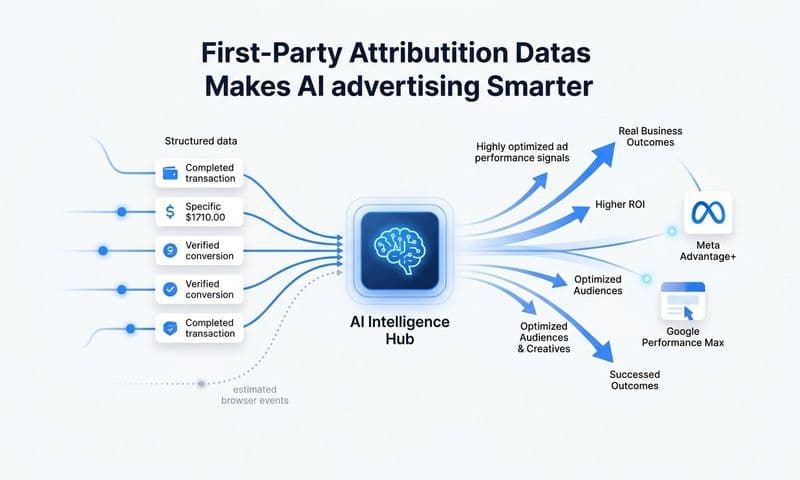
Cometly's Conversion Sync feature takes this a step further by sending enriched, first-party conversion data back to ad platforms like Meta and Google. This matters because when the ad platforms have better data about which conversions are actually happening, their algorithms can optimize more effectively. You're not just improving your own attribution reporting. You're feeding the ad platform AI better signals, which improves targeting and campaign performance over time.
Beyond tracking and attribution, Cometly's AI layer helps you act on what the data is telling you. Rather than spending hours manually analyzing first touch reports and cross-referencing them with conversion data, Cometly's AI recommendations surface insights about which campaigns and channels are performing well across every stage of the funnel. You can identify your top-of-funnel winners from first touch data and immediately see how those channels are performing downstream, giving you the full picture you need to scale with confidence.
For teams running paid ads across Meta, Google, TikTok, LinkedIn, and other platforms simultaneously, having all of that marketing attribution analytics in one place with consistent, reliable tracking is a significant operational advantage. It removes the guesswork from budget allocation and replaces it with clear, actionable data.
Putting It All Together
First touch attribution is a powerful tool for understanding where customer journeys begin. It tells you which channels, campaigns, and creatives are most effective at introducing new prospects to your brand, and that information has real value for anyone trying to scale awareness and grow their pipeline.
But it works best when it's one lens among several, not the only lens you're using. On its own, first touch attribution leaves too much of the customer journey in the dark. Paired with last touch insights and multi-touch analysis, it becomes part of a complete picture that helps you understand not just where conversations start but how they develop and what ultimately drives conversion.
The practical path forward is straightforward. Start by identifying your top-of-funnel winners with first touch data. Find out which channels are consistently generating the first interactions that eventually lead to revenue. Then layer in multi-touch insights to understand the full path, so you can invest in channels that not only attract the right audience but also support that audience through to conversion.
And make sure your tracking infrastructure can support this analysis reliably. Accurate UTM tagging, server-side tracking, and first-party data strategies are what separate attribution data you can trust from attribution data that leads you in the wrong direction.
Ready to elevate your marketing game with precision and confidence? Discover how Cometly's AI-driven recommendations can transform your ad strategy. Get your free demo today and start capturing every touchpoint to maximize your conversions.